The Hobbit Vault is a seven-stage, land-based journey that turns overwhelm into grounded, repeatable confidence. Each progression is intentionally small, so fear and freeze have less room to build momentum. When work is broken into brief, focused steps, it can prevent decline in attention and performance—exactly the effect practitioners aim for with gentle, layered skill-building.
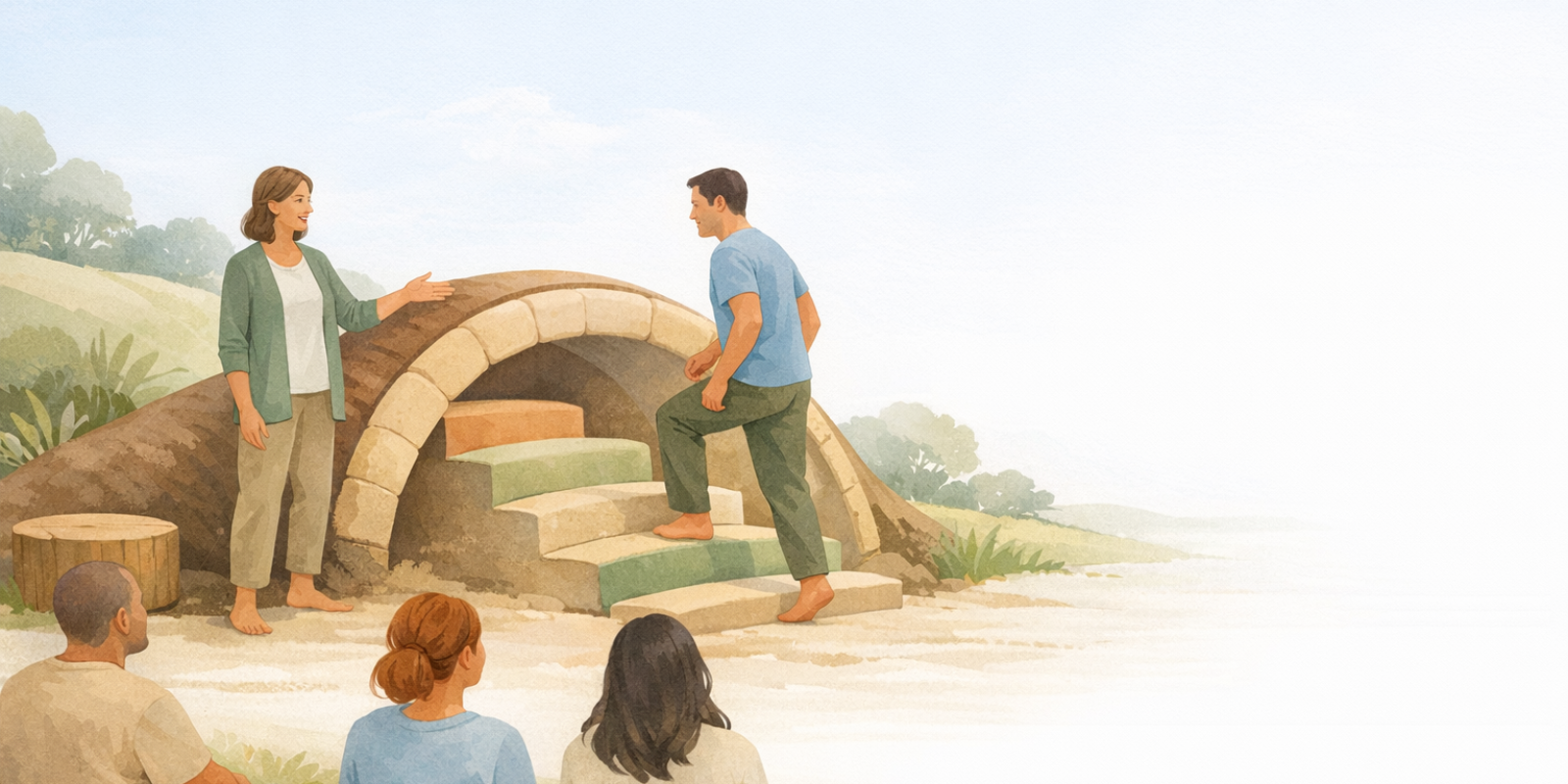
Practically, a Hobbit Vault is a compact, earth-sheltered arch structure that sits quietly in the landscape, often using rounded timber framing and upcycled materials. The Hobbit Vault Course on Naturalistico is shaped for working practitioners and thoughtful beginners, with hands-on lessons and a pace many describe as “very informative and very thorough.”
And it’s not only technique. As Tolkien reminds us, a hobbit-hole “means comfort.” In traditional building cultures, shelter is as much a feeling as a structure: steadiness in the body, clarity in the mind, and a sense of being held. This seven-step rhythm carries that older know-how forward in a modern, repeatable way.
Key Takeaway: Breaking a complex build into seven small, repeatable progressions helps prevent fear from compounding into freeze. By stacking calm planning, short focused work sessions, and clear completion points, you train steadiness in your body and attention—so confidence becomes a natural byproduct of practice.
Progression 1: Draw the Vault Before You Dig – Turning Desire into a Calm Plan
Confidence starts on paper. Drafting the vault—first by hand, then in simple 3D—turns a strong desire into a plan your nervous system can trust.
This is why the learning flow begins with tools that bridge imagination and buildable form. Learners practice 3D modeling alongside sketching, so the structure becomes vivid before any soil is moved. One bio-architecture practitioner describes how to transfer geometries from sketch or CAD into timber—so the idea becomes clear sizes, shapes, and joinery you can actually execute.
Done well, design honors both lineages: traditional timber framing wisdom and modern CAD tools that reduce second-guessing. And keeping “comfort” as the north star makes the drawing stage feel like belonging, not pressure.
From fantasy to draft
To keep this stage gentle:
- Start with a one-page sketch: footprint, arch span, and entry.
- Translate it into a simple 3D massing to see volume and light.
- Choose one “no-drama” decision per session (like arch radius), then stop.
Small wins matter because confidence often follows competence. In skill learning, increases in competence can raise confidence—not the other way around.
Progression 2: Level the Ground – Meeting Reality Without Overwhelm
With a calm plan in hand, the next step is meeting the land with the same steadiness. Leveling with a water level and hand tools turns “reality” into a simple, repeatable ritual.
In the sequence, learners see how to prepare the site and create a flat base with a water level, translating clean lines into clean ground without fuss. Mastering water-level digging builds trust: in the tool, in your eye, and in your ability to keep things true.
This stage also protects energy. Mental fatigue can impair performance, and on a build, that can show up as sloppy choices or rushed checking. Short passes and clear check-in points keep attention fresh.
“It does not do to leave a live dragon out of your calculations.” – Gandalf
Slope, drainage, and soil type are the “dragons.” Once they’re named and measured, the work becomes lighter.
Water levels, not heroic pushes
- Stake corners, string lines, and set one reference height.
- Walk that height around the footprint with the water level, calmly.
- Dig in short, neat passes; stand up often; exhale before checking level.
By the time the base is flat, fear has less to grab. You’ve made contact with the land—without rushing it.
Progression 3: Harvest and Handle the Logs – Relating to Materials and Tools
Now the structure arrives. Respectful harvesting, modest tools, and body-aware pacing turn “heavy” into “held.”
The build path connects forest to footing, including how to take down dry logs and position them with less wasted lifting. The toolkit stays approachable, too: for framing, the instructor notes that only a skill saw or jigsaw is required. For many learners, simplicity reduces hesitation and helps sessions end on a good note.
It also helps to name what’s happening in the body. Sustained effort can increase fatigue, which can ripple into coordination and grip. So this progression favors stable stances, two-handed holds, and planned breaks. Good practice aligns with common tool guidance: matching lighter tools, protective gear, and workloads to your capacity supports steadier outcomes.
For learners with joint sensitivity or hypermobility, movement educators often stress slow, controlled patterns before adding load—an excellent match for timber skills, where steadiness beats speed.
Tool choice and body awareness
“There is little or no magic about them, except the everyday sort.”
This is the everyday sort. Choose what lets you finish each session feeling steady:
- Pick a manageable saw and keep the chain/blade sharp.
- Pre-score long cuts and complete them in stages.
- Lift with partners and levers; let terrain and gravity do their share.
Handling logs well isn’t bravado—it’s relationship, built one careful repetition at a time.
Progression 4: Socket and Pillar Assembly – Stacking Small Wins So Fear Can’t Latch
Standing the first elements is often where fear peaks. This progression dissolves that peak with tiny, precise wins—socket by socket, pillar by pillar.
The sequence breaks complexity into repeatable elements. Learners carve snug sockets in logs or super Adobe and set pillars cleanly, treating each alignment as a low-stakes success. The emphasis stays on micro-focus: clean verticals and horizontals, tuned fit, and steady accumulation rather than one stressful leap toward “perfect.”
That pacing works for the same reason well-timed breaks can prevent decline in performance: one unit, pause, reset attention, repeat.
The gymnastics vault metaphor is useful here. Judges look at judging criteria like angle, base support, height, and tight shape; translated to timber, that’s clean pillar angles, solid sockets, and tidy ties. Even the “lava rule”—once you dismount, don’t run back—fits beautifully: set it well, then step away. The course keeps this stage approachable with clear, hands-on instruction.
Precision over bravado
- Cut, test-fit, and tune each socket before standing the pillar.
- Shim deliberately; mark once, adjust once.
- When a unit is solid, call it complete—no tinkering loops.
Small wins compound into structure. That compounding is what quietly starves fear.
Progression 5: Raise the Arches – From Hesitation to Dynamic Commitment
With pillars steady, energy naturally wants to rise. Lifting and tying in arches is where earlier micro-skills unify into clean, decisive action.
Arches are the vault’s heartbeat. The Naturalistico path teaches how to erect variable arches and blend them into the wall line, bringing drawn geometry into curved timber without drama. Borrowing from vault performance, you can think in terms of clean performance: confident lift, smooth timing, well-placed support, tidy alignment.
At this point, hesitation is the main disruptor. In sport, a mid-skill stall can cause failure to rotate; in framing, half-lifts and repeated resets drain energy and invite sloppy positioning. The solution is simple and traditional: declare the move, rehearse the grips, coordinate the team, then lift once with presence. Clinics that emphasize clear intention for safe entries—like NAWGJ clinics—mirror the same principle: signal the action before you do it.
Height, quickness, and commitment
“You must either go through or give up your quest.”
“There are no safe paths in this part of the world.”
Not to stir fear, but to honor the moment of choice. Put simply: decide, coordinate, then act.
- Pre-fit on the ground and rehearse the path and timing.
- Lift once, tie off immediately, check plumb, breathe.
- Move directly to the next arch to avoid a stall.
Commitment doesn’t appear out of nowhere—it’s trained gently in the earlier stages, then expressed here.
Progression 6: Bury and Blend – Learning to Trust the Earth Above You
With arches up, you do the vulnerable thing: bury and blend. Layering earth and reclaimed materials invites trust in the structure—and in the old, steady wisdom of earth shelter.
This phase shows how to wrap the vault into its surroundings using upcycled materials and graded lifts, building rhythm without overwhelm. In some bio-architecture approaches, nearby materials are understood to support gentle biological activity that can contribute to a sense of passive warmth. Builders also notice how earth wrapping draws on the soil’s thermal mass, helping create a calmer indoor climate than a comparable above-ground cabin.
This isn’t novelty—it’s continuity. Traditional log cabins and earth homes are respected ancestors here, adapted thoughtfully with modern CAD tools for clarity and efficiency.
Layer-by-layer backfilling also suits many learners who build confidence through consistent, low-intensity sessions rather than dramatic pushes. And it helps to remember the aim: a hobbit-hole “means comfort.” Burial is a wrapping, not an entombing.
Earth-shelter as a practice in trust
- Backfill in thin courses; tamp gently; check shape each pass.
- Use geotextile or brush mats to stabilize soil between lifts.
- Let rain teach: observe runoff, then add swales and diversion calmly.
Biomimicry, warmth, ancestral memory
As the vault disappears into the landscape, many people feel a quiet shift from “I hope” to “I know.” Think of it like learning a song: repetition builds rhythm, and rhythm builds trust.
Progression 7: Seal, Step Back, and Stand Upright – Locking in Confidence
Completion is a posture. You seal, check essentials, and then deliberately step away—so confidence consolidates instead of dissolving into endless tinkering.
Finish work is guided, not rushed. Do a final pass on enclosure height and shape, then aim for the kind of upright finish a vault judge would recognize. And keep the “lava rule” close: once sealed, don’t hover and doubt. Stepping away at the right time protects self-trust.
The course structure also makes “done” easier to recognize—learners often call it very thorough, which supports clean closure.
Completion posture and the lava rule
- Seal edges, check drainage, clear the threshold.
- Announce completion to your team; take photos from three angles.
- Walk away from the vault—forward, not back. Name the next right step of your practice.
“Home is now behind you, the world is ahead.”
Confidence isn’t loud; it’s the quiet ease of a finished door swinging cleanly on its hinges.
Conclusion: Turning 7 Hobbit Vault Progressions into a Confidence Framework
These seven progressions are more than a build sequence; they’re a transferable framework for group programs, community learning, and long-term practitioner growth. Draw, level, harvest, assemble, raise, bury, seal—each step mirrors how people move from longing to lived change. Participatory, dialog-based learning can build confidence traits that carry across life, and land-based sequencing works in that same spirit: steady action, steady reflection.
On Naturalistico, the Hobbit Vault Course sits inside a platform designed for ongoing evolution, with learning that connects to real client tools and peer feedback—so skills don’t stay theoretical.
Rhythm matters, too. Consistent effort can improve performance, and practitioners see a similar pattern in craft: repetition clears the mind and steadies the hands. In time, confidence becomes a byproduct of practice, not something you must summon first.
“If I say he is a Burglar… he will be when the time comes.”
You don’t become confident and then build; you build—kindly, progressively—and confidence arrives on the way.
A final, practical note: work within your skill level, local requirements, and available support, and use appropriate protective gear and pacing—especially during lifting, cutting, and earthwork. Traditional building is powerful precisely because it teaches steadiness; there’s no need to rush what’s meant to last.
Published April 9, 2026
Ready to Go Deeper?
Take the next step with a Naturalistico certification — designed for practitioners ready to deepen their expertise.
Explore the Course →