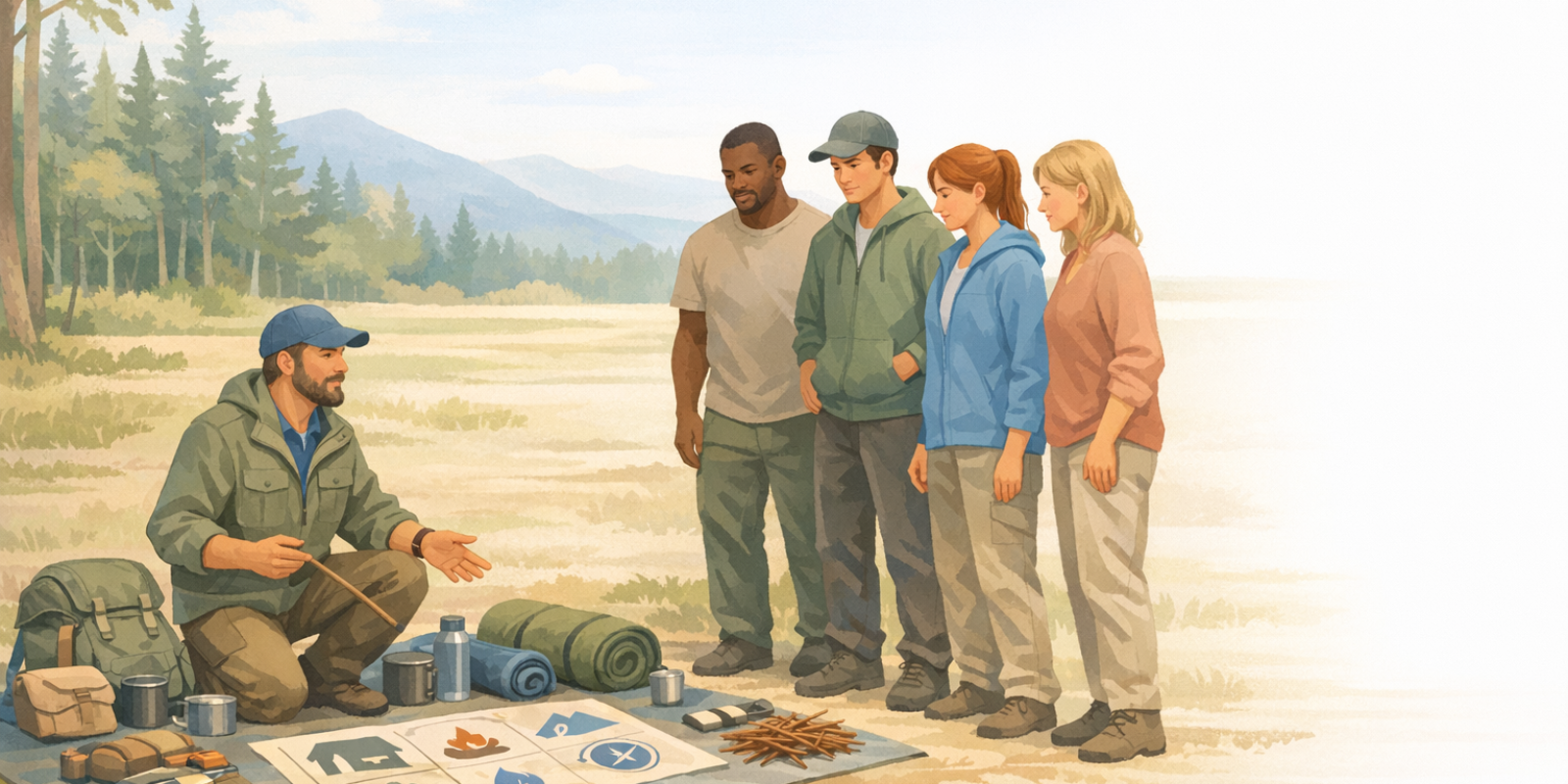
A well-held beginner wilderness survival weekend is more than a bundle of techniques. It’s an initiation into older ways of paying attention—skills that build inner steadiness alongside practical competence, so people leave feeling more capable and more at home outside.
It’s also a format learners are actively seeking. Market analysis points to growing interest in survival-focused courses, especially as more people look for short, accessible intensives as a first step.
Many guides now meet that need with a hybrid approach: foundational prep at home, then focused practice on the land. This mix shows up clearly in established hybrid wilderness courses, and it works well for beginners because the weekend can stay hands-on instead of lecture-heavy.
Most strong beginner weekends circle the same near-term priorities—shelter, fire, water, and simple navigation—then use them as a doorway into deeper learning rather than a “one and done.” And as you design, it helps to remember that growth is supposed to feel like a climb.
Key Takeaway: Build a beginner weekend around a simple survival backbone—shelter/warmth first, then fire, water, and basic navigation—taught through short demos, lots of reps, and gentle scenarios. Pair practical competence with a supportive container so learners leave with steadier decision-making, not just a checklist.
Introduction: Designing a Beginner Wilderness Survival Weekend
“We don’t reach the mountaintop from the mountaintop. We start at the bottom and climb up. Blood is involved.” – Cheryl Strayed
A compassionate container honors that truth: steady pacing, well-chosen challenges, and real care at the edges where learning turns into confidence.
Clarify Your Learner and the Change You Promise
Before you plan sessions, get clear on two things: who this weekend is for, and what change you can honestly promise by Sunday afternoon. When that’s defined, the whole arc tightens—every exercise earns its place.
Name the learner you’re designing for
Beginner weekends often attract a wide range: new hikers, casual campers, hunters wanting a refresh, and nature-curious people trying their first overnight. Industry reporting suggests many groups—from weekend hikers to off-grid advocates—are seeking greater self-reliance outdoors. Keep the difficulty easy to moderate: short walks, plenty of pauses, and choices that don’t punish beginners for being beginners.
A short pre-course intake helps you hold the group well. Ask about previous outdoor experience, mobility, strong dislikes (cold, dark, tight spaces), and personal intentions. That’s usually enough to guide pairings, select an appropriate site, and set the right level of remoteness.
Also be clear about your own strengths. You don’t need to teach everything under the sun. You do need solid proficiency in what you offer, plus a habit of debriefing, refining, and continuing your own practice.
Define transformation, not just a skill checklist
In survival learning, people arrive for “outer competence”—and they stay with you because of “inner steadiness.” Outer competence is shelter, fire, water, and navigation. Inner steadiness is calmer decision-making, more trust in the senses, and a kinder inner voice when conditions get uncomfortable.
Bruce Zawalsky says it plainly:
“What is important is that after you have completed your survival training you feel confident in the wilderness. You should be able to light a fire, build a shelter, and know to carry the proper equipment.”
That makes a strong, beginner-appropriate promise—one you can actually keep:
- Outer: Shelter selection and setup, dependable fire starting, safe water basics, and simple direction-finding.
- Inner: Steadier breath and choices under pressure; stronger sensory awareness; more self-kindness when things get real.
Write your promise down. Then let the weekend unfold as proof, step by step.
Build the Backbone: Rule of Threes and a Two-Day Arc
A beginner weekend works best when it has a clear backbone: simple priorities, taught in an order that matches real-world needs. The Rule of Threes keeps attention on what matters first, and a two-day arc gives learners a satisfying journey from supported basics to light independence.
Turn survival priorities into a weekend timeline
Start with a shared map of urgency. The Rule of Threes—3 minutes without air, 3 hours without adequate shelter in harsh exposure, 3 days without water, 3 weeks without food—naturally focuses beginners on shelter and warmth, then water, long before foraging fantasies take over. Many modern programs also frame training around the first 72 hours, emphasizing preparedness, rapid assessment, and reliable responses to changing conditions.
Then turn that into a simple arc:
- Day 1: Orientation, mindset, clothing-as-shelter, site selection, quick shelters; then firecraft and water basics.
- Day 2: Review, navigation, and gentle scenarios; then a brief solo micro-challenge and closing council.
Adjust for place and season. In cold or wet regions, experienced instructors often prioritize shelter and warmth early, then fire, then water—because getting chilled can quickly unravel everything else. In hot, dry terrain, water stays a near-term focus, and signaling may move up for visibility and morale.
Keep the deeper “why” present, too—because the weekend is also about relationship with land and future practice.
“The richest values of wilderness lie not in the days of Daniel Boone, nor even in the present, but rather in the future.” – Aldo Leopold
Think of the weekend as planting a seed: a few core skills, practiced well, that learners can return to for years.
Day 1 Morning: Grounding, Gear, and Shelter Fundamentals
Day 1 is about safety, pace, and quick confidence. When people feel oriented, learning drops out of the head and into the hands—and the whole group settles.
Opening circle and mindset
Keep the opening unhurried but structured. A typical 9–4 rhythm works well for beginners, especially when you’ve sent simple pre-course guidance so participants arrive with the basics handled.
Begin in a circle: names, pronouns, goals, and practical flags (old injuries, fear of cold, discomfort with darkness). Then introduce a core survival mindset as a daily practice: notice stress, slow the exhale, choose the next wise step. Put simply, you’re training attention under pressure—not just hands-on skills.
Shelter as the first confidence win
Teach shelter early. It’s one of the fastest ways to settle nerves and create an immediate “I can do this” moment.
- Clothing as primary shelter: layers as a wearable micro-climate; adjust before you’re cold or damp.
- Site selection: wind breaks, overhead hazards, drainage, and proximity to resources like firewood and water.
- Quick structures: tarp pitches, simple windbreaks, and basic bedding where appropriate and permitted.
Keep teaching tactile: a short demo, partner practice, then rotate roles. Many instructors see chilling as an early course-breaking issue in wet or windy conditions—so front-loading shelter and clothing awareness prevents problems and builds early success.
As one seminar attendee put it, “I like learning the practical side of survival i.e. Fire Making & Shelter Building skills”—and you’ll hear versions of that all the time when you teach what beginners can use immediately.
Minimalist essentials for Day 1
- Layering system: base, mid, shell; warm hat and dry socks.
- Fire starter and backup; small tinder kit in a waterproof bag.
- Knife and folding saw (if included in your curriculum), whistle, headlamp, simple first-aid basics.
- Two 1-liter bottles, metal cup or pot for boiling, high-calorie snacks.
Day 1 Afternoon & Evening: Fire, Water, and Integration by the Hearth
Once shelter is in place, bring in two of our oldest teachers: fire and water. Aim for a friendly progression—reliable first, then exploratory—so learners leave Day 1 feeling genuinely equipped.
Guided firecraft progression
Start with wins. Teach modern aids first—lighters, matches, dependable commercial tinders—then expand into local tinder, kindling, and spark-based tools (like ferro rods) if conditions allow. In wind or rain, show practical adaptations: raised platforms, feather sticks, careful kindling prep, and shielding.
Keep practice blocks short and repeatable. Guidance in the field often leans on hands-on practice with repetition to build confidence and retention. Essentially, more small reps beat one long lecture—especially with fire.
Water safety and reflective close
Teach water simply and reliably. Discuss likely sources using indicators like topography funnels, greener vegetation, and animal sign, then cover straightforward purification: rolling boil, reliable filters, and chemical tablets as backup. Think of it like a three-layer system: find it, make it safe, and carry enough.
Close the day by a shared flame or lantern-lit space. Invite brief shares: what worked, what wobbled, what surprised them. Reports also note survival training can support resilience and connection to nature; for many learners, those shifts are part of what makes future trips feel more grounded and meaningful. End with a simple gratitude for the place that hosted the group.
Day 2 Morning: Review, Navigation, and Gentle Scenarios
Day 2 starts by turning yesterday’s learning into “I can do this again.” Then you add navigation and gentle scenarios that weave the core skills into real decision-making.
Short review and direction-finding
Open with quick wins: a shelter-setup relay, a one-match fire, and a team water setup or boil. Keep it light and time-bound so energy stays high.
Then teach navigation from the body outward: orient with the sun, notice slope and drainage, and use a simple baseplate compass to follow a bearing. Many curricula recommend basic direction-finding using sun, stars, and landmarks so disorientation is prevented early rather than “fixed” later.
Keep the goal modest. This isn’t technical orienteering—it’s giving beginners repeatable habits that reduce the chances of getting lost in the first place.
Mini-scenarios to weave skills together
Now let the skills talk to each other. A scenario like “wrong turn near dusk” prompts a useful chain of decisions: stay put, build quick shelter, make a signal fire, treat water, mark location, and plan for morning. Many providers encourage scenario-based practice because it builds calmer decision-making under mild stress.
To keep scenarios beginner-friendly, adjust just a few variables: the skills required, whether they work solo or in pairs, how remote the setting is, what equipment is allowed, and how long it runs. One or two “stretch” moments are plenty—everything else should feel predictable.
Keep an eye on two classic unravel points: chilling in cold/wet settings and dehydration in hot/arid ones. Fold in pacing, simple food considerations, and basic hygiene as part of good 24–72 hour decision-making.
Jessie Krebs offers a steadying frame for inclusive facilitation:
“Wilderness is a great equalizer. It doesn’t care who you are, or how much money you make, or what trauma you have in your background.”
That’s a reminder to hold the line on respect and group care, while still keeping the container consistent for everyone.
Day 2 Afternoon: Solo Micro‑Challenge and Group Council
Finish with a carefully supported solo and a closing council. This is where many learners feel the deeper shift: less fluster, more presence, and a steadier inner voice.
Design a safe, supported solo
A solo micro-challenge can be short, bounded, and deeply meaningful. Many progressive systems include a brief solo—often 60–90 minutes—within clear boundaries and check-ins. The goal isn’t hardship. It’s sensory settling, making a simple plan, and completing one or two tasks without leaning on a partner.
Match the solo to the people in front of you. For teens or higher-anxiety participants, reduce remoteness and simplify tasks. For older adults or those returning to movement, offer spaciousness and comfort. Clear time limits and check-ins create psychological safety while still inviting independence.
Solo safety scaffolds
- Defined solo zone with visible landmarks and a clear boundary line.
- Three-signal system: whistle, visual signal (hand/flag), and a pre-set re‑group time.
- Instructor roving schedule and buddy awareness, without hovering.
- Simple skill menu: shelter touch-up, signal fire prep (or mock setup), 10-minute sit-spot, map re‑orientation, journaling.
Closing council to weave learning into life and work
Bring everyone back with a circle. Invite each person to name one skill they trust now, one pattern they noticed under stress, and one promise they’re making to themselves outdoors. By this point, groups often feel more cohesive, and council turns that quiet support into something tangible.
Jessie Krebs captures what this kind of practice teaches:
“It reduces everything to the moment, to a particular time and place and to the law of consequences.”
A well-held solo and council do exactly that—without overwhelming people. The aim is for learners to leave more resourced than when they arrived.
Hold the Container: Traditional Skills, Ethics, and Your Role
Skills land differently depending on the values holding them. When you honor traditional craft, care for place, and facilitate with integrity, a weekend becomes something people trust—and remember.
Blend ancestral skills with modern evidence
Many immersive lineages weave emergency shelters, friction fire, basic tracking, and respectful harvesting into a living relationship with land. When you introduce bushcraft, center reciprocity and sustainability, as seen in programs that teach emergency shelter skills within broader ecological awareness.
Clear guidelines help learners hold tradition with respect. Teach ethical foraging: take only what’s needed, avoid rare or vulnerable species, obtain permissions, and acknowledge cultural roots without appropriation. And encourage a both/and approach—experience older methods while carrying modern backups for reliability.
When practiced this way, traditional knowledge stays alive: not as performance, but as usable skills rooted in place and responsibility.
Boundaries, safety, and business integrity
Create a safety culture people can feel. Teach tool handling with clear cut zones, stable stances, and passing protocols. Keep ratios low enough to supervise sharp tools, fire, and water work responsibly.
And remember: guiding is its own craft. As one instructor notes,
“What I hate more than anything is seeing very talented and skilled instructors not be able to turn their talents into income because they lack business acumen.”
Communication, facilitation, and client care are skills worth practicing with the same humility you bring to shelter and fire.
Professional touchstones
- Clear consent culture: opt-in challenges, non-judgmental pacing, and respect for individual limits.
- Land agreements: permits, local guidance, and place-based etiquette.
- Cultural respect: name lineages where appropriate; avoid extraction and stereotyping; acknowledge teachers.
- Continuous improvement: debrief with co-facilitators; adjust scenarios; refine checklists and communication.
Conclusion: From Outline to Your Signature Beginner Survival Weekend
Designing a beginner wilderness survival weekend is an act of care. Anchor it in place, ethics, and a simple arc—from shelter to fire to water to navigation, from group support to a brief solo and back to community—and you give learners both practical skills and a steadier way of meeting challenge.
Use this framework as a template, then shape it to your bioregion, your lineage of skills, and the people you serve. In dry regions, you might highlight landform navigation and careful harvesting; in colder or wetter places, clothing systems, shelter, and fire naturally move to the center.
Across settings, one pattern repeats: concentrated skills practice builds outer competence and also teaches people how to work with fear more wisely. That’s why many participants describe the experience as making time outdoors feel more fulfilling—and their own capacity feel more real.
If you’re building this into a livelihood, keep an eye on the meta-skill, too:
“In order to make a living (or even part-time income) teaching survival skills, I’ve had to learn an entirely different skill set.”
Marketing ethics, clear boundaries, and thoughtful facilitation belong on the path. As always, tailor challenges to the group, stay within your scope, and build in the redundancies that keep everyone supported—especially when weather, fatigue, or nerves show up.
May this outline help you craft a weekend that feels kind, grounded, and quietly powerful: a doorway back into ancestral wisdom and forward into lifelong, place-based practice.
Ready to Go Deeper?
Take the next step with a Naturalistico certification — designed for practitioners ready to deepen their expertise.
Explore the Course →