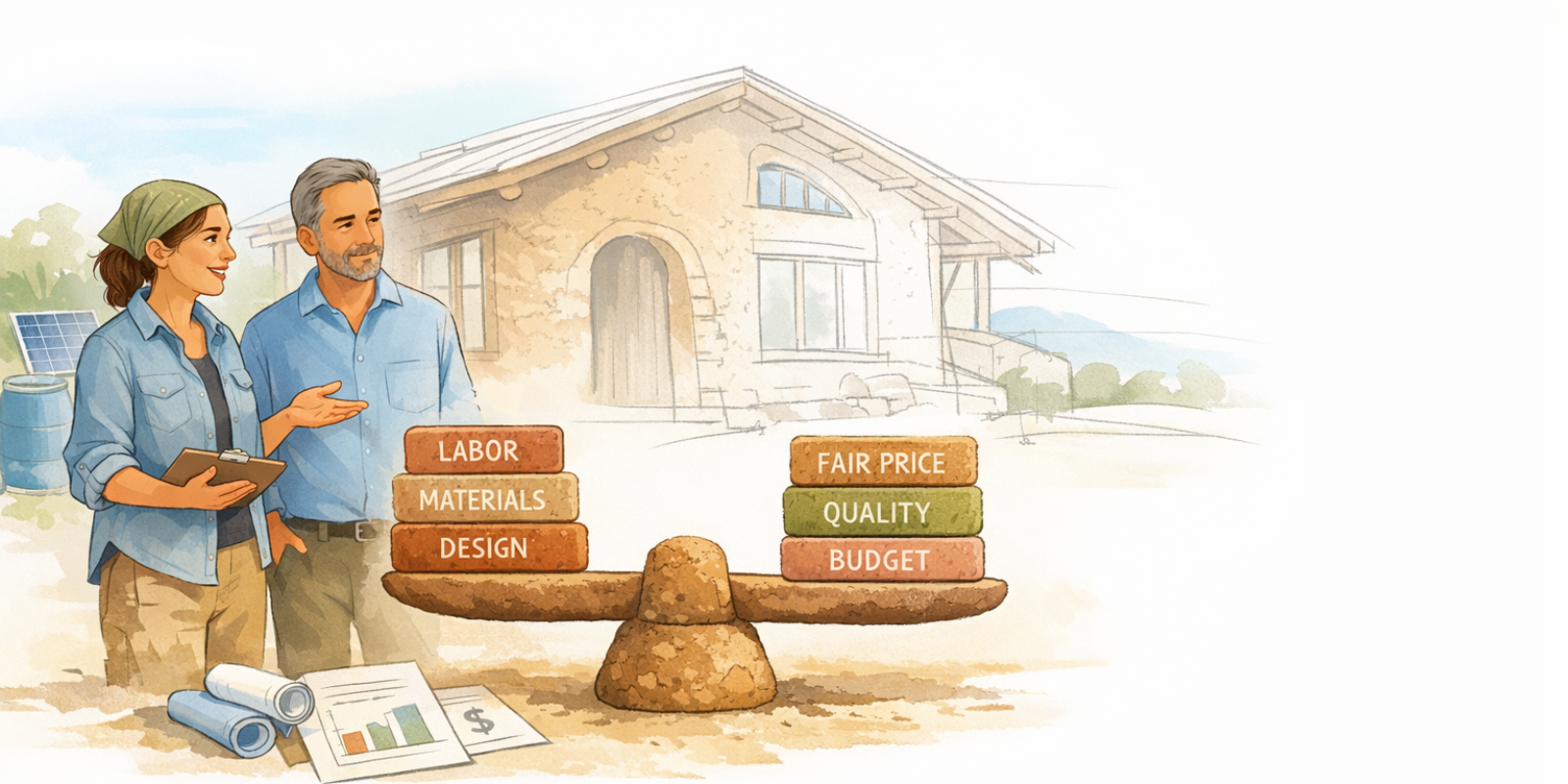
Fair pricing isn’t about squeezing clients—it’s about stewarding a craft that shelters people and places. When pricing is done well, it protects time, skill, and the communities this work is meant to serve.
Natural building has never been just about walls. It’s a way of dwelling that values local soils, fibers, and timber, and design choices that fit a site like a well-worn glove. As one practitioner put it, “with smart design, smaller footprints, and the use of local and natural materials, we can build nontoxic homes that actually make a difference in fighting the climate emergency.” That vision carries real responsibility—and real value.
This craft sits inside a living tradition: structures designed to work with local ecologies and the people who live there. And because professionally built natural homes often land in the 180–300/sf range, pricing decisions quickly connect to life-scale budgets. In other words, your fee isn’t an afterthought—it’s part of the ethics of the work.
Key Takeaway: Price natural building work as a form of stewardship: align your fees with real project budgets, risk, and the value of skilled guidance, then make scope and boundaries explicit. Transparent models and clear service levels protect clients from surprises while protecting practitioners from chronic underpricing and burnout.
Why Natural Building Pricing Feels Different (and Why It Matters)
Money can feel tender in this space because the work is relational, place-based, and often shaped by gift culture. Naming that tension helps you charge fairly without losing your roots.
Many builders and mentors came up through workshops where people arrived “to learn specific practical skills,” but also “to meet new people and have a social experience of immersion in regenerative culture,” as Michael G. Smith reflects on three reasons people show up. When relationships are central, it’s easy to overgive and undercharge.
Yet pricing is also part of an ecological ethic. Natural building aims to fit our built worlds into local ecologies “with minimal adverse effects”—and value exchange is part of that system. The outcomes you support are profound, like someone “developing the confidence” to build their own shelter. That kind of confidence is earned through skilled guidance and steady presence, not quick tips.
There’s also a lineage to protect. Many natural builders choose materials with low embodied energy, and want fees that feel equally non-extractive. But chronic underpricing leads to burnout—and when practitioners can’t stay in the work, the tradition thins. As one knowledge holder warned, institutions can repackage traditional skills without acknowledgment; “academia should do a much better job of listing practitioners as authors” when drawing on experiential knowledge. Fair pricing is one practical way to keep craftspeople visible, respected, and supported.
Honoring gift culture without sacrificing your livelihood
You can hold both. Keep generosity intentional—limited sliding-scale spots, community build days, or occasional pro-bono sessions—while maintaining clear, sustainable rates for core services. That balance keeps giving heartfelt and your practice resilient.
See the Whole Budget: What Your Clients’ Projects Actually Cost
To set fair fees, zoom out. When you understand the full project budget, your pricing naturally lands in proportion to what’s at stake—financially and emotionally.
Even modest earthen homes represent major investments. A cob home can land around $180,000, with many ranging higher depending on size, site, and finishes. Square-foot estimates for cob often run 150–450/sf, while professionally built natural homes commonly sit around 180–300/sf. Contractor-built straw bale homes near 1,000 square feet frequently fall in the 150k–350k range before land.
Here’s why that matters: early guidance influences everything—materials, detailing, moisture strategy, code pathways, and team setup. In many natural builds, human skill is the backbone: labor often accounts for roughly 60% labor of the total cost, with materials around 40%. Put simply, your experience isn’t a minor add-on; it’s a core project asset.
And when clients right-size a home, source locally, and design for the climate, the budget becomes both more realistic and more aligned. As that Mother Earth News piece reminds us, smaller footprints and local materials aren’t just affordability tactics—they’re part of the ethic. Price your role accordingly: you’re helping shape a life-scale project, not simply answering questions.
Why understanding full project budgets protects everyone
Clear, upfront budget conversations prevent scope creep, resentment, and rushed shortcuts later. They help clients match ambition to resources—and they help you quote fees that genuinely cover the work.
Adapting Builder Fee Models to Straw Bale, Cob & Off-Grid Support
Percentage fees and day rates can work beautifully for natural building—especially when they’re transparent, easy to explain, and tied to outcomes clients can feel.
Conventional templates offer a useful starting point. General contractors often charge 10–20% of total project cost, with many projects hovering around 15%. Complexity, site access, weather windows, and travel all affect those numbers—variables natural builders know intimately. For advisory work, you can translate the same logic into a smaller percentage of estimated construction costs (for example, 2–8% for consulting and mentorship across design-through-finish), or a clear day rate supported by simple time logs.
Another strong fit is cost-plus with a fixed fee. Clients pay the actual build costs, plus a clearly stated fee for oversight, sourcing, and project risk. Open-book accounting often aligns naturally with this community. And remember: advisory work already carries recognized market value—custom architectural input for cob projects commonly runs 2,000–15,000, which helps normalize multi-thousand-dollar guidance packages in the natural building world too.
As one sustainability specialist notes, nature-positive design should include “the value chains, and not just the site footprint.” Your contribution often spans sourcing, moisture-safe details, staged learning plans, and on-site culture. Whatever fee model you choose, make the scope visible so the price has context.
Using percentage and day-rate models without losing your values
Keep it simple and transparent. Define what’s included, what’s not, and how extra time is added. Shared checklists, weekly recaps, and clear milestones let clients see the value building as the project moves.
Design Clear Service Levels for DIY, Hybrid & Contractor-Led Builds
What you offer isn’t just hours—it’s clarity, confidence, and continuity. Package those outcomes into service levels that match how your client plans to build.
Not every project needs the same depth. Some clients want a north-star session; others want steady mentorship across seasons. Many are also seeking community—“a social experience of immersion in regenerative culture”—which often signals readiness for deeper support. And because a key outcome is “developing the confidence” to create shelter, multi-session pathways can be the most natural (and effective) container.
Offer tiers that match real needs:
- Clarity Call (DIY-ready): A single consult with a written action brief. Best for feasibility, wall system choices, and site-fit thinking—grounded in practical constraints like locally available materials and basic sequencing.
- Milestone Mentorship (Hybrid builds): Support across key stages—concept, foundation, wall build, moisture detailing, finishes—with scheduled check-ins and review points. Anchoring rates to regional specialist benchmarks (licensed trades often run 70–150/hour) helps clients understand the value of skilled guidance.
- On-Site Coaching (Contractor-led or community builds): A day-rate for critical moments—first bale courses or cob lifts, plaster test panels, training a volunteer crew—with clear deliverables plus travel and prep.
- Engineer-Ready Advisory (Code navigation support): Prep and coordination notes for structural review or wall detailing to reduce rework; structural review alone can cost 1,500–7,000.
Give each level a written scope, decision checklists, and a clean way to add hours. Essentially, your packages should feel like tools—not traps.
From one-off advice to ongoing mentorship
Turn “call me when stuck” into a steady rhythm: office hours, response-time norms, and clear escalation steps for weather events or inspections. Reliability is part of what clients are paying for.
Adjust Your Fees for Straw Bale, Cob & Off-Grid Complexity
Not all walls—or watersheds—are created equal. Adjust rates for risk, climate stress, jurisdictional complexity, and the added layers that come with off-grid energy and water.
Across wall systems, the overall project scale can be similar. Contractor-built straw bale homes around 1,000 square feet often run 150k–350k, comparable to many cob and custom builds, so your baseline model can stay consistent. Then tune it: where labor is the main cost driver—often 60% labor—your coordination and mentorship have even more weight.
Regional context shifts the numbers, but not the principle. In India’s maturing natural building market, professionally executed earthen homes typically range 3,000–4,500 INR per square foot, while community-heavy builds may sit near 1,500 INR. Think of it like this: finish level, labor mix, and local conditions shape budgets everywhere—and your time needs to reflect those realities.
Climate resilience adds real scope. Buildings today must “adapt and thrive” through fire seasons, freeze–thaw cycles, flooding, and longer dry spells. Moisture detailing in bale walls, earthen plasters in wind-driven rain, fire-smart eaves, and robust transitions all demand deeper attention. Off-grid systems bring their own coordination load too: energy storage and solar can trigger storage regulations and inspections even off-grid, which means more documentation and planning time.
Match your price to risk, climate, and technical depth
- Increase your rate for high-severity climates, complex clay–sand balances, high seismic zones, wildfire interfaces, and multi-system off-grid designs.
- Add a risk premium for compressed timelines, remote sites, or multiple volunteer phases.
- Discount strategically for well-prepped clients with clear drawings, stable teams, and strong local sourcing already in place.
Ethical Boundaries and Transparent Agreements
Clarity builds trust. State what you’re responsible for, what requires other professionals, and how decisions and changes are documented.
Transparent fee structures help. In custom work, cost-plus with a fixed fee is common. You can mirror the spirit with time-tracked consulting, a defined retainer, published day rates, and receipts for pass-through costs. When clients understand the drivers of a builder’s fee—complexity, travel, weather, materials access—the numbers feel grounded rather than arbitrary.
Boundaries also protect everyone involved. Many off-grid or hybrid systems require permits, interconnection reviews, or inspections, and energy storage falls under fire and electrical storage regulations. Make it explicit in your agreement when to bring in licensed specialists or engineers, and what your coordination role includes.
Ethics include attribution, too. If a key detail, drawing approach, or community protocol came from a mentor, name it. As one practitioner emphasized, academics should credit experiential knowledge holders; your agreements can model that same integrity. And because natural building is rooted in working with local ecologies with minimal harm, it makes sense to extend that care into honest contracts and respectful collaboration.
Charge fairly without overstepping your role
- Scope page: deliverables, decision points, and items requiring other professionals.
- Change protocol: how added tasks are quoted and approved.
- Safety clause: you can pause work if unsafe conditions or code issues arise.
- Attribution note: acknowledge sources of details, drawings, or community knowledge where appropriate.
Step-by-Step: Calculate Your First Fair Natural Building Fee
Start with your real needs, map the project, and turn that into a clear offer you can test in the field.
From personal needs to clear numbers
- 1) Know your baseline. Add living expenses, business overhead, admin time, and a cushion for slow seasons. Convert that into a weekly and daily target.
- 2) Map the project arc. Estimate time for concept support, detail review, sourcing, on-site coaching, and communications based on size, wall system, climate, and team. Remember: when skilled labor is the main cost driver—often 60% labor—coordination isn’t “extra,” it’s structural to success.
- 3) Choose a model. a) Percentage: 2–8% of projected build cost for end-to-end mentorship; b) Day rate: a transparent daily rate pegged to specialist benchmarks (licensed trades often bill 70–150/hour); c) Hybrid: a base package plus on-call days at a published rate.
- 4) Price the outcome, not just hours. Your guidance can prevent expensive mistakes. Cob wall specialists are paid 35–75/hour or 20,000–80,000 for walls alone—use that context to frame the value of skilled oversight.
- 5) Add scope for design navigation. If your role includes plan reviews or coordination with architects/engineers, reflect the weight of that work; these services commonly run 2,000–15,000 on cob projects.
- 6) Align with values. Make space for local sourcing, mix testing, and low embodied energy decision-making. Name that time clearly, and price it with confidence.
Test and refine your pricing in real projects
- Pilot a package. Offer a Milestone Mentorship for a small straw bale studio, track your time carefully, and ask the client what felt most valuable.
- Use feedback loops. Identify the moments that unlocked progress—first-lift guidance, plaster tests, moisture detailing—and build your next package around those.
- Offer hybrid support. Many builds blend DIY with hired help. Position your services to guide hybrid models with decision maps, shopping lists, and training days.
- Refine for context. If a build includes batteries or complex PV, add a coordination line item for permits and storage regulations. In wildfire or freeze–thaw zones, include a climate detailing review.
- Build a runway. Keep a small pro-bono fund or sliding-scale spots, but protect your sustainable baseline so you can keep serving for years.
Clients aren’t just buying time—they’re investing in the deep change of “developing the confidence” to create shelter. Price like that matters.
Conclusion: Pricing as Stewardship of Straw Bale, Cob & Off-Grid Skills
Fair pricing is care in action. It supports your ability to keep showing up, honors those who taught you, and keeps straw bale, cob, and off-grid knowledge alive and respected.
Natural building is part of a wider movement: weaving structures into local ecologies with minimal harm, and helping people create nontoxic homes through wise design and local materials. As one voice cautioned, traditional, experiential knowledge has too often been undervalued or co-opted; naming and compensating experiential knowledge is one way to honor elders and communities in practical terms.
Keep your scope clear, adjust for complexity, and put agreements in writing. And as you refine your offers over time, let your pricing reflect both skill and stewardship. A final note of caution: be explicit about boundaries, permits, and when other licensed professionals are needed—clear roles protect the project, the client, and the integrity of the craft.
Published April 9, 2026
Ready to Go Deeper?
Take the next step with a Naturalistico certification — designed for practitioners ready to deepen their expertise.
Explore the Course →