


Horticultural Therapy Certification
Train in horticultural therapy — therapeutic gardening, sensory garden design, and plant-based interventions for wellbeing. The Horticultural Therapy certification suits occupational therapists, carers, and garden facilitators using growing to heal.


11
模块
11h 28min
音频课程
5.0/5
课程评价
∞
终身使用权
功能
本课程包括

11 个模块
完整课程

11 PDFs
可下载指南

11h 28min 音频课程内容。
旁白课程

互动测验
测试您的知识

完成证书
完成后颁发

保险合格(ICHAP)
保险认可资格

终身使用权
可在任何设备上24/7访问

每周直播Q&A
每周直播课
概述
课程描述
Learn to design safe, meaningful, and evidence-informed plant-based therapeutic programs
Horticultural therapy brings together the living world of plants with structured therapeutic practice. This course introduces learners to the foundations, science, ethics, design principles, facilitation skills, and program-development methods needed to use gardens and plant-based activities with care, purpose, and professional clarity.
👥 Who This Course Is Designed For
Designed for practitioners in health, education, social care, community work, rehabilitation, wellbeing, and garden-based settings, this course is ideal for anyone who wants to move beyond “gardening is good for people” into a more intentional, ethical, and applied approach.
🌼 For Gardeners, Educators, Coaches, and Nature-Based Practitioners
It is also well suited to gardeners, activity coordinators, support workers, educators, coaches, and nature-based practitioners who want to understand how horticultural therapy differs from recreational gardening, therapeutic horticulture, and broader green care.
🎯 What You’ll Be Able to Do by the End of the Course
By the end of the course, learners will be able to connect plant knowledge with therapeutic goals, design accessible and sensory-rich garden spaces, adapt activities for diverse populations, evaluate outcomes, and begin building sustainable horticultural therapy programs in real-world settings.
🌍 Why Horticultural Therapy Matters Today
Horticultural therapy matters because people need more than beautiful spaces. They need accessible, purposeful environments where movement, memory, sensory engagement, confidence, connection, and care can unfold safely.
🧘 A Response to Stress, Isolation, and the Need for Meaningful Connection
In a world marked by stress, isolation, climate anxiety, ageing populations, and growing interest in nature-based wellbeing, practitioners need approaches that are both compassionate and well structured.
This course stands out because it balances inspiration with professional responsibility. It does not treat gardens as automatically healing or offer vague claims about nature.
🛠️ Practical Tools for Ethical, Inclusive, and Sustainable Programs
Instead, it teaches learners how to assess needs, design safe activities, adapt for different populations, collaborate with professionals, evaluate outcomes, and build programs that are ethical, inclusive, trauma-informed, evidence-informed, and sustainable.
🌸 Final Invitation: Bring Plants, People, and Practice Together
Enroll with confidence if you are ready to bring plants, people, and practice together in a more intentional way.
📚 Leave With Frameworks, Case Examples, and Applied Tools
You will leave with language, frameworks, case examples, exercises, and applied tools that help you design horticultural therapy experiences with clarity, humility, and practical skill.
 模块
模块
课程大纲
Module 1: Foundations of Horticultural Therapy
54:24
Learners begin by defining horticultural therapy and understanding how it differs from general gardening, therapeutic horticulture, green care, and other nature-based practices. The module explores the historical development of healing gardens, rehabilitation gardening, occupational traditions, biophilia, attention restoration, stress reduction, self-efficacy, and meaningful occupation. Learners will also examine core outcome domains, including physical, psychological, cognitive, and social goals. By the end, they will have a clear conceptual framework for what makes horticultural therapy structured, purposeful, and professionally distinct.
Module 2: Horticultural Science Essentials for Therapeutic Practice
1:27:22
This module strengthens the plant-science knowledge needed for safe and effective therapeutic practice. Learners explore plant biology, roots, leaves, life cycles, microclimates, soil texture, drainage, organic matter, watering, nutrients, toxic plants, and plant selection. They learn how to match annuals, biennials, perennials, herbs, edibles, sensory plants, and low-maintenance species to therapeutic goals and client abilities. Practical planning includes containers, raised beds, indoor systems, vertical growing, plant safety checks, and simple maintenance routines.
Module 3: Therapeutic Garden Design and Sensory Engagement
57:57
Learners discover how garden design shapes safety, comfort, orientation, sensory engagement, and participation. The module introduces key design principles such as coherence, legibility, refuge, prospect, complexity, zoning, looped paths, wayfinding, accessibility, universal design, and sensory “volume.” Learners practise designing small-scale therapeutic spaces, including courtyards, balconies, indoor green corners, mobile carts, and sensory gardens. The focus is on creating spaces that are calming, accessible, maintainable, and responsive to client needs.
Module 4: Horticultural Therapy Techniques and Activity Design
52:25
This module turns gardening tasks into intentional therapeutic activities. Learners explore individual and group formats, structured and open sessions, task-oriented and reflective work, active gardening, nature appreciation, grading, pacing, partial participation, and activity analysis. They learn how to adapt tools, instructions, workstations, timing, sensory input, and social demands for different abilities. Group norms, roles, conflict response, guided reflection, and simple nature-based creativity are also introduced as core facilitation skills.
Module 5: Assessment, Goal Setting, and Outcome Evaluation
56:37
Learners are introduced to practical, ethical assessment methods for horticultural therapy. The module covers referral review, HT client profiles, functional observation, task analysis, cognitive and physical assessment considerations, trauma-informed questioning, loneliness and social connection measures, and culturally sensitive intake. Learners practise translating assessment findings into collaborative goal areas and SMART goals. They also learn to design simple treatment plans, outcome indicators, pre/post tools, feedback forms, and program-improvement reviews.
Module 6: Populations, Settings, and Adaptation of Horticultural Therapy
1:02:21
This module explores how horticultural therapy is adapted across client groups and environments. Learners examine older adults, dementia care, children and adolescents, schools, rehabilitation, disability services, mental health, trauma-informed groups, community programs, and secure environments. They learn to plan using a strengths–risks–goals–activities–adaptations framework. Practical applications include reminiscence gardening, sensory regulation, youth behaviour support, rehab-aligned garden tasks, secure-setting tool procedures, and context-specific safety planning.
Module 7: Ethics, Professional Standards, and Interdisciplinary Collaboration
51:57
Learners deepen their understanding of ethical and professional practice in horticultural therapy. The module covers autonomy, beneficence, non-maleficence, justice, informed consent, confidentiality, scope of practice, boundaries, dual relationships, red flags, ethical referrals, supervision, duty of care, risk management, cultural humility, and respectful language. Learners also practise communicating with interdisciplinary teams using clear, non-diagnostic language and SBAR-style updates. The emphasis is on safe, accountable, client-centred practice.
Module 8: Research Literacy and Evidence-Informed Horticultural Therapy
33:48
This module helps learners become confident consumers of horticultural therapy research. They explore common study designs, including randomized controlled trials, quasi-experimental studies, pre/post studies, case studies, qualitative research, and mixed methods. Learners practise matching research questions to designs, reading articles efficiently, interpreting basic statistics, and translating evidence into practical language. They also learn how to collect lightweight program data through attendance records, rating scales, session logs, observations, and participant feedback.
Module 9: Program Development, Management, and Sustainability
57:44
Learners move from session design to whole-program planning. This module covers program structure, frequency, duration, participant flow, staffing, space assessment, access agreements, seasonal calendars, weather contingencies, transport planning, budgets, funding streams, in-kind resources, ecological sustainability, maintenance systems, participant leadership, garden committees, succession planning, and scaling criteria. Learners practise building realistic, sustainable programs that can survive staff changes, seasonal challenges, and funding pressures. The emphasis is practical: a good program must be safe, fundable, maintainable, and useful.
Module 10: Integrating Horticultural Therapy into Practice and Ongoing Development
54:03
The final module helps learners integrate the full course into their own setting and professional identity. Learners create context maps, identify barriers and enablers, choose realistic starting points, align ideas with organisational mission, and test small pilots using Plan–Do–Study–Act cycles. They refine facilitation skills, supervision plans, self-care practices, innovation goals, and personal development pathways. By the end, learners synthesize the course into a coherent personal practice framework and a realistic plan for next steps.
Horticultural Therapy Course References
好处
为什么选择 Naturalistico
即时访问
立即获得所有课程内容的终身访问权限
在 美国 获得认证
我们的认证保护并保障您的执业
475.9K 学生
加入不断壮大的全球教练社区
免费试用30天
所有课程享有30天退款保证
 认证
认证
我们的认证获得国际认可
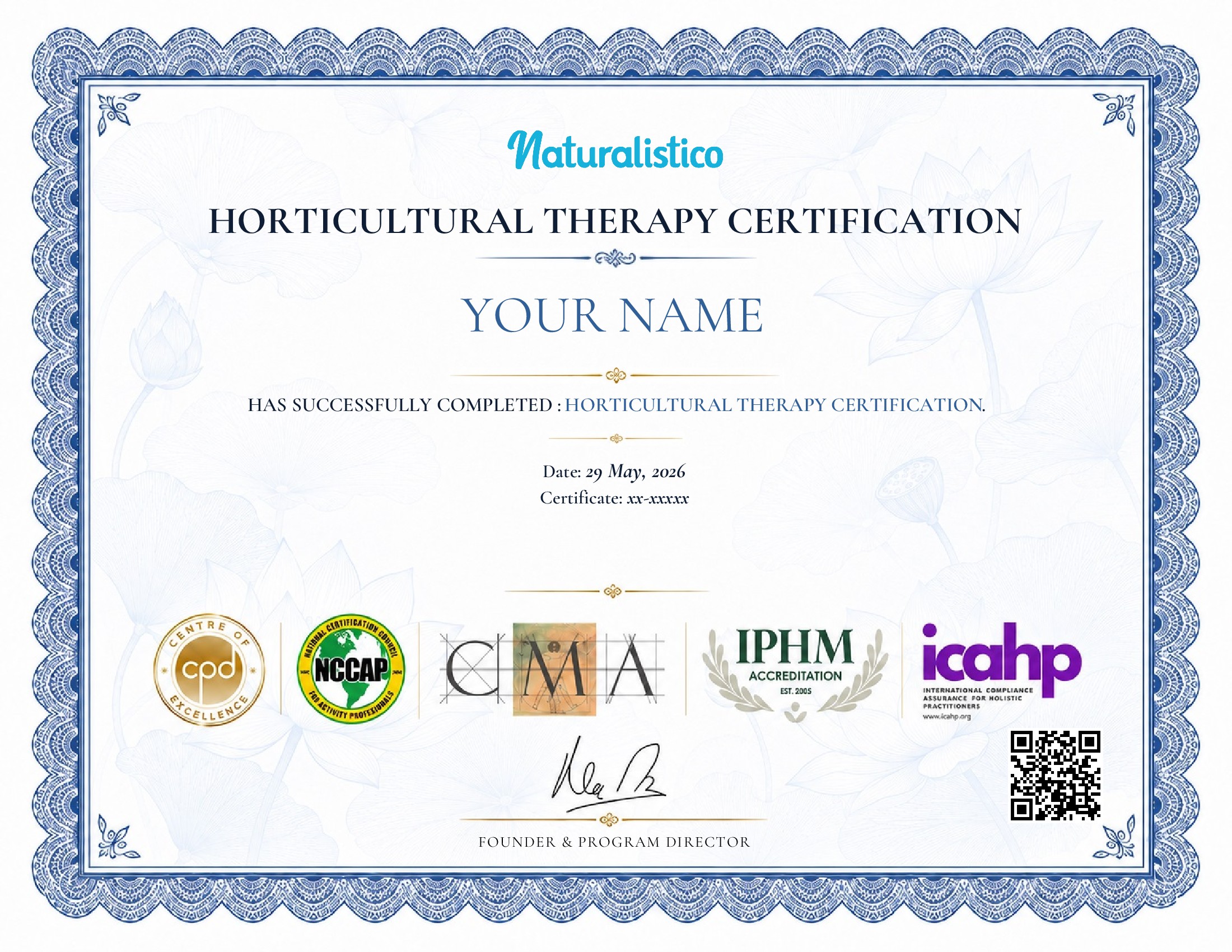
我们的证书由 IPHM(国际整体医学从业者协会)、CMA(补充医学协会)和 CPD(卓越中心)认证,这意味着它们已被国际评估和认可。
课程提供方
了解您课程背后的机构

Naturalistico
专业化
整体医学
教练与咨询
能量疗法
课程
Facebook Client Attraction Certification
Cognitive Behavioral Therapy (CBT) Course
Breathwork Practitioner certification
Cacao Ceremonial Guide Certification
Ericksonian Coach certification
At Naturalistico, we’re dedicated to empowering therapists, coaches, and practitioners to thrive in their careers. Our platform combines accessible education with professional tools to help you grow your practice and manage it with ease. We collaborate exclusively with highly experienced educators to create our courses, ensuring you receive the highest quality knowledge and insights. We’re a passionate team committed to providing straightforward, affordable solutions that support your success. From comprehensive courses to CRM management tools, we offer resources designed to fit seamlessly into your busy life. Our mission is to help you build a practice that’s not only sustainable but also impactful. At Naturalistico, your growth and success are at the heart of everything we do.
对比
从业者为何选择 Naturalistico
| 功能 | 我们的方式 Naturalistico $97.00,已认证,自主进度学习 | ICF / PAAC 课程 $4,000.00 至 $13,000.00 | 大学学位 $40,000.00 至 $120,000.00 |
|---|---|---|---|
| 学费 | $97.00 | $4,000.00 至 $13,000.00 | $40,000.00+ |
| 形式 | 自主进度,全程在线 | 实时班级,按计划开课 | 线下或混合式 |
| 完成时长 | 约 40 小时 | 6 至 24 个月 | 2 至 6 年 |
| 认证 | IPHM, CPD, CMA | ICF, PAAC | 地区性学术认证 |
| 适合人群 | 希望获得可信、实惠资质的从业者 | 因特定岗位需要 ICF 或 PAAC 的人士 | 临床或学术职业发展路径 |
| 持续访问权限 | 终身访问权限,无额外费用 | 有限,因课程而异 | 仅限校友访问 |
| 退款政策 | 30 天退款保证 | 有限或没有 | 没有 |








Practitioners certified across 6 continents
 獎金
獎金
享受此课程的独家奖励
报名此课程的学员也喜欢这些内容。

奖励 1
Facebook Client Attraction Certification (Valued at $395.00)
Ready to grow your holistic practice? Join our Facebook Client Attraction Certification course!

Holistic-Focused Strategies
Proven Techniques
Get Certified

奖励 2
Earn $15 in Credits with Your First Purchase! (300 points)
Start your learning journey and get rewarded instantly — earn 300 points ($15 value) on your first course purchase! Redeem your points for free courses and exclusive rewards. 🎓
Earn while you learn
Redeem for free courses
Grow your rewards with every purchase

奖励 3
Holistico CRM business suite
Experience the power of Holistico Professional+ with a complimentary trial, your all-access pass to our most advanced tools. Or keep exploring with our Free Plan, always on us.
Take payments
Manage your appointments
Have your services discovered

奖励 4
Free Weekly Live Classes
Get free access to our Weekly live classes to learn new skills and keep growing personally and professionally.
Interactive Live Sessions
Learn from Experts
Connect with a Global Community
奖励 5
Student map (Valued at $120.00/year)
Calling all students! Explore our Student Map platform designed to help you connect, chat, and collaborate with fellow students worldwide.
Easy Student-to-Student Connections
Global Networking Opportunities
Chat and meet others to practice your craft

奖励 6
Forum
Students, it’s time to connect, discuss, and share your insights on our vibrant Student Forum.
Engage with Peers Worldwide
Explore Diverse Topics
Collaborate and Learn

奖励 7
Every Purchase Plants 1 Tree!
With every order, we're teaming up with One Tree Planted to plant a native tree, creating a greener planet. 🌱
Improved Air Quality
Restore wildlife habitats
Support sustainable communities
限时优惠
$2,503.00
96% OFF
套餐总价值
今天报名仅需
$97.00
支付 $97.00 — 获得以下所有内容。
$2,503.00 套餐 — 包含顶级 Naturalistico 认证、专业营销培训、直播课程、商业软件和全球学生社群 — 今天报名即可获得所有内容。
- 获得认证以吸引更多客户
- 使用专业商业工具管理您的业务
- 现场学习并与全球学生互动
 好处
好处
常见问题
你有问题,我们有答案。
我如何報名課程?
选择您想要的课程,然后点击“加入购物车”按钮。您可以添加任意数量的课程。 进入购物车后,您可以确认付款。在此步骤中,也可以选择订购纸质证书。此选项为自选项。 完成付款后,您将收到一封订单确认电子邮件。
完成一门课程需要多长时间?
完成课程或参加期末考试没有截止日期。一旦注册,您将终身可以访问课程。我们的大多数课程预计需要大约40小时完成。但是,每个学生的学习进度是不同的。一些课程活动可能会花费比其他活动更多的时间,或者您可能需要复习一些概念。最重要的是您感到学习过程舒适。
如果我需要课程帮助,可以提问吗?
是的,完全可以。学生论坛是专门为此设置的。您可以提出问题,培训师或其他学生会进行回答。我们鼓励您在需要时随时提问,以免在学习中卡住。请允许培训师在不包括周末和节假日的情况下最多48小时内答复。此外,欢迎您与我们分享您的学习进展和成就!
如果我丢失了登录信息,该怎么办?
您可以通过电子邮件发送消息至 [email protected] – 您也可以在登录界面点击“忘记密码?”。不过,我们建议您在收到注册确认邮件后立即记下您的登录信息。
是否需要参加旅行或工作坊?
不会,整个课程都在线上进行。不需要旅行或参加工作坊。您可以独立学习,并按照自己的节奏进行。您可以下载课程模块和音频文件,在任何地方收听。如果有任何问题,可以在论坛中提问。
在课程中我如何被评估?
每门课程包括多个模块。每个模块结束时都会提供一个测验来评估您的学习成果。大量的实践活动也让您能够应用所学知识。在课程结束时,您需要完成一个在线最终考试,形式为多项选择问卷,以验证您的学习情况。最低分数要求为80%。如果未达到80%,您可以随时重新参加考试。不过,我们建议您在此之前复习课程内容。
有什么先决条件吗?
没有任何先决条件或最低教育水平要求。我们所有的课程都经过精心设计,以便尽可能多的人能够参与。您可以通过电脑、平板电脑或智能手机学习。如果您的互联网连接不稳定,我们建议下载PDF模块和音频文件,以便随时离线访问。但是,完成测验和参加期末考试时需要互联网连接。
课程结束后我会收到证书吗?
如果您在注册时订购了纸质证书,您将会收到它。否则,您也可以稍后在学生门户的“证书”部分订购,或者免费下载PDF格式的证书。
这些认证是否得到官方认可?
我们的课程所针对的职业在大多数国家属于非监管职业。这意味着没有官方认可。然而,当地法规可能有所不同。我们建议您咨询相关部门。
限时优惠
Horticultural Therapy Certification
所有课程享有30天退款保证
今天报名仅需
$97.00
$395.00 · 75% 折扣
- 终身使用权
- 含证书
- 30天保障
30天退款

Naturalistico 客服
通常几秒内回复
🎓 今天就考取认证 — 75% 优惠
你好,关于这门课程有什么想了解的吗? 👋
关于 Horticultural Therapy Certification,价格、认证、授课方式还是退款,都可以问我。也可以从下面选一个话题。
由 Naturalistico 提供
Horticultural Therapy Certification for $97.00
 30天保证
30天保证


