If you work with clients around nutrition, herbs, or performance, medicinal mushrooms will come up sooner or later. Many people arrive with catchy promises—reishi for sleep, lion’s mane for focus, cordyceps for energy—and hope for fast results. But the space is crowded, products vary wildly, and labels can blur true actives with cheap starch. Your role is to turn all that noise into something steady, affordable, and safe to follow.
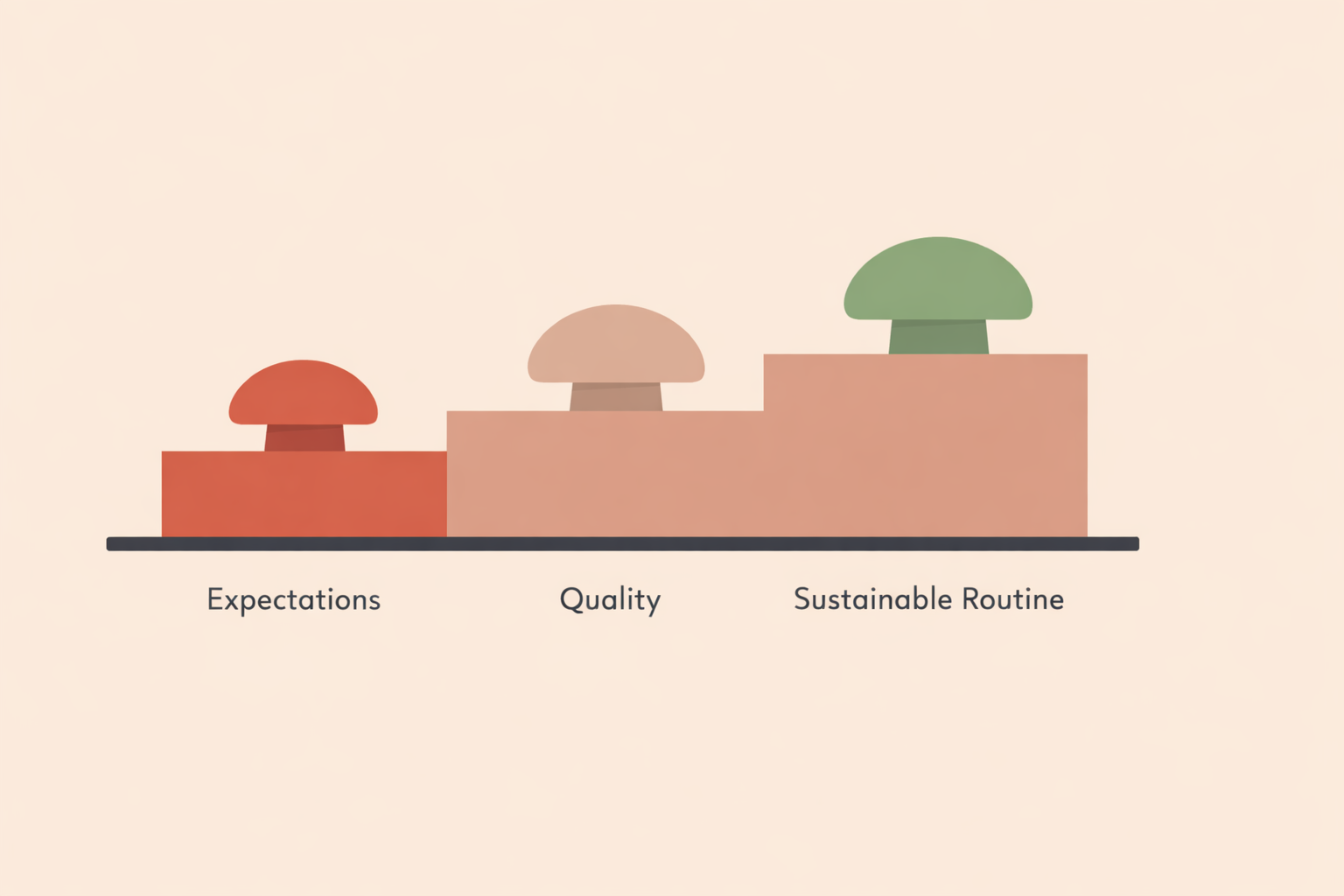
Strong mushroom plans rest on three foundations working together: grounded expectations, verified product quality, and personalised, sustainable planning. Hold those three at once, and you can support real progress without hype.
Key Takeaway: Effective medicinal mushroom plans work best when you align realistic timelines with verified product quality and a simple, personalised routine. Focus on species accuracy, meaningful actives like beta-glucans, and batch testing, then start conservatively, track subtle changes over weeks, and screen for interactions.
Foundation 1: Set grounded expectations for medicinal mushroom use
Medicinal mushrooms can offer meaningful support for wellbeing, but they work best when approached as steady, cumulative allies. Traditional use gives us a long view—how these fungi have been valued for resilience, nourishment, and long-term vitality—while modern research is beginning to map that experience into current language. Recent reviews describe mushrooms as having anti‑inflammatory, antioxidant, metabolic, and microbiome‑supportive properties, which fits the “slow build” practitioners have observed for generations.
That framing matters because mushrooms carry a lot of mythology. Reishi is often called the “mushroom of immortality”—a phrase that points to deep respect. In real client work, it’s more helpful to translate that reverence into practical aims: steadier evenings, better reserves, smoother recovery, and the kind of wellbeing that grows over time.
Traditional use has never been random. Across East Asian lineages, reishi, shiitake, and maitake were valued for vitality, and many Indigenous communities have long worked with local fungi through foodways and land-based knowledge. A broad review notes mushrooms “have been used for millennia” as supportive allies—not as passing trends.
As mushroom cultivation expert Jeff Chilton puts it, “To some degree, all mushrooms have medicinal compounds in them. What makes the difference between one of those mushrooms being highly medicinal and the other one is just being how much of those compounds are in the mushroom.”
What this means is simple: mushrooms belong in thoughtful plans, not in miracle narratives. You’re guiding clients away from “What mushroom fixes this?” and toward “What kind of support is realistic—and how do we build it steadily?”
In practice, that might look like reishi for calmer evenings, lion’s mane for improved cognitive function (especially in older adults), or cordyceps as part of a stamina-focused routine. And it’s worth keeping culinary mushrooms on the table too: reviews describe edible mushrooms as nutritional powerhouses, and one long-term cohort associated weekly intake with about a 50% lower risk of mild cognitive impairment—an encouraging reminder that “small, consistent” can be powerful.
Mushrooms also contain compounds linked with long-term resilience, including ergothioneine, which UCLA describes as “an amino acid and antioxidant that prevents or slows cellular damage.” Here’s why that matters: it echoes the traditional emphasis on nourishment and longevity rather than quick, dramatic shifts. The National Cancer Institute similarly notes a long history of using mushrooms to promote health and longevity.
The first foundation, then, is hopeful and honest: mushrooms often work through subtle improvements that accumulate—steadier energy, calmer evenings, smoother digestion, gentler recovery—rather than overnight transformations. Once clients understand the timeframe, it becomes much easier to choose products (and plans) that can actually deliver.
Foundation 2: Choose mushroom products that truly deliver
Grounded expectations set the direction; product quality determines whether you get anywhere. Even the best-designed plan will disappoint if the product is weak, mislabeled, overly starchy, or sourced carelessly.
Start with the basics: species matters. Reishi and lion’s mane aren’t interchangeable. A detailed review describes Ganoderma (reishi), Hericium (lion’s mane), Trametes (turkey tail), and Cordyceps as having distinct metabolites linked to different effects. Put simply: if the species isn’t clearly identified, the rest of the label is mostly decoration.
Next is the part used. Comparative analyses show higher beta‑glucans are often found in fruiting-body extracts than in mycelium grown on grain. And for reishi specifically, key triterpenes are associated mainly with the fruiting body (and spores), and are much lower in grain-based biomass products.
This doesn’t mean mycelium is “bad.” It means you need transparency. If a label says “mycelium” without clarifying the growth medium, extraction method, or what proportion is actual fungal material, it may be more starch than mushroom. One compositional study found many commercial products were high in α‑glucans (starch) and low in β‑glucans, even when labels highlighted “polysaccharides.”
That’s why experienced practitioners don’t rely on broad “polysaccharide” claims. Researchers warn polysaccharides may include inactive starch, while beta‑glucan testing is a more meaningful marker of mushroom actives. Another analysis showed large variation in β‑glucan content across products—clear evidence that branding is not quality control.
When you’re checking labels or speaking with suppliers, look for:
- Clear species identity (common and Latin name)
- Part used (fruiting body, mycelium, or both—stated plainly)
- Extraction type (hot water, dual extract, etc.)
- Beta‑glucan content rather than vague polysaccharide totals
- Batch testing with Certificates of Analysis
- Contaminant screening (heavy metals, microbes)
These are practical standards, not perfectionism. One study emphasized β‑glucan measurement as a more accurate indicator of actives, and a broader safety review notes mushrooms can bioaccumulate heavy metals, so screening matters.
Sourcing is also ethical. Wild-harvested materials—especially chaga—can raise overharvesting and contamination concerns. In many cases, cultivated material with clear origin and controlled conditions is the more responsible choice.
There’s a cultural layer here too. These mushrooms come from living traditions and local knowledge, not from modern marketing departments. Respect shows up in how we speak about them, how we choose suppliers, and how we avoid using culture as decoration.
Once quality is handled—species, part used, extraction, testing, sourcing—you can finally do the most important work: tailoring the plan so it fits a real person’s life.
Foundation 3: Turn quality mushrooms into personalised, sustainable intake plans
The best plans are easy to follow, clear enough to measure, and flexible enough to evolve. With a solid product in hand, your job becomes matching species, dose, timing, and pacing to the client’s goals, routine, sensitivity, and budget.
Think of it like building a “living plan,” not running a fixed protocol. Most people do better starting with one mushroom (or one blend) than stacking several at once. Simplicity makes changes easier to notice—and easier to stick with.
A practical plan usually comes down to four decisions:
- Species: what support is the priority right now?
- Dose: what is the lowest useful starting point?
- Timing: morning, midday, evening, or with meals?
- Review window: when will you check progress and adjust?
For common extracts, referenced ranges often include around 500–1500 mg/day for reishi, cordyceps, and turkey tail, and up to about 3000 mg/day for lion’s mane. Essentially, numbers are a guide—starting low and building gradually is usually the more skillful move, especially for clients new to extracts or already using multiple supports.
Timing is less about rigid rules and more about fitting the client’s rhythm. Reishi is often used later in the day to support calmer evenings. Cordyceps tends to suit earlier use for active clients seeking daytime stamina. Lion’s mane often fits morning or midday when concentration is the goal.
Just as important: set the timeframe. People usually do better thinking in weeks rather than days. Research timelines often reflect that: reishi effects on calm and sleep may show over 2–8 weeks, lion’s mane cognitive shifts over 4–12 weeks, cordyceps performance-related changes over 1–6 weeks, and turkey tail is often used over 4–12 weeks or longer in studies.
To keep momentum, track the kinds of changes mushrooms are known for: subtle improvements that accumulate. Instead of “Do you feel totally different?”, you might track:
- Energy rhythm throughout the day
- Focus and mental steadiness
- Sleep quality and ease of winding down
- Digestive comfort
- Stress resilience in everyday situations
- Consistency with the routine
This is especially helpful with cordyceps. Reviews describe possible support for exercise capacity and fatigue resistance, while also noting mixed findings overall. The practical takeaway is coaching: aim for training-style, incremental improvements—not stimulant-like expectations.
Personalisation also includes wise screening. The National Cancer Institute notes mushrooms can cause side effects, may interact with other substances, and may be inappropriate for some individuals. They may have additive effects with substances used for blood thinning, glucose regulation, or blood pressure support, and their polysaccharides can be immunomodulatory—a key consideration for people with complex immune contexts.
In coaching, that means keeping a clear intake conversation: what else are they taking, what major health contexts are present, and when is it appropriate to pause and refer to a licensed professional for additional guidance.
Done well, the plan feels steady and human. UCLA’s description of mushrooms as a source of ergothioneine that helps prevent or slow cellular damage captures the spirit: many of these benefits are about resilience and nourishment, built day by day.
Conclusion: Weaving the 3 foundations into a resilient, ethical mushroom practice
A resilient medicinal mushroom practice rests on three things working together: honest expectations, verified quality, and personalised planning. Drop any one of them and the work gets shaky—clients feel confused, products underdeliver, or routines don’t last. Combine all three and you create support that’s practical, respectful, and genuinely sustainable.
It’s encouraging to see modern institutions echoing what tradition has long held. Public-facing resources now connect mushrooms with antioxidant support and cognitive aging, as well as microbiome balance and immune function. That doesn’t replace ancestral knowledge—it simply gives you additional language for conversations practitioners have been having for a long time.
At the same time, popularity raises the bar. Reviews emphasize mushrooms are rich in bioactive compounds while underscoring the need for quality control. And analyses show many products are weak, mislabeled, or overly starchy—exactly why these foundations are now professional essentials, not “nice-to-haves.”
Interest is likely to keep growing, with market projections pointing to sector expansion over the next decade. The field doesn’t need louder claims; it needs practitioners who can hold tradition and evidence together with clarity, cultural respect, and strong product discernment.
Master Medicinal Mushrooms Foundations
Build confident protocols with the Foundations of Medicinal Mushrooms Certification for quality, dosing, and client-safe planning.
Explore Foundations of Medicinal Mushrooms →