The week before a first class, sequencing notes multiply while confidence doesn’t. You wonder whether you need a peak pose, a playlist, perfect cues, and faster pacing to earn trust. Meanwhile, the real risks are simpler: an overstuffed plan, a racing voice, and a room that needs steadiness more than spectacle. New teachers frequently learn that pressure rises, transitions wobble, and clarity matters more than choreography. What sets the tone of that first hour isn’t showmanship; it’s safety, coherence, and a clear invitation to participate.
The path is refreshingly practical: lead with intention, keep the arc simple and adaptable, rehearse just enough to feel steady, and teach with concise cues, consent, and room-aware presence.
If nerves spike, you’ll be glad you built something you can trust at a glance—a one-page arc, a few key transitions you know well, and extra space in the timing so you can actually meet the room.
Key Takeaway: Your first yoga class feels confident when you teach a simple, intention-led arc with built-in time and options. Rehearse just enough to steady your pacing and voice, then deliver short sequential cues, normalize rest and modifications, and stay adaptable to what the room needs.
Step 1: Plan a simple, intention-led first yoga class
Your first class plan doesn’t need to impress anyone. It needs to feel clear, steady, and easy to follow when your mind is busy.
Early on, confidence grows less from performance and more from building safety and coherence—the quiet sense that the experience is held. People aren’t asking to be dazzled; they’re asking to be guided.
Start where the practice starts: with intention. Before you chase creativity, decide what you want students to feel and explore—grounding, steadier breath, gentle spinal mobility, or simply coming home to the body after a long day. Think of that intention like a thread through fabric: it keeps everything connected, even if you need to adjust on the fly.
As the Bhagavad Gita reminds us, “Yoga is the journey of the self, through the self, to the self.”
That reminder softens a common first-class trap: teaching “at” people. A steadier approach is to hold a structured experience where they can meet themselves.
Now shape your plan into a one-page class arc—something you can glance at and instantly know where you are. A simple outline tends to calm nerves better than trying to perform a memorized script, especially when script memorization adds pressure.
The most supportive early sequences are simple for a reason. Choosing fewer poses, simpler transitions, and a slower pace gives you room for breath, clarity, and real settling—especially when your inner tempo wants to sprint.
Your page might look like this:
- Arrival and centering — 3 to 5 minutes
- Gentle warm-up — 8 to 10 minutes
- Standing sequence — 10 to 15 minutes
- Floor-based settling — 8 to 10 minutes
- Closing rest and integration — 5 to 8 minutes
Inside each block, keep only essentials: main shapes, key transitions, and one or two cueing priorities. Overplanning is the usual culprit—teachers try to account for every possibility, then carry too much mental load. A more reliable approach is a repeatable framework you can teach from with presence.
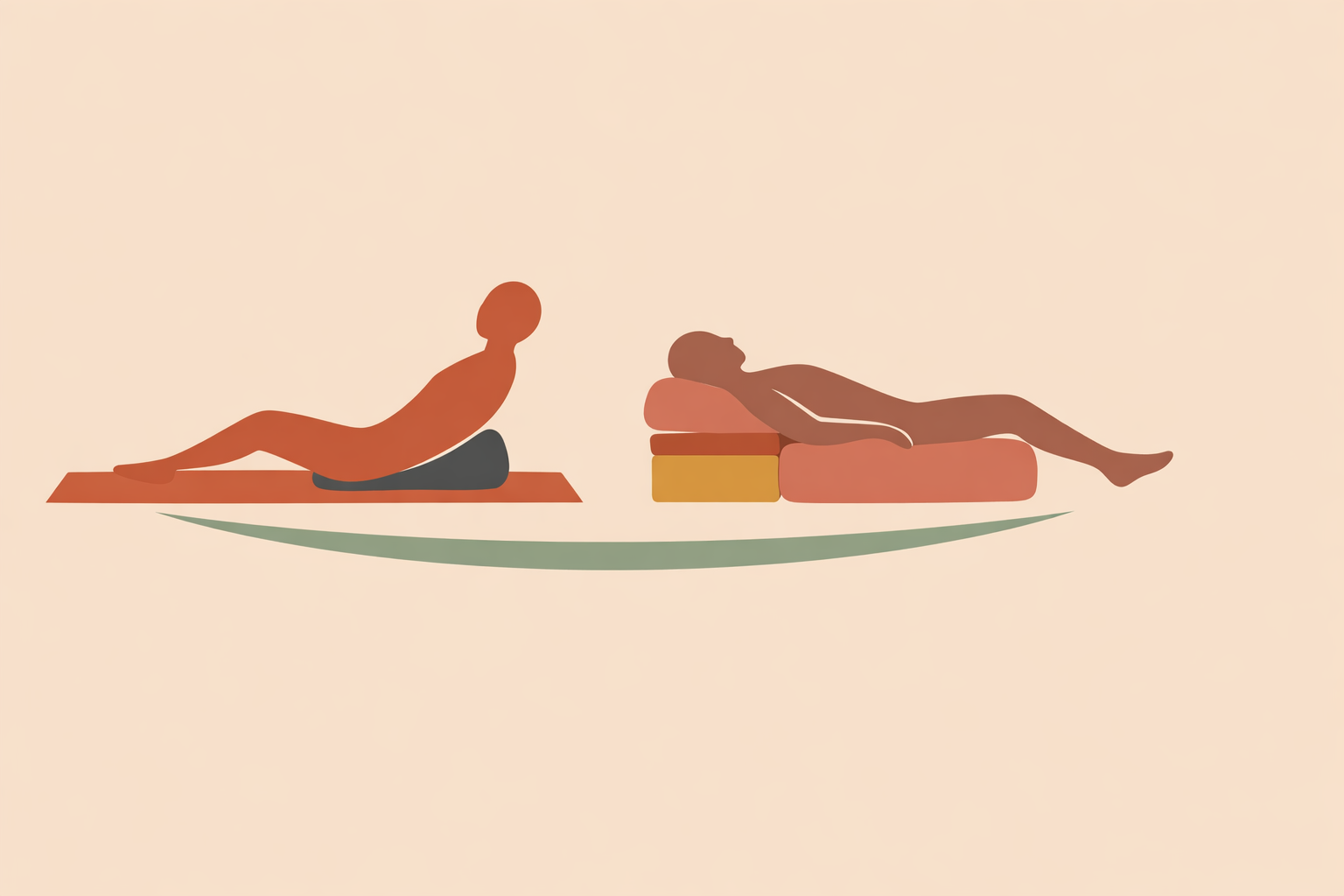
Build options in from the start. Props and modifications aren’t a modern add-on; they reflect long-standing practitioner wisdom that yoga is adaptive and responsive. Decide ahead of time where you’ll offer wall support, a block, a bent knee, child’s pose, or a rest. When options are planned, you stay calmer and less reactive.
One detail that changes everything: give each block rough minutes, and plan 10–15% less than you think you need. Put simply, having space is a skill. It lets you pause, observe, and teach what’s actually happening instead of chasing the clock.
When your plan is done, you shouldn’t feel stuffed with ideas. You should feel settled. Then it’s time to let your body and voice learn the map.
Step 2: Rehearse your sequence just enough to feel steady
Rehearsal turns a written outline into embodied confidence. The goal isn’t drilling until it’s perfect—it’s practicing until it’s familiar.
Confidence tends to grow through preparation and rehearsal, plus feedback that helps you simplify. If you rehearse so much that you get rigid, it can fuel anxiety rather than steadiness.
Do one full run-through close to real pace. Set up your mat and props, use a timer, and include anything you expect on the day. Practicing in a similar space reduces those small logistical surprises that can throw you off early.
Then speak the cues out loud. Hearing yourself teaches you faster than silent planning: you’ll catch rushed pacing, clunky wording, and missing steps. Over time, practice improves delivery, and it also softens that first-time voice shock many new teachers experience.
If something feels cluttered when spoken, that’s a win—rehearsal is showing you exactly what to trim.
Give extra attention to the moments that commonly wobble: the opening and a few major transitions. Guidance for new teachers repeatedly highlights the first minutes and key transitions as the most vulnerable points. Knowing these well is like knowing the trailhead and the turns—you’ll relax once you’ve found them.
- Opening: greeting, intention, and centering
- Transition points: the big shifts (floor to standing, standing to floor)
- Closing: rest and a clear, calm ending
Typically, one to two run-throughs is enough. You’re not trying to lock the class into a script—you’re making the structure trustworthy.
The old line “Practice, and all is coming,” often attributed to K. Pattabhi Jois, applies to teaching as much as to asana.
If you can, do one rehearsal as if students are present: leave pauses, walk around, and imagine someone needs more time. Notice where your breath disappears or you rush—those are your cues to simplify.
Peer feedback can help, as long as it stays specific:
- Where did I sound clear?
- Where did I rush?
- Which transitions felt smooth, and which felt confusing?
- Did the overall pace feel welcoming?
Now your class has rhythm, not just ideas. That frees you to teach with presence.
Step 3: Teach with clear cues, consent, and adaptable presence
On the day, your job is wonderfully simple: offer clear guidance, genuine choice, and a steady presence. A strong first class isn’t defined by complexity—it’s defined by how supported people feel.
Because you planned simply and rehearsed realistically, you can pay attention to the room instead of living in your notes. That presence is felt.
Keep cues short, sequential, and spacious. Layered communication helps people engage without getting overwhelmed, and when language gets too dense, confidence can drop because students are decoding words instead of moving.
A useful rhythm is: name the shape, offer one action, then pause. For example: “Step your right foot forward. Ground through both feet. Lift through the chest.” Essentially, you’re giving the nervous system time to catch up.
Silence is part of good cueing, too. Strategic silence gives beginners time to process, feel breath, and find their place in space. Often, a slower class with sequential cues lands deeper than a fast class filled with constant instruction.
Consent is the culture you set from minute one. Trauma-aware teaching emphasizes predictable sequencing, genuine choice, and non-coercive language. Practically, that means rest is welcome, options are normal, and opting out is always okay.
Simple lines near the start can do a lot:
- “Please take rest whenever you need it.”
- “I’ll offer options throughout, and you’re always welcome to choose what supports you today.”
- “If a cue doesn’t feel right in your body, let it go.”
This tone supports accessibility, and it also reflects traditional, practitioner-led wisdom: the practice meets the person, not the other way around. It’s encouraging that modern standards increasingly value communication skill alongside demonstration.
Normalize props, wall support, shorter stances, and rest as part of the class—not as a special intervention. Offering options to everyone makes them feel like a normal part of practice culture.
As T.K.V. Desikachar said, “The quality of our actions depends on the quality of our awareness.”
For a new teacher, awareness includes your breath, your pacing, and the subtle difference between guiding and controlling.
And when something goes off-script—late arrivals, a forgotten side, a brief tech glitch—return to simplicity. Teaching guidance recommends rehearsed responses over long apologies. A calm reset keeps the room steady:
- “Welcome, come in and join when you’re ready.”
- “Let’s all take one breath here while I reset the next step.”
- “We’ll take that on the second side now.”
These “repair” moments show something important: steadiness doesn’t mean never wobbling. It means knowing how to return.
Conclusion: Turn your first class into a confident teaching path
Your first class isn’t a final exam. It’s the beginning of a relationship with your voice, your presence, and the tradition you’re learning to carry with care.
In many cases, confidence grows quickly once you’ve taught a real class. Students tend to care far more about feeling welcomed than about a flashy sequence—and once you feel that in the room, the pressure to impress starts to loosen.
The most useful next step is reflection, not self-judgment. Afterward, take a few minutes and ask: Where was I clear? Where did I rush? Did the pace feel spacious? Did options and rest feel genuinely welcome? These kinds of reflective questions build skill faster than “I was good” or “I was terrible.”
Then teach again. Skill grows through iterative practice—often repeating the same short class and refining it gently each time. That rhythm mirrors the deeper practice: repetition, attention, and lived experience.
As B.K.S. Iyengar put it, “The study of asana is not about mastering posture. It’s about using posture to understand yourself.”
Teaching is similar. Each class shows you how you communicate, how you settle under pressure, and where your natural strengths already are.
Keep it simple. Plan with intention. Rehearse until you feel steady. Teach with clarity, consent, and adaptability. Then let your first class become what it was always meant to be: not proof that you’re perfect, but proof that you’ve begun.
Train with Yoga Teacher Certification
Build clear sequencing, confident cueing, and consent-based teaching through Naturalistico’s Yoga Teacher Certification.
Explore Yoga Teacher Certification →