Sacred geometry manifestation layouts can give a practice a steady backbone: symbolic patterns that help organize intention, guide attention, and align daily actions with what you’re calling in. Think of them as living templates—rooted in ancestral pattern wisdom, and easily paired with modern, heart-led strategy for your work and your community.
Across cultures, geometry has long been used as a bridge between the seen and unseen. Many describe it as the architecture of the universe, with spirals, hexagons, and circles repeating from the tiniest forms to the most expansive. That familiarity is part of the magic: these shapes echo patterns life already “speaks,” so the mind and body often settle into them quickly.
Motifs like the Flower of Life, Seed of Life, and Metatron’s Cube carry enduring themes—unity, creation, transformation—that work beautifully as visual anchors for a crystal grid layout or manifestation altar. Many contemporary teachings highlight their connection to unity and creation, and the courage to evolve. When stones or tokens are arranged on these templates, practitioners often report an container effect: a focused “field” that helps intention feel coherent rather than scattered.
There’s also a grounded, felt component. In spaces designed with geometric art, many practitioners notice a gentle downshift—breath softens, shoulders drop, and conversations slow into something more spacious. These motifs are often used to support a calmer nervous system tone, which can make reflective work feel safer and more accessible.
And importantly: none of this is new. Temples, mandalas, mosques, and cathedrals across civilizations have woven proportion and pattern into daily life. Histories of sacred geometry trace these roots across temples worldwide—reminding us we’re stepping into a very old conversation.
“Geometry is one and eternal…” — Johannes Kepler
This Kepler reflection still invites a reverent approach: work with the forms as allies, not as shortcuts.
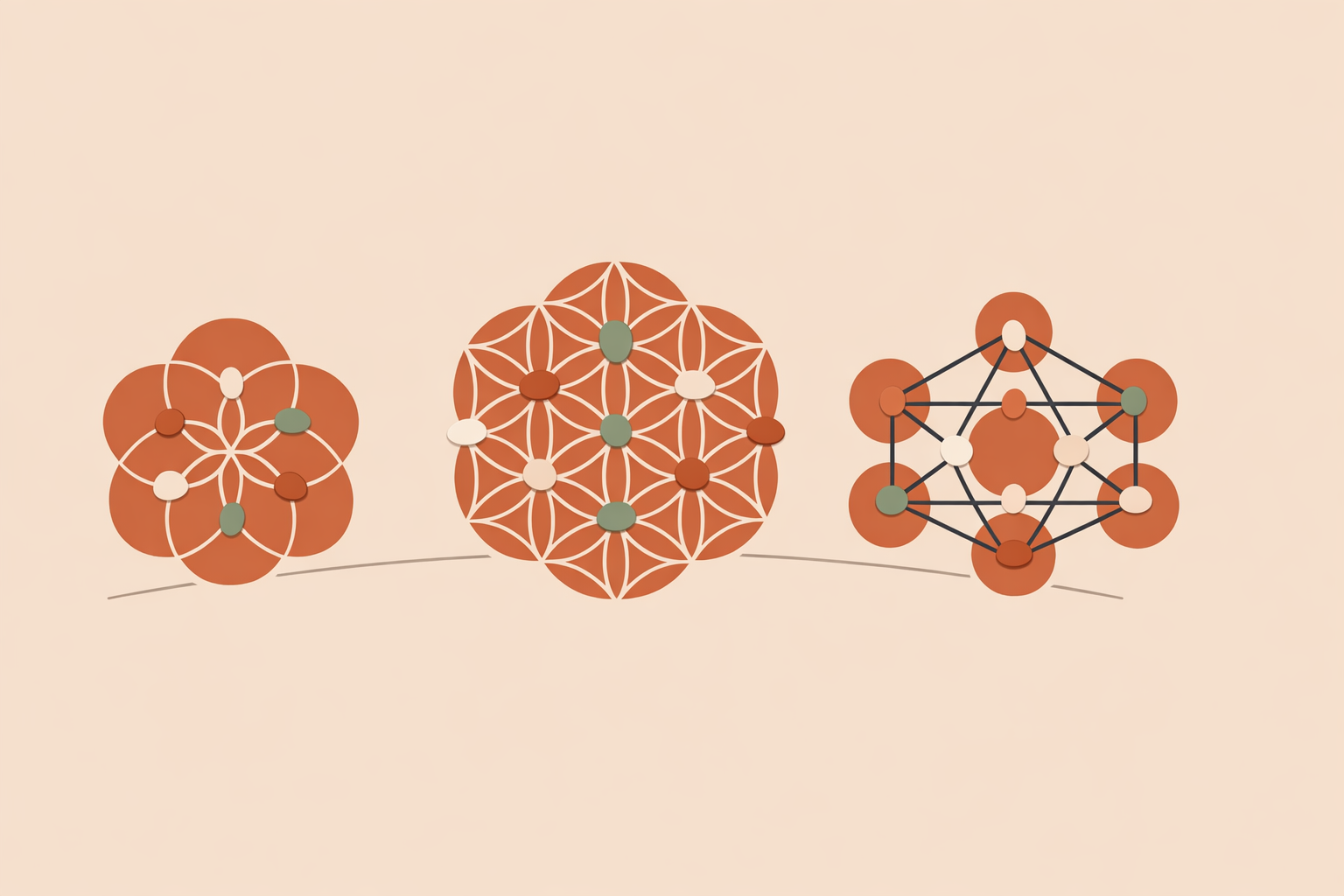
With that spirit in mind, the three layouts below move from foundation to focus to integration: the Flower of Life for vision, the Seed of Life for new beginnings, and Metatron’s Cube for translating insight into aligned, sustainable action.
Key Takeaway: Sacred geometry layouts work best as practical containers for attention: a steady base for vision, a focused map for one new intention, and a structured pattern for turning insight into repeatable habits. Used ethically, they support grounded decision-making and values-led action without overpromising outcomes.
Layout 1: Flower of Life Client-Intention Grid
The Flower of Life is an all-purpose foundation—useful for steadying practice vision and setting a coherent tone in your workspace. It’s especially supportive when you’re clarifying who you serve and the kind of experience you want people to have with you.
Its repeating circles naturally suggest wholeness. When you place a core intention at the center and echo it outward with supporting stones or tokens, you’re training attention to return—again and again—to what matters most.
Why the Flower of Life Calms and Contains
The Flower of Life’s overlapping circles form a lattice recognized for centuries as a symbol of unity and the blueprint of creation—an elegant visual expression of meaning. That symmetry is one reason it’s such a popular base for grids: the placement feels intuitive, balanced, and easy to repeat.
For many, that balance isn’t just visual—it’s somatic. Circular, repeating motifs are often described as helping to slow the breath and open presence. Put simply: when the body feels more settled, it’s easier to stay honest, receptive, and grounded in values.
“The harmony of the world is made manifest in Form and Number.” — D’Arcy Wentworth Thompson
It’s a reminder of the beauty humans reliably recognize in proportion and pattern. In modern practice life, the Flower of Life can also be woven into branding and space design as a quiet cue of interconnectedness—helping people feel “held” from the moment they arrive.
Step-by-Step: Build a Flower of Life Client-Intention Grid
A calm, grounded way to bring the Flower of Life into your daily work and visioning:
- Prepare the field: Clear your surface with smoke, sound, or simple breathwork. Lay down a printed Flower of Life template or a carved plate.
- Name your intention: Write your core practice vision in one sentence. Fold it and place it under a stone at the center.
- Choose your anchors: Select 1–3 stones or tokens that match the feeling-tone you want to embody (rooted, clear, compassionate, brave).
- Place supporting stones: Add 6–12 smaller stones along the rings. Let each hold a sub-intention (for example: “courageous conversations,” “consistent referrals,” “honest feedback”). Keep it simple and symmetrical.
- Activate with presence: Slowly trace the lattice with your attention or a small wand from the center outward and back again, like breathing with the grid. Speak the intention once, calmly.
- Integrate into your space: Keep the grid near your desk or session area. When decisions come up, let it bring you back to what “coherent” feels like.
Pro tip for practitioners: at the end of a session, set a micro-intention at the grid—one sentence about the quality you’ll hold between now and next time. It keeps the field steady without gripping the outcome.
Layout 2: Seed of Life New-Beginnings Layout
Once your vision feels steady, the Seed of Life helps you plant one living intention—like a new offer, a collaboration, or a wave of aligned clients. It’s compact, focused, and surprisingly potent.
Use this layout when you want momentum on something specific that naturally sprouts from your Flower of Life foundation.
Seed of Life as a Map for Growth
The Seed of Life is formed by seven overlapping circles within the larger Flower of Life. Across lineages, it’s associated with creation and early-stage growth—core qualities of Seed of Life work. Many practitioners choose it for fresh intentions because it concentrates attention without feeling tight or rigid.
Think of the center circle as the seed desire, and the six surrounding circles as what nourishes it—structure, relationships, communication, rhythm, and resources. Many guides suggest placing a central stone, then adding companions in the surrounding circles to represent the real pathways you’ll cultivate.
Nature offers a helpful metaphor here: growth tends to spiral and scale. Many teachings point to patterns like the golden ratio and the Fibonacci Sequence as ways of describing that rhythm. Essentially, the Seed of Life invites the same approach—small, consistent steps that compound into visible change.
Step-by-Step: Design a New-Client or New-Program Layout
Use this when you’re about to launch, hire, or open a new client container. Keep it values-led and action-oriented.
- Define the seed: Write one sentence that’s clear enough to guide action.
- Center stone: Choose one stone or token that embodies the essence of what you’re building. Place your written intention beneath it at the center.
- Map the six supports: Assign each surrounding circle to a tangible support channel. Examples:
- Circle 1: Messaging clarity
- Circle 2: Community referrals
- Circle 3: Email sequences
- Circle 4: Calendar rhythm
- Circle 5: Onboarding ease
- Circle 6: Values-aligned pricing
- Assign stones intentionally: Pick distinct stones or tokens for each circle. Let color and texture act as a cue (warmth for community, structure for scheduling, openness for messaging).
- Set micro-commitments: Under each support stone, place a tiny paper with one small action you’ll take this week. Refresh weekly to keep momentum moving outward.
- Journal with the Seed: At week’s end, sit by the layout and reflect: what sprouted, and what needs nourishment? Many practitioners pair this with journaling so growth stays aligned with values.
Ethical note: don’t force outcomes. The Seed of Life is a partner, not a lever—when something stalls, refine the intention, improve the support, or give it time.
Layout 3: Metatron’s Cube Integration Layout
When vision and new growth are underway, Metatron’s Cube supports integration—where insight becomes repeatable, embodied action. This is where clarity turns into cadence.
It’s especially useful during “make it sustainable” cycles: refining your schedule, strengthening boundaries, and improving how you deliver what you offer.
Why Metatron’s Cube Supports Deep Change
Derived from the Flower of Life, Metatron’s Cube contains the five Platonic solids—a symbolic way of holding the building blocks of reality within one harmonized image. Many practitioners work with it for balance and transformation because its interlocking lines feel like scaffolding that can actually “hold” a new structure.
Many manifestation teachers describe it as circuitry: a pattern that links inspiration to real-world choices. Visualization practices with geometric forms are also used for focus, engaging both intuitive and analytical modes so decisions are easier to follow through on.
Architectural theorist Charles Jencks relayed Buckminster Fuller’s insight that contemplating geometry can help you “organize and harmonize” life with the structure of the world. Designers echo this today, using patterns like Metatron’s Cube as cues for order and the felt sense of “everything has its place”—a contemporary thread of design.
Step-by-Step: Create an Integration Grid
Use this when something is already in motion and you’re refining delivery, bandwidth, and boundaries. Think of it like a practical ritual for alignment.
- Clarify the integration theme: Choose one domain to harmonize—time, money, energy, or relationships.
- Choose a structural center: Place a grounding stone at the Cube’s heart. Under it, write one sentence defining success in sensory language (for example: “My Mondays feel spacious and quiet.”).
- Map the solids to habits: Assign each Platonic-solid position to a habit or boundary:
- Tetrahedron: First action (the spark) you’ll take each week
- Cube: Non-negotiable container (blocked hours, phone off)
- Octahedron: Exchange balance (pricing, energy reciprocity)
- Dodecahedron: Vision alignment (does this match your values?)
- Icosahedron: Flow and recovery (breaks, water, movement)
- Link with lines: Trace the straight lines between stones with a finger or wand as if wiring a circuit. Name each connection out loud (for example: “Boundaries feed focus.”).
- Install a cadence: Place a small object (bead or seed) at one corner for each day you complete the habit. At week’s end, gather them under the center stone as “evidence of integration.”
- Close the loop: Each week, adjust one element: shorten something, simplify something, strengthen one boundary. Tiny, continuous tweaks are where this layout shines.
Optional refinement for sacred geometry coaching tools: if you facilitate groups, invite participants to draw a simple version of Metatron’s Cube and fill it with their own habits. Opening and closing circles can become a shared moment of rewiring—each person placing one bead for one action completed.
Working With the Three Sacred Geometry Layouts
Together, these layouts create a simple living framework: the Flower of Life steadies vision, the Seed of Life focuses growth, and Metatron’s Cube turns growth into routines and boundaries you can trust. With humility and skill, they can support practitioner well-being and client outcomes.
One quiet gift of sacred geometry is how it shapes the background. Simply living and working with these forms—on walls, shelves, or altars—is often described as building a subtle harmony over time. Here’s why that matters: geometry trains attention, and attention trains life.
That’s also why many facilitators pair grids with visualization. Practices that use triangles, pyramids, or lattices are often used to deepen presence and insight, making these layouts supportive allies for values-based action. It’s a key reason people lean on visualizations alongside journaling and mindful planning.
Ethics, Inclusivity, and Scope
Ethical use matters. Keep language clear: these are supportive, exploratory practices held within cultural traditions that honor form, rhythm, and right relationship. They are not guarantees. Professionals who integrate subtle-energy approaches often emphasize the importance of avoiding overpromising and allowing outcomes to emerge.
Inclusivity matters just as much. Some faith communities consider energy-based practices incompatible with their doctrine. Skilled facilitators check in about language, beliefs, and boundaries, and offer alternatives—like breath practices or values-mapping—when that’s a better fit. Respect is a practice, not a position.
On safety and scope: gentle geometric layouts can sit alongside many well-being approaches. Resources discussing Reiki note it is generally described as safe for most people when offered by those who train responsibly, and that it may complement other supportive paths. Encourage clients to seek appropriate professional support for serious concerns, while staying inside the boundaries of your role.
Bringing the Layouts Into Your Calendar
A simple rhythm that keeps things steady (without overwhelm):
- Quarterly: Refresh your Flower of Life grid to realign your practice vision and the experience you’re creating.
- Monthly: Build a new Seed of Life for one focused initiative—an offering, collaboration, or skill you’re growing.
- Weekly: Tend your Metatron’s Cube to reinforce habits, boundaries, and delivery quality. One bead per action. Review at week’s end.
Practical tips for a professional, ethical manifestation practice:
- Language first: State intentions in values-based words (“reciprocity,” “consistency,” “clarity”). Let metrics follow, not lead.
- Consent matters: If using layouts in sessions, ask whether the client wants the grid present or would prefer something simpler.
- Documentation: Keep brief notes linking grid elements to actions taken. It helps you track real evolution and refine your approach.
- Cultural respect: Acknowledge the lineages that inspire your practice. Avoid borrowing aesthetics without context or credit.
- Ritual hygiene: Open and close your grids. When a cycle completes, disassemble mindfully and compost or recycle papers.
As Robert Lawlor reminds us, the golden ratio points to the relatedness of the created world to its source—and to our potential for thoughtful evolution.
Let these forms apprentice you to that rhythm.
Continuing Your Sacred Geometry Practice
If you feel called to deepen, Naturalistico supports ongoing development with community, tools, and training designed for real client work. Many practitioners start by weaving the layouts into onboarding, session flow, and post-session reflection; others choose a more structured path through a Sacred Geometry Certification pathway within the ecosystem.
However you proceed, keep the heart of the work simple: honor the pattern, honor the person, honor the pace. May your grids be clear, your actions kind, and your practice aligned.
Published April 24, 2026
Master Sacred Geometry Certification
Deepen your layout work with the Sacred Geometry Certification and bring structure to ethical, repeatable client rituals.
Explore Sacred Geometry →