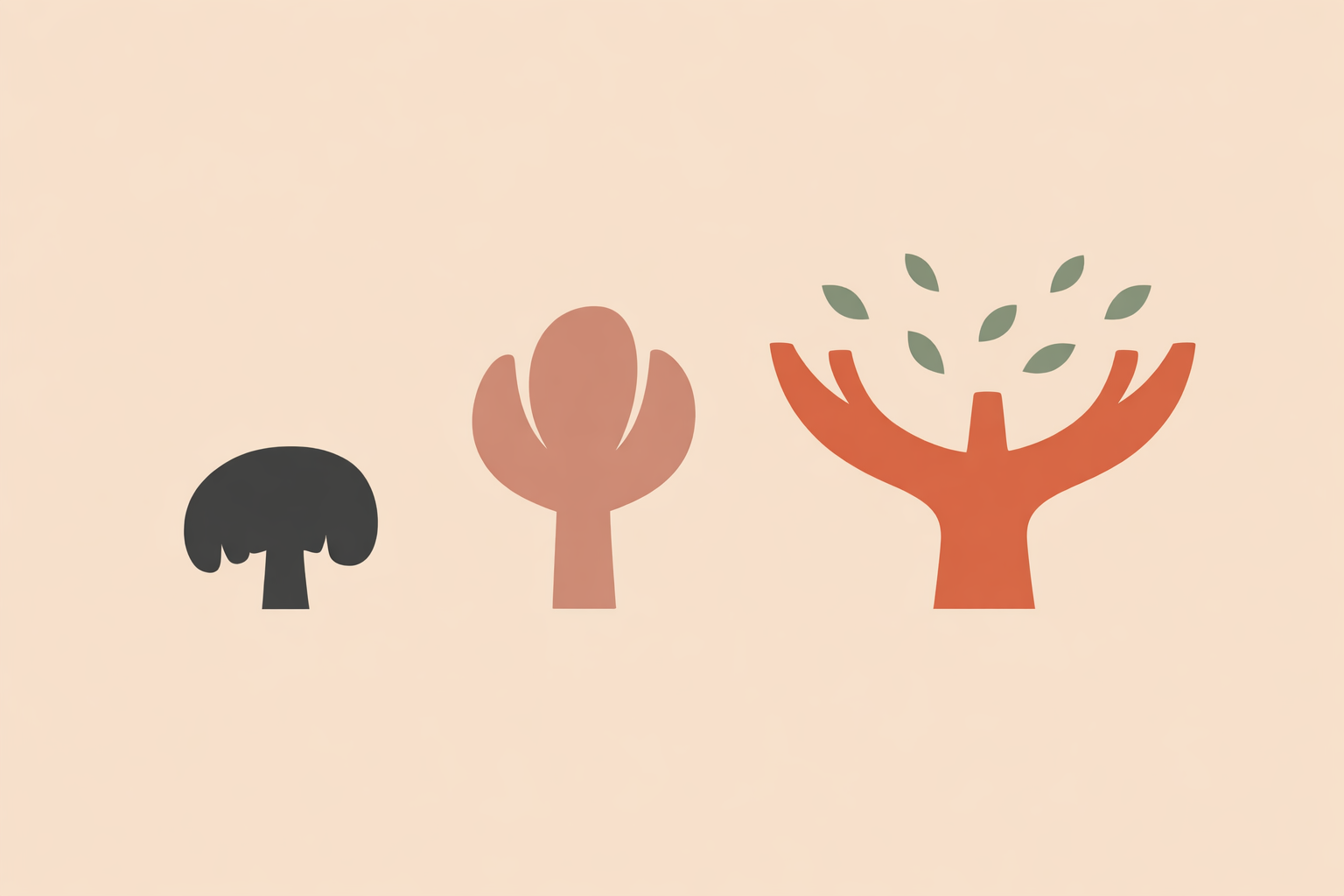
Burnout tends to walk into nature-based sessions in two familiar shapes: the person who can’t get moving no matter how gentle the invitation, and the person who’s wired-and-tired—caught in a stress loop that conversation alone doesn’t unwind. Outdoors, it’s easy for a walk to drift: too little structure to shift state, or too much pressure to feel safe.
What helps most is a simple progression you can trust: first thaw, then complete, then renew. In practice, that means language that meets freeze without pushing, choices that let activation finish its cycle, and small creative acts that rekindle interest without turning anything into a performance. Across all three flows below, the through-line is consent, right-sizing, and letting the forest offer steadiness while you hold the container.
Key Takeaway: Burnout-sensitive sylvotherapy works best as a simple sequence: thaw freeze states with gentle sensory contact, help the body complete unfinished stress responses through guided discharge and settling, then invite renewal with choice-led, low-stakes rituals that rebuild curiosity and meaning without pressure.
Flow 1: From Freeze to Gentle Movement with Trees
When burnout shows up as numbness, heaviness, or “I can’t make myself move,” the most supportive forest session is usually the gentlest one. This flow meets freeze with slowness, sensory contact, and tiny movements, so aliveness can return without demand.
A tree-centered session works beautifully here because it doesn’t ask for performance. The forest offers rhythm, texture, and quiet companionship—conditions that many people find naturally regulating. Forest bathing programs report reduced anxiety and reduced fatigue, alongside increased vigor—exactly the kind of gentle shift a shutdown system needs.
From a somatic lens, freeze often includes inertia and disconnection, and it tends to thaw through small movements and permission rather than big pushes. Think of it like warming your hands near a fire: you don’t force heat; you get close enough, long enough, for warmth to return.
Time among trees is also associated with lower stress and better mood. Environmental psychology calls one of the helpful ingredients soft fascination—the gentle pull of leaves, bark, birdsong, and shifting light that engages attention without demanding effort.
As one writer on sylvotherapy notes, “One of the key benefits of sylvotherapy is the ability to disconnect from the stresses and distractions of modern life.” In freeze states, that disconnection can be the first doorway back into felt experience.
Suggested session length: 25 to 45 minutes
Best for: low energy, shutdown, numbness, indecision, post-overwhelm depletion
Scripted flow
- Arrival: “We are not here to achieve anything today. We’re only here to notice what becomes possible when nothing is forced.”
- Orientation: Invite the client to stand or sit where they can see one tree clearly. “Let your eyes rest on the shape of the trunk, the way it rises, the places where it twists or steadies itself.”
- Breath without effort: “You do not need to change your breath. Just notice whether the air feels cool, warm, shallow, deep, or somewhere in between.”
- Micro-movement: Offer one tiny movement at a time: unclench the jaw, lift and drop the shoulders, sway one inch side to side, press the feet into the earth, soften the hands.
- Tree contact: If welcome, invite the client to place a hand on bark or rest their back near a trunk. “Notice texture, temperature, firmness. Let the tree be something you can lean your attention into.”
- Tracking aliveness: “Where do you notice even 2% more sensation — warmth, tingling, weight, breath, emotion, or ease?”
- Closing reflection: “What changed, even slightly, from when we began?”
The heart of this flow isn’t “getting someone moving.” It’s the message: you are allowed to come back in fragments. Somatic work describes how tiny movement can lead to a fuller exhale and gradually soften defensive bracing.
When something is too big, the most skilled move is often to shrink it. “Let’s make this smaller.” If swaying is too much, try shifting attention between feet. If tree contact feels too direct, stay a few steps away and simply look. The aim is to create conditions where contact feels possible.
Many nature-based practitioners also notice that some people can’t access a “safe place” through imagination alone—but can feel it through the landscape. Nature exposure can reduce anxiety and support self-regulation in a very concrete way. As somatic guide Anita Chari puts it, “the forest often becomes the first ‘safe place’ my clients can feel in their bodies, not just imagine in their minds.”
To close a little deeper, invite a simple symbolic anchor: “Choose one quality from this tree — steadiness, flexibility, rootedness, patience — and take it with you for the next few hours.” This kind of imagery can help people retain benefits by linking an inner shift to a clear, memorable reference point.
Once there’s even a faint spark of aliveness, the next step is rarely “do more.” It’s helping the body finish what stress has left incomplete.
Flow 2: Completing the Stress Cycle in the Forest
Burnout isn’t only about what someone has been carrying—it’s also about what the body hasn’t been able to complete. Stress research describes how unfinished stress responses can contribute to ongoing exhaustion, with activation that keeps recycling in the background.
This is why someone can understand their stressors clearly and still feel tense, irritable, tired-but-alert, or unable to rest. What this means is: insight is valuable, but the nervous system may still be running. Heightened activation can persist even when a person can explain exactly what’s happening.
When that cycle stays unfinished, it often shows up as chronic tension and emotional exhaustion. This is where guided forest work shines: structured forest sessions can reduce rumination and stress, giving shape to a process that otherwise feels endless.
Forest-oriented programs are linked with lower perceived stress and reduced negative mood, and the guidance matters: a container helps people move through activation rather than circle it.
Suggested session length: 40 to 60 minutes
Best for: chronic stress, agitation, emotional overload, “always on” burnout, restless exhaustion
Scripted flow
- Opening check-in: “Before we move, where do you notice stress in your body right now — chest, jaw, belly, shoulders, thoughts, breath?”
- Name the weather: Invite a simple metaphor. “Does your inner state feel like fog, wind, static, pressure, drought, fire, or something else?”
- Walking discharge: Begin a slow walk for 5 to 10 minutes. “Let your pace match what your body needs, not what looks right.”
- Physical completion: Pause and offer choices: shake out the hands, exhale with sound, press palms against a tree, step more firmly into the ground, stretch the back body, or swing the arms loosely.
- Emotional permission: “If there is an emotion under the stress — anger, grief, fear, frustration — you do not need to fix it. Just let it have a little more room.”
- Tree witnessing: Invite the client to stand with one tree as a silent witness. “Imagine this tree can hold steadiness while you notice what is moving through you.”
- Settling phase: Sit or stand in stillness for several minutes. “Notice the moment after expression. What is here now?”
- Meaning-making: “What is your stress trying to protect? What boundary, truth, or need does it point toward?”
- Closure: “What would completion look like for the rest of today — not forever, just today?”
The turning point is the middle: if the client only talks about stress, they may feel validated but unchanged. Body-oriented approaches show that adding movement, breath, or vocalization can shift the system from bracing to releasing—so reflection becomes clearer and kinder.
Guidance helps people stay with that arc. Evidence suggests guided nature-based programs can bring larger mood improvements than unguided visits, likely because structure supports emotional regulation without overwhelm.
Adjust the “completion” choices to the energy in front of you. For frustration, firmer footsteps, pushing gently against a fallen log, or a strong exhale into open space can be grounding. For grief, less is often more: a hand on the chest, a long pause under branches, listening to wind and birds while silence does its work.
Overall, burnout tends to soften when sessions address emotional exhaustion and reduce perceived stress through a blend of movement, pauses, symbolism, and reflection. Trees support this sequence naturally: steady, unhurried, and tangible.
After release and settling, many people notice a new need: not just relief, but renewal. That’s where ritual and creativity—kept simple—can bring momentum back.
Flow 3: Reclaiming Flow and Meaning through Forest Ritual
Once safety and stress release are online, burnout-sensitive work can gently turn toward joy, interest, and purpose. This flow uses ritual, choice, and low-stakes creativity to invite flow in a way that feels nourishing rather than demanding.
A quieter impact of burnout is a reduced interest, even when someone is still “functioning.” This flow helps a person experience themselves again as someone who can notice beauty, follow curiosity, and create meaning—one small step at a time.
Flow experiences are associated with better attention and increased creativity, and research finds a negative association between frequent flow states and burnout symptoms. Put simply: when attention gathers naturally, strain loosens. Forests are ideal for this because they offer endless “small tasks” with no audience and no pressure.
Flow tends to emerge with a balance of challenge and skill, plus clear goals and feedback. In sylvotherapy, that can be as simple as building a tiny mandala from fallen materials, tracing leaf veins, following a birdsong, or finding five textures that match five feelings.
Suggested session length: 35 to 60 minutes
Best for: emotional flatness, loss of meaning, low motivation, post-burnout rebuilding, reconnecting with intrinsic spark
Scripted flow
- Opening invitation: “Today we’re not trying to solve your life. We’re making room for one honest moment of interest.”
- Choice-based entry: Ask the client to choose one pathway: texture, color, sound, scent, or shape. “Follow what draws you, even if it seems small.”
- Micro-flow task: Offer one clear activity for 5 to 10 minutes, such as collecting three fallen objects that represent strength, softness, and change.
- Focused noticing: “Let your attention stay close. What patterns do you see? What detail keeps revealing more detail?”
- Ritual act: Create a tiny arrangement on the ground, tie a biodegradable ribbon to a branch temporarily, or place a hand on a tree while naming one value you want to reclaim.
- Meaning reflection: “What did you choose without forcing? What does that say about what is still alive in you?”
- Future bridge: “What 10-minute version of this feeling could belong in your ordinary week?”
This works because meaning usually returns sideways. Ask someone who’s deeply burned out, “What is your purpose?” and you may get blankness. Invite them to follow a shaft of light through branches, compare bark textures, or create something small from fallen leaves—and attention reawakens first. Here’s why that matters: attention is often the first “yes” the system can offer.
Research on nature connectedness suggests meaningful engagement matters more than simply being outside. Pathways such as emotion, meaning, beauty, and compassion are especially linked with well-being. Essentially, the forest becomes a partner in restoring relationship, not just a backdrop.
This also aligns with attention-restoration findings: simple absorbing acts in green spaces can support reduced mental fatigue, creating a softer, steadier focus that often bridges depletion and flow.
Ritual has a place here when it stays grounded, respectful, and free of borrowed symbolism that doesn’t belong to you or your client. A ritual can be very simple: selecting a stone to represent a boundary, offering gratitude to a tree in one’s own words, or making a pattern from naturally fallen materials and then letting it return to the land. Literature notes ritual in nature can support change by giving inner shifts an outer form.
As a tourism and wellness writer describes, sylvotherapy is increasingly understood as a structured well-being activity rather than just a walk in the woods. For practitioners, that’s a useful reminder: design matters, and a few well-chosen invitations can turn “time outside” into a coherent session with follow-through.
“I really enjoyed the quality of research in the information provided.” — Naturalistico learner
Training can deepen a guide’s ability to offer intuitive yet well-held work; professional bodies highlight that training and certification in nature-based approaches support ethical standards, safety, and effective facilitation.
Together, the three flows create a natural pathway: thaw what’s frozen, complete what’s unfinished, then invite curiosity and meaning to return in small, believable ways.
Conclusion: Weaving Sylvotherapy Flows into Burnout-Sensitive Work
These flows work best as a progression, not a rigid formula. Start with settling and thawing, move into completion and release, and then, when the moment is right, invite renewal, flow, and meaning.
This sequencing reflects what traditional practice has honored for a long time: don’t ask for deep insight from a system that hasn’t yet found steadiness. Modern trauma-informed guidance also emphasizes safety first before deeper processing—an approach that pairs naturally with the slower wisdom of trees.
Across cultures, forests have long served as places of sanctuary and renewal, and contemporary forest therapy can be understood as a structured evolution of that ancestral relationship. Modern programs formalize this relationship for well-being, while still drawing from something much older than any single framework.
For best results, keep the forest as one strong pillar within a wider support plan. Public health guidance emphasizes combining rest, boundaries, and social support with other supportive approaches for sustained stress reduction.
Ethically, the work is always to fit the flow to the person and the place. Benefits show up across many settings, including city parks, gardens, and even views of nature—so you can work with what’s accessible. Some people need silence; others need more spoken structure. Some like symbolism; others prefer straightforward sensory prompts. That flexibility doesn’t dilute the work; it makes it more respectful.
When people are met with patience, clear invitations, and the steady presence of trees, nature research shows beneficial shifts in mood, stress, and focus are common. In the field, it often feels like something wise begins to reorganize—slowly, but enough to take the next grounded step.
Train in Sylvotherapy
Deepen these burnout-sensitive flows with the Sylvotherapy Practitioner Certification.
Explore Sylvotherapy Certification →