Early-stage permaculture work is where many projects quietly drift off course. A new site (or a new client) can create pressure to move fast—set beds, order plants, “get something in.” But quick installs can lock in paths, water behavior, and maintenance burdens for years.
The practitioners who tend to do well in the first 90 days move differently: they observe first, make pattern-level decisions, and test small ideas before committing to major changes.
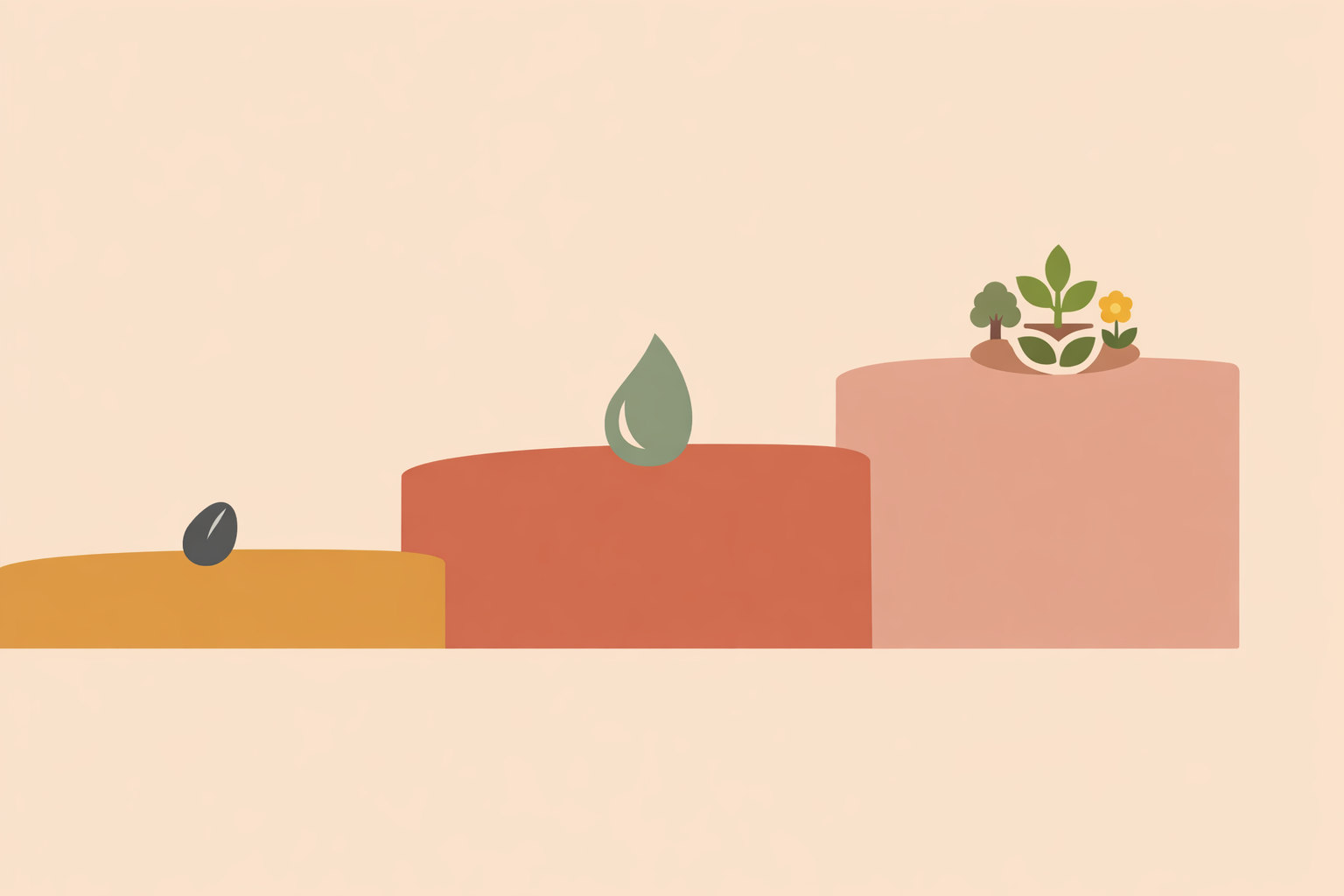
A solid 30–60–90 day plan gives you visible progress without overbuilding. It creates clearer decisions, steadier momentum, and records you can reuse. The flow is simple: start with ethics and a design brief, build a daily observation habit, map a usable baseline, let water shape the pattern, strengthen soil through modest closed loops, install small pilot guilds, then review and carry what you learned into the next cycle.
Key Takeaway: A strong 30–60–90 day permaculture start prioritizes observation and pattern-level decisions before installs, so water, access, and maintenance land in the right places. Build a usable baseline, design water-first concepts, strengthen soil with simple loops, test small guilds, and review what you learned to guide the next cycle.
Step 1 (Days 0–7): Start with ethics and a clear design brief
Begin by choosing your compass. In the first week, root the whole process in permaculture’s core ethics: Earth care, people care, and fair share. When ethics come first, technique becomes easier to place—layout, materials, access, and maintenance stop being abstract and start aligning with what the land and the people involved actually need.
Ethics guide placement because they steer you toward designs that work with natural relationships and reduce unnecessary effort over time. That’s also why a written brief is such a strong start: it gives the project clear aims, boundaries, constraints, and a simple way to check whether the work is heading in the right direction.
The spirit matters as much as the structure. As David Holmgren put it, “The greatest change we need to make is from consumption to production… in our own gardens,” a line that brings the work back to humility and participation. And Toby Hemenway’s reminder—“Permaculture gives us a toolkit for moving from a culture of fear and scarcity to one of love and abundance”—keeps the design oriented toward generosity, not just efficiency.
Ethics also ask us to honor lineages. Indigenous polycultures were cultivated in Eastern North America long before the word “permaculture” existed. Respecting that history means learning carefully, naming influences honestly, and avoiding the habit of presenting old knowledge as if it were newly discovered.
In client-facing work, ethics become practical immediately: clarity around purpose, boundaries, and consent with land stewards protects trust and keeps expectations realistic from day one.
Write a one-page design brief that includes:
- Who the design serves
- The main aims for the next 90 days
- Non-negotiable boundaries
- Time, budget, and labor realities
- What progress should look like at 30, 60, and 90 days
Step 2 (Days 0–30): Observe land, water, and people every day
In the first month, observation is the work. The goal isn’t to delay action—it’s to let action arise from pattern rather than impulse. Practitioners who settle into a site well usually do so by observing first and testing ideas on a small scale before expanding.
Yes, watch sun, shade, wind, water, and slope. But also watch the human layer, because people flows often decide whether a design feels easy to live with. Where do people naturally walk? Which route gets used in bad weather? Where do they pause without thinking?
Consistent beats occasional. Daily notes tend to reveal rhythms that a single long “site visit” can miss. And rainy-day puddles will teach you more about infiltration and flow than any dry-day guesswork.
Bill Mollison’s maxim, “Everything gardens,” fits perfectly here. The land is shaping the design—but so are routines, edges, animals, neighboring trees, and the way people already use the place.
A simple daily observation practice:
- Spend 10–15 minutes on site at two different times of day
- Note sun, shade, wind, standing water, and movement patterns
- Sketch quick symbols on a paper map
- Record one pattern and one question for tomorrow
Those notes become the raw material for everything that follows.
Step 3 (Days 7–30): Build a usable baseline map
By the end of the first month, your observations should become something you can actually design from: a simple base map, a few repeat photo points, and grounded site notes. It doesn’t need to be fancy. A hand-drawn map is often enough if it shows the right things clearly.
Mark boundaries, buildings, existing hard paths, large trees, taps, obvious slopes, and known access points. Then layer in what you’ve been noticing: wind direction, seasonal shade, noisy edges, wet spots, dry spots, and common walking routes.
Fixed-point photo monitoring is a quiet but powerful habit. Repeating the same angles over time makes change visible in an honest way—erosion, volunteer succession, growth, shade spread, and whether a trial bed is truly thriving or just “getting by.”
At this stage, simple soil checks are enough. Look, feel, compare. Think of it like learning the site’s current “accent”—you’re not writing a technical report; you’re getting fluent in what the land is asking for now.
As one familiar teaching line puts it, “Permaculture as a design system contains nothing new. It arranges what was always there in a different way.” Baseline mapping helps you see those relationships before you rush to add more elements.
Your baseline can include:
- A base map with fixed features
- Zones, sectors, and people-flow notes
- Two or three repeat photo points
- Simple notes on soil texture, moisture, and infiltration
Step 4 (Days 31–60): Design from patterns to details and let water lead
Once the baseline is clear, move into concept design. This is the time to shape the big relationships rather than fine-tune every detail. Draft two or three concept options that organize access, use frequency, shelter, and water movement.
Frequently used elements belong where they’re easy to reach; less-frequent features can sit farther out. This is basic zoning, but it remains one of the simplest ways to make a design genuinely livable—daily rhythms are either supported, or they become friction.
Most importantly, let water lead. Designing water first tends to make everything else easier to maintain. Roof catchments, runoff routes, puddling areas, infiltration zones, and safe overflow paths should be visible before you commit to major planting or path placement.
This matters even more now because climate conditions are already outside the comfort of averages. Put simply: variability belongs in the brief. That’s why perennial polycultures offer useful resilience lessons—layered structure, diversity, stronger soil relationships, and more buffering against weather swings.
Geoff Lawton’s line, “You can solve all the world’s problems in a garden,” lands best here as a design challenge rather than a slogan: even a small site can harvest water, soften heat, grow fertility, support pollinators, and create shared use when the patterns are coherent.
At this stage, do three things:
- Draft 2–3 concept maps rather than one “final” design
- Walk each concept physically on site
- Choose the clearest option and leave details flexible
Step 5 (Days 31–60): Build soil with modest, repeatable loops
As the concept design settles, turn toward soil. In permaculture, soil is not a side project—it’s the foundation for water holding, plant health, and long-term ease. The good news: improvement usually begins with simple, repeatable actions.
Healthy soil can often be improved with cover, compost, organic additions, and minimal disturbance. And better infiltration within a season is a realistic outcome when you add living cover and organic matter consistently. Here’s why that matters: water becomes an ally instead of a constant problem to manage.
Keep loops manageable. Simple cover-crop mixes often perform as well as more complex blends for beginners because they’re easier to understand and maintain. In real projects, the best system is the one that actually continues long enough to change the land.
Traditional land-based knowledge points in the same direction: build fertility from what is near, seasonal, available, and culturally appropriate. Leaves, prunings, kitchen scraps, straw, chop-and-drop biomass, and neighborhood organic materials all have a place when used with care.
“Instead of Pay It Forward I prefer Plant It Forward,” writes Howard Story. It’s a fitting line for this phase, because soil building works best as a rhythm, not a heroic event.
Choose one or two repeatable loops such as:
- Leaves to mulch
- Kitchen scraps to compost
- Prunings to path cover
- Living cover between seasonal plantings
Step 6 (Days 61–90): Install small guilds and pilot beds
Only now is it time to install. By this point, you understand water, access, soil condition, and use patterns well enough that early plantings teach rather than trap you.
Start with a few small pilot beds near daily-use areas. They’re easier to observe, easier to maintain, and more likely to generate steady feedback—especially when life gets busy.
Guilds are useful here because they train the eye to see relationships instead of isolated plants. A guild gathers plants with complementary functions around a central element: groundcover, insect support, nutrient cycling, mulch production, shade, root diversity, and harvest.
Compatible species and varied root depths can improve productivity and stability. At the same time, simpler mixes can match or outperform more complex ones when time and management capacity are limited. Essentially, cooperation and fit matter more than piling on variety.
Many practitioners use early beds to generate biomass, cover, mulch, and insect support first, then shift toward more food-focused guilds as soil deepens and the system settles. This staged approach often creates better long-term outcomes than trying to build a “finished” abundance garden all at once.
And again, the design spirit is worth remembering: “It arranges what was always there in a different way.” Good guilds often come from recombining familiar species into more supportive patterns.
For your first pilots:
- Install 1–3 small beds in easy-to-observe locations
- Choose an anchor plant for each bed
- Add 2–4 support species with clear functions
- Keep a short weekly “tend and learn” routine
Step 7 (Days 61–90): Review, document, and prepare the next cycle
The final phase isn’t about declaring the design “done.” It’s about closing the loop well, so the next loop begins with more intelligence. That’s the gift of a 30–60–90 cadence: it turns inspiration into something grounded, visible, and repeatable.
Simple monitoring is usually enough. Repeat photos, short seasonal notes, and a few chosen indicators can tell you more than elaborate dashboards—because they keep you honest about what’s actually changing.
Useful indicators might include:
- How quickly water infiltrates in a trial area
- Mulch persistence
- Weed pressure in pilot beds
- Plant vigor and survival
- Pollinator activity or general insect presence
At the 60–90 day review, ask: What worked? What created friction? What surprised you? What is the next smallest useful move?
If you’re building a professional path, this is also the moment to turn notes into a case study. Clear documentation supports client communication and keeps learning repeatable. A public record of choices, photos, maps, and reflections becomes part of an evolving body of work.
Conclusion
A strong 30–60–90 day permaculture design plan is less a checklist than a cadence. It starts with ethics and intention, deepens through observation, becomes visible through mapping, takes shape through water-first patterning, gains strength through simple soil loops, and comes alive in modest pilot plantings. Each phase supports the next, and rushing any phase usually creates downstream friction.
It also helps to hold two commitments at once: honor traditional lineages, local knowledge, and the lived intelligence of place—and stay evidence-informed where outside research genuinely clarifies a claim. The blend is often where the most resilient practice grows.
Ninety days is enough time to move from inspiration to a living, grounded roadmap that can keep evolving season after season. The main caution is simple: avoid locking in major paths, water decisions, or high-maintenance plantings before you’ve truly seen the site through different weather and daily use. What matters most isn’t how much you install—it’s how well you learn.
Build Better Permaculture Designs
Apply this 30–60–90 cadence with the Permaculture Design Course for clearer briefs, mapping, and water-first decisions.
Explore Permaculture Design Course →