


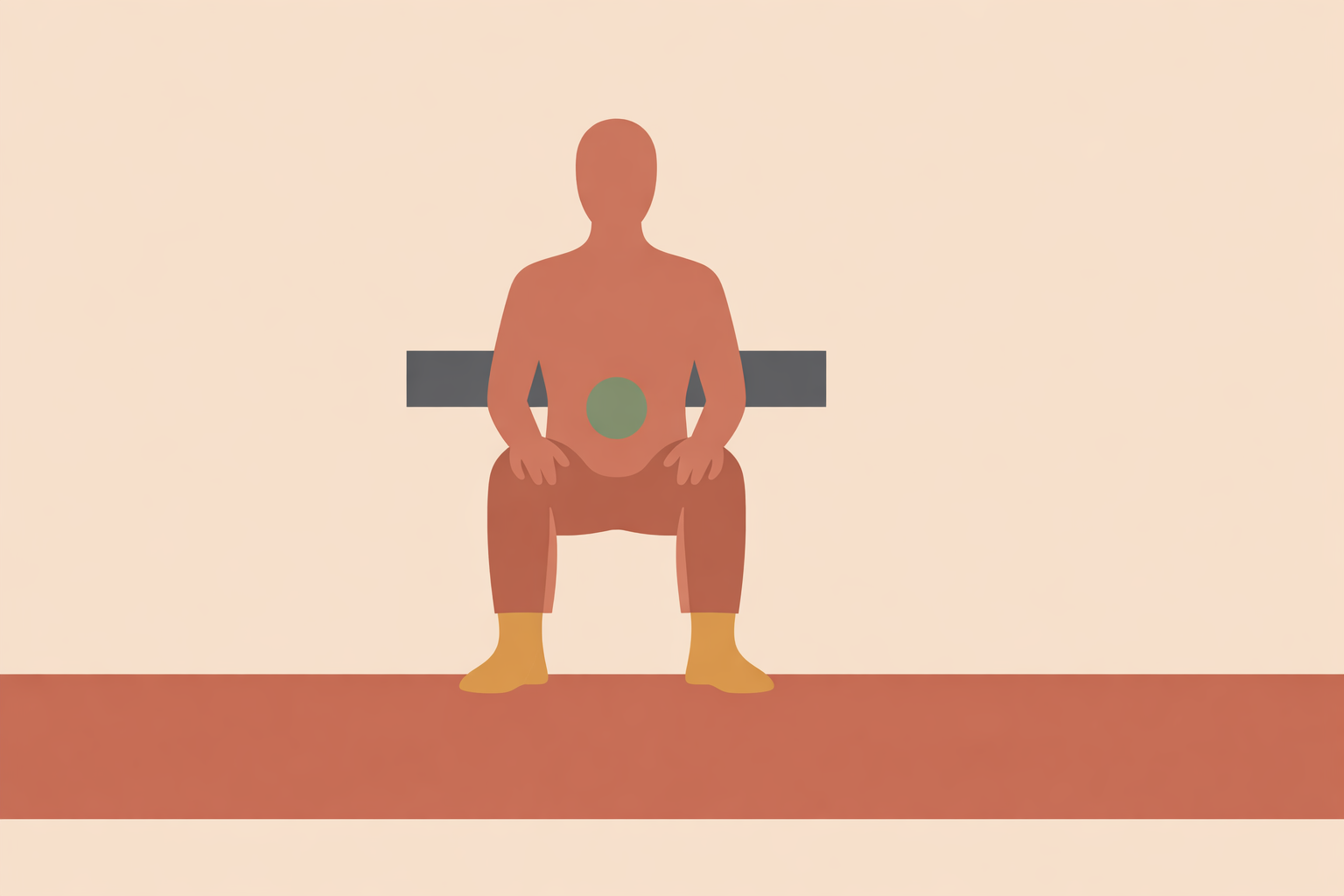
People-pleasing often shows up as speed: someone agrees before their body has caught up. Attention narrows onto the other person’s reaction, urgency rises, and the boundary phrase arrives a beat too late. In live requests, the fawn response can be automatic, driven by the body more than careful thought.
In that moment, long explanations rarely help. What tends to help is something small, quiet, and usable: a breath, a point of contact, an orientation cue, a delay line, a subtle movement. These practices don’t need to be perfect; they only need to lower urgency enough for choice to come back online.
Key Takeaway: When people-pleasing spikes in real time, body-first grounding can lower urgency long enough to restore choice. Small, repeatable tools—like a longer exhale, firm contact with support, sensory orientation, factual self-talk, and gentle movement—pair well with respectful delay or boundary phrases.
2. Use Contact and Pressure to Feel “I Am Here” Before Responding
If someone is pulled into monitoring the other person, contact brings them back into themselves. Feet on the floor, hands on thighs, back against the chair—simple ways to feel where the body ends and the room begins.
That kind of grounding can buy time before a knee-jerk yes. Firm, steady contact often gives just enough steadiness to notice, “Do I actually have capacity for this?”
In a people-pleasing state, awareness often shifts away from internal signals and toward reading the room—facial expressions, tone, tiny changes in mood. A clear contact point interrupts that drift. It can be as plain as pressing heels down or feeling the chair supporting the back.
Steady pressure can also help when it feels comforting rather than overwhelming. Some people respond well to a folded blanket on the lap, a hand over the chest, or the weight of their own palms pressing into their thighs. The goal isn’t intensity; it’s tolerable, organizing input.
“Trauma victims cannot recover until they become familiar with and befriend the sensations in their bodies…”
- Feet: Press both feet into the floor and notice the support coming back up.
- Hands: Rest palms on thighs or press fingertips together under the table.
- Back: Lean into the chair and feel its shape.
- Boundary pairing: “I’m here. I can answer later.”
3. Use Sensory Orientation to Shift Attention Out of Other People’s Reactions
Orientation works because it gives attention somewhere else to go. Instead of staying locked on the other person’s face, the mind returns to the room—and the body often settles with it.
For many people-pleasers, the strain isn’t only the quick yes. It’s the over-monitoring before and after: reading micro-reactions, predicting disappointment, rehearsing fallout. Turning toward the environment can lighten that load quickly.
A classic option is 5-4-3-2-1: notice five things you see, four things you feel, three things you hear, two things you smell, and one thing you taste. In a live request, a shorter version is often more realistic: three things you see, two things you hear, and one point of contact.
Orienting to the present environment can calm the body and support steadier choice. For people-pleasers in particular, shifting attention off the other person’s face and back into the room often reduces urgency.
“Healing from trauma can also mean strength and joy…”
- Mini version: “Three colors I see. Two sounds I hear. One place my body meets support.”
- Best target: Neutral details, not charged ones.
- Next step: After orienting, use a delay phrase instead of answering immediately.
4. Use Factual Self-Talk and Delay Lines to Restore Options
Once the body is steadier, simple language helps. Not affirmations. Not forced positivity. Just facts that remind the system it has options.
Short orientation statements can be surprisingly regulating: “I’m in my office.” “It’s Tuesday.” “I can pause.” Think of them like signposts that bring you back to the present and out of the urgency spiral.
People-pleasing often runs on fear of criticism, disapproval, or losing connection. That’s why delay lines matter so much. A sentence designed to buy time can interrupt the appease-now impulse before it turns into another unwanted commitment.
Useful phrases are usually short, respectful, and repeatable:
- Orientation trio: “I’m here. It’s today. I can pause.”
- Delay line: “I don’t have to answer yet.”
- Practical response: “Let me check what’s realistic and come back to you.”
- Clarifying line: “What timeline are you working with?”
These scripts matter because reflexive yeses rarely reflect true capacity. A respectful pause protects honesty and helps relationships stay cleaner over time.
“No recovery from trauma is possible without attending to issues of safety, care for the self, reparative connections…”
5. Use Gentle Movement When Fawn and Freeze Blend Together
Sometimes breath and words aren’t available because the body has gone too still. In those moments, a small movement can help restore agency.
Movement has long been part of grounding in traditional practice: walking, swaying, stretching, shaking out the hands, changing posture. These are ordinary, time-tested ways of coming back into contact with oneself.
Small, respectful movements can discharge stress energy and restore a felt sense of choice—especially when someone looks agreeable on the outside but feels flooded on the inside. It can be as subtle as uncrossing the legs, rolling the shoulders, widening the chest, or standing up to get water.
For some people, movement works especially well when people-pleasing is mixed with shutdown. The shift doesn’t need to be dramatic; even turning the body slightly can make the moment feel less trapped.
“Healing takes courage, and we all have courage, even if we have to dig a little to find it.”
- Standing reset: Feel both feet, lengthen the spine, soften the jaw.
- Seated reset: Press knees outward gently and widen your view of the room.
- Walking bridge: “I’m going to grab some water and then respond.”
- Practice principle: Pair movement with a boundary phrase so the body learns choice under pressure.
A Simple Sequence for Coaching People-Pleasing in the Moment
When these tools are taught together, they create a clean, repeatable flow that people can actually use when pressure is on:
- Regulate: Use breath, contact, orientation, or movement.
- Pause: Name the present moment in simple language.
- Check: Ask, “Do I have capacity?” and “Am I actually willing?”
- Communicate: Use a respectful delay or boundary phrase.
- Repair inwardly: If guilt rises, meet it with steadiness rather than self-criticism.
Boundaries are practiced skills, not fixed traits. Starting small matters: time limits, scope limits, and delayed responses are often the best first steps—especially when a fawn pattern developed around real past risk.
Above all, it helps to hold a kinder frame. People-pleasing isn’t a personal defect; it’s often a protective pattern shaped by experience, and protective patterns can be updated with practice, support, and repetition.
“Healing is not about forgetting; it’s about embracing our scars.”
To keep this work ethical and grounded, offer choice and avoid pressure. Be thoughtful with touch-based suggestions, and respect the cultural roots of any ancestral practices you draw from. Let the person’s lived experience set the pace in a trauma-informed coaching container.
Train Trauma-Informed Coaching Skills
Trauma healing coach certification helps you apply grounding, boundaries, and consent-based pacing in real client moments.
Explore Trauma healing coach certification →










