


Process-focused coaching often hits familiar snags: a client senses change but can’t name it, conversation loops faster than insight, a tender moment tips toward overwhelm, or a “vision” never becomes behavior. What helps is a structure that can hold real experience without rushing it—something clear enough to guide a 50-minute session, yet flexible enough to fit different goals and personalities.
The seven prompts below do exactly that. They make inner material visible, invite meaning-making, and connect what emerges to practical next steps. Used as a sequence, they create a steady arc for both one-to-one and group settings.
Key Takeaway: A simple, repeatable prompt sequence helps clients externalize identity, emotions, and inner dialogue, then translate insights into boundaries, resources, and concrete next steps. By pacing creative exploration inside clear agreements, coaches can support meaning-making without overwhelm and reliably move sessions from “felt sense” to behavior change.
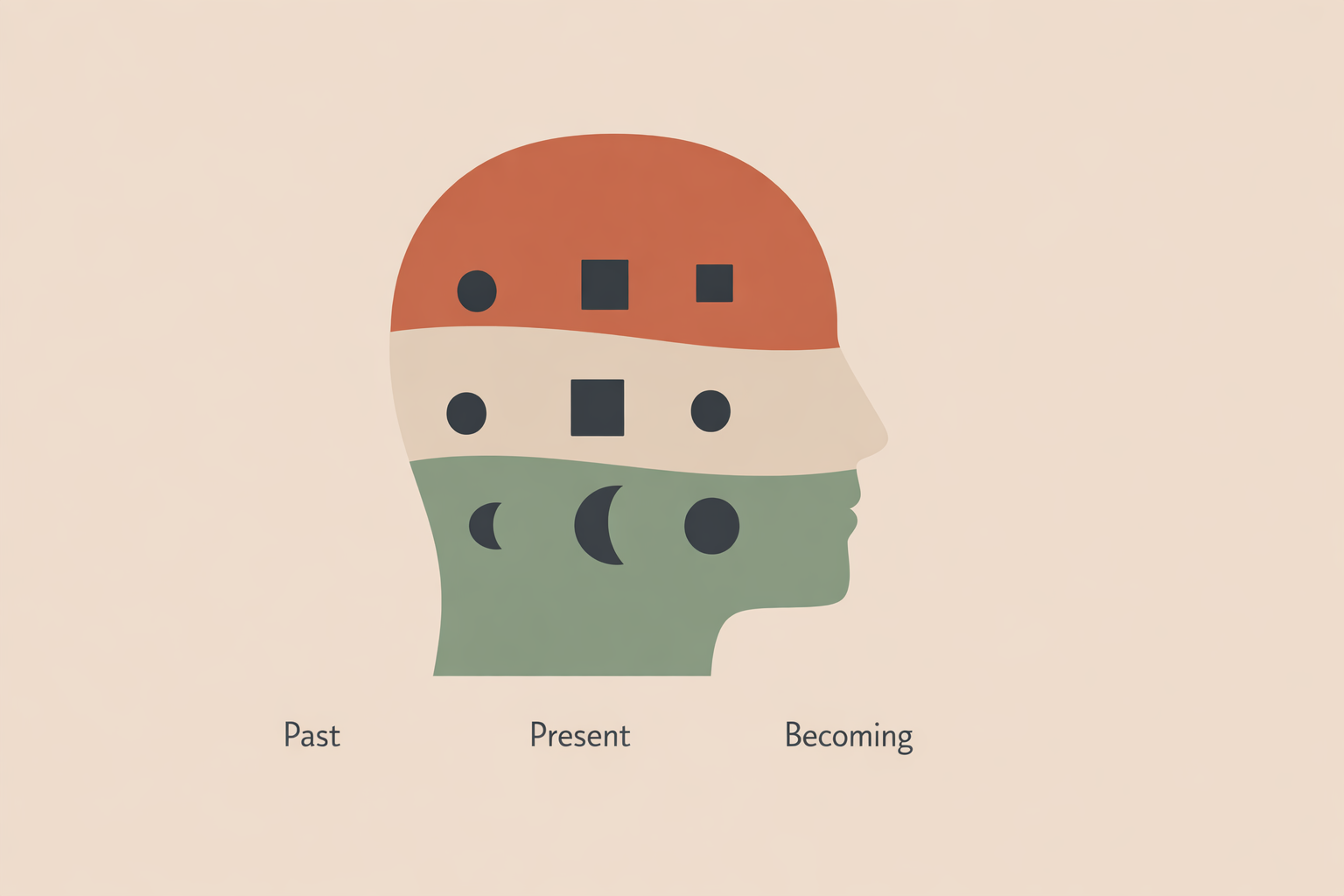
Prompt 1 – Identity Maps in Color: Making Past–Present–Becoming Visible
Identity mapping gives clients a way to see identity in motion—who they’ve been, who they are now, and who they’re becoming. Once that’s on the page, direction feels less abstract, because it’s no longer trapped in the head.
In expressive arts coaching, the goal isn’t a polished result; it’s a form sturdy enough to hold meaning. Naturalistico frames this as coaching supported by creative expression—a practical blend that helps clients make sense of experience and move forward.
Invite clients to build a page with colors, symbols, words, or torn images for roles, values, longings, and tensions. As pieces land, implicit material surfaces—think of it like developing a photo in a darkroom. Identity drawings can also express hard-to-word experiences that talk alone often can’t catch.
That visibility often brings relief. Putting a transition into an image can create psychological distance—enough space to reorganize what felt tangled and close.
This practice also sits in an older human lineage. Across cultures, symbols and pattern-making have long supported life passages and social roles, as seen in traditional story practices. Modern coaching simply offers a clear container for that timeless instinct.
Creative approaches can encourage open self-expression; art-making can express emotions without words and, in supportive contexts, can be linked with less stress. In coaching, that means the map becomes less about “explaining your past” and more about choosing your becoming.
A useful prompt sounds like this:
- “Create a page that shows who you have been, who you are now, and who you are becoming.”
- “Use colors for values, symbols for roles, and images for what is calling you forward.”
- “When you look at the finished map, what wants more space in your life?”
Once identity is visible, the next layer—today’s emotional “weather”—becomes easier to approach.
Prompt 2 – Emotion Landscapes: Turning Feelings into Safe, Shareable Images
Emotion landscapes help clients name what they feel without having to relive the whole story. In art therapy research, landscapes have supported people to explore feelings through imagery without detailed retelling.
Invite the client to draw their inner weather with color fields, lines, textures, or shapes. A trauma-focused paper notes that metaphorical landscapes can support deep processing with less overwhelm than direct recollection.
Here’s why that matters: steadiness comes from pacing and choice, not intensity. Naturalistico’s safety guidance aligns with approaches that use present-focused grounding, and this kind of prompt can settle a session because the client stays with what’s here now.
Art-making can open emotional exploration when words aren’t possible, and even brief creative practice is often associated with stress reduction. The image gives the feeling a shape before explanations rush in.
Traditional communities have long used color and motif to communicate shared states—grief, celebration, transition—reflected in symbolic community arts. “Emotion landscapes” is contemporary language for a very old human skill.
A strong coaching invitation might be:
- “If today’s feelings were a landscape, what would it look like?”
- “Where is there pressure, movement, stillness, warmth, or fog?”
- “What does this landscape need more of right now—space, support, softness, structure?”
Once emotions are visible without taking over, clients are ready to meet the voices commenting on those emotions.
Prompt 3 – Inner Critic vs Inner Ally: Rewriting the Inner Conversation
This prompt helps clients step back from harsh inner commentary and strengthen a steadier, kinder voice. Identifying and dialoguing with an “inner critic” creates distance, and turning the problem into a character can increase agency.
Ask the client to create two figures—symbols, masks, abstract shapes—one for the inner critic and one for the inner ally. Then let each “speak” on paper. Many inner-work models understand self-critical parts as protective subpersonalities trying to prevent shame or failure. Essentially, the critic is often trying to help—just with an outdated strategy.
Naturalistico captures the spirit of this beautifully: “Creative expression can unlock deeper levels of understanding and emotional healing,” the editorial team writes.
Trauma-informed principles emphasize respect and non-pathologizing—guidance echoed in care principles. Instead of trying to silence the critic, the work becomes: what is it protecting, and what support would help the client feel safe enough to act differently?
Adding writing often deepens integration. Research links expressive writing with deeper processing, and structured reflection can increase meaning-making. The art opens the door; the dialogue helps the client walk through it.
This, too, has traditional echoes—storytelling and mask traditions that personify inner roles through ancestral forms and rituals. The approach is modern in format, old in wisdom.
Try prompts such as:
- “What does your inner critic look like, and what job does it think it has?”
- “What would your inner ally say back—not to argue, but to steady you?”
- “Which voice do you want to practice trusting this week?”
With the inner conversation clearer, it becomes easier to imagine a future self led by values rather than self-doubt.
Prompt 4 – Future Self Vision Board: From Vague Dream to Embodied Direction
A vision board makes hope visible and easy to revisit. Studies on visual goal representation suggest that pictorial goal cues support pursuit more than words alone. Put simply: when a direction has shape, it’s easier to follow.
At this stage, the board isn’t about fantasy. It’s a grounded question: “What does an aligned life look and feel like for me?” Images answer before the mind edits them into what seems “reasonable.”
Naturalistico notes the value of ongoing creative practices, and vision boards work best when they’re revisited and linked to action. Collage work can strengthen commitment to chosen goals, often by revealing patterns the client didn’t realize were consistent.
As Naturalistico explains, “By incorporating various forms of art—painting, drawing, music, and writing—into coaching sessions, clients are able to express their emotions and insights in ways that traditional talk therapy may not allow,” the editorial team writes.
It also helps when the board becomes part of the client’s environment. Research suggests visual cues support intended behavior, which is why the board should be seen regularly, not tucked away.
There’s ancestral depth here as well: communities have long placed symbols and objects in shared spaces to seed the future, reflected in communal visioning practices. A future image isn’t just wishful—it’s a declaration of direction.
To make it practical, ask:
- “Build a collage of the life you are growing toward, not the life you think you ‘should’ want.”
- “Circle three images that feel most alive.”
- “What is one action this future self would take in the next seven days?”
When direction sharpens, clients often notice what needs to shift around them—especially in relationships.
Prompt 5 – Boundary Constellations: Mapping Relationships, Needs, and Choice
Boundary constellations turn relational complexity into something you can literally see. Research on spatial “sculpting” suggests space makes dynamics visible, and family sculpting has long shown that position reveals patterns words can blur.
Invite clients to choose simple tokens—stones, paper slips, shells—to represent people, roles, commitments, and even parts of themselves. Then place them in relation. Who feels too close? Too far? What feels draining, supportive, hidden, or central?
Because the situation is outside the client, they gain a fresh vantage point. They can experiment without committing: move a token back, add a missing support, rotate an obligation, remove an unnecessary role. Constellation research notes this can surface new perspectives quickly, and the here-and-now attention can also have a calming effect.
For groups, clear agreements are essential. Naturalistico emphasizes confidentiality, consent, and the right to pass, along with not interpreting someone else’s work for them. Trauma-aware frameworks similarly emphasize choice and autonomy.
And again, this is not new. Many communities have long used circles, seating patterns, and spatial ritual to represent kinship and belonging, reflected in traditional community rituals.
You might guide the exercise like this:
- “Place yourself in the constellation first.”
- “Now add the people, roles, or obligations that shape your week.”
- “Which arrangement feels true? Which one feels nourishing?”
- “What boundary, request, or choice does this layout make visible?”
After boundary work, clients often feel clearer—and a little tender. The next prompt turns deliberately toward support and strength.
Prompt 6 – Resilience Trees and Resource Altars: Anchoring Strengths and Support
Resilience trees and resource altars help clients reconnect with what already holds them up: strengths, relationships, practices, and lineage. Narrative “tree of life” practices have been shown to connect strengths and cultural roots with supportive relationships.
When the focus stays only on challenges, clients can start to feel like problems to be solved. Strengths-based work suggests that focusing on resources reduces “problem” identity. A resilience tree can include roots (values/ancestry), a trunk (current strengths), branches (hopes), and fruits/leaves (supportive people and practices). A resource altar gathers images, objects, words, and symbols of belonging and courage.
Naturalistico highlights these kinds of strength anchors. Positive psychology suggests that attending to strengths can support resilience, and once resources are visible, action can feel more possible.
There’s also a grounding quality in making. Brief art-making has been linked with lower cortisol and relaxation. Even without measuring anything, many clients feel it directly: hands engaged, breath steadier, attention gathered.
Trauma-informed approaches emphasize resourcing and stabilization before going deeper. For many people, resourcing includes cultural memory and ancestry—trees, bundles, and altars that appear across traditions as focal points for remembrance and courage, echoed in communal grounding practices. The respectful stance is key: invite clients toward what is genuinely theirs, supported by cultural humility.
Useful prompts include:
- “What are the roots that hold you?”
- “Who, what, or where helps you remember your strength?”
- “What symbol belongs in this piece as a reminder of support you can actually use this week?”
With support clearly pictured, integration becomes much easier—pulling everything into one coherent story.
Prompt 7 – Story Weaving: Integrating Insights into a Coherent Life Narrative
Story weaving turns separate exercises into one meaningful whole. Narrative work suggests coherent storytelling can increase readiness for change, and coaching research links integration and planning with greater behavior change.
The format can be simple: a mini-zine, a folded booklet, a set of cards, or a mixed-media “journey map.” The essential move is revisiting earlier pieces and asking, “What story are these making together?” Naturalistico describes this kind of integration as consolidated insight—not just symbolism, but something the client can live from.
That matters because narrative shapes behavior. When clients craft a story that positions them as an active participant, research connects this with more agentic identities. Essentially, the story shifts from “life happens to me” toward “I can choose my next step.”
Naturalistico recommends a clear arc of grounding, exploration, integration, and forward planning, and story weaving is where that arc lands. It also fits the learning rhythm reflected in trauma-aware experiential frameworks: what happened, so what does it mean, now what will I do.
This closing step sits inside a long tradition. Story circles, song, carving, and communal textile work have helped people weave experience into guidance for generations, reflected in ancestral story traditions.
To close the sequence, ask:
- “What themes repeat across your artworks?”
- “What story about yourself are you leaving behind?”
- “What story are you choosing now?”
- “What is one concrete step that makes this new story real?”
Conclusion: From Creative Moments to Real Client Growth
These seven prompts work best as a sequence—not as a rigid script, but as a steady progression from identity to emotion, from inner dialogue to vision, from boundaries to resources, and finally to integration. Even without a single study on this exact set, the supporting evidence across identity mapping, visual goal cues, externalization, and narrative work points to a reliable outcome: creative insight becomes easier to translate into real-world action.
The container matters as much as the prompt. Naturalistico emphasizes clear scope and consent, respectful handling of client creations, and explicit agreements about how creative work is shared and used. Broader frameworks reinforce the same foundations of safety, choice, and collaboration.
Cultural respect belongs here too. When symbols, ancestry, or ritual forms enter the space, the aim is never to “borrow what looks meaningful,” but to support clients in reconnecting with what is truly theirs—or what they approach with context, permission, and humility.
With practice, these prompts become less like a worksheet and more like a responsive language you can speak with any client: steady, respectful, and genuinely useful.
Train as an Art Life Coach
Apply these prompts ethically and effectively with the Art Life Coach Certification.
Explore Art Life Coach →










