Every practitioner eventually meets the sensitive client who tenses the moment hands approach the eyes, swallows when the throat is in focus, or subtly guards the chest and lower belly. Some can’t settle lying flat; others want to keep their eyes open or instinctively pull back when touch feels too close. In those moments, the question isn’t whether you’re doing “real” Reiki when you adapt—it’s whether you’re listening well.
Usui-style practice has always included on-body, off-body, and distance attention. The craft is choosing the right dose, placement, and rhythm for the person in front of you. For sensitive, trauma-aware, or perinatal clients, small shifts can turn a session that feels like “too much” into one that’s deeply settling.
Key Takeaway: Adapting Reiki for sensitive clients is less about changing the practice and more about refining delivery—using indirect placements, optional touch, and flexible positioning to protect comfort and agency. When you soften intensity through pacing and placement, Reiki often becomes easier to receive and more settling.
1. Keep Head Work Gentle and Leave the Face Open
One of the simplest ways to soften a session is to stop covering the face. Direct hand contact over the eyes and forehead can feel intense for many people. For those with anxiety or a heightened startle response, that intensity can spike quickly. Many highly sensitive clients settle faster when the face stays open, spacious, and visible.
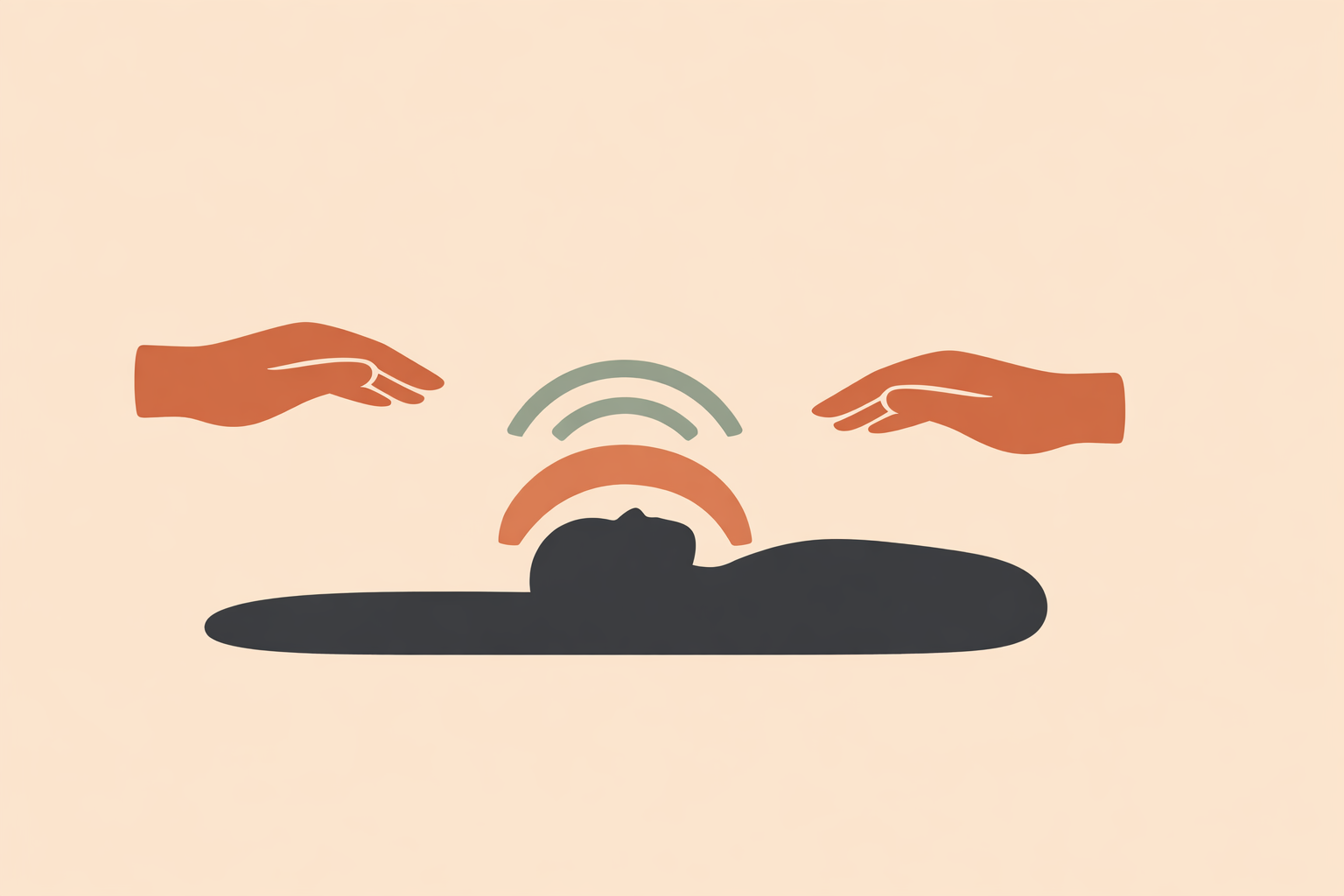
This isn’t a departure from tradition. Reiki can be offered with the hands lightly on the body or just above it, so hovering near the head fits comfortably within the method. What matters most is steady presence—not forcing a placement when the system is already bracing.
“After my first Reiki session, I felt like I had taken a deep, restorative nap... My mind felt clearer and the constant buzzing anxiety... was just…quiet,” shares one client experience.
That “rested mind” quality often arrives more easily when the eyes aren’t covered and the forehead is approached with a lighter touch or no touch at all.
Practical options for the head
- Hover a few inches above the crown, temples, and forehead.
- Cradle the back of the head or hold at the occiput while keeping the face untouched.
- Work from the shoulders while allowing the head to receive indirectly.
- Ask simply: “Would you prefer no touch around your face today?”
2. Support the Throat Without Touching the Neck
The throat is often more vulnerable than it looks. Many sensitive clients feel exposed when someone touches the throat or neck area. When that region carries tension, an indirect approach is usually more settling than direct contact.
In Reiki practice, throat support can be offered through the upper sternum, the back of the neck, the upper back, or a gentle hover. When the area is approached with spaciousness rather than pressure, many clients find their breath and voice soften naturally.
Choice is a powerful stabilizer. Trauma-informed guidance emphasizes control and choice as core supports for helping the system settle. In Reiki, that can be as simple as naming options and letting the client steer.
“Through the Reiki training, I not only learned that I am a wonderful channel for the universe, but I am loved by the universe – and that I should love myself.”
Practical options for the throat
- Place hands over the upper sternum instead of the throat.
- Hover above the throat without direct neck touch.
- Support from behind at the upper back and base of the skull.
- Invite self-placement: “Would you like to place your own hand there while I support from behind?”
3. Work with the Heart Centre Without Chest or Breast Contact
Heart-centred work doesn’t require direct contact with the chest. In many settings—especially perinatal and caregiving spaces—practitioners naturally choose the upper sternum, shoulders, or the space between the shoulder blades instead of the centre of the chest. The connection stays warm and present, while boundaries and modesty are clearly respected.
Many clients experience above-body Reiki as gentler and less intrusive around intimate areas. Hovering over the heart field—or inviting self-contact while you hold the surrounding space—often keeps the intention clear while making the experience feel safer and more spacious.
Because Reiki sessions may be offered with hands on or slightly above the body, these shifts are simple, respectful, and well within the practice.
“Life changing! Amazing! I felt a connection to something I have never felt before,” shares one client praise.
That sense of connection is often easiest to access when boundaries are honored without debate or over-explaining.
Practical options for the heart
- Work over the upper sternum rather than the centre of the chest.
- Place attention between the shoulder blades for back-body heart support.
- Hover at the edge of the chest field.
- Invite the client to place their own hands over the heart while you support from above or behind.
4. Ground Through the Hips, Sacrum, Legs, and Feet
If the lower abdomen or pelvis feels too activating, grounding can still be supported beautifully without going there directly. Shifting attention to the hips, sacrum, low back, legs, and feet often brings steadiness without the intensity that front-body pelvic work can carry.
The lower abdomen and pelvis can carry a strong charge for sensitive or trauma-aware clients. By contrast, many people feel safest when attention flows down through the feet, legs, hips, and sacrum. Think of it like widening the base of a lamp: stability increases when the foundation is strong.
In perinatal settings, extra care is often taken around the abdomen and torso, with more indirect support through adjacent areas. That same respectful pathway serves a wide range of sensitive clients.
As one member quote reflects, grounding attention can help release stuckness—and that often starts from the back body down through the legs.
Practical options for grounding
- Hold at the sacrum and low back while leaving the front pelvis untouched.
- Spend more time at the knees, ankles, and feet.
- Work along the sides of the hips to connect upper and lower body gently.
- Close the session at the soles of the feet to reinforce steadiness.
5. Use Shorter Holds and a Softer Rhythm
For highly sensitive clients, pacing matters as much as hand positions. Shorter holds, micro-movements, and a lighter pace help the nervous system stay present and receptive. Rather than waiting until intensity builds, it’s often kinder—and more skillful—to move on sooner.
A familiar sequence can still be followed, but the rhythm doesn’t need to be fixed. “Gentle” doesn’t always mean “long.” Sometimes it’s created through brevity, clean transitions, and small pauses that let the system integrate within a more repeatable session arc.
“I left with a beautiful sense of peace, joy and contentment which lasted me the rest of the day.”
Ways to soften the rhythm
- Try shorter holds before moving to the next area.
- Use micro-movements rather than static pressure.
- Pause between placements for a breath or two.
- Offer pacing choices: “Would you like a gentler, quicker rhythm today?”
6. Blend Touch and No-Touch Without Breaking the Flow
Some of the most elegant sessions blend light touch in neutral areas with hovering elsewhere. This widens choice without interrupting flow, and it often deepens trust—especially when you approach sensitive zones with extra spaciousness.
Clients commonly experience above-body Reiki as softer and less intrusive while still feeling clearly “held” in the process. In perinatal contexts, hovering around the abdomen and torso is often used to prioritize comfort and modesty, and that same sensitivity translates well to many other settings.
Reiki is often described as low-risk, which supports its role as a gentle well-being practice. Within that light-touch framework, thoughtful contact choices matter: not every area needs touch, and not every person wants the same level of closeness.
As Chyna Honey reminds us, “Relaxation is key... it initiates our natural and innate healing abilities,” a sentiment many practitioners echo about Reiki’s core gift.
How to make hovering feel intentional
- Explain transitions clearly: “I’m going to hover here rather than place my hands directly.”
- Keep one hand in a neutral anchor point, such as the shoulder or forearm, if welcome.
- Use off-body work consistently rather than apologetically.
- Invite feedback if any area feels too active or too close.
7. Offer Seated, Side-Lying, and Supported Positions
Positioning changes everything. Seated, side-lying, and well-supported setups can help sensitive clients feel less trapped and more in charge than lying-flat arrangements.
Agency, predictability, and choice of position align closely with trauma-informed guidance. When clients know they can keep their eyes open, adjust a blanket, or shift position mid-session, their system often settles more—not less.
Put simply: the more freedom a body feels, the more easily it can soften.
As one practitioner note puts it about sensitivity, the art is in regulating the flow to match the client—human or animal—so the energy never overwhelms.
Useful setup options
- Seated with foot support for clients who dislike lying down.
- Side-lying with pillows for those who need more comfort or spaciousness.
- Reclined with bolsters under the knees for extra support.
- Open permission to adjust clothing, blankets, or position at any time.
Bringing the Seven Tweaks Into One Coherent Practice
All seven tweaks point to the same kind of mastery: responsive presence rather than rigid repetition. Hovering instead of touching, shortening a hold, skipping the face, or choosing the feet over the lower belly doesn’t dilute Reiki—it often helps it land.
When the practitioner refines the session to fit the client (not the other way around), the result is usually steadier, kinder, and more effective for restoring ease and awareness. Sensitive clients rarely need “less” support; they need it delivered with more precision, more listening, and more room to choose.
Master Sensitive Reiki Sessions
Deepen these adaptations with the Reiki Master Certification for more confident, client-responsive session structure.
Explore Reiki Master →