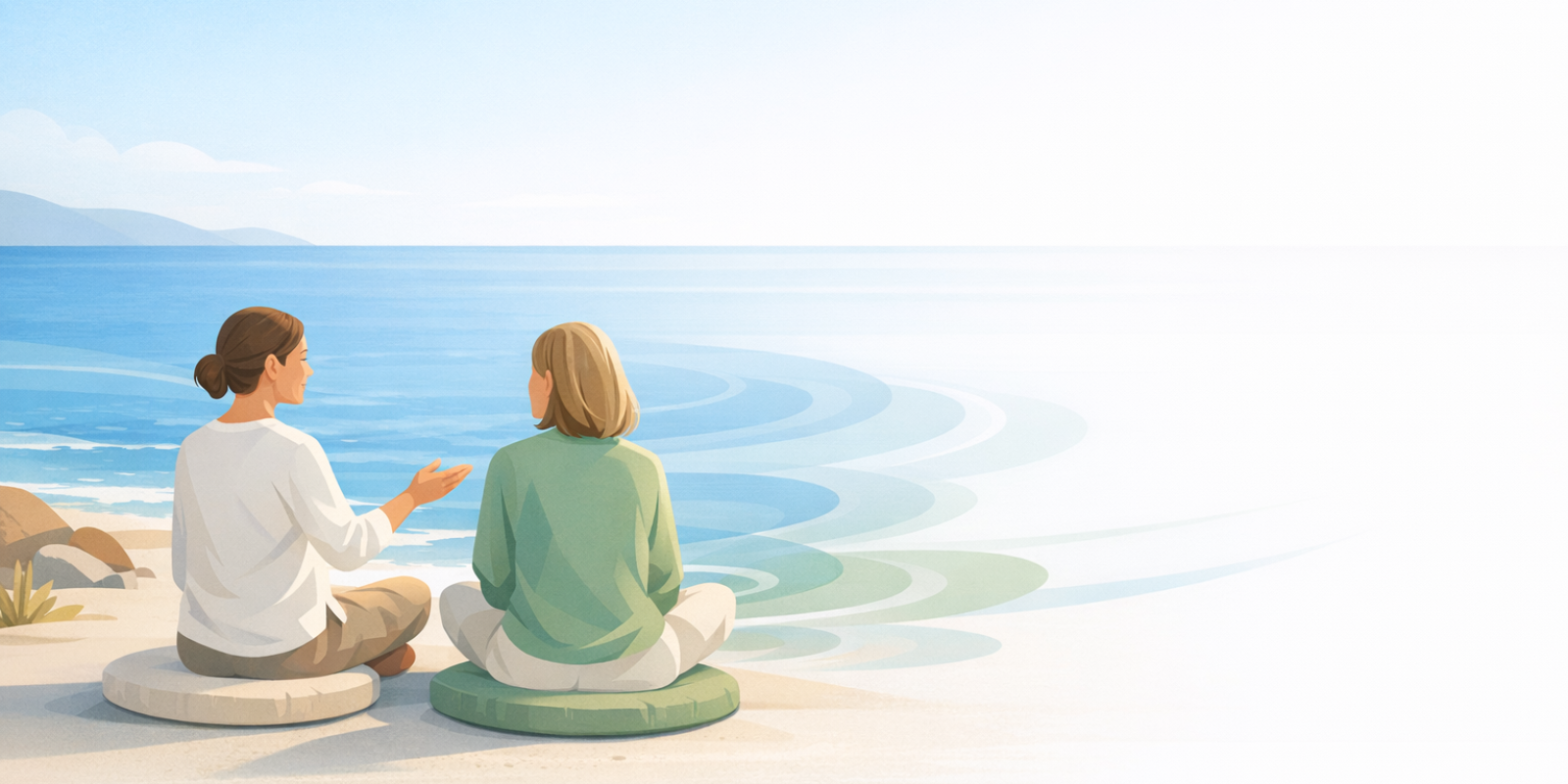
For many anxious first-timers, the shoreline can feel both beautiful and intense. The most supportive approach is to meet the ocean in stages—honoring traditional water wisdom and weaving in Blue Mind insights—so the coast becomes a steady ally rather than a sensory overload.
Across cultures, people have long turned to water for clarity, calm, and renewal. It’s no surprise that communities have flourished near water, and that simply being close to rivers, lakes, or ocean edges is linked with reduced stress. The Ocean Conservation Trust also highlights that simple coastal activities can support well-being—about two-thirds of participants reported improvement, and 94% said ocean interaction mattered to them.
As marine biologist Wallace J. Nichols puts it, “According to current research in cognitive neuroscience (which now echoes much historical wisdom), when you spend time around water, what happens is very good indeed.”
That’s the spirit behind these seven sessions: start well back from the waves, build trust with breath and sensory anchors, and only move closer when the client’s system says “yes.” For continuity, Blue Mind educators often recommend a daily “Bluescription” of about 23 minutes in, on, or near water.
Key Takeaway: The most effective ocean-based sessions for anxious first-timers prioritize pacing and consent: begin at a comfortable distance, use breath and sensory anchors to build regulation, and only add closer contact when the client’s nervous system signals readiness—turning the shoreline into a steady, repeatable resource.
Session 1: Grounded Blue Mind Orientation at a Safe Distance
Begin well away from the waterline—on a bench, dune, or promenade—so the client can see and hear the sea without feeling swamped by it. A calm, choice-led start tells the nervous system: nothing is being forced here.
Why it works: simply being near water is associated with steadier mood and lower stress. Think of this as introducing the ocean like you’d introduce any powerful ally—slowly, respectfully, and with clear boundaries.
Why beginning away from the waves soothes the system
Open views can soften the fight-or-flight response. Even brief exposure to blue spaces is linked with feeling better, and some explainers describe calmer brainwave patterns when people see or hear moving water.
Micro-structure for Session 1
- Opening script: “Let’s find a spot where you feel steady. You set the pace; I’ll slow everything down with you.”
- Choice menu: sit, stand, or lean; eyes open or softened; listen first, then look.
- Two-minute scan: horizon line, edges of land, sky; name three sounds and two colors.
- Consent check: “Would you like to stay here today, or try a few steps closer?”
Session 2: Slow Barefoot Shoreline Walk as a Blue Sensory Practice
When distance feels safe, invite a slow walk along firm sand near—but not in—the wave reach. The goal is simple: move attention from spiraling thoughts into the steady “now” of sound, light, and texture.
In community projects, straightforward coastal time like walking has supported well-being, with about two-thirds of participants reporting improvement. Popular summaries also link beach time with lower stress and improved mood.
A slow barefoot pace can become a sensory ritual—cool sand, salt air, the soft pull of gravity through the feet. One writer describes ocean-based work as a way to cope with anxiety; in coaching, that translates into gentle structure, permission, and choice.
Turning a simple walk into a calming sensory ritual
- Tempo: slower than usual; match steps to the exhale for 1–2 minutes.
- Anchors: “What do your feet notice—cool, grainy, smooth?” “Which three sounds are farthest away?”
- Visuals: track one wave from crest to foam; notice horizon color shifts.
- Closure: pause and stand still; notice any change in shoulders or breath.
Many people also find beach time supports restful sleep, especially when combined with daylight and gentle movement.
Session 3: Wave-Matched Breathing at the Water’s Edge
Now bring breath into relationship with the ocean’s rhythm. Sit or stand where waves are clearly visible, staying out of splash range, and let the sea become a natural metronome.
Blue Mind educators teach ocean breathing: inhale as a wave rises, exhale as it falls. Repetitive water sounds can support a meditative state, and many practitioners recognize how rhythmic environments help the body “downshift.” Research on water immersion also points toward calmer nervous system patterns—useful context even when you’re simply working beside the sea.
Using ocean rhythms to retrain anxious breath
- Set-up: “Let the ocean set the pace. We’ll count waves, not seconds.”
- Timing option A: inhale for one wave, exhale for one to two waves (a longer out-breath).
- Timing option B: boxed by waves—inhale (rise), hold (crest), exhale (fall), rest (trough).
- Cues: “If your breath tightens, return to watching only. Rejoin when ready.”
For some people with trauma histories, the sea’s rhythm can create short windows of quiet—enough to reconnect with breath and the present moment.
Session 4: Seated Ocean Gaze and Listening for Mental Quiet
This session is about stillness. Sitting on sand, a rock, or a promenade seat, the client simply gazes outward and listens—letting vastness do what it does best: soften mental noise.
Blue Mind educators describe water’s role in supporting attention and creativity through restorative networks. Many writers also note that ocean gazing can shift brain waves toward a mild meditative state. Nichols describes the sea’s ability to evoke awe and perspective—often a gentle antidote to fear-based narrowing.
Letting horizon, sound, and stillness do the work
- Horizon gaze: soften the eyes; widen the visual field; let details blur.
- Sound map: find the nearest, middle, and farthest sounds; rest attention on the farthest for 60 seconds.
- Inner question: “If the sea could hold one worry for a while, which would you hand it?”
If the client can’t get to the coast between sessions, even recorded waves can offer familiar settling cues and reduce stress.
Session 5: Choice-Based Paddling and Gentle Wading
Only when readiness is clear do you introduce ankle-deep contact. The emphasis isn’t “being brave”—it’s micro-dosing, attunement, and stepping back before the system tips into overwhelm.
There’s growing interest in sea swimming and mood, and modern summaries note sea contact can relax muscles and lift spirits. Parallel community practices like surfing are also discussed for helping decrease anxiety and support sleep. Alongside that, traditional sea-bathing has a long history as a refreshing, enlivening ritual—experience many coastal cultures never needed a paper to validate.
Ocean well-being charities describe supported sea time helping people move from hyper-alert states toward calmer patterns. Broader reviews also link exposure to blue spaces with fewer stress-related and low-mood symptoms across groups—good reinforcement for keeping contact light and respectful.
Inviting playful contact without overwhelm
- Consent script: “Would you like one wave-touch at the ankles? We can stop after five seconds.”
- Micro-dose: step in for one wave, step back for two; repeat 2–3 times max.
- Warmth reset: dry feet, add socks, or stand on sun-warmed sand between exposures.
- Choice close: “On a scale of 1–10, where are comfort and energy right now?” Step away at 6+ activation.
Keep the container practical: scout safe entry points, avoid strong shore breaks, track tides, and stay oriented to exits. Your calm presence becomes part of the co-regulating environment.
Session 6: Tides, Driftwood, and Shells as Coaching Metaphors
With the setting familiar, let the sea teach in its own language. Tides, seaweed lines, driftwood, and shells offer living metaphors for cycles, boundaries, and resilience—an elegant meeting point between ancestral coastal knowing and modern coaching craft.
Blue health practitioners often point to natural metaphors at the shore: tides rise and fall, storm lines redraw the beach, currents leave gifts and take what’s outgrown. Others describe partnering with found objects to explore persistence and change. Some Blue Mind curricula also use frameworks like the three states of water to reflect on adaptability and life stages.
As Nichols has written, neuroscience is catching up with what coastal peoples have carried for generations: “current research… echoes much historical wisdom.” This session follows that lead—inviting meaning rather than forcing it.
Using water’s cycles to explore change and resilience
- Tide lines and boundaries: trace the high-tide mark; “Where do you need a higher tide line in life?”
- Driftwood and letting go: choose one piece; “What has been carried far enough?” Leave it respectfully.
- Shells and resilience: find a weathered shell; “Which strengths were shaped by choppy waters?”
- Storm stories: name a recent squall; “What breaks? What bends? What anchors you?”
Session 7: Closing Gratitude Ritual and Take-Home Bluescription
Close with gratitude and a realistic daily practice the client can actually keep. The aim is continuity: a water-centered habit that works by the ocean, but also in everyday life.
Blue Mind educators often recommend about 23 minutes a day in, on, or near water to help balance day-to-day stress. Regular exposure can boost mood and restore attention. When the coast isn’t accessible, recorded waves, showers, or baths can still provide familiar cues. It’s also encouraging that, across repeated ocean encounters, about two-thirds of participants report better well-being, and 94% say ocean interaction is important to them.
On the physiology side, Nichols points to reports that bathing practices may reduce salivary cortisol. Put simply: you don’t need to make this clinical to respect what tradition has long observed—water rituals help many people feel steadier.
Designing a daily 23-minute water practice clients can trust
- Gratitude close: one spoken sentence to the water, a small bow, or a pebble placed with thanks.
- Personal Bluescription: choose one anchor (shower, kettle, park fountain, stream, ocean audio).
- Rhythm: 5 minutes listening; 8 minutes wave-matched breath; 10 minutes slow walk or gentle stretch.
- Reminder: set a phone cue with a water symbol; keep it flexible—consistency beats intensity.
Bringing These Ocean-Based Session Ideas Together
Supporting anxious first-time clients at the sea is less about big moments and more about pacing. Start far from the waves, add sensory anchors and breath, then introduce stillness. Only when it’s genuinely welcomed do you bring in playful contact, followed by metaphors and a Bluescription that travels home with them.
Traditional practice places water in a long lineage of steadiness and renewal. Blue Mind language and community findings help name what many have already experienced—complementing tradition rather than replacing it.
Ethics, Safety, and Cultural Respect
- Scope and consent: stay within your role as a coach; let the client’s body lead; “no” is celebrated.
- Water safety first: check tides, wind, swell, and exits; choose lifeguarded areas when possible.
- Access and inclusion: offer seated options, mobility-friendly routes, and virtual water practices.
- Respect the place: learn local coastal customs; avoid appropriating cultural rituals; leave no trace.
- Aftercare: invite warm layers, hydration, and a few quiet minutes before driving or screens.
If one principle matters most, it’s this: slow is smooth, and smooth is soothing. When you honor choice, safety, and cultural respect, the shoreline becomes a reliable setting for nature-based coaching—and a doorway into Blue Mind that clients can return to again and again.
Ready to Go Deeper?
Take the next step with a Naturalistico certification — designed for practitioners ready to deepen their expertise.
Explore the Course →