7 Primitive Survival Skills Every Nature-Based Coach Should Teach (Beyond Starting a Fire)
Introduction: Why Teach Primitive Survival Skills Beyond Starting a Fire
Primitive survival skills help practitioners move from abstract concepts to embodied wisdom. They root nature-based coaching in lived experience, deepen resilience, and keep outdoor learning practical, human, and grounded. Wilderness program research also links immersive skill practice with stronger psychological resilience.
The wilderness has a way of simplifying what matters. As Jessie Krebs puts it, “the great equalizer.” Out there, presence often counts more than gear lists, and small actions stack up fast. That’s why experienced educators remind us that even short outings can turn serious when conditions shift, and why skills matter more than equipment when it counts. Krebs herself leans toward the “best skills” camp.
These aren’t novelty tricks. Across the world, communities refined recurring patterns—fire, shelter, navigation, tracking—over generations, returning to the same materials and methods in ways that echoed early human survival. Teaching these skills today honors those roots while helping modern clients build steadiness and discernment in uncertain terrain—outdoors and within.
So yes, we’ll begin with fire and all the way through, each skill can double as a coaching tool: a way to practice patience, decision-making, boundaries, and respectful relationships with the places.
Skill 1: Friction Fire as a Transformative Core Practice
Friction fire turns “I can do hard things” into a lived experience. It trains presence, pacing, and the ability to recover after frustration—capacities that can translate beautifully into real-life leadership and self-trust. Many educators note that repetition builds muscle memory and pattern recognition that carries well beyond the fire lay.
From “Can I Light It?” to “Can I Stay With It?”
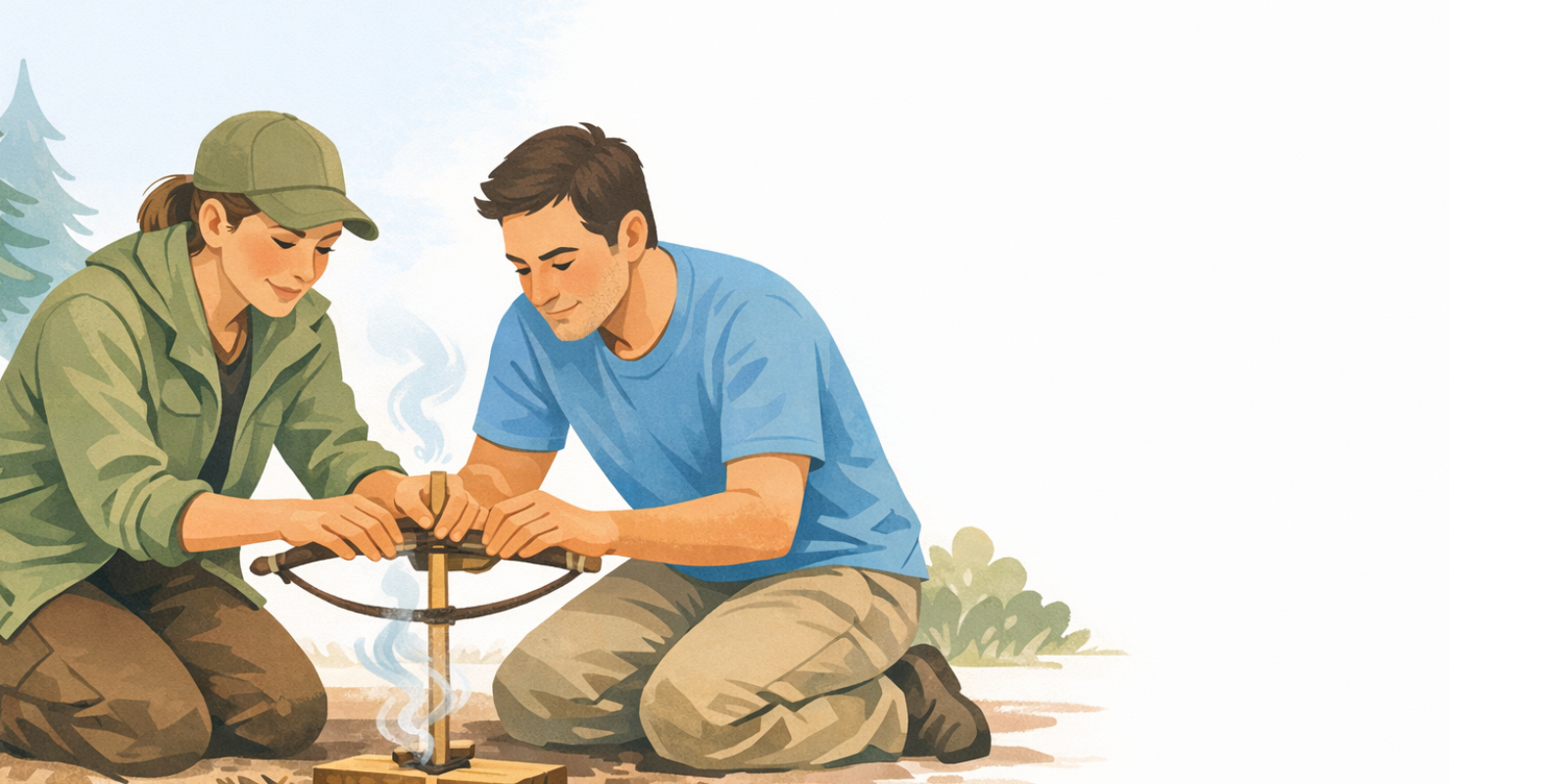
Bow-drill and hand-drill setups use a softwood spindle and baseboard (common pairings include yucca or cedar), consistent pressure, and steady speed until a coal forms. Clear instruction on the bow drill and hand drill helps learners feel oriented from day one.
What makes this teachable is staging. Many instructors build in checkpoints: airy tinder, a stable ember, then a clean transfer into thin kindling before moving up in size. Put simply, “chunking” prevents the process from becoming one overwhelming push. Traditional teachings about material selection pair well with modern guidance on tinder prep.
As skills grow, small variations build calm under pressure. One-handed bow-drill practice, for instance, rehearses adaptability and aligns with field training that emphasizes resilience under strain.
Conditions matter too. Some field testers notice efficiency often improves in a moderate humidity band—around 60–80%. Framing details like this as “relationship with the element” makes the lesson bigger than technique: you read weather, adjust effort, and regulate breath. In Krebs’ words, “survival tends to favor those with the “best skills.”
Teaching notes for practitioners
Normalize failure early; build a simple reset ritual (posture, breath, and mindset).
Coach a quick “micro-check”: spindle alignment, notch geometry, tinder loft, and transfer sequence.
Close with reflection: Where else do you push too hard, too soon? Where do you quit too early?
Skill 2: Warm, Body-Sized Primitive Shelters
Shelter is about heat retention and healthy boundaries. When people build a warm, body-sized space, they stop guessing what safety feels like—and start understanding how to create it.
Teaching Clients to Build a Micro-Climate
In temperate forests, debris huts and A-frames are reliable because insulation does the real work. A thick, continuous layer of leaves, grass, or needles traps air, and dense internal bedding is what makes debris shelters perform.
In snow, the principle is the same: design for warmth, not brute force. Practical guidance on snow shelters often emphasizes a raised sleeping shelf, a slightly lower entrance “cold well,” and a ventilation hole to balance warmth and airflow.
Ground contact drains heat quickly. Adding at least 4 inches of insulating material under the body makes a noticeable difference, and comparisons suggest dense debris improves heat retention more than sparse coverage.
Placement matters as much as construction. Turn entrances away from prevailing winds, use natural features or built barriers as windbreaks, and keep openings modest. Think of it like coaching in the physical world: small boundary choices prevent large energy leaks.
If someone does get turned around, shelter teaching connects directly to best practice. Krebs notes the strongest predictor of being found is often staying put. Build the micro-climate first—then decide what’s next.
Skill 3: Sourcing and Honoring Water with Primitive Methods
Water work teaches relationship and pace. When learners slow down to find, prepare, and carry water, they reconnect with the place—and with how small choices shape outcomes.
From Commodity to Relationship
Start by teaching where to look. Seek spring seeps, clear upwellings, or shaded side channels rather than defaulting to main flow. This habit shows up across water-sourcing teachings and reflects long-standing fieldcraft.
In drylands, patience becomes a skill. Rock depressions and basins can hold stormwater. A transpiration bag setup can collect moisture over time, and when fire is available but a pot isn’t, heated stones can bring water to a simmer in a bark or carved wood containers—often seen alongside solar pasteurization.
For clarity and safety, combine the steps. Layered gravel–charcoal–sand setups can reduce debris, then boiling or solar pasteurization becomes the second line—an approach echoed in practical field filtration guidance.
Ancestral plant knowledge belongs here, taught with respect. Ethnobotanical work and practitioner accounts note that some “water plants” have been used traditionally for hydration in arid regions. The deeper lesson is discernment: permission, right relationship, and humility—not a checklist for extraction.
Ultimately, water instruction is about making clear decisions under pressure. As Lafroy Stevens reminds us, “Knowledge is power.”
Skill 4: Navigating by Landforms, Sun, and Stars
Navigation protects bodies and clarifies minds. When learners orient themselves by landforms and light, they practice choosing direction on purpose—outdoors and in life.
Orientation as Direction and Choice
Begin with dead reckoning: track pace and time from a known start to estimate position. This is a steady baseline in many navigation teachings and pairs naturally with the reflective question, “Where am I now?”
Then teach terrain association. Ridges, valleys, and shorelines become “handrails” that keep a mental map aligned when trails fade. This “big shapes first” approach sits at the core of terrain association guidance and mirrors how many traditional travelers read the land.
When tools fail, the sky still offers structure. The shadow-stick and watch-face techniques are accessible forms of natural navigation. At night in the Northern Hemisphere, Polaris remains a reliable cue for north—classic celestial navigation using the Big Dipper as a pointer.
Analog skill matters even more in a GPS world. Blending map, compass, pace counts, and occasional device checks aligns with observations that these kinds of training reduces disorientation in the field.
Krebs also reminds us that “day hikes are the most perilous,” often because we underestimate them. Teach learners to name decision points aloud, read the land, and choose consciously when not to move.
Skill 5: Animal Tracking for Deep Awareness
Tracking is the art of paying attention. Prints, scat, and subtle signs build pattern recognition and patience—the same muscles used in attuned facilitation.
From Footprints to Patterns of Life
Start with the basics: toe count, claw presence, and overall shape and size. Add substrate reading, and you have a strong base for early confidence—core tracking fundamentals.
Then zoom out to movement. Gait patterns—diagonal walkers, bounders, direct-registering cats—help learners “hear” rhythm with their eyes, as described in experiential accounts of reading gaits.
Teach simple ways to estimate freshness: edge sharpness, moisture, and debris in the depression. These heuristics are central to many track-aging teachings and become more accurate when paired with wind and sun awareness.
As students improve, trailing becomes a lesson in subtlety: bent grass, disturbed duff, hair on bark, fresh rubs, scat texture. Many Indigenous lineages also emphasize seasonal behavior—migration, rut, water cycles—and observational work suggests extended dirt time builds skill in exactly this way.
And a reminder worth keeping close: Krebs notes that those who sometimes do best in the wild are children, because they notice without overthinking. Tracking helps adults remember that kind of sight.
Practice prompts for groups
Walk a trail in silence, then debrief only with questions: “What else could this be?”
Make a “track aging row” in damp sand; return periodically to re-observe edge changes and color shift.
Map where sign intersects water, windbreaks, and food sources across a season.
Skill 6: Cordage and Simple Tools from the Landscape
Making tools by hand builds quiet competence. Cordage and simple tools teach reciprocity, boundaries, and the difference between force and finesse.
Building Self-Reliance, Not Heroics
Introduce plant fibers with reverence. Inner bark from nettle, dogbane, and yucca can be processed and twisted using the reverse-wrap method. Well-made natural cord can be surprisingly strong; some field tests report it can exceed 50 pounds of breaking strength.
Pair cordage with safe tool handling so students create, not just consume. Controlled push cuts and other conservative carving techniques can produce pegs, stakes, spoons, and feather sticks with lower risk. From there, abrasion and simple knapping echo long tool-making traditions that shaped early human life.
Teach ethics alongside technique. Name cultural roots and avoid claiming authority over traditions that aren’t yours—principles often highlighted in reflections on cultural roots. Krebs’ compass applies here too: don’t chase prestige—choose the best skills for the moment, practiced with care.
Workshop ideas
Harvest-and-make cycle: gather nettle with gloves, process fibers on-site, twist two-ply cord, then rig a small tarp with your own line.
Consent practice: role-play asking land stewards or community elders how to gather responsibly.
Repair clinic: mend straps and clothing with field-expedient cordage and toggles.
Skill 7: Food, Signaling, and the Wisdom of Staying Put
Food and signaling round out the picture: when to seek resources, how to ask for help, and when stillness is the wisest move.
When to Move, When to Wait
Start with energy conservation. Passive systems—deadfalls, snares on established trails, basket traps, and V-shaped weirs that guide fish into shallows—can offer calories without constant movement. These methods show up across cultures and are summarized in many primitive trapping overviews.
Ethics are non-negotiable. Teach legal context, species respect, and impact awareness. Some conservation-minded guidance recommends taking no more than about 10% from any plant stand and rotating harvest areas to support regeneration and long-term relationship.
When it’s time to call for help, visibility and simplicity win. Clear ground-to-air symbols, smoke signals, three whistle blasts, and mirror flashes are widely recognized approaches in emergency signaling guidance.
And keep the central discernment: not every problem is solved by motion. Krebs points out the best predictor of being saved after getting lost is often not moving once you realize you’re lost. In the field—and in coaching—stillness can interrupt the panic loop long enough for wise action. Accounts from extended trips echo how working outward from one shelter can support a safer overall experience.
Facilitation sequence you can run this weekend
Calorie math: compare effort spent hiking for “maybe” food vs. effort saved by setting two passive systems.
Signal drill: each participant builds a visible ground sign, a whistle routine, and a mirror plan in under 10 minutes.
Stillness practice: 30 minutes staying put, tending micro-tasks (insulation, water, signal), then group reflection.
Conclusion: Weaving Primitive Skills into a Modern, Ethical Practice
These seven skills are more than backcountry checklists. They’re a grounded framework for guiding people through challenges—steadily, respectfully, and with deep roots in living tradition alongside contemporary awareness.
Design for embodiment: short lessons paired with real field time. Open with safety, close with reflection, and let practice do what theory can’t. Many modern pathways thoughtfully blend online learning with on-land immersion so practitioners can study, rehearse, and then bring skills into client work responsibly.
Keep strong boundaries as you teach. Work in relationship with place and lineage, choose methods that fit local ecology, and model consent—with land stewards, with participants, and with yourself. Aim for capacity, not bravado; for care, not conquest.
With that approach, a coal in the hearth, a warm debris shelter, or finding north by starlight becomes more than “survival.” It becomes remembering how to belong—to self, to community, and to the more-than-human world.
Ready to go deeper and share these skills responsibly? Explore the Wilderness Survival Instructor pathway and learn how to turn core primitive skills into grounded, ethical offerings for your community: Wilderness Survival Instructor.