Primitive survival skills are a living pathway for resilience, self-trust, and embodied learning. Practiced well, they help people stay steady under stress while building a real relationship with the land—so the learning becomes personal, not just practical.
The wilderness has always been a mirror. As survival instructor Jessie Krebs puts it, it’s a great equalizer that pulls attention into the present moment. That intensity is exactly why immersive ancestral skills training can create powerful outcomes: people learn what they do under pressure, then build the capacity to respond to stress and uncover inner truths.
In most advanced training arcs, the progression is natural: shelter, fire, and water first—then awareness skills like tracking and navigation, followed by food and communication. Many modern programs also lean into accessible, land-sensitive approaches that reduce gear dependency, while strengthening mental toughness and community support.
Below are seven practitioner-ready skills that sit beautifully inside a modern, holistic outdoor practice—rooted in traditional knowledge and taught in a way clients can genuinely use.
Key Takeaway: The most effective primitive skills training is taught as a calm, repeatable sequence—shelter, water, awareness, navigation, firecraft, food/fiber, and signaling—so clients build real regulation, judgment, and confidence under stress while staying ethical, land-sensitive, and rescue-ready.
Primitive Skill 1: Sheltercraft for Felt Safety and Regulation
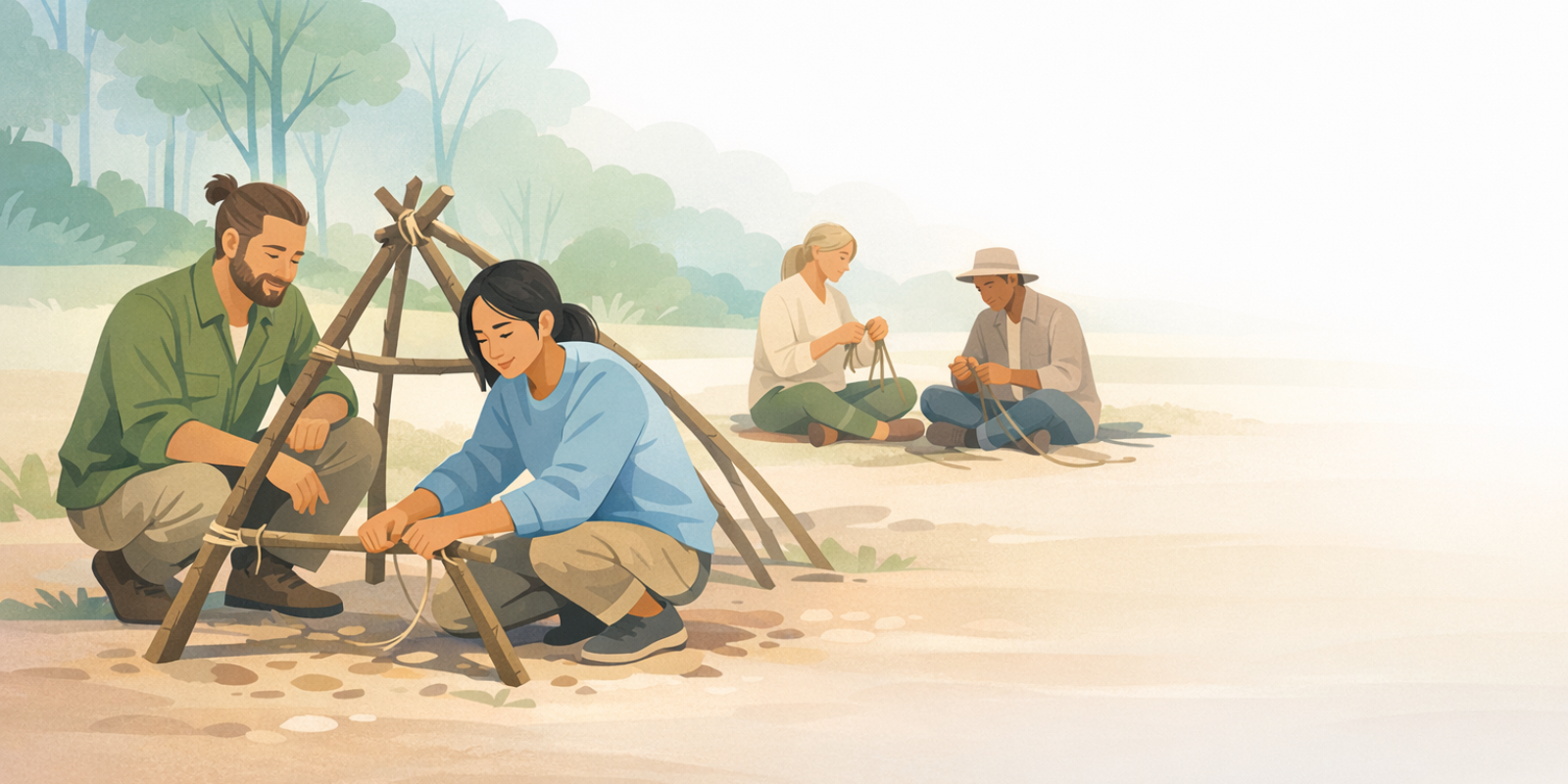
Shelter comes first because warmth and cover change everything. A well-made, body-sized refuge quickly builds felt safety—helping clients settle, think clearly, and act with steadier hands.
Framing shelter-building as safety, not just construction
When people are cold, wet, and windblown, the nervous system tends to clamp down. Teach compact, biomimetic designs that hold heat and reduce energy loss—debris huts, A-frames, and wick-up structures—classic shelter skills that stay reliable when gear doesn’t.
Details make shelters work. A debris hut is most effective with roughly 2–3 feet of outer vegetation and plenty of bedding inside, and cold-ground builds typically benefit from 4 inches (or more) of insulation under the body to slow heat loss into the earth.
Then teach the craft many people skip: choosing the right spot. Good site selection means wind protection, reasonable drainage, and access to materials—while steering clear of animal trails, unstable branches, and low cold pockets. Finish with orientation: keep the entrance away from prevailing winds and as small as practical.
Many effective designs draw from Indigenous forms and principles—layering, airflow control, and smart shapes—supported by observations that biomimetic designs can retain more warmth than simple, single-layer walls.
It’s also worth normalizing “unexpected overnights” even on short outings. Jessie Krebs notes that day hikes can be surprisingly risky when people under-pack and underestimate wind and exposure.
- Shelter quick-check: body-sized interior, 4+ inches bedding, full debris coverage, wind-sheltered door, safe site.
- Practice a 20-minute micro-shelter drill for day outings (bedding + windbreak + ground barrier) to build confidence fast.
Primitive Skill 2: Water Wisdom and Natural Purification
Once there’s shelter, water becomes the next steadying pillar. The goal isn’t just “find water,” but to help clients read the land well, choose safer sources, and purify with practical methods grounded in tradition and simple science.
Teaching clients to read the landscape for safer water
Start with locating and collecting water even without modern containers. Rock basins, tree crotches after rainfall, and branch-bag methods can help; simple transpiration bags can produce modest amounts over time. When traveling, teach clients to favor clearer, slower upwellings; when available, spring seeps are often a better bet than downstream draws.
Purification skills are where confidence really grows. When there’s no pot, teach rock boiling in wooden or bark containers, and show how layered gravel–charcoal–sand filters can help pre-clean water before heating.
On bright days, solar pasteurization is another time-tested option: temperatures around 150–160°F can inactivate many microbes. Ethnobotanical knowledge also matters here—many landscapes hold water-rich species that can support hydration when used appropriately and respectfully.
Set clean expectations so students don’t waste effort. Traditional solar stills are often low-yield, so it’s wiser to teach a toolkit of strategies. As wilderness instructor Lafroy Stevens puts it, “Knowledge is power.”
- Water sequence: safer source → pre-filter (cloth/sand) → heat (rocks/boil/pasteurize) → safe storage.
- Landscape drill: find three “hidden water” clues (bird activity, greener ribbons, damp soil, game trails trending downhill).
Primitive Skill 3: Tracking as the Language of the Land
Tracking shifts clients from “getting through the day” to listening. It turns prints, wind, and bird calls into a conversation—and that widened awareness is often deeply regulating.
From footprints to story: helping clients widen their awareness
Begin simply: identify prints by toe count, claw marks, and movement patterns—whether an animal is a diagonal walker, hopper, or bounder. Then add track aging using cues like edge sharpness, windblown debris, and moisture changes.
From there, teach “sign” as a storyline. Bent grass, hair on bark, fresh scat, and even disturbed spider webs can combine into a clear narrative. Encourage students to notice how game paths can point toward water, richer plant communities, and safer movement corridors.
With practice, tracking becomes a real skill—not a guess. Comparisons show experienced trackers can reach about 85% accuracy, which is a strong reminder that time on the ground is the teacher. Traditional lineages also emphasize whole-pattern reading—season, wind, habitat edges, and bird language—rather than treating tracks as isolated objects.
As attention narrows to what’s real and immediate, people often feel steadier. Jessie Krebs calls this the law of consequences: the land rewards presence, and tracking naturally trains it.
- Awareness drill: “Circle the sign”—make a 10-meter circle around one print and find four more clues before choosing direction.
- Ethics: trail respectfully; avoid pressuring wildlife and minimize disturbance near nests, dens, and riparian zones.
Primitive Skill 4: Navigation Without GPS (and Teaching People Not to Panic)
After close-in awareness comes the wider view. GPS-free navigation is as much about emotional steadiness as it is about direction—replacing panic with a simple process clients can trust.
Designing low-risk navigation drills for clients
Start with fundamentals that build an internal map. Dead reckoning uses a known start point, a personal pace count, and time to estimate location. Pair it with terrain association: constantly matching ridges, drainages, and prominent features to the map.
Then add quick, low-tech tools. Teach a shadow-stick for direction, and the wristwatch compass method as a backup. For route simplicity, use handrails like rivers, ridgelines, and roads, and introduce night basics with Polaris.
Technology is helpful, but it can fail in dense canopy, canyons, and certain terrains. Practicing map-and-compass plus celestial cues has been associated with 60% reductions in disorientation in GPS-denied drills. What this means is simple: pacing, handrails, and frequent pauses create calm, reliable navigation.
Finally, teach a clear “lost protocol.” Jessie Krebs emphasizes that a strong predictor of being found is not moving once you realize you’re lost—stop long enough to think, signal, and shelter so the situation doesn’t spiral.
- “STOP” script: Stop. Take three breaths. Observe handrails. Plan one move—or make camp.
- Drill: a 30-minute “lost-proofing” loop—leave a trail intentionally, then backtrack using landmarks and pace count.
Primitive Skill 5: Advanced Friction Fire and Heat Management
Now return to fire at a deeper level. Friction fire, fuel progression, and heat management move clients beyond “spark tricks” into a steady relationship with flame—built on rhythm, patience, and judgment.
Moving clients from “spark tricks” to real fire relationship
Begin with a bow drill and teach it like a craft, not a stunt. Wood choice matters, but rhythm matters more: consistent pressure and smooth speed often produce a cleaner bow drill coal than brute force. For minimal-gear practice, introduce the hand drill as a progression.
Then teach fire growth as a sequence: ultra-fine tinder, then tiny twigs, then progressively larger fuel—a disciplined fuel progression that matches how flame actually develops. The ember-to-flame moment is often won through breath control and timing; many traditional firekeepers treat this as a cornerstone lesson because it trains calm under pressure.
For realistic adaptations, explore one-handed bow-drill setups and two-person systems. Also teach heat without open flame when conditions call for it—hot-rock pits can store warmth more safely in enclosed shelters. Field notes also suggest friction methods tend to perform best when conditions sit around 60–80% humidity, making smart material choice and sheltering your kit part of the lesson.
Ultimately, firecraft rewards steadiness over swagger. “The survival world is pretty equally divided between those with the best gear and those with the best skills,” Jessie Krebs notes, placing herself firmly on the skills side—a strong north star for teaching.
- Firekeeper checklist: dry tinder bundle, ventilated coal bed, staged fuel, wind shield, safe perimeter, clear exit.
- Coaching cue: celebrate small, clean fires—control and wood choice beat size every time.
Primitive Skill 6: Foraging, Trapping, and Cordage for Nourishment and Craft
With shelter, water, direction, and fire in place, food and fiber become less frantic and more skillful. This is where respectful harvest, simple capture methods, and cordage bring real confidence.
Teaching respectful harvest and simple food security
Start with fiber because it unlocks everything else. Teach reverse-wrap natural cordage from plants like nettle, dogbane, or yucca; properly finished lines can exceed 50 lbs of strength. Think of cordage like a “portable toolkit”: once students can make it, shelter upgrades, carrying systems, and snare practice become possible.
For animal-based skills, teach principles, ethics, and simplicity. Demonstrate deadfalls and snares with a focus on quick action and minimizing non-target risk, including figure-4 and Paiute triggers. In waterways, traditional fish weirs are a powerful lesson in timing and landscape reading; simple rock weirs show how structure and current work together. Minimalist tools like gorge hooks also teach ingenuity and restraint.
Ethnobotany belongs here too—taught with humility and clear lineage. Modern confirmation methods have supported the edibility of over 300 plants used by Indigenous communities, and many foragers teach the 10% rule (harvest lightly from any one stand). When a technique has a specific cultural origin, name it and model cultural respect so students learn stewardship rather than extraction.
Keep boundaries clear: local regulations and permissions matter. Depending on location and context, it may be most appropriate to teach non-lethal demonstrations, skill mechanics, and ethical decision-making as the core learning outcomes.
- Foraging mantra: identify twice, harvest once—use sight, smell, habitat, and season.
- Reciprocity practice: give first (pick up litter, tend a patch, scatter seed) before you take.
Primitive Skill 7: Signaling and Simple Communication for Rescue
Signaling is the skill that turns simple materials into clear communication. When taught well, it helps clients act decisively—without wasting energy or disappearing deeper into terrain.
Turning basic materials into clear, high-contrast signals
Start with a universal pattern: “three” is widely recognized as distress. The National Park Service highlights the whistle’s effectiveness; carry one and use three blasts at regular intervals.
Then practice light and movement. A mirror can throw a bright flash across long distances in clear conditions; teach the signal mirror method using a finger “V” sight and a controlled sweep toward distant targets. When visibility is lower, movement and contrast matter—wave a bright cloth, reflective blanket, or high-contrast garment.
Fire signals complete the toolkit. In daylight, build smoke with layered fuels; at night, aim for a bright, steady flame. Many regions recognize three fires in a triangle as a distress marker. On open ground, lay out a large, high-contrast symbol (X or arrow) with rocks or logs where it can be seen from above.
Finally, pair signaling with stillness: it’s often safer to stop, shelter, and become conspicuous than to keep moving. Encourage a small, pre-packed signaling kit (whistle, mirror, bandana, bright bag) so clients can act quickly when it counts.
- Rescue rhythm: signal for 1 minute, rest and listen for 2. Repeat.
- Place a ground signal near a clearing and another at camp to improve visibility from multiple angles.
Weaving These Skills Into a Holistic Outdoor Practice
Taught in sequence, these skills help clients generate safety (shelter), meet needs (water, fire, food), read patterns (tracking, navigation), and ask for help (signaling). That arc supports real personal evolution, and wilderness survival training has been linked to psychological resilience and deeper self-trust.
From a practice-building perspective, these modules fit naturally into seasonal cycles. Spring favors tracking and water-reading. Summer supports navigation challenges and foraging. Autumn is ideal for fire and cordage craft. Winter shines for shelter clinics and signaling drills under short daylight.
- Create 90-minute micro-immersions for each skill, then run a full-day integration once per month.
- Pair each field session with one prompt: “What did this skill show you about how you meet uncertainty?”
Ethics, Safety, and Respect for Lineage
Primitive skills are communal inheritances. Teach with care: credit lineages where techniques have specific cultural roots, avoid appropriation, and model reciprocity with the land. Keep group safety primary through permissions, local regulations, fire awareness, wildlife boundaries, and leave-no-trace craft.
As instructors, our integrity is our north star. We protect ecosystems, we protect communities, and we protect the dignity of the traditions we carry forward.
Bring It Home: Practical Next Steps
To embed these seven skills into your work, start small and real. Choose one skill you practice weekly, draft a 60–90 minute session with a clear safety envelope, and pilot it with a small group. Gather feedback, refine, then add the next skill once your group is ready.
Platforms like Naturalistico are designed to support this kind of grounded, evolving practice—combining continuing professional development with tools for real client work, including scheduling, notes, community spaces, and a growing library of evidence-informed courses.
If you’re ready to deepen your own relationship with land-based skills while expanding your teaching toolkit, explore the Wilderness Survival Instructor pathway on Naturalistico. It’s a focused way to turn these seven skill areas into a coherent, ethical, land-honouring season of work with your clients.
Ready to Go Deeper?
Take the next step with a Naturalistico certification — designed for practitioners ready to deepen their expertise.
Explore the Course →