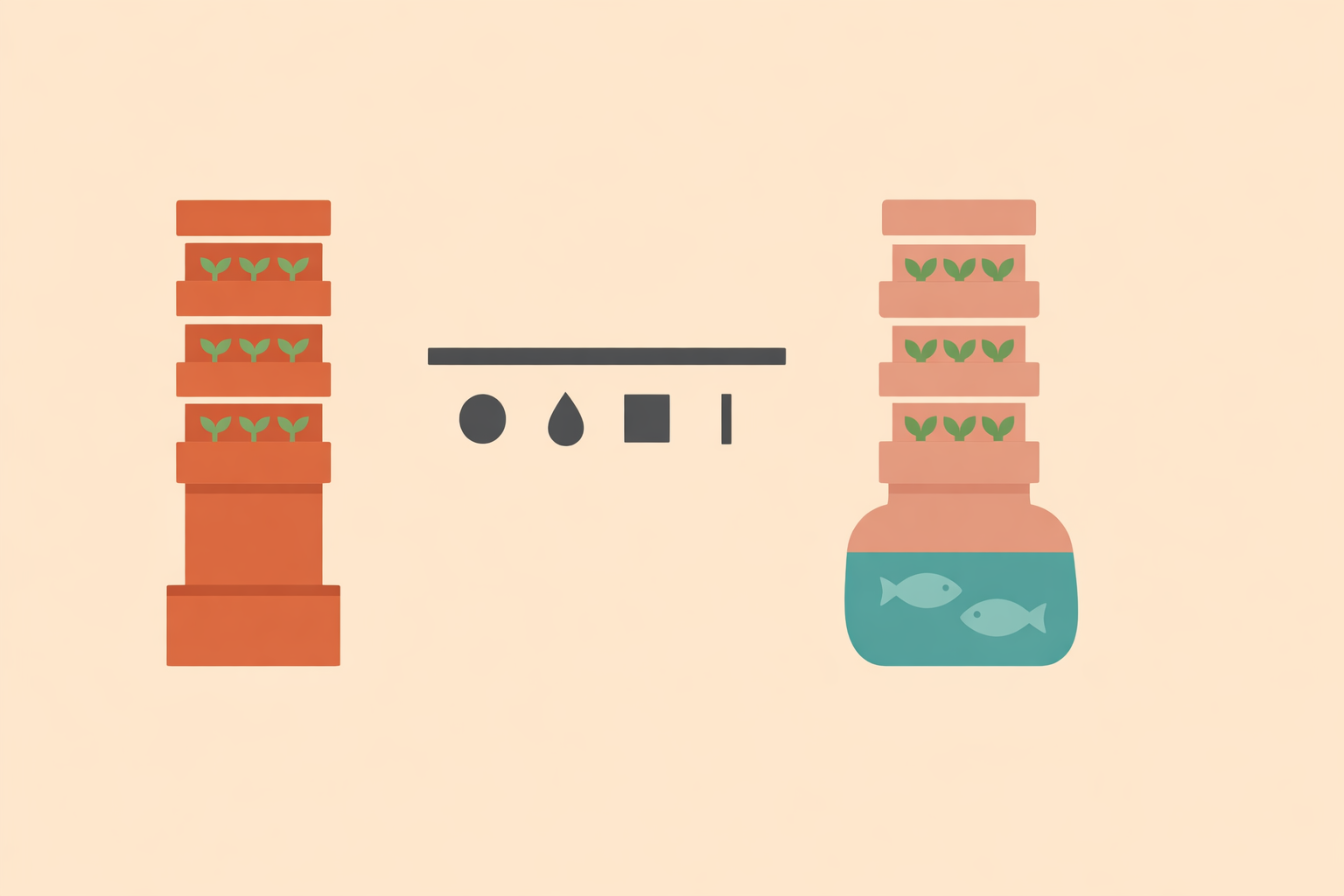
Urban growers make decisions under hard constraints: rent limits how much you can build, utility bills cap your energy choices, and partners often expect steady harvests week after week. In that reality, “aquaponics or hydroponics?” isn’t a philosophy debate—it’s an operational decision that shapes budgets, staffing, and day-to-day workload.
Some teams already have racks, lights, and a nutrient plan dialed in. Others are building around a community kitchen, school, or local food project that wants fish in the system and a more circular story. Either way, the best choice is the one that fits your footprint, timeline, and purpose.
Key Takeaway: In urban farming, the most practical comparison is output per m², per kWh, per liter of water, and per labor-hour. Hydroponics typically delivers faster, more standardized plant cycles, while aquaponics can reward patience with integrated edible output and nutrient cycling once the system stabilizes.
How to measure yield in urban agriculture
In a city, total harvest is only part of the story. The more useful comparison is output per square meter, per kWh, per liter of water, and per hour of labor—because those are the constraints urban projects feel most sharply.
Performance reviews of vertical farming commonly focus on yield per unit area, energy use, and water-use efficiency. That’s the real “scoreboard” in dense settings.
Energy is often the make-or-break variable. In indoor and vertical farms, high energy demand for lighting and climate control can outweigh impressive growth rates.
Labor matters just as much. Hydroponics often supports predictable dosing, standardized routines, and automation. Aquaponics can generate nutrients within the system, but it asks for steadier hands—because fish, plants, water, and microbial life are all part of the same rhythm.
Before choosing a method, define what “success” looks like for your site:
- How much food do you need per square meter?
- How expensive is power in your area?
- How much daily attention can your team realistically offer?
- Are you measuring only plant output, or total edible output?
Where hydroponics tends to lead
If your priority is fast, dense, predictable plant output, hydroponics often has the edge—especially for leafy greens and culinary herbs in tightly designed spaces.
Essentially, hydroponics simplifies the mission: you can fine-tune feeding, standardize cycles, and build for plant production alone without waiting for a broader ecology to stabilize. That clarity makes it easier to scale routines and keep harvest timing consistent.
This advantage gets even stronger in vertical farms, where layout and environmental control strongly influence results. Indoor farming reviews highlight how light, temperature, CO₂, and airflow shape output alongside irrigation and nutrition.
Hydroponics is often a strong match when you need:
- short-turn greens and herbs
- maximum stacking in limited floor area
- high consistency for weekly harvest schedules
- clear SOPs and lower biological complexity
For many urban projects, that combination makes hydroponics the most straightforward operational fit.
Where aquaponics comes into its own
Aquaponics becomes most compelling when the goal is bigger than plant speed alone. Once established, it can offer combined edible output, nutrient recovery, and a visible model of circular stewardship.
Think of it like a well-run ecosystem in miniature: as the biology matures, the whole system often becomes more productive and more efficient—especially when fish and plants are counted together rather than as separate enterprises.
This is why aquaponics is so often chosen for schools, community hubs, and mission-led city projects. The system teaches as it produces: what looks like waste in one corner becomes nourishment in another.
Practical guidance emphasizes that aquaponics involves management of fish, plants, and microorganisms in one recirculating setup. That added complexity is real—and for many growers, it’s also the point, because it builds skill in reading living systems.
When designed well, aquaponics can also reduce waste losses. In integrated systems, nutrients are recovered by plants, which lowers discharge and extends water use compared with standalone fish production.
As systems mature, mineralization units can help convert solids into plant-available forms. Reviews describe plant-available phosphorus, along with potassium and micronutrients, being released through this process.
Aquaponics often shines when you want:
- greens, herbs, and fish from one integrated setup
- a strong circular narrative for community engagement
- learning-rich environments where ecology is visible
- a system that builds stewardship as well as output
The time factor: why early comparisons can mislead
Many debates about aquaponics versus hydroponics are really debates about timing. Hydroponics can be ready to perform quickly. Aquaponics usually needs a runway.
What this means is simple: early comparisons often favor hydroponics, while longer timelines can reveal aquaponics’ strengths. In aquaponics, time-to-steady-state and design choices frequently influence outcomes as much as the nutrient source itself.
At the beginning, the system is still finding balance—fish stocking, feeding, microbial establishment, and plant uptake all have to meet in the middle. Clemson guidance highlights the importance of balancing fish stocking, feed input, and plant uptake so nutrients stay in a productive range.
Seasoned operators often recognize a clear “settling” period that can take months of observation and adjustment. That slower stabilization isn’t a weakness—it’s the natural pace of a living loop.
For teams willing to learn the system’s rhythm, aquaponics can reward patience with long-view stability and a deep sense of coherence.
Design choices that often matter more than the method
In urban growing, form matters as much as philosophy. Channels, rafts, media beds, towers, airflow routes, and service access often decide whether a project feels efficient—or becomes a daily struggle.
Hydroponic systems are usually easier to optimize purely for plant throughput. Aquaponic systems can be equally productive, but the design has to respect solids, biofilms, oxygen levels, and buffering capacity (your system’s ability to resist swings in water chemistry).
Deep water culture raft systems are widely considered the commercial workhorse in aquaponics. Guidance notes that raft systems are commonly used commercially, in part because larger water volumes help buffer fluctuations.
By contrast, NFT channels can be excellent for hydroponics but may demand closer attention in aquaponics, where fine solids and biofilms can build up. Media beds are often valued for resilience and learning, though they typically require more space and hands-on upkeep than stacked channels or trays.
Useful rules of thumb:
- For pure plant throughput, hydroponic channels or stacked trays are often the cleanest fit.
- For buffering and operational resilience, aquaponic rafts are often easier to steward than narrow channels.
- For mixed crops and educational settings, media beds can make the biology more visible.
- For tight city footprints, ceiling height, access aisles, and airflow planning matter as much as the growing method.
Culture, stewardship, and the value beyond yield
Urban growing is rarely only about volume. In many settings, the system also needs to teach, gather people, and strengthen relationships around food.
Aquaponics is especially strong here because its circular logic is easy to understand and remember. It has been described as a circular system that aims to use everything and waste nothing. In community settings, that story often deepens participation and care.
Hydroponics carries its own kind of value. Its clarity and precision make it a powerful way to learn resource use, crop planning, and disciplined growing. The point isn’t that one system is meaningful and the other is merely efficient—each supports a different relationship with the space.
When approached respectfully, both can also become bridges between modern urban constraints and older food wisdom: not imitations of ancestral systems, but thoughtful translations shaped by today’s space, water, energy, and community needs.
Choosing the right system for your urban farm
If you need rapid, predictable plant throughput with strong automation potential, hydroponics is often the clearest choice. If you want a slower-building but more visibly integrated ecology, aquaponics may offer greater long-term value.
To choose with confidence, ask:
- Do you need the fastest possible plant cycles?
- Are you optimizing for plants only, or for total edible output?
- Can your team steward a living, multi-part ecology over time?
- Is community storytelling part of the project’s purpose?
- Will power costs or labor availability be your main constraint?
In many city farms, the best answer is situational, not ideological. Hydroponics often wins on speed, density, and operational control. Aquaponics often wins on integration, circularity, and the kind of productivity that matures with care.
Both approaches can be practiced skillfully. The strongest results usually come from matching method, design, and mission—rather than expecting one system to do everything at once, especially in vertical farming and other tight urban layouts.
“Urban farms can serve as living laboratories.”
That idea captures the heart of the choice: a city farm isn’t only a production unit. It’s also a place where people can see how food, water, energy, and stewardship connect in real time.
Master Urban Agriculture Certification
Apply these aquaponics and hydroponics tradeoffs in real projects with the Urban Agriculture Certification.
Explore Urban Agriculture →