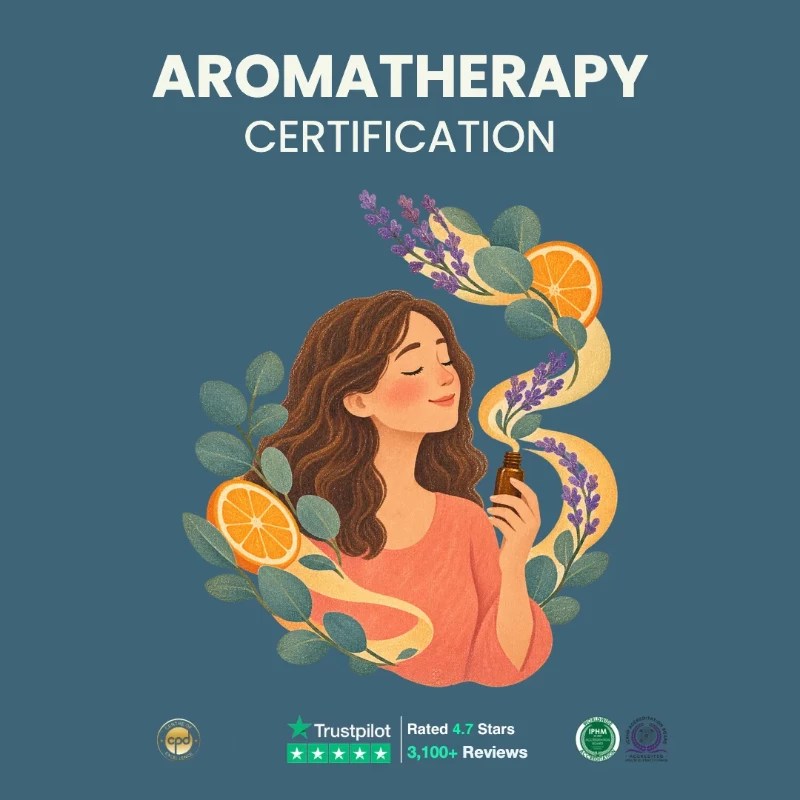
Practitioners across the well-being space are meeting the same crossroads: a client asks for a blend to support rest, a studio wants a signature scent, or a boutique invites you to co-create a product—and suddenly you pause.
You already know aroma can shift a moment quickly. You also know essential oils are powerful, sensitivities are real, and the rules around products and claims aren’t optional. The real question becomes: what does “trained enough” look like, where are the boundaries, and how can aromatherapy stand confidently as part of your work without overreaching?
Key Takeaway: Aromatherapy is becoming a more structured profession, where credibility comes from clear scope, informed consent, conservative exposure practices, and disciplined communication. Whether you work with clients, groups, spaces, or products, competence is defined by safety literacy, ethical boundaries, and ongoing education—not just blending skill.
Why aromatherapy is maturing as a profession
Aromatherapy is steadily moving from “nice extra” to a more structured professional path—one still rooted in traditional plant wisdom, now supported by clearer standards and expectations.
Across cultures, aromatic plants have long been woven into ritual, daily living, and seasonal practices. What’s changing isn’t the value of that knowledge—it’s that the field is increasingly organizing itself so the work can be offered consistently, safely, and ethically.
One clear signal is education structure. NAHA recognizes three levels—Foundations, Professional, and Advanced—so practitioners can grow in stages rather than relying on guesswork or trends.
Those expectations aren’t just about knowing “what oil for what.” NAHA includes competence in oil chemistry, consultation skills, safety, and professional practice. As Jill Hoiles puts it, Level 2 is “a 200-hour-plus education” designed for professional use.
Ethics are becoming just as visible as technique. The AIA’s standards outline ethics, informed consent, confidentiality, and scope—an important sign that the field is committed to integrity, not just inspiration.
The marketplace reinforces this push toward clarity. The FDA notes fragrance ingredients in cosmetics must be safe under labeled use, which raises the bar for how practitioners communicate, formulate, and collaborate.
Essentially, the tradition remains the heart of aromatherapy—and structure is increasingly the container that keeps it trustworthy.
From single modality to portfolio aromatherapy career
Many aromatherapists don’t build their livelihood around one narrow service. They create a portfolio career, weaving aromatherapy into coaching, body-based work, skincare, education, events, and digital offers.
This is a natural fit because scent changes the tone of an experience quickly. Think of it like lighting in a room: the same space can feel energizing, soothing, or ceremonial based on subtle sensory cues. Aromatics can help mark ritual, support presence, and shape atmosphere—without needing to be the “whole” offering.
The AIA’s emphasis on scope and collaboration fits this reality. Aromatherapy often works best as one strong thread in a larger well-being fabric.
Because formats vary, the common thread becomes professionalism: using plant knowledge in ways that are appropriate to the setting and clear to everyone involved.
That’s where business clarity matters. NAHA includes record keeping and professional communication because a multi-service practice needs clean boundaries—clients should never have to guess what they’re receiving.
Language is part of that boundary. The FDA draws a line between cosmetics and products making body-function claims, which is why many practitioners focus on comfort and ambiance rather than inflated promises.
And aromatherapy skills travel well across industries because real-life fragrance contact happens everywhere. RIFM highlights real-world exposure across personal care and home environments, which helps explain why aromatherapy can support everything from workshops to product design.
Once you see aromatherapy as a flexible professional language, the next natural step is exploring how it shows up in direct client work.
Client-facing aromatherapy: consultants and wellness coaches
One-to-one work is often the clearest entry point. Aromatherapy consultants and wellness coaches help clients shape personal aromatic routines that feel intentional, culturally respectful, and grounded in safety.
The best work starts with listening, not “matching symptoms to oils.” Daily rhythms, scent preferences, sensitivities, household context, and cultural associations all matter—because the same goal can call for very different approaches depending on the person.
That’s why NAHA expects skills like case documentation alongside chemistry and blending strategy. Personalized aromatic planning is part art, part discernment.
Ethics protect autonomy here. The AIA emphasizes informed consent and honest communication about benefits and limitations, so clients can make choices that truly fit them.
Safety literacy is a cornerstone of trust. As Harpreet Gujral explains, because pure essential oils are potent, diluting them in a carrier oil is “the best way to avoid a bad reaction” for topical use.
And sensitivity isn’t rare. One U.S. survey found 34.7% report health problems from scented products. A dermatology review also describes fragrances as among the most frequent chemicals linked with contact reactions.
Practically, strong intake conversations often include:
- history of fragrance sensitivity or contact reactions
- comfort with topical vs. inhalation-based use
- preferred and disliked scent families
- other fragranced products already used daily
- willingness to patch test and begin gently
When done well, this work feels less like “selling oils” and more like designing an aromatic journey a client can actually sustain. From there, many practitioners naturally expand into group and space-based experiences.
Group and space-based work: spa, workplace, and community
Aromatherapy can be powerful in shared spaces—spas, retreats, workplaces, and community settings—when it’s offered with cultural respect, clear choice, and conservative exposure practices.
Group work shifts the craft. Instead of one person’s preferences and history, you’re designing for diversity: different bodies, associations, tolerance levels, and cultural relationships with aromatic plants.
This is where the AIA’s attention to cultural background and autonomy becomes especially practical. A scent that comforts one person may overwhelm another, so skilled practitioners build in options rather than assuming a universal response.
Training supports that flexibility. NAHA-aligned learning covers multiple application methods, making it easier to choose low-intrusion approaches like gentle diffusion, optional inhalers, scent stations, or fragrance-free alternatives.
Exposure also needs thoughtful limits. IFRA notes certain ingredients have inhalation and respiratory toxicity limits, which is one reason enclosed-space diffusion should stay conservative. As Hana Tisserand puts it, essential oil use is a balance between potential risks and benefits.
Inclusion often means making fragrance-free choices normal, not “special.” The U.S. Job Accommodation Network recommends fragrance-free areas or policies as a reasonable accommodation for people with sensitivities.
In real career terms, group and space-based work can include:
- designing spa rituals and signature scent journeys
- supporting retreat or yoga spaces with aromatic ambiance
- creating workplace sensory guidelines for calm, focus, or welcome
- leading community workshops on safe home use and blending basics
- consulting on scent experiences for hospitality or event settings
These roles highlight something traditional practitioners have always known: aromatic plants support not just individuals, but environments and communities. And some of the most influential work happens even further behind the scenes.
Behind the scenes: formulation, quality, research, and education
Not every aromatherapy career is client-facing. Many practitioners thrive in roles that shape products, quality standards, education, and research translation for the wider field.
If you love the “why” behind materials—sourcing, aromatic profiles, and consistency—behind-the-scenes work can be deeply satisfying.
Formulation is a common route: oils, mists, bath blends, body products, candles, or scent rituals designed for everyday use. But it’s not just creativity; it requires attention to labeling, intended use, concentration, and batch consistency.
Quality assessment supports trust. Industry guidance notes fragrance materials are commonly checked by gas chromatography to help detect adulteration or inconsistency.
Even the broader market is leaning into stronger testing norms. A report on gas chromatography points to rising quality and safety testing needs, and newer systems are marketed as compact “benchtop” instruments for faster quality control.
Education and research translation matter just as much. RIFM brings together exposure data, toxicology, and analytical chemistry—information that educators and consultants can turn into practical guidance for founders, teams, and learners.
Behind-the-scenes roles might look like:
- formulator for body, home, or ritual products
- quality specialist focused on sourcing, documentation, and testing
- educator teaching safe use, blending, and ethics
- content or curriculum creator translating research into accessible learning
- brand consultant helping businesses communicate honestly and responsibly
These paths may be quieter, but they’re often what helps a field mature without losing its roots.
Standards and ethics: what “professional aromatherapist” really means
Professional aromatherapy is less about status and more about boundaries. The title carries responsibilities: clear scope, informed consent, confidentiality, honest communication, and ongoing learning.
Aromatherapy is easy to romanticize—beautiful scents, rich traditions, and experiences that can feel deeply personal. But professionalism starts where vagueness ends: being precise about what you offer, what you don’t, and how people can choose freely.
The AIA Standards spell out expectations around scope, consent, confidentiality, and avoiding misleading claims. These aren’t “extra admin.” They’re what protect trust.
Ongoing development is part of the role. NAHA ties professionalism to a code of ethics and ongoing study, acknowledging that best practice evolves as the field evolves.
Marketing language is one of the biggest integrity tests. The FDA explains that products promoted to treat or prevent disease (or to affect body structure/function) cross an important regulatory line—so responsible practitioners learn to communicate around experience, support, and well-being without overstating.
Ethics also include practical risk awareness. A dermatology review describes fragrances as a leading cause of allergic skin reactions, which is why patch testing and conservative use belong in everyday practice.
As Trisha Gilkerson observes, there is no equivalent of a formally educated health professional in the essential oils industry, but certification can signal real commitment to education and safety. Put simply: professionalism shows in discipline, not inflated claims.
Skills and expectations: what people look for in an aromatherapist
Today, enthusiasm isn’t enough. Clients and collaborators increasingly look for practitioners who combine traditional plant knowledge with safety fluency, strong communication, research awareness, and solid business basics.
This is a healthy shift. As interest grows, it matters that practitioners can explain not only what they use, but why, how, and when to hold back.
NAHA’s guidance reflects that through training in chemistry, safety, consultation, blending, and professional practice—not just memorizing oil “keywords.”
Relational skill is equally visible. People want to feel heard, not managed. Partners like studio owners or product founders also value clear boundaries, clean documentation, and calm, professional communication.
Continuing development is increasingly expected. The AIA explicitly encourages professional development, which keeps practice aligned with evolving safety guidance and sourcing realities.
And some foundations stay simple. Johns Hopkins emphasizes that essential oils should be diluted to reduce the chance of adverse skin reactions—one principle that influences daily decisions about carriers, concentrations, patch testing, and whether topical use makes sense at all.
Modern risk awareness doesn’t replace tradition; it refines it. RIFM’s focus on cumulative exposure and sensitivity can sit alongside long-held practitioner wisdom about preparation, dose, season, and context. And, as Hana Tisserand reminds us, it comes back to balance.
In practice, the skill mix people increasingly expect looks like:
- traditional grounding in aromatic plant use and cultural respect
- safety fluency in dilution, exposure, and contraindication-aware decisions
- consultation skill with strong listening and documentation
- ethical communication without inflated claims
- business basics such as pricing, boundaries, and client experience
- ongoing learning rather than static knowledge
That blend is what keeps aromatherapy rooted and genuinely useful in modern settings.
Conclusion: building an aromatherapy path with integrity
Aromatherapy careers are broader—and more grounded—than many people assume. The field is growing into a profession with clearer standards, more visible ethics, and multiple viable paths.
That evolution doesn’t dilute ancestral knowledge. It asks practitioners to carry it with more care: respecting tradition while practicing with thoughtful safety, clean boundaries, and honest communication.
Some practitioners will focus on one-to-one consulting. Others will thrive in workshops, spas, workplaces, formulation, quality, education, or a portfolio practice that blends aromatherapy with other well-being support. What makes these paths strong is the same thing: integrity.
A final note of practical caution: essential oils are concentrated materials, and sensitivity is common—so conservative use, clear consent, inclusive fragrance-free options in shared spaces, and disciplined claims are not “nice-to-haves.” They’re part of what keeps this work respectful and sustainable.
Train in Aromatherapy Certification
Build safer, clearer aromatherapy services with Naturalistico’s Aromatherapy Certification.
Explore Aromatherapy Certification →