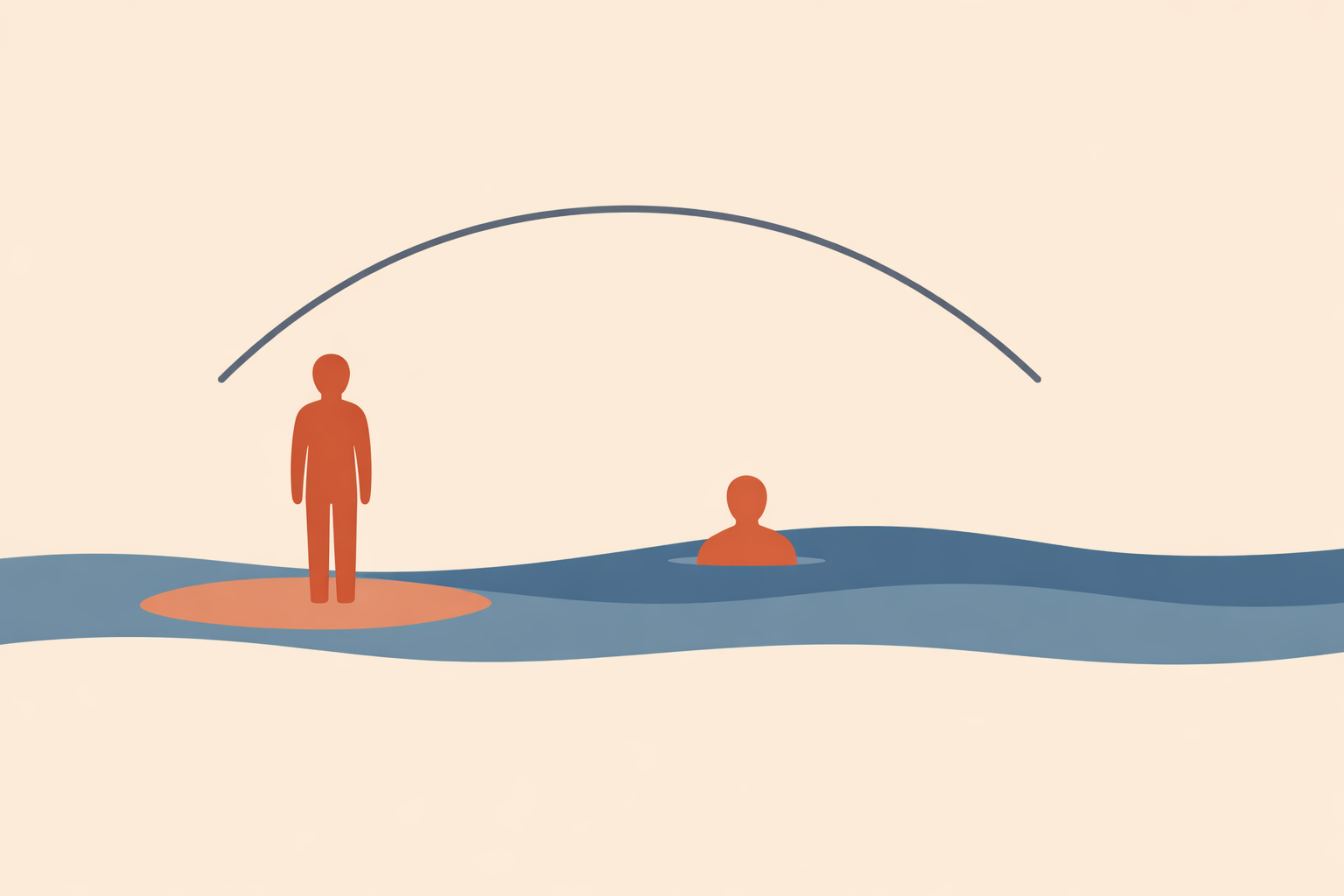
Clients keep asking for sessions at the beach, lake, or river. Interest in short cold dips is spilling into coaching requests. If you guide mindset, breath, and nervous-system work, water can feel like the natural next setting—until you’re weighing swell, visibility, cold, and mixed abilities while also holding consent and emotion.
Many coaches end up improvising: a shoreline walk becomes ankle‑deep wading; a quiet check‑in turns into a group dip; the plan shifts with the wind. The real question isn’t whether blue spaces help—it’s whether your structure is steady enough to keep the work supportive when conditions (and feelings) move.
This practitioner’s frame pairs the pull of blue therapy with clear boundaries: a progression from observation to immersion, five risk checks you can operationalize, and a bright line between informal shoreline moments and sessions that call for more formal preparation. The aim is to help you decide what to run, how to staff it, how to speak about choice and culture, and when to pivot.
Key Takeaway: Open-water blue therapy works best when water is treated as a co-facilitator and sessions follow consistent, consent-led safety checks. Use a shoreline-to-immersion progression, right-size groups to real reach and visibility, monitor conditions continuously, and keep cold exposure brief and breath-led while staying within your true scope.
Why Open Water Calls to Blue Therapy Coaches
Open water is magnetic because it can invite deep relaxation and fast shifts in state. In traditional practice, water has long been respected as both ally and threshold—powerful enough to soothe, and strong enough to demand clear agreements.
In contemporary practice, blue therapy uses water and aquatic landscapes to support emotional balance, clarity, resilience, and deep relaxation through sensory presence and gentle engagement. It’s less about feats in the water and more about how waves, light, sound, and buoyancy help people soften tension and find steadiness. Naturalistico describes this as water-guided practices that favor awareness over intensity, where pacing and consent matter as much as place-based wisdom.
Across cultures, springs, rivers, and seas have long been woven into rituals of renewal and community bonding. Naturalistico holds this as a living dialogue between ancestral knowledge and evolving evidence, reflected in its certification curriculum.
The modern “Blue Mind” conversation simply gives fresh language to what many water-connected cultures already knew: being near water often shifts people toward calm and restoration. Contemporary research echoes this, with blue spaces repeatedly correlating with lower stress and improved emotional well-being.
As more coaches bring groups to the shore—and beyond—clear standards become part of respectful practice. Naturalistico notes growing demand for standards and training so water-guided work stays supportive rather than risky. We go to water because it’s effective; we plan with care because it’s potent.
From Shoreline Moments to True Open-Water Sessions
Not all “water-based coaching” is the same. The moment you move away from the shore’s predictability, your responsibilities change—so it helps to name what you’re offering, and pace it with intention.
The sensory ladder: how far do you go? Naturalistico teaches a simple progression: start with watching or listening, then layer in breath and choice, and only then consider touch or immersion. Their arc—arrival, consent checks, breath-led regulation, gentle movement, reintegration—keeps sessions grounded even as emotions shift. See their sensory ladder for a repeatable structure.
On the shore, this can be beautifully simple: walking with attention to sand textures, tracing shapes on the surface, “wave bows” that sync movement to swell cycles, or a brief ankle-deep wade followed by an explicit reassessment. Naturalistico collects these movement options in one place.
Inclusive design also means people can benefit without getting wet. Visual-only shore practices, seated options, and water-sound meditations can be just as meaningful—and a warm, familiar pool may be a better fit for accessibility and comfort. Naturalistico shares these inclusive practices as part of practical session design.
Here’s the ethical line: occasional nature-and-water moments woven into existing work can stay informal; structured open-water walks or swims, cold exposure, or deeper emotional processing call for more formal preparation. Naturalistico’s guidance on blue therapy qualifications clarifies when responsibility—yours and the water’s—truly increases.
Risk Check 1: Reading Water, Weather, and Location
Before inviting anyone toward immersion, treat the body of water like a co‑facilitator: you “read the room” every time. “Never swim alone” is a baseline; professional readiness is the fuller container.
Open water is alive—tides, currents, wind shifts, sandbars, submerged debris, and temperature changes can reshape a session quickly. Skilled coaches scout location specifics, choose conservative boundaries, and identify safe entry/exit points. Naturalistico places these checks at the center of open-water safety.
Aquatic sport protocols offer a helpful lens: USA Swimming highlights a supervision standard where responders should be able to reach a participant within about 20 seconds. Officials also use pre-event meetings to review currents, tides, surf, hazards, and route layout—rigor that adapts well to a simple group briefing.
Conditions must be monitored throughout, not just checked once. Open-water safety plans emphasize tracking changing conditions like wind and waves, while still honoring the basics: never swim alone, use spotters, and keep a shore-based watcher when possible.
When in doubt, pivot early and explain it simply. Naturalistico encourages plainspoken boundaries so clients feel cared for, not judged.
- Scout: entries/exits, footing, currents, lifeguard presence, and visibility lines.
- Monitor: wind shifts, wave sets, tide timing, and temperature changes during the session.
- Plan response: who watches, who signals, how you reach someone within “20 seconds.”
- Decide early: if any factor degrades, pivot to shore practices without apology.
Risk Check 2: Emotional, Cultural, and Consent-Led Safety
Water work is relational. In traditional lineages, water is approached with respect and choice—not bravado. That same spirit translates well into modern coaching: consent, cultural humility, and informed options are the container.
Naturalistico models “options-first” invitations—no pressure, no ranking of courage—using consent-led language that keeps agency in the client’s hands.
Inclusion also means naming real-world context. Some communities face elevated risks due to structural barriers to swim access and intergenerational impacts; Naturalistico discusses these community water risks so people can make self-honoring choices. Their scripts keep alternatives fully valid, including shoreline observation, seated practices, or simply listening to water sounds.
The emotional arc matters, too. Blue settings can soften defenses quickly—grief, joy, and release may rise. Naturalistico’s certification outlines practical safeguards for holding emotion with steadiness and warmth, without letting the session tip into overwhelm.
As relationship expert and coach Karen Doherty puts it, “It’s so important to create spaces where people feel safe enough to express themselves fully.”
In open water, that “safe enough” space is built from both heart and procedure: clear roles, modest groups, and agreements that stay consistent even when the sea is changing.
- Normalize choice: “In-water, at the edge, or from the shore are all equal options.”
- Name context: speak plainly about community risks and personal histories with water.
- Set roles: who watches, who models, what privacy means in public space.
- Hold capacity: if emotions crest, shift to breath, shore, or warmth, and slow the pace.
Risk Check 3: Group Size, Ratios, and Real Capacity
Your attention is a key safety tool. In moving water, the question isn’t “How many can you book?” but “How many can you truly see, track, and reach?”
Benchmarks from related fields can help you set conservative limits. The American Camp Association cites a maximum lifeguard-to-swimmer ratio of 1:25 for general group swimming (often lower depending on ability). Some open-water programs aim around 1:20 coach-to-swimmer when lifeguards and first-aid cover are present.
But capacity is more than a ratio. USA Swimming’s “reach within 20 seconds” standard is a practical translation for blue-therapy-style work: surf, visibility, cold, and emotion all affect what “manageable” looks like today.
Groups can help, too. Some guidelines note that group swimming can speed up collective response—but larger numbers also dilute attention. Naturalistico flags these group risks and encourages modest sizing as part of training that stays responsive to conditions.
- Pick a ratio you can manage in today’s water, not a generic policy sheet.
- Maintain “20 seconds” reach: if you can’t see and access everyone fast, reduce the group or add support.
- Use visible markers: bright caps, buddy pairs, and shoreline watchers with agreed signals.
- Scale depth with numbers: the colder the water or deeper the process, the smaller the group.
Risk Check 4: Cold Water and Resilience Practices
Cold is a teacher, not a test. In a traditional frame, strong elements are approached with dose, respect, and integration—never with ego. Ethical blue therapy coaching treats cold exposure as brief, breath-led resilience, not endurance.
Naturalistico encourages a “low dose, well integrated” approach, emphasizing gradual resilience rather than “push through” culture.
Preparation starts before contact: settle on shore, guide breath first, then approach the edge with choice and curiosity. Naturalistico’s certification reinforces this breath-led regulation approach when conditions are colder or more activating.
Event safety guidance aligns with that conservatism, including planning for experience level, acclimation checks, and wetsuit options. Organizers also recommend communicating water and air temperatures ahead of time so people can choose gear and limits with clarity.
Think of the sensory ladder as your built-in brakes. Pause at ankle- or knee-deep stages and reassess—there is no mandate to “progress.” Naturalistico shows how to place these pauses within the sensory ladder, and how to set clear time limits and exit cues before anyone enters.
- Lead with breath, then contact; don’t reverse it in cold water.
- Use time, not ego; very brief exposures can be plenty.
- Choose gear wisely: wetsuits, gloves, and booties can support steadiness.
- Plan warmth: towels, layers, gentle movement, and a sheltered integration spot.
Risk Check 5: Training, Agreements, and Staying Within Your Lane
Scope isn’t about shrinking your work—it’s about protecting its quality. The more you include open water, cold exposure, group dynamics, or deeper emotional processing, the more your preparation should match your intention.
Naturalistico’s guidance is clear: informal shoreline moments may fit within existing coaching, while structured open-water walks or swims, cold exposure, group facilitation, and deeper emotional work call for formal credentials and written agreements.
The Blue Therapy Certification at Naturalistico covers field-ready essentials—session design, risk assessment, inclusive adaptations, and practical safety protocols—organized around real coaching scenarios. See how the program structures risk assessment and on-the-ground frameworks.
Ethics is equally practical: steady consent, clear redirection, and boundaries that keep openings supportive. Naturalistico outlines these consent frameworks in its training overview. It’s also normal for adjacent fields to require structured safety education; for example, USA Swimming requires members to meet safety training requirements, reflecting a strong culture of accountability.
Formal rules elsewhere can inspire your own clarity. Some youth open-water participation rules require explicit guardian consent acknowledging risks—useful as a model for setting expectations. Naturalistico also emphasizes evolving your practice through community and resources, reflected in its ongoing support focus.
- Map your scope: list what you can run safely now; identify what needs more training or support.
- Align offers with your current lane: don’t borrow competence from “future you.”
- Build a team: spotters, assistants, or lifeguards increase oversight and ease.
- Put it in writing: consent, expectations, roles, and environmental respect in simple language.
Conclusion: Growing a Safe, Water-Literate Blue Therapy Practice
You don’t have to choose between answering the call of open water and practicing with care. Start close to shore, keep the work relational, and let skill grow at the same pace as your sessions.
For many coaches, the strongest foundation is a rich shoreline practice: visual attention, sound meditations, and gentle movement that settles the body and invites reflection. Naturalistico’s shoreline practices show how meaningful this stage can be.
When you do step toward immersion, carry the five checks with you: read the water and weather; center consent and culture; right-size groups with true reach; treat cold as brief, breath-led resilience; and stay within your real scope.
Traditional wisdom and modern research point in a similar direction: time in blue spaces, paced with consent and choice, can support relaxation, emotional steadiness, and creative renewal. Naturalistico’s ethos of kindness, integrity, and continuous improvement invites coaches to keep weaving ancestral water knowledge with evolving evidence—and to practice in ways that respect the waters we work beside. Their training also encourages blue planet–positive habits, aligning practice with place.
A final word of care: open water is never “set and forget.” Conditions, confidence, and comfort can change fast—so keep your plans simple, your groups right-sized, and your pivot points pre-decided. Walk the shoreline often, and let your protocols be as steady as the horizon—one breath, one consent check, one session at a time.
Train in Blue Therapy
Apply these open-water risk checks with confidence through the Blue Therapy Certification.
Explore Blue Therapy →