


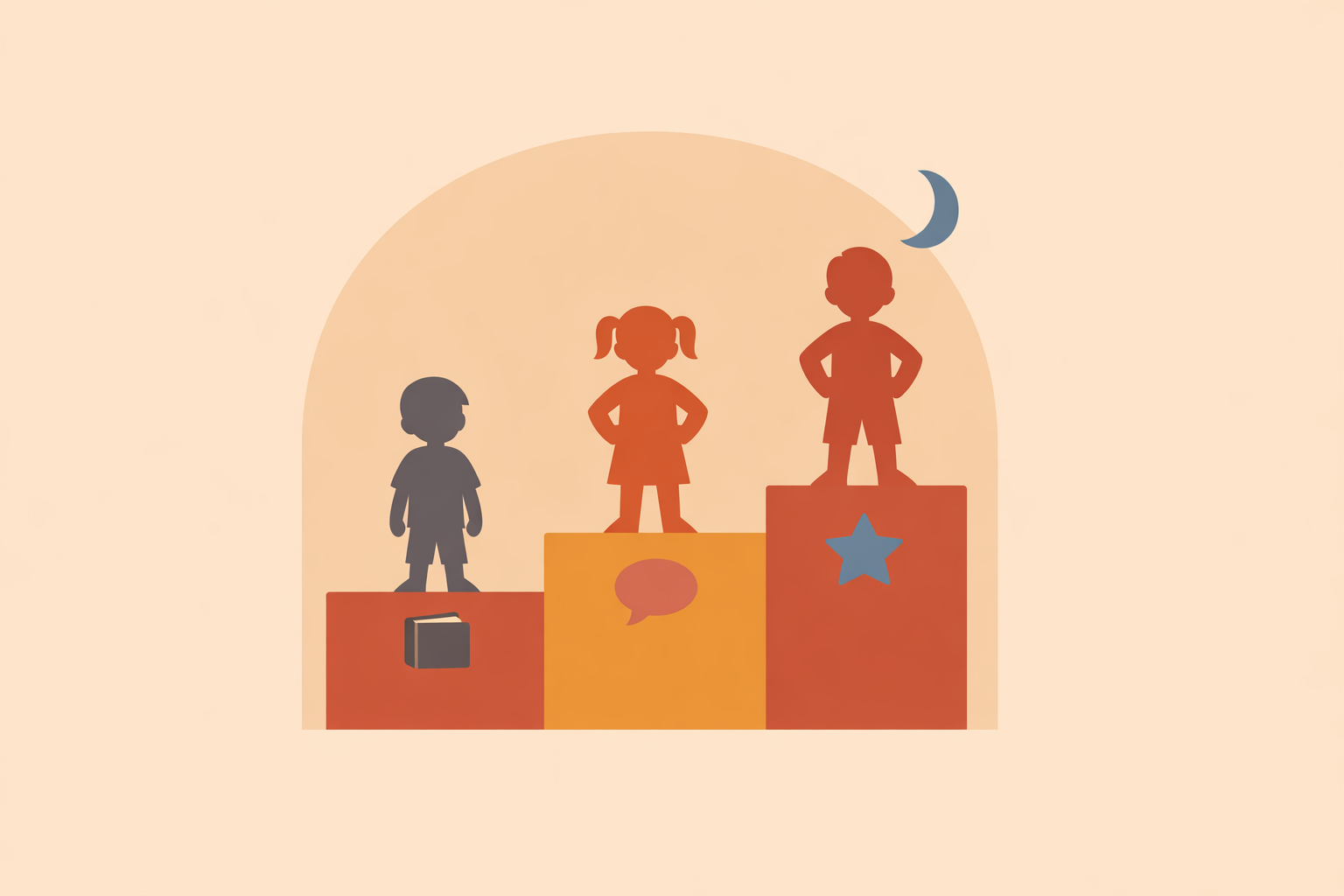
Child-focused practitioners often hear the same request from families: “We just want more confidence.” It sounds simple, but in real life it shows up as five different weekly struggles—homework meltdowns, playground hesitation, pre-recital nerves, quiet comparison after scrolling, or a new school that has thrown everything off.
That’s why generic “self-esteem” offers often feel vague to parents. Families invest in observable change, and children benefit most from targeted support. In practice, “confidence” isn’t one service—it’s a set of context-specific capacities that can be strengthened with the right kind of challenge, the right fit, and language that names exactly what you help a child do (without drifting beyond scope).
This more precise view matches what modern frameworks measure. SEL research separates outcomes like self-efficacy, perseverance, and optimism, which reflects what experienced practitioners already know: confidence changes depending on the setting.
So the journey moves where confidence most often wobbles—school, friendships, performance moments, digital life, neurodivergent fit, and big transitions. Across every niche, the throughline stays the same: graded challenge, a good match to the child, and coaching that turns “be brave” into doable steps.
Key Takeaway: Families don’t need a vague promise of “more confidence”—they need context-specific, observable outcomes. When you design offers around where confidence wobbles most (school, friendships, performance, digital life, neurodivergent fit, and transitions), graded challenge, child-environment fit, and clear coaching steps create repeatable wins.
Child Confidence Niche 1: Academic Confidence and the "Brave Learner"
Academic confidence grows best when children experience themselves as capable through small, real successes. Families often assume confidence comes from praise, but it more reliably comes from “I did it.” Doing things themselves—with steady support—builds the kind of inner sturdiness that carries into the next challenge.
That’s also why it’s more useful to praise what the child can repeat. KidsHealth recommends focusing on effort and progress rather than labels like “smart.” Essentially, labels can feel nice, but skills build a track record.
Many effective approaches return to the same foundations: mastery experiences, modeling, specific feedback, and emotional steadiness. Think of it like building a staircase—small steps, clearly seen, repeatedly practiced.
Traditional mentoring has carried this wisdom for centuries. In craft apprenticeships, oral learning traditions, and community skill-building, children weren’t pushed into the deep end and judged. They were guided through rhythm, repetition, and relationship. A modern Brave Learner offer works beautifully when it keeps that spirit.
“The goal of education is not to increase the amount of knowledge but to create the possibilities for a child to invent and discover.” — Jean Piaget
So the aim isn’t to make learning effortless. It’s to help children trust themselves enough to stay with the process.
Practically, this niche is strongest when it targets self-efficacy (“I can do this”) instead of vague self-esteem. SEL programs can strengthen self-efficacy and self-esteem, but the day-to-day wins look like: starting homework, asking for help, and trying again after a mistake.
When you design a “Brave Learners” offer, build experiences children can repeat:
- Stepwise challenges that turn school tasks into winnable stages
- Process praise focused on effort, strategy, and help-seeking
- Learning-profile adaptation so expectations better fit how the child engages
- Reset tools for frustration, shutdown, or pressure
That “fit” piece matters. KidsHealth notes children do better when adults match difficulty to the child. Put simply, confidence isn’t only something a child “has”—it’s also something the environment invites.
And for many children, the toughest part of school isn’t the worksheet. It’s the social world around it.
Child Confidence Niche 2: Social Confidence and Friendship Skills for "Shy-to-Ready" Kids
Social confidence isn’t about turning a quiet child into a loud one. It’s about helping children feel safe and skillful enough to enter connection in their own way, with enough practice that friendship stops feeling mysterious.
“Shy” can mean many things: not knowing how to join, fear of getting it wrong, or simply getting overwhelmed in groups. The entry point changes depending on the child’s “inside story.”
“There’s usually an ‘inside’ story to every ‘outside’ behavior.” — Fred Rogers
When coaching honors that inside story, children stop feeling pushed and start feeling supported.
SEL research links structured approaches with better perceptions of safety and inclusion. That aligns with what practitioners see every day: children take social risks when they feel safer, and when they have real skills—not when they’re told to be outgoing.
So this niche thrives on graded, real-life tasks: how to say hello, how to watch a group before entering, how to ask to join, and how to recover after an awkward moment.
Traditional communities have long used play as the training ground for belonging—circle games, storytelling, call-and-response, communal tasks. Modern practice can draw from that wisdom with respect: play isn’t a detour; it’s often the doorway. As one overview notes, play builds confidence because it lets children rehearse life in a low-pressure way.
“Every child wants to succeed. Every child wants to have a good relationship with others. Every child wants to have a sense of belonging and significance.” — Jane Nelsen
That belonging is the heart of it—and it’s built one doable moment at a time.
- noticing body signals before overwhelm
- using one or two reliable opening lines
- practising shared play (not forced conversation)
- debriefing what went well after real-world attempts
- building small, steady connections with trusted adults
Those adult connections matter more than people assume. SEL work shows stronger perceptions of safety and inclusion when caring relationships are present. Here’s why that matters: felt safety often comes first; courage follows.
And once a child risks being seen socially, the next challenge often arrives in brighter lights—sports, recitals, auditions, presentations.
Child Confidence Niche 3: Performance Confidence for Young Athletes, Artists, and "Little Presenters"
Performance confidence is built through preparation, rhythm, and recovery—not pressure. Children do better when they know what to do before nerves, during nerves, and after mistakes, whether they’re on a field, on a stage, or at the front of a classroom.
Families notice this one quickly: freezing, quitting, tears after an error, or avoiding opportunities they used to enjoy. The goal isn’t to erase nerves; it’s to keep access to skills even when the body is activated.
This is where deliberate practice and simple routines shine. Guidance for building confidence encourages adults to break goals into realistic benchmarks. What this means is the child gets a clear path: “Here’s what I do to prepare,” “Here’s what I focus on,” and “Here’s how I regroup.”
Traditional cultures understood this too—young people were often guided through steadying rituals before visibility or challenge. You don’t need to borrow sacred forms to apply the principle: familiar patterns calm the body and focus the mind.
A strong “Team Heart” or “Little Presenters” offer often includes:
- pre-performance rituals the child can repeat anywhere
- mistake recovery plans so one slip doesn’t become a spiral
- confidence cues like a phrase, gesture, or breath pattern
- behavior tracking that measures showing up and using the routine
Tracking behaviors keeps the work grounded. KidsHealth highlights the importance of emphasizing effort, progress, and attitude over outcomes. Put simply, children become brave by doing brave things repeatedly—not by waiting until they feel fearless.
Because performance environments can get intense, boundaries matter. Coaching ethics emphasize clear boundaries and role clarity, especially with young people, so the child’s experience stays central.
“Never miss an opportunity to make a kid feel better about themselves.” — often attributed in coaching circles
The deepest version of performance confidence isn’t polish. It’s self-trust under pressure.
Of course, today many children feel “on stage” even when they’re not performing at all. Their most relentless audience can be online.
Child Confidence Niche 4: Digital-Age Confidence and Online Self-Respect
Digital-age confidence is about self-respect, discernment, and boundaries. Children and preteens don’t just need warnings; they need practical skills for understanding what they see, how it shapes them, and how to stay rooted while using digital spaces.
Comparison now arrives quietly and daily. Work on social media and well-being highlights why critical thinking about online content matters—especially when curated images and popularity signals start to feel like “the truth.”
The most effective support here blends digital literacy, boundary setting, and reframing. Children benefit from learning how feeds are shaped, how privacy choices work, and why algorithms keep serving more of what hooks attention.
Traditional wisdom offers a steady compass in different words: not everything presented with confidence deserves your trust. The skill is staying centered.
A “Digital Self-Respect” offer can teach children to notice feelings after scrolling, name comparison spirals, pause before posting, and choose actions that match their values. Add emotional naming and self-compassion, and setbacks online become easier to hold.
“Putting your students' emotional needs first is important because without feeling safe and understood, no instructional strategy will be effective.” — Chandra J. Jasper
Online skills land best when children feel accompanied, not policed.
Families often do best when they build rituals, not just rules—device-free meals, evening check-ins, or reviewing content together. These can become modern “hearth practices,” giving children a place to process what they’re absorbing.
It also helps when adults model the same limits they teach. Clear agreements around platforms and communication align with sustainable boundaries. In a quiet way, your practice becomes part of the lesson.
And once you’re thinking in terms of fit and boundaries, an essential niche comes into focus: confidence work that truly supports neurodivergent children.
Child Confidence Niche 5: Strength-Based Confidence Coaching for Neurodivergent Children
Neurodivergent confidence work starts with fit, not fixing. Children often thrive when expectations, communication, and environments make space for how they actually process the world. From there, self-trust and self-advocacy can grow naturally.
Many neurodivergent children have heard subtle messages that they are “too much” or “not trying.” Ethical confidence work replaces that storyline with something more accurate: “Your needs are real, and we can build supports that help you participate with dignity.”
Environmental support is often the fastest way to create relief. Guidance notes that adjusting noise levels, movement opportunities, and visual supports can improve participation. Essentially, when the world becomes more workable, children don’t have to spend all their energy just enduring it.
“Challenging behavior occurs when the demands placed on a child outstrip the skills they have to respond adaptively to those demands.” — Ross Greene
That lens changes the coaching conversation from “What’s wrong?” to “What’s too hard right now, and what support would help?”
Traditional communities often held varied roles—deep observers, pattern-noticers, solitary makers, story-bearers. Remembering this can be healing for families: human groups have long relied on many kinds of minds.
In practice, strength-based support may include:
- environmental mapping to find what supports participation (and what drains it)
- self-advocacy language the child can use in everyday settings
- strength narratives that name real capacities without romanticizing struggle
- family collaboration to create consistency across home and school life
Ongoing learning helps practitioners offer better fit. Research on training in sensory processing suggests it can improve tailored support, which is one reason this niche rewards steady development.
Supportive environments can also strengthen well-being more broadly. SEL evidence highlights that strong settings can build competencies and reduce distress—a partnership model rather than a “fixing” model.
Integrity still requires scope awareness. Coaching ethics emphasize knowing your scope and using respectful referral pathways when needs go beyond coaching. Within those boundaries, this niche can be profoundly empowering.
When identity, belonging, and adaptation are centered, one final niche follows naturally: confidence during big life transitions.
Child Confidence Niche 6: "New Roots" Confidence for Big Life Transitions
Transitions are identity moments, not just scheduling changes. A move, a new school, blended family life, or cultural shifts can shake confidence quickly—and also deepen it when children are supported to build belonging and a coherent story about who they’re becoming.
In these seasons, children often ask silently: Where do I fit now? Who knows me here? What parts of me come with me? A “New Roots” approach meets those questions directly, instead of assuming adjustment will simply happen with time.
Structured support tends to work better than pep talks. SEL research links strong programming with better outcomes, including perceptions of safety, which matters enormously when everything feels unfamiliar.
Near-peer modeling can be especially powerful here. When a child meets someone just a little ahead of them who has already navigated the same change, “Maybe I can” starts to feel real.
“The key is the revelation of the psychology of the young child, the psychology of man in the first phase of his development.” — Maria Montessori
So transition support works best when it’s built around the child’s lived experience, not only the adult timeline.
This niche also calls for cultural humility. International work points to cultural differences in how social-emotional skills are expressed and valued. Confidence isn’t one look: some families value expressive assertiveness; others value humility, respect, and group harmony. Goals are strongest when co-created.
Ancestral wisdom can be a steady support during change. Rites of passage, migration stories, family narratives, and blessing rituals have long helped young people make meaning. The principle is what matters: creating grounded, respectful ways to say, “You are changing, and you still belong.”
Simple anchors often do the most:
- shared meals as steady points in the week
- regular check-ins that give children language for change
- personal story practices like “what I’m bringing with me”
- small rituals that mark first days, endings, and new beginnings
These “micro-roots” help children stay connected while the outer landscape shifts. And they underline the bigger truth: child confidence isn’t one thing—it’s a family of capacities shaped by context.
Conclusion: Choosing Your Child Confidence Niche (and Deepening Your Training) for 2026
The best child confidence niche is usually where empathy, lived interest, and practical skill meet. Whether you’re drawn to learning struggles, friendship skills, performance pressure, digital self-respect, neurodivergent fit, or transitions, the clearest path is choosing outcomes you can actually observe and support.
Instead of promising “higher self-esteem,” aim for behaviors families can see: starting homework, joining play, trying again after mistakes, using a settling routine, asking for what helps, or finding footing in a new environment. KidsHealth emphasizes tracking effort and attitude, which fits this practical approach well.
It also helps to remember that confidence work is rarely only about the child. The messages children hear from adults shape how they see themselves, and everyday routines shape a child’s inner world. That’s why many strong offers include family support alongside child sessions.
“One of the most important tools for parents is the power of observation.” — often cited in parent-coaching literature
Often, the turning point is simply learning to notice what’s really happening—and what helps.
From there, training becomes a natural next step. Strong SEL programs can improve academic and social-emotional outcomes, and sustainable practice is built on child development, cultural sensitivity, and professional boundaries, plus the discernment to refer out when needs go beyond coaching.
However you choose to specialize, the opportunity remains the same: helping children experience themselves as capable, connected, and worthy of support—and helping families recognize the small steps where confidence quietly becomes real.
Train in Child Psychology Coaching
Ground your confidence niches in developmentally sound tools with the Child Psychology Coach Certification.
Explore Child Psychology Coach Certification →










