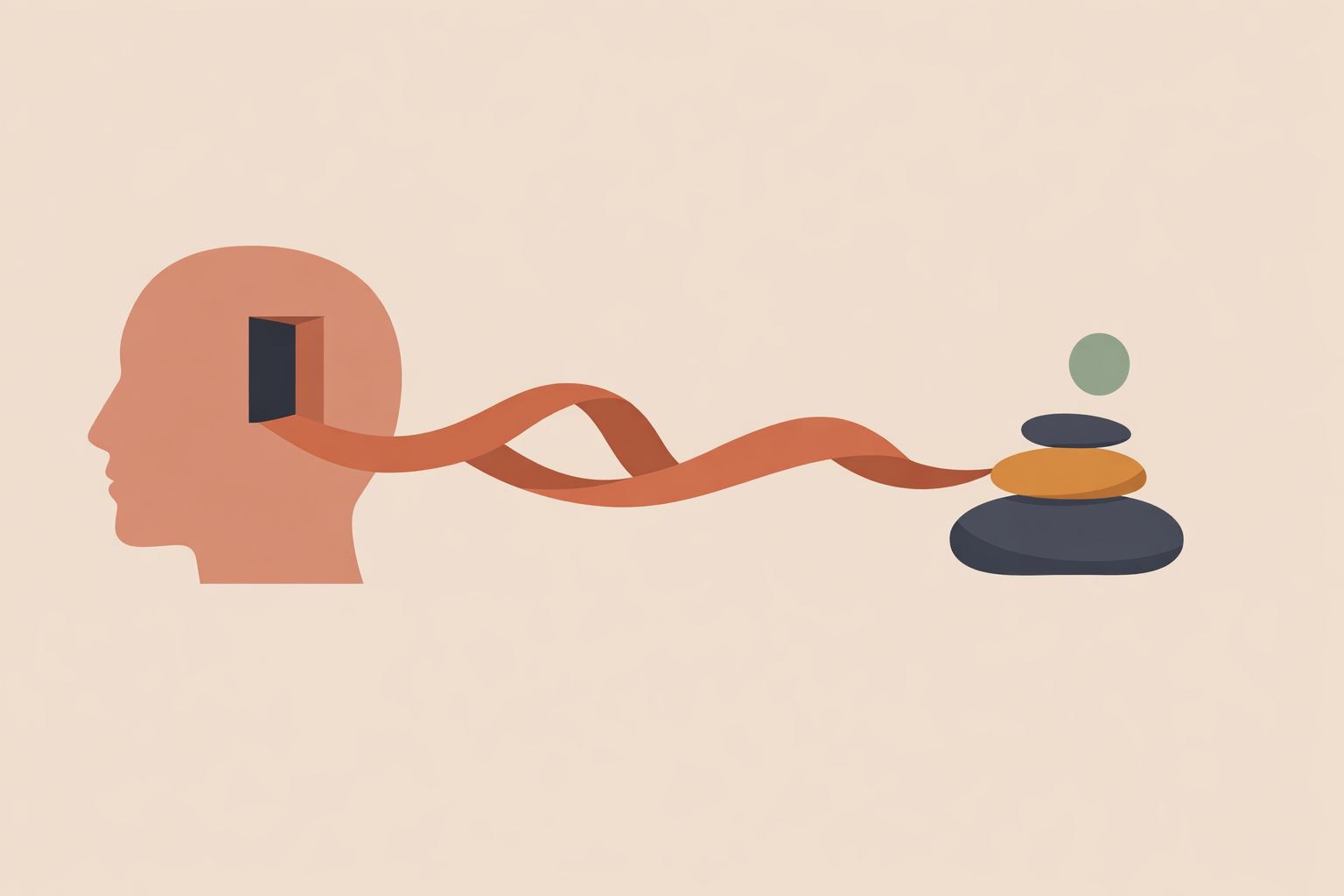
Integration coaches often hear the same themes: someone can’t stop replaying a breakup, second-guesses every decision, or feels strangely unmoored after a powerful ceremony. These Psychological challenges can look like confusion, anxiety, and difficulty carrying insights into everyday life. In real sessions, it frequently shows up as more analysis at the exact moment the person needs grounding, rhythm, and a simple way to make sense of what’s happening.
One of the most helpful names for this pattern is the default mode network (DMN). In coaching-friendly language, it’s the inner narrator: the part that tells the life story, replays the past, imagines the future, and keeps asking, “Who am I now?” Used as a plain-language map, DMN framing helps clients relax around their experience instead of getting pulled under by it—and it offers clean words for identity shifts, looping thought, and the swing between overthinking and openness.
Key Takeaway: Using DMN language as a plain, non-diagnostic map helps clients recognize when the “inner narrator” is looping or too diffuse, then shift from explanation into regulation. Grounding practices, light structure, and respectful ritual make insights easier to translate into steady daily choices without reducing the person to a brain concept.
How to translate “stuck in my head” into workable patterns
Clients already bring the raw language. The coach’s job is to reflect it back clearly and kindly, so it becomes usable.
- “I keep replaying the breakup.” → The narrator is looping through memory.
- “What if, what if, what if.” → Attention is pulled into imagined futures and social scripts.
- “I can’t turn off the critic.” → The inner storyteller has become overtrained and harsh.
- “I feel bigger, but also less solid.” → Identity is reorganizing after a strong experience.
Framed this way, the person isn’t being labeled—they’re being given a map. And a map points toward action: breath, movement, rhythm, song, prayer, story limits, place-based routine, and other practices that help attention settle into the present.
This approach also fits naturally alongside ancestral and traditional frameworks. Many lineages have long understood that stories create worlds, repeated thought shapes experience, and rhythm, prayer, song, and nature can soften the grip of obsessive narration. Neuroscience offers one language for that; traditional knowledge offers another. Skilled coaching can hold both without forcing either one to dominate.
Practices like prayer, song, movement, and nature time can soften looping narrative and increase presence. Research points to reduced rumination and more present-centered awareness with contemplative and nature-based practices—something many practitioners recognize from lived experience long before it’s described in a paper.
Meeting the brain’s storyteller: identity, narrative, and the DMN
The DMN isn’t only “mental chatter.” It also supports a felt sense of self—how a person knows themselves across time. Broadly, it integrates memory and future projection into a coherent “me.” Think of it like the thread that stitches yesterday, today, and tomorrow into one story.
That’s one reason powerful experiences can feel both liberating and destabilizing: the usual self-story loosens, and something larger—or simply less defended—can come forward. Research suggests psychedelics can disrupt integrity in this network, which helps explain why people may feel freed from old identity grooves while also briefly disoriented by what opens up.
Sometimes the storyteller is too loud; sometimes it becomes unusually quiet. Both can be workable, and both are often best met with steady, respectful integration coaching rather than alarm.
In session, you can hear identity forming in real time:
- “I’m the one who holds everyone together.”
- “I’m the one who ruins things.”
- “I saw a version of myself that felt gentle.”
- “I don’t know who I am without the old story.”
These aren’t just thoughts—they’re identity statements. The aim isn’t to erase them, but to right-size them so the client regains choice.
A simple structure can help make the story visible:
- Title. Name the current life chapter as if it were a story.
- Tone. Notice how the narrator sounds: harsh, frightened, wise, exhausted, devotional, skeptical.
- Thread. Choose what thread to keep feeding, and what thread to stop feeding.
“The essence of integration lies in maintaining an openness to receive lessons from the psychedelic experience,” as one support community reminds us.
That openness is much easier to sustain when it’s tied to small, repeatable acts: a morning prayer, a short walk, one evening song, a brief check-in with a trusted person, a written intention near the bed. Big insight often needs a modest container.
When the narrator is too loud or too diffuse
After powerful experiences—and during heavy rumination—two broad patterns show up again and again.
If the narrator is too loud, it often sounds like:
- “I can’t stop analyzing.”
- “Every choice turns into a spiral.”
- “I keep retelling the same story.”
Here, the priority is usually not more interpretation. It’s rhythm, sensation, and present-time contact. Slow exhale breathing, humming, steady walking, hand pressure, drumming, prayer repetition, or simply orienting to the horizon can shift attention in a clean, immediate way. Research suggests slow breathing may decrease activity in default mode regions while supporting more here-and-now awareness.
If the narrator is too diffuse, it often sounds like:
- “I feel open, but not solid.”
- “Everything changed and now I don’t know how to organize myself.”
- “Part of me feels free, part of me feels unmoored.”
In that state, anchors matter: name, values, kinship, place, and purpose. Gentle structure helps too—sleep, regular meals, repeated daily markers, and a few simple responsibilities can restore continuity without forcing someone back into an old, rigid identity. When sleep disturbance is present, emotional steadiness is often harder to maintain, so strengthening routine becomes even more important.
It also helps to remember that both over-activity and under-activity in this network can challenge coherence. Reviews connect altered DMN patterns with self-processing disruptions. For coaches, the practical takeaway is simple: the aim isn’t silence—it’s balance.
Simple practices that help clients rebalance attention
Once the pattern is named, the next step isn’t a lecture—it’s a practice. The most helpful options tend to be short, embodied, and easy to repeat.
Here’s a simple “Network Balance Kit” to adapt in session:
- For a loud narrator: six slow breaths with long exhales, eyes on the horizon, name five sounds, then hum for 20 seconds.
- For a diffuse narrator: say your name aloud, feel your feet, name one value, remember one elder or mentor, then choose one task for today.
- For either state: move from storytelling into action by asking, “What is one thing that would help you feel more here?”
Rhythm- and sensation-based practices often work especially well because they interrupt abstraction without asking the person to “solve” themselves first. Steady walking, long-exhale breathing, humming, and repetitive movement can be surprisingly reliable bridges back into presence.
Story hygiene matters too. Limiting repetitive retelling to a small number of compassionate listens each day can reduce looping and create room for action or rest. This is classic practitioner wisdom: there’s a difference between meaningful witnessing and feeding a spiral.
Light-touch self-tracking can support learning. A client might rate rumination or groundedness before and after a brief practice a few times a day for a week. The point isn’t perfection—it’s noticing what reliably shifts their state. Over time, that builds confidence and choice. Research on mindfulness suggests connectivity can change over time in ways that support less narrative fixation and more present-centered awareness.
Bridging neuroscience with tradition, ritual, and place
The most grounded integration work doesn’t pit modern language against older ways of knowing. It lets them reinforce each other.
A DMN frame can sit comfortably beside traditional teachings about prayer, rhythm, land, breath, and story. If a client comes from a lineage where songs carry memory, proverbs shape conduct, or repeated walks are a way of listening, those are not “extras.” They’re central supports—and they often bring the kind of belonging that makes change sustainable.
Some practical pairings:
- Breath + word: pair a slow exhale with a prayer, mantra, or proverb that genuinely belongs to the client’s own world of meaning.
- Movement + place: walk the same local path daily to knit continuity through repetition and contact with place.
- Sound + reflection: end the day with a song, then write three sentences that honor the day without reopening every loop.
When regulation practices join lineage-based meaning, they often land deeper—because they link the nervous system to belonging and memory. Daily place-based routines can be especially steadying: physical activity supports well-being over time and can help reestablish continuity day by day.
The ethical point stays simple: credit roots, avoid imitation without context, and stay in consent. If a practice comes from a living tradition, it deserves respect. If it does not belong to the coach, it should not be repackaged as personal invention.
Keeping the work grounded and within scope
The DMN is a helpful map, not the territory. It can explain inner narration, identity shifts, and attention patterns in clear language—but the person always comes before the concept.
In practice, that often means:
- Name the pattern without judgment.
- Offer a short reset before deeper reflection.
- Translate insight into one concrete action.
- Use rhythm, ritual, and routine to support continuity.
- Track what genuinely helps rather than pushing intensity.
It also means holding firm boundaries: avoid promises, avoid grand interpretations, and respect culture, consent, and pace. When someone needs a form of support beyond coaching, help them connect with appropriate local services. Integrity includes knowing when to walk alongside someone—and when to point them toward a different kind of care.
Above all, this work is about helping people live what they learned. Some days the narrator needs softening; some days it needs strengthening. And some days, the next right step is simply a slower breath, a steadier walk, and one honest sentence about what matters now.
Train in Integration Coaching
Apply DMN-informed practices with ethical structure in the Psychedelic Integration Coaching Certification.
Explore the Certification →