Live sessions move fast. You’re tracking story, emotion, posture, and a sense of safety—while deciding whether to slow down, ask more, or help someone settle. In all that complexity, the simplest cues are often the most helpful. Breath location is one of them.
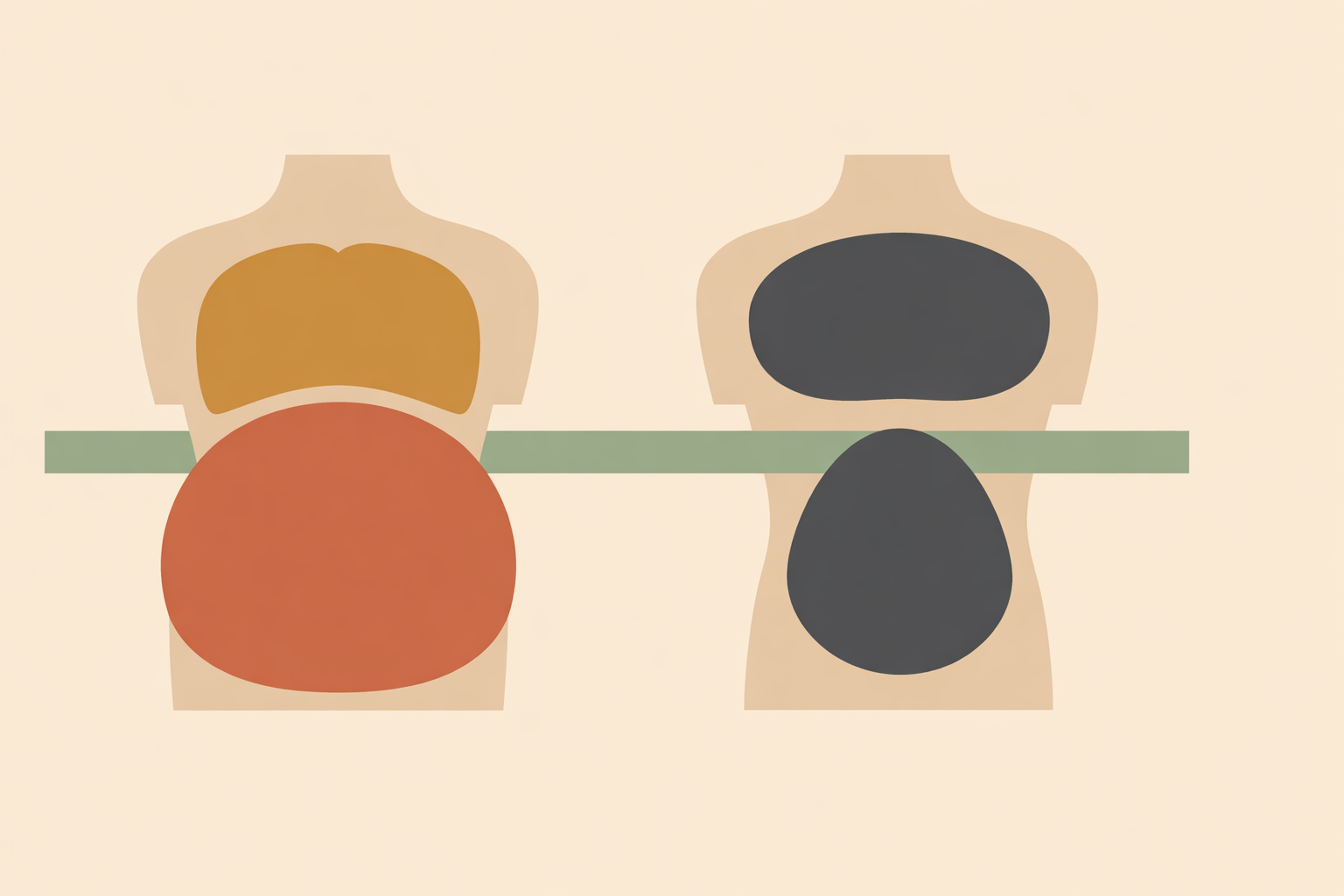
Where the breath “lands”—mostly in the belly and lower ribs, or mostly in the upper chest—can offer a quick, respectful read on state. In many sessions, belly-led breathing goes with more steadiness, while chest-led breathing often travels with mobilization, guarding, or a higher stress load. Slow, diaphragmatic breathing is associated with parasympathetic activity, which helps explain why this pattern is so informative in real time.
Key Takeaway: Breath location offers a fast, respectful read on moment-to-moment regulation: belly-led breathing often signals steadiness, while chest-led breathing can indicate mobilization or strain. By tracking where movement begins, plus pace and depth, you can pace the session and suggest small, consent-based shifts.
How to spot belly breathing vs chest breathing in under 30 seconds
You don’t need a long protocol. A quick look at pace, depth, and location is usually enough to orient yourself.
At rest, belly-led breathing shows movement through the abdomen and lower ribs, with little lift in the upper chest and shoulders. Diaphragmatic breathing recruits lower lung regions, which is why the lower torso often leads when this pattern is available.
A simple hand cue can make this clearer: invite one hand on the chest and one on the belly. If the lower hand leads, you’re likely seeing a diaphragmatic pattern. If the upper hand leads, the pattern is more chest-dominant.
“Placing one hand on your upper chest and the other just below your rib cage allows you to feel the diaphragm move... the goal is to keep the chest hand as still as possible.”
As you watch, keep it simple:
- Which area moves first: upper chest or lower ribs and belly?
- Are the shoulders quiet or lifting?
- Is the breath shallow and fast, or slow and easy?
- Does the abdomen move freely, or does it seem held?
- Does the person look comfortable, or subtly strained?
In practice, this read can be surprisingly useful, especially when combined with what you’re hearing and seeing elsewhere. It’s not a perfect “autonomic score,” but it’s a strong coaching signal—both in person and online.
What belly-led breathing often tells you
When the belly leads during ordinary conversation, it often suggests more available regulation. Many practitioners associate it with steadier emotions, clearer pacing, and fewer sudden spikes of activation.
There’s also a practical mechanical reason it can feel easier: belly and lower-rib expansion can improve ventilation efficiency and support a slower rhythm. Put simply, the breath can feel more “complete,” with less of the reaching sensation that sometimes comes with hurried upper-chest breathing.
Traditional breath teachings often describe this as a steady resting pattern—quietly organized rather than dramatic. In lived practice, people who can access the lower breath more easily often look more resourced in conversation, too.
Research also aligns with what many practitioners observe: diaphragmatic breathing training has been linked with reduced negative affect and steadier attention.
“Our findings suggest that practicing diaphragmatic breathing can improve sustained attention and decrease cortisol levels.”
Some practitioners also frame diaphragmatic breathing as the most energy-efficient resting pattern. That view is largely rooted in training traditions and repeated session experience—and as a working concept, it’s often useful: when the lower breath is available, the whole system tends to look like it’s working less hard.
What chest-dominant breathing may reveal about stress load
Chest breathing isn’t “wrong.” It’s a capable pattern for action, effort, and immediate response. The key question is whether it stays dominant when the moment no longer calls for it.
At rest, chest-dominant breathing often suggests a higher stress load or guardedness. Clinical guidance commonly notes upper-chest breathing alongside anxiety and stress, while diaphragmatic breathing is frequently used to help settle arousal.
In sessions, you may notice lifted shoulders, visible effort through the neck, or an abdomen that looks braced rather than responsive. Over time, many practitioners also hear reports of upper-body tightness and fatigue when this pattern is a default.
Chest-first breathing can also travel with a faster pulse and a more anxious mindset. Slow breathing around six breaths per minute has been associated with improved HRV and less anxiety, which helps clarify the broader relationship between breath rhythm and state.
People often describe this as “breathing high” or “not getting a satisfying breath.” Essentially, when the lower breath is underused, the system may keep reaching for more air instead of settling into a slower, fuller rhythm.
Reading shifts during a session
Breath location becomes especially useful when it changes. Someone may begin with a belly-led rhythm, then move into chest breathing as a topic becomes tender, demanding, or emotionally charged.
That upward shift often acts like a live marker of rising activation—shoulders lift, the upper chest leads, or a brief breath-hold appears around a difficult moment. Think of it like a weather change you can see: it doesn’t tell you everything, but it tells you something important right now.
The reverse shift matters too. When the breath returns toward the belly, it often signals that more ease and self-regulation have come online. Many experienced practitioners recognize that moment as “more choice is back.”
If you choose to support the transition directly, brief slow belly breathing can help. Breathing at about six breaths per minute has been shown to reduce subjective anxiety and increase vagal markers in healthy adults.
Diaphragmatic breathing training has also been associated with cognitive and emotional regulation, which is one reason small, well-timed breath interventions can lower intensity without turning the session into a formal practice.
How to guide micro-shifts with consent
Once you notice the pattern, gentle guidance tends to work better than correction. The aim isn’t to force calm—it’s to widen awareness and offer another option.
Collaborative, concrete language usually lands well:
- “Would you like to try a short breath experiment?”
- “Notice which hand is moving more right now.”
- “Let’s see what happens if the lower ribs soften and widen a little.”
- “Only two or three slower breaths—no need to force anything.”
- “If it feels off, we stop.”
Keep the intervention small and achievable:
- Lengthen the exhale slightly.
- Invite breath into the lower ribs rather than the upper chest.
- Use a supported seated or reclined position first.
- Try gentle pacing, such as in for 4 and out for 6, for 60 to 90 seconds.
Where appropriate, the hand-on-chest/hand-on-belly cue helps people feel the difference directly. That kind of embodied “breath literacy” often sticks better than a long explanation.
For at-home practice, brief and consistent usually beats intense. Many breath educators start with short, repeatable periods—especially for beginners and when choosing breathwork styles.
Belly breath in traditional lineages and modern research
Belly-led breathing isn’t a new discovery. Traditional systems have centered it for generations, each with its own language and philosophy.
In yogic pranayama and East Asian hara or dantian traditions, the belly is often treated as a foundation for steadiness, meditation, martial discipline, and energy cultivation. Physiological analyses of pranayamic breathing describe slow deep breathing with abdominal emphasis as central to these practices.
This convergence is worth respecting. Traditional knowledge arrived through long observation and disciplined practice, and it remains a meaningful body of evidence in its own right. Contemporary research can clarify mechanisms, but it doesn’t replace the lineages that preserved and refined the work.
Holding both perspectives creates a grounded approach: honor ancestral teachings, stay evidence-informed, and be clear about what’s well-established, what’s emerging, and what’s primarily practitioner knowledge.
Using breath location well in practice
A quick look at breath location can change the quality of a session. It helps you sense whether the pace is workable, whether more settling is needed, and whether a smaller intervention might be wiser than a bigger one.
Used well, this isn’t about labeling someone. It’s about meeting the moment with accuracy and respect. Chest breathing can reflect effort, protection, or overload. Belly breathing can reflect ease, organization, or returning steadiness. Both patterns are meaningful.
As the VA Whole Health team summarizes, “Breathing can be a useful tool for quieting sympathetic arousal.” Let that keep your approach clean and humane: observe, ask permission, invite a small shift, and watch what changes.
Finish with care. Avoid pushing for bigger breaths than the person wants. If light-headedness, tingling, or distress shows up, stop and return to easy, natural breathing. The goal isn’t performance—it’s more choice, more awareness, and a steadier relationship with the moment, especially with breathwork safeguards in mind.
Train Breathwork Practitioner Skills
Apply these session cues with more confidence in the Breathwork Practitioner certification.
Explore Breathwork Practitioner →