Coaches supporting neurodivergent clients often meet the same pattern: a new board feels promising, it works for a few days, and then it quietly fades. Time still feels foggy, transitions still spike stress, and the same logistics get repeated at home or in a team.
Visual planning boards earn their place when they make time, tasks, and choices visible in the simplest form the person will actually use. In neurodiversity-affirming work, “progress” isn’t just more output. It’s more ease, clearer options, and energy that lasts.
Key Takeaway: Visual planning boards work best when they reduce uncertainty and executive-load by making time, transitions, and next steps visible in a low-effort format. Track progress by felt outcomes—initiation, transition ease, energy, communication load, and self-advocacy—rather than task totals alone.
Why neurodivergent coaches use visual planning boards
Visual planning boards reduce uncertainty by turning “invisible time” and competing demands into visible, pointable steps. When the plan is out in the open, it often calms the whole environment: memory is externalized, progress is easier to see, and decision fatigue tends to soften.
For many autistic and ADHD clients, time can feel abstract and slippery. Research describes atypical time perception in autism, including challenges with estimating and managing time in daily life. Converting time into coloured blocks, icons, and short sequences gives the day edges—something the mind can hold—and can support time awareness.
Once time and tasks are on a wall or screen, the board can carry the mental load. As one ADHD planning guide puts it, “Assign specific colours to different areas of your life… A physical wall, door, or board covered with sticky notes can serve as an external memory system.” Many coaches see the same thing in practice: when planning moves outside the head, stress often drops with it.
Simple structures usually win. Moving tasks through To-Do, Doing, and Done helps people perceive progress even on uneven days. Physical vs. digital matters less than whether the board stays visible, easy, and repeatable.
From invisible time to visible pathways
Across traditional cultures, people have long mapped time and sequence with marks, beads, knots, and calendars to steady the mind before action. A visual planning board is a modern cousin of that same human instinct: give the day a shape you can return to when things get noisy.
In coaching spaces, even small structure can change the feel of the work. As our coaching team often says, a simple agenda and timer can make the session steadier; a gentle “check-in → create → integrate” arc offers both reliability and room to breathe.
That’s the deeper value of visual tools in neurodiversity-affirming practice: fewer surprises, more choice, and a steady reference point when attention, energy, or sensory load shifts.
Redefining progress: less friction, more autonomy
Progress isn’t “more tasks done at any cost.” In neurodiversity-affirming coaching, progress looks like less friction, more self-direction, and energy that lasts beyond Friday.
Where boards often shine is day-to-day ease: getting started with fewer prompts, shifting between activities with less charge, and leaning less on someone else to hold the plan. Think of the board as scaffolding—supporting independence without making life feel like a performance.
Energy is a metric, not an afterthought. If task counts rise while calm and autonomy fall, the board isn’t doing its job. Sometimes the first change isn’t behaviour but clarity: the client spots patterns sooner, names what overloads them, or chooses a kinder pace.
The anchor is the person’s own sense of a good week: manageable, aligned, and respectful of their energy rhythms.
Defining a good week together
Co-create a light definition of success that protects dignity and consent:
- Ease: fewer stuck moments and gentler transitions
- Clarity: the plan feels understandable at a glance
- Choice: real options to move, pause, or swap when energy shifts
- Voice: visible self-advocacy, such as asking for a time shift or buffer
- Sustainability: the board is used without pressure, dread, or shame
This reframing matters. A board is there to support participation and self-trust—not to become a scoreboard.
Choosing a visual planning board that fits the client
Match the board to the person’s processing style, transition profile, and sensory needs, then keep the format as simple as possible. The “right” board is the one they can and want to use—most days, in real life.
Start with the sticking point. If transitions are the hard part, a compact plan showing only now and near-next is often enough. If working memory is the pinch point, an always-visible one-page view can reduce load without over-structuring the day. If sequence gets lost, short icon routines often land better than long written lists.
Common board formats and when to use them
- Now/Next: Best for transitions. Showing only the current activity and the next step can reduce uncertainty and ease stress around switching.
- First/Then: Helpful when initiation is hard, especially with non-preferred tasks. A First/Then format can improve initiation by linking one clear step to a preferred or regulating activity.
- Icon routines: For morning or evening flows, 3–5 steps are often enough. Short picture sequences can reduce prompting and support more independent follow-through.
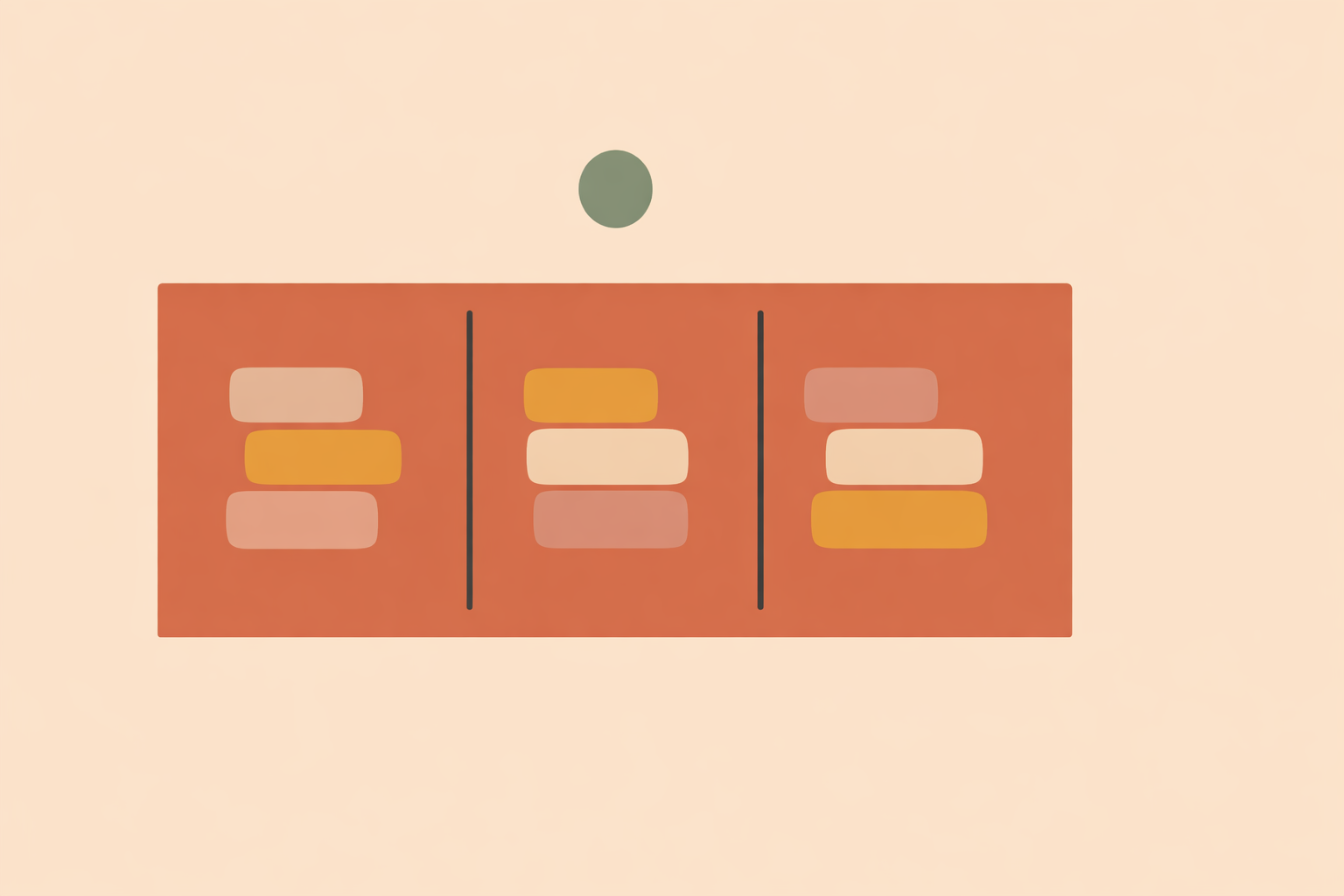
- Kanban: A simple To-Do / Doing / Done layout works well when the client benefits from seeing movement. Visual boards help make progress visible, which matters on uneven days.
- One-page day or week: Useful when working memory is the main challenge. An always-visible one-page view can reduce cognitive strain by keeping the whole plan in sight.
Format includes the “language” of the board: words, symbols, photos, or even objects. Many practitioners find multimodal boards are easier to read than text-only systems for visual processors. What matters most is low effort: the board should be readable without strain in the person’s real sensory world.
Physical or digital? Consistency matters more
Physical or digital matters less than whether the board stays in view and gets touched regularly. Visual support guidance commonly emphasizes keeping tools visible and accessible rather than insisting on a single medium.
So choose what fits daily life:
- a whiteboard in the kitchen
- sticky notes by the desk
- a tablet on a stand
- a simple app left open on the home screen
If the tool disappears, it stops supporting. Visible beats sophisticated.
What to track weekly on a visual planning board
Track what actually shows the board is helping: initiation, prompts, transitions, energy, and communication load. Keep it supportive, not surveillance-based.
A good weekly snapshot includes both action and regulation. Did the board make it easier to start, switch, and land? Did it reduce stress, confusion, or repeated negotiation? Those signs usually matter more than raw task totals.
Seven weekly signals to watch
- Task initiation: Did getting started feel easier this week?
- Prompts needed: Coaches often notice reduced prompt dependence when a board truly fits.
- Transition ease: Were switches between activities gentler, faster, or less charged?
- Energy and overwhelm: Did planning protect energy and reduce spikes of overload?
- Task switching: Was it easier to postpone, swap, or break steps down without shame?
- Communication load: In families or teams, did the board reduce repeating, negotiating, or nagging?
- Self-advocacy: Did the client ask for a buffer, break, swap, or different timing?
Keep logging minimal: a date plus one or two notes is often enough. Essentially, you’re tracking guidance for next week—not building a record.
Turning the board into a weekly ritual
A gentle rhythm keeps a board alive. Brief daily touchpoints plus a short weekly review are usually enough. The goal isn’t perfect compliance; it’s reflection, pattern-spotting, and small compassionate adjustments.
- Morning: Scan the board, choose one true priority, and add one buffer.
- During the day: Move a card once or twice, rename a step if it’s unclear, and park surprises in a Later space.
- End of day: Close loops, move leftovers kindly, and note one thing that made the day easier.
- Weekly review: Ask, “Did this board make life easier?” Then adjust only what needs adjusting.
Week-to-week reviewing reduces reliance on memory and makes planning more grounded. It also helps separate “didn’t do it” from “couldn’t do it yet,” which makes room for curiosity instead of blame.
Many coaches also work visually during sessions. As one visual coach describes: “It’s a standard session with one addition: as we talk, I’m drawing… By the end of the session you have a visual map of where we went.” That kind of living map can easily become next week’s board—co-created, not imposed.
When visual boards backfire
Boards backfire when they shift from supportive to heavy: overdesigned, rigid, or treated like a rulebook. When that happens, the best move is usually to simplify—fast.
Early signs include avoidance, perfectionism spirals, dread about updating the board, and guilt when it falls behind. Overbuilt systems can quietly increase executive-function load: they look organized, but they cost too much to run.
Rigidity is another common problem. If the board feels like law, distress rises when plans change. That’s usually the moment to shrink the system, not push harder.
How to simplify a board quickly
- Cut features: Remove colour-coding, extra lists, or unnecessary categories.
- Reduce visual noise: Less clutter often makes the board easier to read and use.
- Add a Plan B lane: A visible backup space reduces the sense of failure when plans change.
- Track fewer things: Log only one or two signals that guide next week’s decisions.
- Pause and relaunch: If dread is high, stop for a few days and restart with a minimal format.
- Return to consent: The board should be offered, adapted, and shared in a way that respects the client’s agency.
When in doubt, simplify again. A smaller, kinder board often restores trust faster than a better-designed complicated one.
Visual planning boards, one week at a time
Visual planning boards help many neurodivergent clients turn fog into form by making time visible, choices tangible, and next steps kinder. The secret isn’t complexity—it’s fit.
Simple formats used regularly often outperform ornate systems because they reduce overall load. As you apply this, look for the felt signs of progress: more clarity, calmer transitions, lighter communication, and greater independence.
If stress rises, cut the system in half and try again. A low-pressure starting experiment is a one-page Today / Doing / Done board reviewed in about five minutes. One board, one week at a time, is often enough to create meaningful change.
Neurodiversity Coach Certification
Apply these board strategies in practice with the Neurodiversity Coach Certification.
Explore Neurodiversity Coach Certification →