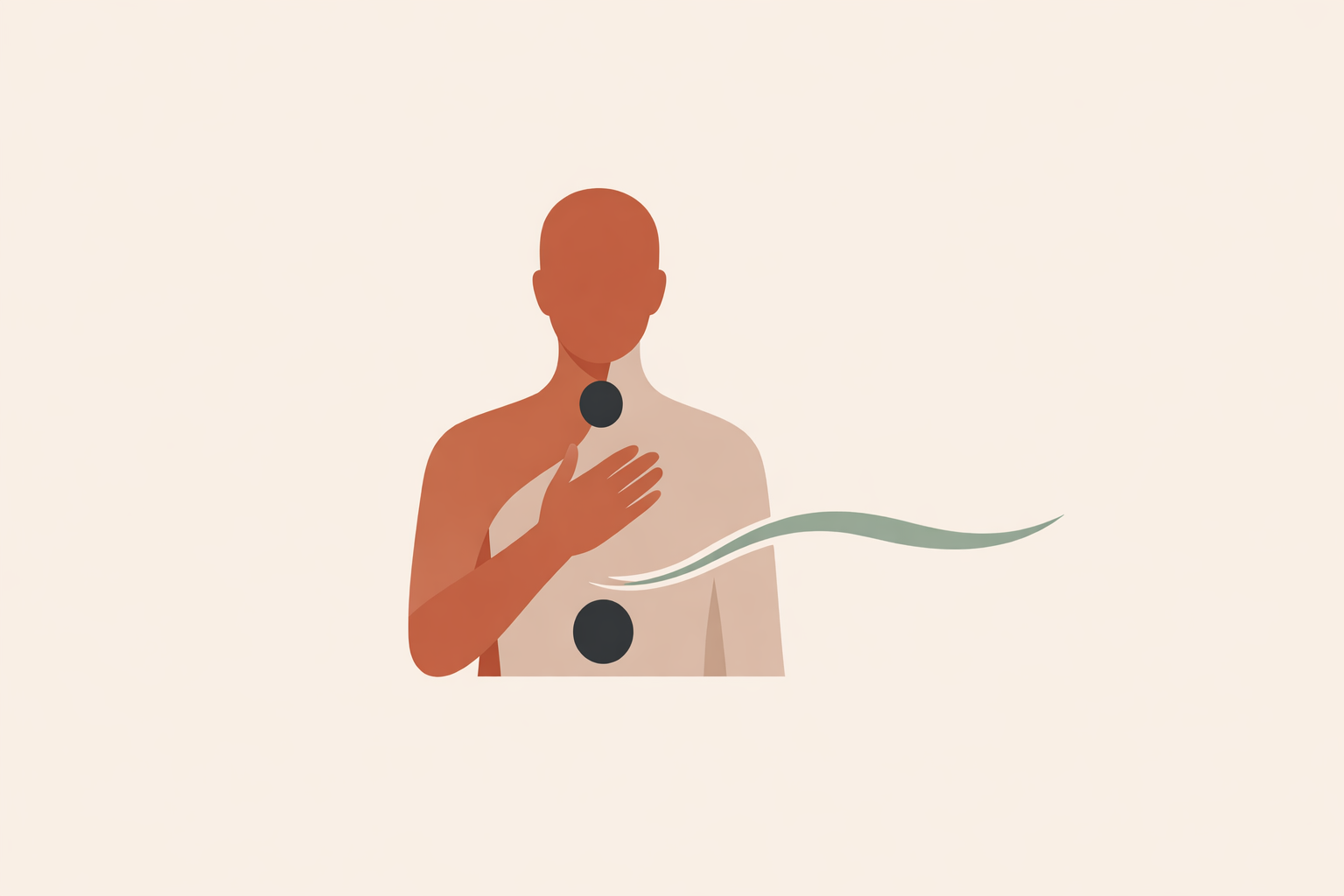
Most coaches find the toughest part isn’t what happens during a session—it’s what happens after. A client can feel grounded with you at 10 a.m., then feel flooded again at 3 p.m. when a message lands, the commute stalls, or family pressure rises. What sometimes gets labeled “non-compliance” is more often a mismatch between a practice that worked in the calm of session and the intensity of real life.
When follow-through dip, the practical challenge is simple: support has to survive busy, interrupted days. That’s why body-first, low-friction practices matter. The goal isn’t a perfect routine—it’s a small, usable skill someone can still remember when under pressure.
The most reliable tools are brief, sensation-led, and easy to repeat. They ask for little setup, create little pressure, and travel well into ordinary moments: before email, during a tense conversation, in the car, or while standing in a queue.
Key Takeaway: Between-session regulation is more reliable when clients use tiny, body-led practices that still work under real-life pressure. Keep tools short, sensation-based, and easy to repeat, then pace them gently, personalize to patterns and culture, and reinforce them with a repeatable session structure.
2. Start with the body: interoception, proprioception, and present-moment cues
Body-first work is practical because emotional shifts are tightly linked to inner state. Essentially, the system often signals change through sensation before a person can make sense of it in words.
Emotions closely track changes in the autonomic system. That’s why sensation-level awareness matters: bodily sensations can be the earliest usable cues—tightness in the throat, buzzing in the chest, heaviness in the limbs, warmth in the face, pressure in the jaw.
This is where interoception and proprioception become foundational. Interoception helps someone notice inner signals like fluttering, holding, numbness, or warmth. Proprioception helps them feel weight, position, support, and contact with the ground. Together, they return attention to what’s immediate and workable.
Immediate sensation can interrupt spirals and reduce overwhelm. And naming sensations often softens activation and restores choice. In everyday practice, that can be as simple as: “My chest feels tight.” “My hands feel cold.” “There is pressure behind my eyes.”
Traditional breath and movement lineages have refined this body-led approach for generations, and modern evidence increasingly mirrors the same point: interoceptive awareness supports clearer emotional tracking and steadier states.
As one editorial team notes, body-based work helps people catch the earliest whispers of activation before they swell. Or, in the words of Strozzi-Heckler, the heart of this craft is guiding people to feel the animating force of life moving through them.
3. Build micro-practices people will actually use
The best between-session practices are easy to remember under pressure. Think of them like a pocket tool: one to three steps, under two minutes, discreet enough for public or work.
Breath is a strong starting point because it’s portable and familiar. Longer exhales can be taught quickly, used almost anywhere, and are associated with more settling and ease.
Orientation is another reliable tool. Looking around, naming a few colors, and feeling the support of a chair or the floor can widen attention when it has narrowed around pressure. Grounding that draws on external sensory detail can help shift from threat-fixation toward wider awareness.
I usually design micro-practices around a few core principles:
- Simple: one to three steps only
- Short: easy to complete in under two minutes
- Portable: usable seated, standing, or walking
- Sensation-led: anchored in what can be felt now
- Flexible: adaptable to secular or spiritual language
- Low-friction: no special setting required
Examples I often use:
- Longer Exhale x3: Notice the breath. Inhale softly. Exhale a little longer than the inhale. Repeat three times.
- Three Points of Support: Feel feet. Feel seat. Feel hands. Then notice one thing you can see.
- Jaw-Shoulders-Eyes: Unclench the jaw. Let the shoulders drop. Soften the eyes and widen the gaze.
These aren’t dramatic interventions—and that’s the point. Small practices become familiar, and familiarity is often what makes a practice feel trustworthy in the moments it’s truly needed.
4. Build steadiness gently: titration, pendulation, and choice
Capacity tends to grow in small, rhythmic doses. Rather than pushing intensity, it’s usually more supportive to touch the edge of activation and then return to something steadier—like dipping a toe in and coming back to the shore.
This is where titration and pendulation help. Titration means approaching charged material in small amounts. Pendulation means moving between activation and ease, or between discomfort and support. Both are longstanding practitioner tools for building steadiness over time.
A simple between-session version might look like this:
- Notice one mild sensation linked to the challenge.
- Stay with it for one or two breaths.
- Shift attention to support: feet on the floor, the chair behind you, or a neutral area like the hands.
- Repeat for two or three rounds.
- Finish on the more resourcing sensation.
How you name the experience matters, too. When activation, numbness, or resistance are understood as protective adaptations rather than personal failures, shame often loosens. Support that normalizes reactions can help people stay engaged and willing to practice.
Steadiness is built through structure: clear pacing, genuine choice, permission to stop, and practices that can be adjusted in the moment.
The same principle appears across ancestral traditions that work carefully with breath, rhythm, posture, and attention: steadiness grows through respectful repetition, not force.
5. Personalize by pattern and cultural roots
One size rarely sticks. A practice becomes far more usable when it matches the person’s patterns, preferences, and cultural meaning-making.
For shutdown or collapse patterns, long stillness or eyes-closed focus can sometimes deepen disconnection early on. In those moments, gentle movement and outward orientation are often more supportive: standing up, turning the head slowly, looking around the room, or taking a brief walk.
For hyperarousal, slow breathing with a slightly longer exhale plus simple sensory grounding is often a better fit. By contrast, rapid breathing can mimic hyperventilation, so it’s usually not the best starting point without direct guidance.
For chronic pain or shame, it often helps to begin with neutral sensations rather than going straight into the hardest areas. Hands, feet, or the support of the chair can be more workable entry points, especially with explicit permission to stop early.
For attention challenges, people often do better with tiny movements and visible prompts placed at natural pause points: near a screen, beside a kettle, on the dashboard, or by the front door. The guiding idea stays the same: build for the life they actually live.
Cultural meaning matters just as much as patterning. Prayer, song, drumming, ritual movement, time in nature, or other inherited practices may already offer a living pathway into steadiness and connection. Cultural adaptations often improve engagement because they feel relevant rather than imposed.
As Maude Burger-Smith puts it, when we return attention to the body, we are noticing where the story has been stored. When that process is held with cultural respect, the work often becomes both deeper and gentler.
6. Turn the session into a repeatable template
A good session does more than create insight—it gives someone a shape they can repeat later on their own.
Consistency helps. Repeating the same brief opening and closing sequence across sessions builds familiarity: orient to the room, feel support beneath the body, take two longer exhales, notice what is present. Over time, many people start using that same structure in commutes, transitions, and hard conversations.
The coach’s presence matters, too. pacing matters alongside voice, face, and pacing and can act as a powerful form of co-regulation in the room. Clients learn not only from what you suggest, but from the steadiness you embody while suggesting it.
Tracking can stay light. A two-line somatic log is often enough:
- What I noticed
- What helped
When it’s time to close, one clearly named practice is usually better than several options. Single goals tend to be carried out more reliably than vague or competing ones. So instead of sending someone away with five possibilities, choose one concrete action tied to one real-life moment.
Optional light-touch support can help maintain momentum. Brief audios, tiny trackers, or a midweek check-in can support continuity; used gently, between-session contact can encourage practice without adding pressure.
Conclusion: make emotional regulation portable, respectful, and repeatable
Between-session support strengthens when it’s built for real life rather than ideal conditions. Start in the body. Keep practices short. Use sensation before story. Pace the work kindly. Match tools to the person in front of you, and respect their cultural anchors. Then repeat enough structure in session that they can carry it into the rest of the week.
Over time, many people stop reaching for these tools only when things feel hard. They begin using them proactively to support ease, creativity, and connection in daily life. When a practice fits someone’s values and roots, it’s far more likely to become part of their way of being.
As with any body-first work, the essentials are simple: keep it choice-led, scale it to the person’s current capacity, and encourage them to pause or seek additional support when a practice feels too activating. With that foundation, traditional wisdom and modern insight meet in the same place—steady, repeatable skills that hold up in ordinary life.
Train Somatic Coaching Skills
Build portable, body-first regulation tools in real sessions with the Somatic Coach Certification.
Explore Somatic Coach Certification →