Functional nutrition in 2026 moves faster than most coaching calendars. One person thrives on a fermented, fiber-rich lunch; another feels off after the same meal. A third shows up with a genetics PDF and a gut test you didn’t request. Meanwhile, public guidance keeps pointing back to minimally processed, plant-forward patterns. The temptation is to chase every data point—even as you’re trying to keep the work food-first, culturally grounded, and genuinely livable.
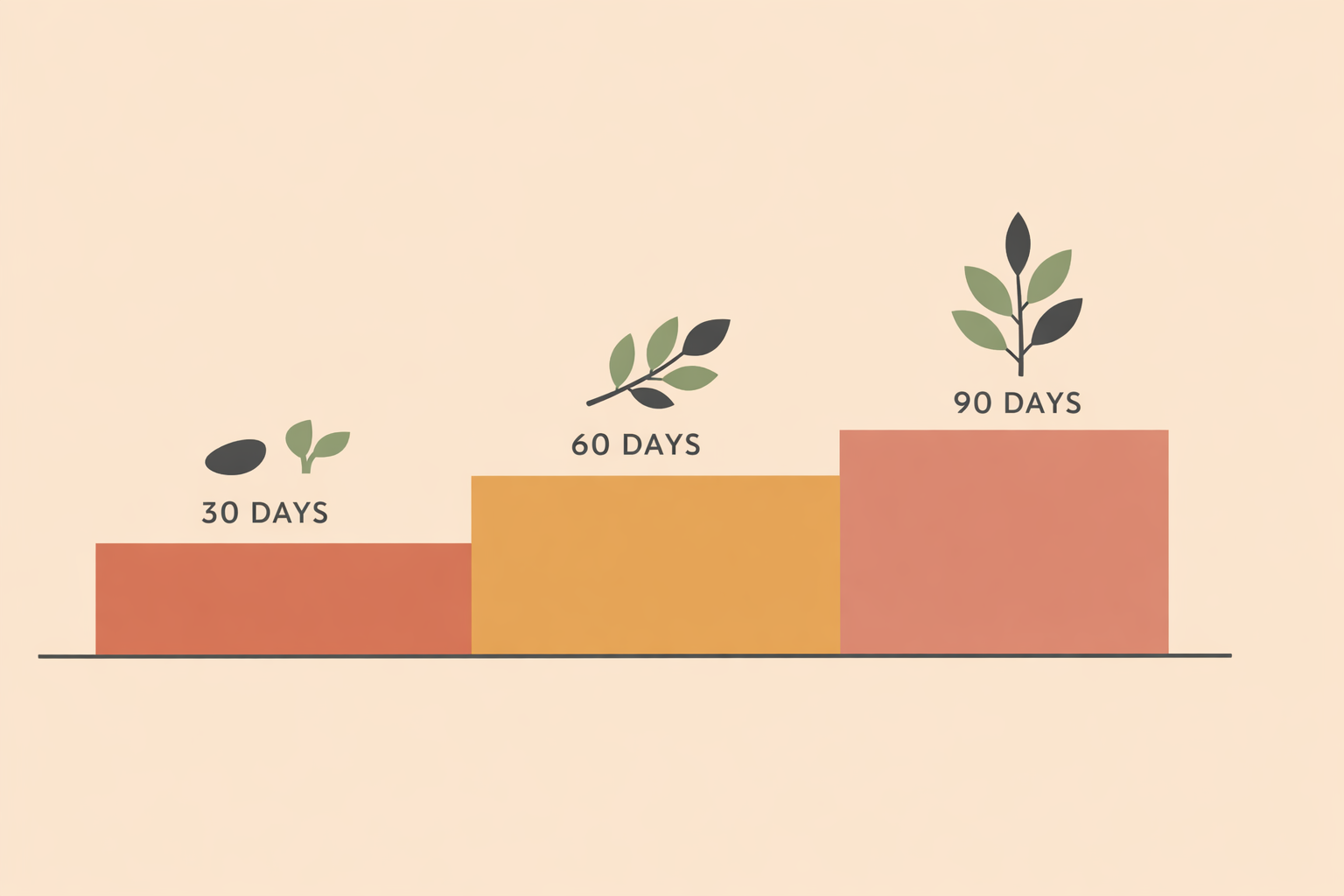
What helps most is a cadence, not more inputs. Functional nutrition is fast-moving, and a scattered approach makes it harder to integrate what matters. A 30-60-90 day review roadmap turns constant change into a steady sequence: build foundations, run real-life experiments, then review outcomes to refine how you work and who you serve. Genomics can be threaded through as context and motivation—not a verdict—supported by clear consent and simple workflows. Used this way, a 30-60-90 cadence helps a practice absorb science without losing scope clarity, cultural fit, or client momentum.
Key Takeaway: A repeating 30-60-90 cadence turns fast-moving functional nutrition into steady practice: build foundations first, then run simple real-life experiments, then review outcomes to refine your approach and niche. Genomics fits best as probabilistic context supported by clear consent, privacy-first systems, and food-first habits people can repeat.
Days 0–30: Ground yourself in systems thinking and traditional foodways
The first 30 days are about roots. Before you lean on genomics or personalization, you want a stable grasp of systems thinking, traditional food culture, and clear boundaries around what you do.
Systems-based approaches encourage you to map a person’s experience across interconnected areas like digestion, energy, mood, resilience, and structural vitality—rather than focusing on one complaint in isolation.
Once you think in systems, basics become powerful again. Digestion influences energy; energy shapes choices; choices affect rhythm, mood, and capacity. That’s why month one is an ideal time to revisit human physiology—especially digestion and energy metabolism—before going deeper into genetic interpretation.
“You need to already have a pretty good handle on human anatomy, biochemistry and physiology to really get the most out of all the genetic variants discussed.”
As one Naturalistico student reviewer put it, solid foundations keep advanced learning useful instead of overwhelming.
This is also the month to re-root in traditional foodways. The FAO describes traditional diets as seasonal, locally sourced, minimally processed foods prepared at home, often including fermented foods tied to place and culture. Modern digestive well-being guidance echoes similar themes, like plant diversity, fermented foods, minimally processed staples, and regular routines.
Methods like fermentation, broth-making, slow cooking, soaking, seasonal eating, and aligning meals with the day aren’t fads. Reviews highlight them as durable practices, and contemporary guidance increasingly points back to fermented foods and fiber-rich plants as practical anchors.
Finally, clarify scope early—especially when genetic data might appear. Ethical genetics education stresses clear limits before working with genetic information, not after confusion arises.
By the end of the first month, you want three answers to feel steady:
- What systems am I actually observing?
- What traditional nutrition principles do I trust and understand deeply?
- Where does my role begin and end?
From there, personalization becomes purposeful instead of noisy.
Days 31–60: Turn knowledge into livable, personalized plans
The second month is where learning becomes real life. The goal isn’t perfect protocols—it’s simple experiments that fit a person’s routines, culture, budget, and capacity.
People live inside work schedules, family meals, cravings, sleep disruptions, and social expectations. A functional lens helps connect those everyday realities to meal timing, fiber intake, macronutrient balance, movement, and rest.
Personalization gets practical when you remember there is real individual variability in responses to the same foods, shaped by microbiome and lifestyle. So instead of assuming one “best” plan, you ask better questions: What changes if they eat earlier? What shifts with more protein and fiber at breakfast? How do fermented foods land in their body and their culture?
Genetic insights can help here, but they work best as gentle orientation. For example, some evidence suggests that variants like TCF7L2 may relate to glucose handling in ways that can inform genotype‑based guidance. The craft is translating that into a calm, doable pattern—not a rigid rule.
Think of month two as “test and learn.” You’re not guessing; you’re observing, adjusting, and repeating what fits.
Many effective experiments are wonderfully simple:
- increase fiber gradually rather than all at once
- add a familiar fermented food in a culturally appropriate way
- shift the largest meal earlier in the day
- reduce ultra-processed convenience foods step by step
- track energy, cravings, bowel regularity, and mood steadiness for a few weeks
This aligns with guidance emphasizing gradual fiber increases, individual tolerance, and fermented foods over dramatic overhauls.
It also fits evidence that meal timing consistency can influence metabolic markers even when total intake stays similar. That doesn’t mean one schedule suits everyone—only that rhythm can be a useful lever when it’s realistic.
Traditional wisdom often shines here, because many cultures already organize meals around daylight, shared eating, and preparation methods that support digestion. Research on Mediterranean-style patterns suggests traditional cultural eating can be more sustainable and easier to adhere to than restrictive, supplement-heavy approaches.
And many people notice meaningful improvements in comfort and energy within a few weeks when they reduce ultra-processed foods, adjust fiber types, and eat more consistently. Those early wins build trust and momentum.
By the end of this phase, success looks like this: you can spot patterns, choose sensible experiments, and co-create plans people can actually live with.
Days 61–90: Show impact and let your niche emerge
The third month is about honest review. When you look closely at what truly helped, your niche starts to emerge naturally—without forcing it.
It’s easy to focus only on external markers, but many nutrition trials treat self-reported shifts as meaningful. A strong review includes subjective outcomes like steadier energy, calmer digestion, more predictable hunger, better meal consistency, and stronger routines around sleep and plant diversity.
Essentially, you stop asking “Did we do it perfectly?” and start asking “What became easier?” and “Where did momentum build?” That’s often where the real story is.
Your niche then becomes clearer through repetition. If you keep seeing great outcomes around digestive comfort, food rhythm, fermented foods, or plant diversity, that’s information. If culturally adapted, minimally processed patterns consistently land well, that’s information too.
There’s also a timely wider context: food-system analyses suggest plant-forward patterns can support both personal well-being and broader resilience, which makes tradition-rooted, minimally processed approaches especially relevant right now.
And mainstream guidance continues to highlight plant diversity, fermented foods, and movement—coherent themes you can build practice areas around.
Genomics belongs here too, with maturity. Some evidence suggests genotype-based plans don’t consistently outperform strong standard plans on measurable outcomes, even if genetic feedback can boost engagement for some people. That’s useful, because it keeps your niche compelling without drifting into overpromising.
Jim Kaput’s observation remains relevant: dietary exposures matter, and people differ dramatically in their responses. That blend of dietary impact and individual variation is fertile ground for a thoughtful, food-first niche.
By day 90, the aim is clarity: not rigid specialization, but a sense of what you support best and what kind of change you trust most.
Thread functional genomics gently through all three phases
Functional genomics works best when it runs through the whole 30-60-90 journey. Used well, it adds nuance; used poorly, it turns into a label that flattens the person in front of you.
In the first 30 days, keep it contextual. Reviews describe how common variants can influence pathways like methylation and lipid handling, while the bigger picture is still shaped by lifestyle factors.
That’s why José M. Ordovás’s line continues to matter: “We are moving beyond ‘one-size-fits-all’ dietary guidelines...” The value isn’t certainty; it’s the move toward individualized nutrition with more respectful nuance.
In days 31–60, genomics can become a conversation starter. If a report suggests tendencies in blood sugar handling, inflammatory tone, or nutrient processing, you can prioritize experiments around food quality, rhythm, movement, and stress. Presenting genes as tendencies is consistent with recommendations to use genetic information as gentle guides, not deterministic prescriptions.
Epigenetics reinforces this perspective: gene expression can shift over time with patterns like diet and stress exposures. Traditional systems have long echoed a similar truth: repeated daily choices shape vitality over time.
By days 61–90, genomics is often most helpful in review. Did it reduce confusion? Improve motivation? Help someone understand why certain habits fit better? Case-based reports suggest that understanding predispositions can sometimes clarify why standard plans felt like a poor match and support more resonant personalization.
Ethical communication keeps this clean. Genetics guidance recommends probabilistic language and clear explanation of limits, especially when you’re discussing modifiable habits rather than making predictions.
And ethics isn’t separate from practice design: training resources stress privacy and consent and avoiding deterministic messaging outside specialist contexts.
Most importantly, genomics should land back in daily life. Research links fiber diversity and routines—including fermented foods, movement, and rest—with richer microbiota and improved markers, and general guidance continues to emphasize everyday habits as the foundation.
Let genomics refine your questions, not dominate them.
Build ethical, sustainable systems behind your sessions
Insight doesn’t sustain a coaching practice—systems do. Good systems protect privacy, support consistency, and keep your values present in every touchpoint.
When sensitive personal data is involved, guidance emphasizes secure handling, transparent communication, and respect for someone’s choice not to explore certain areas. In day-to-day practice, that can look like clear intake language, explicit consent, and straightforward documentation routines.
It’s equally important to recognize what sits outside your scope. Genetics education stresses the need for referral pathways when consumer genetic data raises questions that shouldn’t be interpreted in a coaching setting. Clear boundaries protect everyone.
Your systems should also support a non-judgmental experience. Guidance increasingly encourages moving away from fear-based food messaging and toward what can be added—like fiber-rich plants, fermented foods, movement, and routine. That tone belongs in your forms, session flow, and follow-ups.
Because food is never just food, your workflows should leave room for stress, sleep, family structure, appetite cues, cultural identity, and emotional context. Gut–brain axis research shows stress and sleep can meaningfully affect digestive comfort, so a food log alone rarely tells the full story.
Traditional practice also offers design cues. Reviews associate plant-rich, fermented, minimally processed diets and communal eating with greater microbial diversity, and guidance increasingly revisits traditional practices like fermentation, slow cooking, seasonal eating, and shared meals.
As one practitioner, Mike Kreder, puts it, understanding genomic predispositions can help explain why standard plans failed and support a more personalized direction. There is a useful point inside that quote: better personalization should make the work more humane, not more complicated.
Used well, insights about predispositions can reduce blame and increase fit.
Practical systems that support sustainability include:
- a secure intake and note-taking process
- clear consent around personal data
- simple session templates focused on patterns, not perfection
- resource libraries organized by theme and food tradition
- follow-up prompts that celebrate progress rather than compliance
When systems are values-led, your practice can grow without drifting away from what matters.
Use 30‑60‑90 reviews as ongoing reflective practice
The real power of a 30-60-90 framework is that it can repeat. Each cycle gives a structured moment to refine judgment, simplify what’s bloated, and stay honest about what’s actually helping.
Behavior change tends to improve when reflection and self-monitoring are built in. Research links reflection with stronger habit maintenance, and coaching practice also benefits from regular review rather than “set it and forget it.”
Reviews should track more than completion. Digital personalized nutrition programs often see early wins in subjective changes like steadier energy, calmer digestion, fewer cravings, and greater confidence around food. Those are real outcomes and often the bridge to deeper change.
This timeline is also reassuring. Many people report noticeable improvements in comfort and regularity within weeks, while deeper shifts in resilience and routine typically take longer. Reviews help you respect that rhythm instead of forcing premature conclusions.
Kashif Khan describes functional genomics as a way of seeing not just which genes are present, but how efficiently they are working in a pathway.
Whether or not you use that exact phrasing, the practical point is clear: review helps you spot the weakest links in a person’s patterns more reliably than generic assumptions. Research on reflective practice suggests it helps practitioners notice individual signals that standard protocols can miss.
Over time, the review can become a simple ritual with prompts like:
- What patterns am I noticing repeatedly?
- Which recommendations felt realistic, and which felt forced?
- Where did traditional food practices improve adherence or comfort?
- Did genomics add clarity, or add noise?
- What am I ready to simplify?
Food choices, seasons, life stages, and tools will keep changing. Regular review supports flexibility. Coaching coverage suggests quality investment helps coaching stay effective over time, rather than drifting into rigid scripts.
Perhaps best of all, cyclical reviews protect you from perfectionism. Wider conversations about sustainability increasingly favor continuous improvement over flawless adherence—and that mindset serves coaching beautifully.
Your reviews aren’t there to prove worth. They’re there to support evolution.
Conclusion: A 90‑day rhythm for a modern, tradition‑aware practice
A 30-60-90 roadmap offers something more valuable than speed: direction. In 90 days, you can move from broad curiosity to a steadier coaching practice built on systems thinking, traditional food wisdom, thoughtful personalization, and reflective review.
Sustainability comes from accepting that the field will keep evolving—and so will you. Long-range perspectives on food systems point toward ongoing adaptation rather than one-off solutions, and the same is true for skill-building as a practitioner.
Genomics and personalized nutrition will likely continue to expand, but the core remains stable: individual context, supportive relationships, culturally aware food patterns, and realistic habits repeated over time.
José M. Ordovás’s point about moving beyond one-size-fits-all guidance still fits the moment. The future isn’t only more data—it’s more personalized guidance delivered with care, clarity, and strong ethics.
If you’re building your path as a functional nutrition coach, let your first 90 days do what they’re meant to do: root you deeply, sharpen your observation, and help you create work that feels both modern and ancestral. Then repeat the cycle. That’s how confidence becomes craft.
Train in Functional Genomics
Go deeper on ethical interpretation and food-first personalization with Functional Genomics & Nutrition Coach.
Explore Functional Genomics →