Sacred-geometry sessions can get muddy when the Golden Ratio and the Fibonacci sequence are blended into one “magic spiral.” A more satisfying approach is to keep them distinct: phi is a ratio, Fibonacci is a sequence. Once that foundation is clear, people can enjoy the patterns for what they are—beautiful structures that can support drawing, design, and personal meaning—without anyone feeling pressured to sign up to a grand theory.
Key Takeaway: A clear session talk track separates φ as a ratio from Fibonacci as a sequence, then uses both as creative tools without overclaiming. This keeps sacred-geometry work grounded, visually useful, and open to personal meaning without turning symbolism into fact.
Why a clear Golden Ratio vs Fibonacci explanation matters
In a mixed group, people come in with very different starting points. Some are excited by spirals in shells, some have heard big claims about beauty and “perfect proportion,” and others just want a straightforward way to draw.
When the phi/Fibonacci distinction is missing, the room can slide into debate or disappointment. When it’s present, the mood softens. Participants understand they’re being invited into exploration, not asked to accept a fixed story, and that makes sacred geometry work feel both spacious and grounded.
A simple facilitator script might sound like this: “Today we’re meeting two related ideas. Fibonacci is a counting pattern. Phi is a proportion. They connect beautifully, but they are not identical. We’ll use them as creative armatures and notice what they open up.”
Introducing phi and Fibonacci through natural patterns
Start with what people can already recognize: fern curls, seed spirals in a sunflower, the spiral quality of a shell, the layered structure of a pinecone. Familiar examples keep the learning embodied before terms and definitions arrive.
Fibonacci is a counting pattern: 1, 1, 2, 3, 5, 8, 13, and so on. Each number is made by adding the two before it. Phi, or the Golden Ratio, is a single proportion of about 1.618.
The connection is part of the charm. If you divide one Fibonacci number by the one before it, the result begins to approach phi. People quickly grasp the relationship: Fibonacci describes growth in steps, while phi describes a steady proportional relationship.
In session, it can be enough to say: “Fibonacci helps us count growth. Phi helps us measure harmony between parts and whole.”
Golden Ratio vs Fibonacci: one proportion, one sequence
Fibonacci is a rule for generating numbers. Phi is a ratio used to compare lengths or proportions.
Fibonacci gives you a ladder of whole numbers. Phi gives you a measuring relationship. They’re related, but they do different jobs, and that difference matters most when people want to draw, compose, or reflect instead of getting stuck in abstraction.
If you want a quick, practical bridge, compare pairs like 21 and 34, or 55 and 89. The quotients drift closer to phi. A brief demonstration is usually plenty.
Using golden rectangles and spirals in visual work
Once the distinction is clear, the patterns become easier to use with confidence. Phi supports proportional layouts, and Fibonacci supports building spiral-like forms step by step.
A golden rectangle is a rectangle whose long side is phi times the short side, a proportion of about 1 to 1.618. A key feature is self-similarity: remove a square, and the remaining shape is still a golden rectangle. In formal geometry, self-similarity is one of the defining qualities of the form.
For a hands-on example, draw a 100 mm by 161.8 mm rectangle. Remove a 100 mm square. You’re left with a 61.8 mm by 100 mm rectangle that matches the original proportion, which makes phi-based layout easy to show even with beginners.
In composition, a phi grid can offer anchor points that feel different from the usual “rule of thirds” once people are comfortable framing. It’s another option in a larger design vocabulary, especially within spirituality and ritual practices that use pattern and form reflectively.
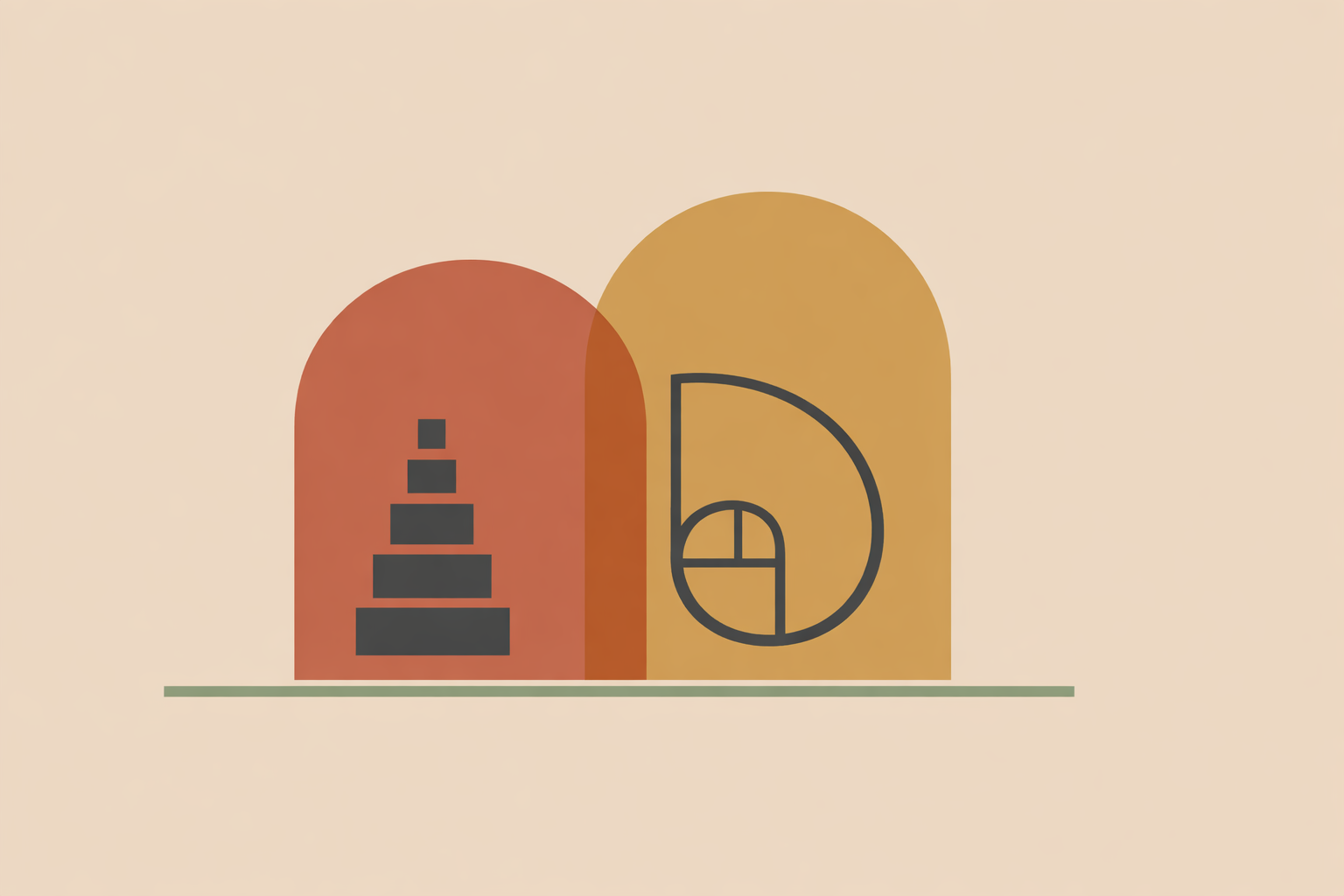
For spirals, you have two closely related constructions. A golden spiral comes from nested golden rectangles. A Fibonacci spiral is built from adjoining squares sized 1, 1, 2, 3, 5, 8, and so on. Visually, they often look alike because the Fibonacci spiral approximates the golden spiral.
For most viewers, the difference is more mathematical than visual. Both are logarithmic spirals, so it usually makes sense to teach whichever construction is easiest for your group to draw.
What you can responsibly say about nature
Nature offers meaningful examples, and sacred geometry gains credibility when you describe those patterns with care rather than exaggeration.
In sunflowers and pinecones, the counts of counter-spirals often match consecutive Fibonacci numbers. This is one of the clearest entry points because people can actually look and count.
Phyllotaxis (the arrangement of leaves and seeds) can hover around 137.5°, often called the golden angle. Models suggest this angle can support efficient distribution of plant elements, so it’s fair to present it as a recurring and useful pattern.
It also helps to name the wider truth: nature contains many kinds of order. Fibonacci is one family among many, and variation is part of what makes living forms so compelling.
What you can responsibly say about art and architecture
Questions about famous buildings and artworks come up often, and this is a place where tradition and discernment work well together.
Golden-ratio overlays placed on well-known facades or paintings are often retrofitted overlays, not proof of original design intent. Harmonious proportion still matters; it just isn’t always tied to one specific ratio.
A more accurate teaching frame is that artists and builders have long used proportion—sometimes phi, and sometimes simple relationships like 1:2 or 2:3. Phi belongs to a larger lineage of pattern, craft, and aesthetic sense.
That approach honors sacred geometry as a meaningful design language without turning every admired work into “evidence” for a single idea.
From proportion to meaning: balance and growth as metaphors
Once the visual basics land, you can open the door to reflection. The key is to keep metaphor optional and personal.
Phi is often experienced as a symbol of balance between part and whole. Used lightly, it can support prompts like: “What in your life feels like a part of a larger whole right now?”
Fibonacci invites a different reflection. Because it unfolds step by step, it pairs naturally with journaling, coaching conversations, or art-based reflection focused on progress through small, real stages.
Pattern drawing itself can be settling. In art-based settings, repetitive drawing has been associated with relaxation and focus. That’s a helpful reminder in facilitation: the exact proportion doesn’t need to carry the whole experience.
One boundary belongs here: avoid presenting phi as an ideal for human bodies. Sacred geometry is far more life-giving as a language of observation, composition, and reflection than as a measuring standard for worth.
A simple session talk track you can adapt
When in doubt, keep the flow visual, steady, and choice-based.
- Welcome participants and name choice: observe, draw, reflect, or simply follow along.
- Begin with images or objects from nature such as a pinecone or sunflower.
- Explain Fibonacci as a counting pattern and phi as a proportion.
- Show how Fibonacci ratios begin to move toward phi.
- Build a small Fibonacci square sequence and sketch a spiral.
- Show a golden rectangle and remove a square to demonstrate self-similarity.
- Offer optional metaphor: phi as balance, Fibonacci as unfolding growth.
- Move into making: a phi grid, a spiral drawing, or a brief reflective prompt.
- Close by inviting participants to share what they noticed, without pressure to interpret.
This kind of structure matches what many facilitators aim for: letting clear concepts and lived experience sit together. It’s possible to hold artistic and scientific languages side by side without forcing either one to dominate.
Bringing Golden Ratio and Fibonacci into ongoing practice
At their best, phi and Fibonacci aren’t arguments to win. They’re companions for creative work and reflection.
Fibonacci offers a way to notice growth in steps. Phi offers a way to sense proportion between parts and wholes. Their relationship is elegant, and the everyday value is practical: they help people see, arrange, draw, and reflect with more care.
When you teach them with clarity, the room stays open. Participants don’t have to choose between skepticism and wonder. They can work with pattern directly, allow meaning to emerge if it does, and leave with something usable in their hands.
In the long run, that’s often the strongest stance in sacred geometry: respect for tradition, openness to evidence, and care with claims. Those qualities keep the work welcoming and trustworthy within broader spirituality and ritual practice.
Explore Sacred Geometry Certification
Deepen your understanding of phi and Fibonacci with structured practice in the Sacred Geometry Certification.
Explore Sacred Geometry →