


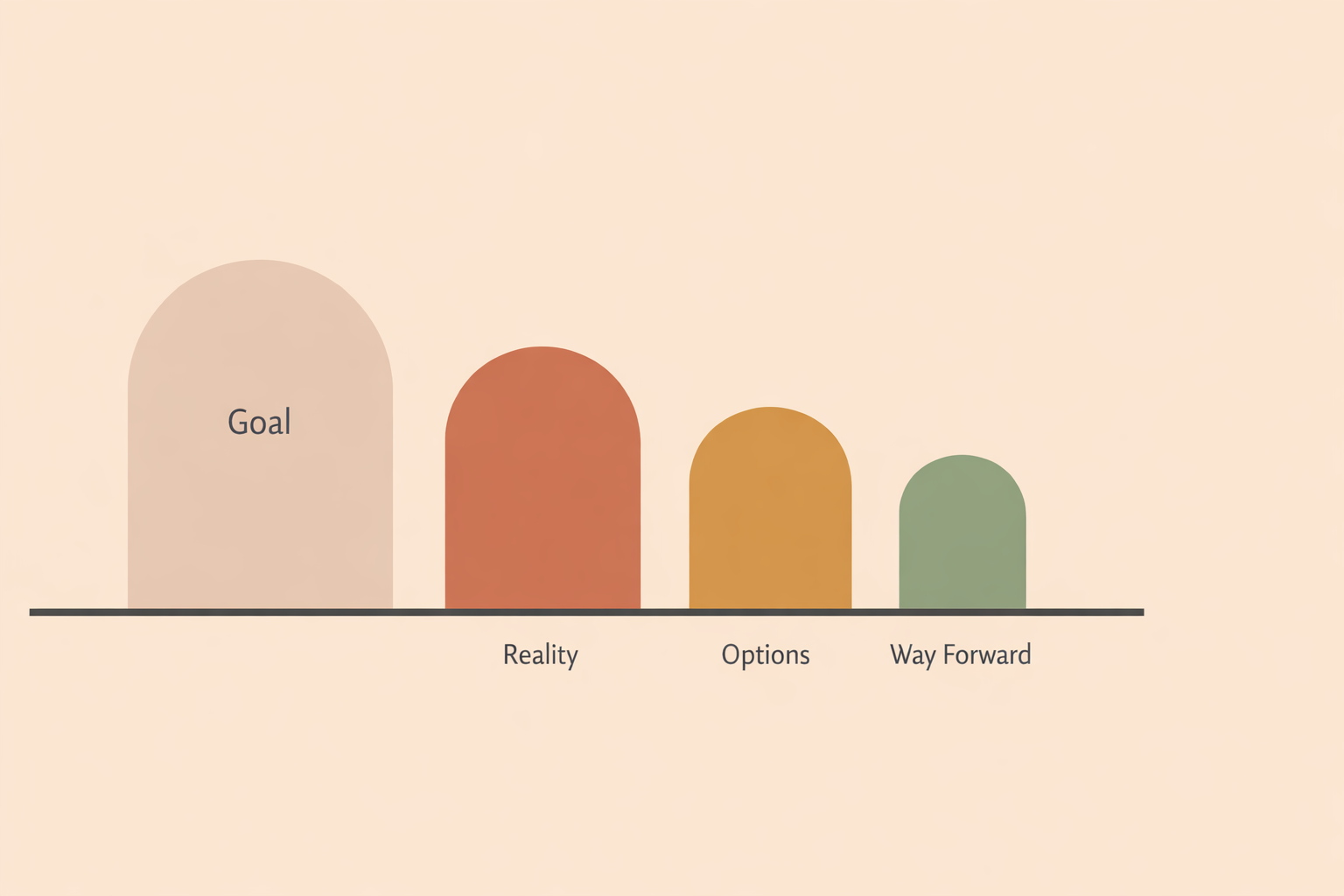
Most coaches hit the same snag: clients arrive with a topic—“confidence,” “energy,” “career change”—not a goal. When you move ahead anyway, sessions drift, options stay shallow, and next steps are less likely to stick. The shift usually isn’t “more advice,” but better sequencing. Get the opening minutes right, and you’ll often notice commitments hold more naturally after the call.
Used well, GROW offers a steady, non-directive backbone for real conversations. It helps you turn a loose theme into a client-owned aim, name what’s truly happening, widen choices without overwhelm, and translate insight into action. In many practices it becomes a living cycle: clarify, explore, choose, act, reflect, refine.
Key Takeaway: Use GROW to turn a vague topic into a client-owned, measurable session goal, then slow down to map present reality before exploring options. Close with one to three specific commitments and revisit them in follow-ups so reflection refines the plan and momentum compounds over time.
Step 1: Goal — turn the topic into a client-owned aim
The first job is simple: move from a broad topic to a clear goal for this conversation. In GROW, the Goal stage sets the foundation for everything that follows. When the goal is vague, the rest of the session can feel wobbly—like building on soft ground.
Most people begin with a theme, not an outcome. “More confidence” or “better balance” might be true, but it’s not yet specific enough to guide today’s conversation. A brief Topic moment before Goal can help the client land, then gently shape the work into something actionable.
It helps to think in two horizons:
- Longer direction: what matters in the client’s wider life, values, or personal path.
- Today’s aim: what would make this session useful, clear, or relieving right now.
Because GROW is a structured framework, it works best when the client generates the goal rather than receiving one. That client-led stance matters: client-centred coaching supports autonomy and motivation, which tends to make follow-through more sustainable.
If the goal is fuzzy or heavily shaped by someone else’s expectations, stay here longer. In practice, that extra time often saves time later. Goal questions help keep the rest of the conversation focused and effective.
A simple, human way to shape the goal:
- What would feel meaningful to leave with today?
- What would you like to be clearer about by the end of this session?
- What small shift would tell you this conversation helped?
Then test it:
- Is the goal in the client’s own words?
- Would an outside observer know whether it happened?
- Does it fit real life, not an ideal version of it?
As holistic practitioners, we can widen the frame without losing precision: “What would make this goal feel respectful of your body, culture, and current season of life?” That question often transforms performance pressure into an honest, workable aim.
Step 2: Reality — map what is true before solving
Once the goal is clear, turn toward what’s actually happening now. The Reality stage grounds the conversation. In GROW, this phase focuses on current facts, helping clients separate what’s happening from what they fear might happen.
This is where sessions either deepen or stay surface-level. Rush Reality and you may build action on assumptions; stay with it and you understand the person’s circumstances before action planning, which usually makes the “next step” far simpler.
Good Reality work is both practical and attentive. You’re listening for:
- Facts: what happened, when, how often, and in what context.
- Patterns: what repeats, what improves things, what makes them harder.
- Inner signals: emotions, tension, resistance, relief, or clarity.
- Context: family roles, routines, work demands, environment, and support.
Helpful questions include:
- What is happening at the moment?
- When is this easiest, and when is it hardest?
- What have you already tried?
- What helped even a little?
- What tends to get in the way?
It also helps to name both internal blockers and external constraints. Exploring what might get in the way can reduce overwhelm because the situation becomes specific—and specificity is navigable.
Some clients arrive foggy: generalities, contradictions, or a blurry sense of time. That’s usually not a cue to speed up; it’s a cue to stay in Reality longer. Reality questions bring perception back into contact with the present moment.
Traditional ways of working have long respected timing, cycles, and readiness. When you let story come before strategy, many clients stop forcing themselves into shapes that don’t fit—and start seeing what’s truly available right now.
By the end of this stage, aim for a plain-language picture: what the client wants, what’s happening now, what supports them, and what constrains them. Once that picture is clear, options become easier to generate.
Step 3: Options — widen the field, then sort wisely
Now open the conversation. The Options stage works best when you generate possibilities first, then narrow. In GROW, that means exploring various options instead of settling for the first workable idea.
Think of it like widening a path before choosing where to place your next step. Start with divergent thinking (more ideas, less judgment), then shift to convergent thinking (what fits, what’s realistic, what’s aligned).
Keep your tone light, spacious, and non-directive. Ask:
- What else could you do?
- If this were easier, what might be possible?
- What would a gentler version of progress look like?
- Which options feel practical, and which feel nourishing?
If it serves the client, invite wisdom from their own world—family knowledge, seasonal rhythms, daily rituals, community support, or practices they already trust. This is often where traditional and modern approaches meet well: not as opposites, but as different kinds of resources.
After widening the field, help the client sort. Simple tools work especially well for people who ruminate: pros and cons, small experiments, and short trial periods bring choices into focus.
GROW can also serve as a problem-solving framework between sessions. Once clients learn the rhythm—goal, reality, options, way forward—they often start using it for everyday decisions and for a steadier session flow.
A simple flow for this stage:
- Open: list as many possible next steps as you can.
- Feel for resonance: which ideas feel lighter, steadier, or more doable?
- Reality-check: what fits the next 7–14 days?
- Shortlist: reduce the menu to three to five viable choices.
When traditional practices enter the conversation, cultural respect matters. Support what is meaningful and appropriate for the client, rather than borrowing symbols or rituals out of context. Options tend to stick when they feel rooted, familiar, and genuinely theirs.
Step 4: Will — turn insight into clear commitments
This is where the session becomes concrete. The final GROW stage asks the client to choose what they will do, by when, and how they’ll stay engaged. Follow-through is often stronger when you keep this stage focused—many guides recommend one goal at a time and manageable steps over long lists of intentions.
A strong Will stage is specific without becoming rigid. Aim for one to three actions the client can actually picture themselves doing.
- What is your next step?
- When exactly will you do it?
- How will you know it is done?
- What might interfere?
- What support will help you remember?
Language matters here. “I will” usually creates more ownership than “I should” or “I’ll try.”
For example:
- I will take a 12-minute walk after lunch on Monday, Wednesday, and Friday.
- I will spend 10 minutes on my journal before bed three nights this week.
- I will send the message I have been avoiding by Thursday at 4 p.m.
Accountability supports completion and learning. Regular follow-up helps the action stay alive after the session ends.
There’s also a balance: too much management from the coach can weaken ownership. Client-led sessions keep the person in charge of their own growth, which is what makes action more sustainable.
A good closing check is simple: “Does this feel realistic, respectful, and worth doing?” If yes, the action is ready.
Step 5: Add monitor and evaluate so progress compounds
One session can spark movement, but repeated reflection is what helps change settle into everyday life. Many practitioners extend GROW with monitoring and review, and expanded approaches suggest that adding recovery and review can feel more effective for behavioural change.
Put simply, you revisit what happened, what was learned, and what needs adjusting. Over time, coached reflection has been linked with increased vigor and meaningful shifts in well-being.
A simple rhythm looks like this:
- Monitor: what did the client do, notice, avoid, or discover?
- Evaluate: what worked, what didn’t, and what now needs refining?
This cyclical use of GROW protects autonomy while supporting action. When new insight appears, it’s often wise to revisit the Goal and re-check Reality before choosing next steps.
For ongoing work, regular check-ins matter. In many settings they help people redefine next steps when blockers emerge. The exact cadence matters less than consistency: smaller habits may suit weekly review, while bigger transitions may need more space.
Even when outward results are slow, inner shifts often arrive first. Coaching can support self-efficacy—the quiet sense of “I can do this”—which is often where lasting momentum begins.
GROW as a steady backbone for holistic coaching
GROW has lasted because it’s simple, memorable, and flexible. It offers enough structure to keep a session moving, with enough space to honour complexity, intuition, and the client’s own wisdom. Used with care, it becomes a dependable rhythm: clarify the goal, map reality, widen options, choose the way forward, then return to review and refine.
For holistic practitioners, this structure pairs beautifully with deep listening, cultural respect, and attention to seasons of life. The model doesn’t have to flatten the work. It can hold story, body awareness, ancestral perspective, practical planning, and reflective growth in the same conversation.
It also supports practitioner growth. Reflective practice can strengthen boundaries, presence, and grounded support over time. Certification can also show that a coach has studied and practised to a professional standard, and for those building a professional path, life coach certification markers such as IPHM, CMA, or CPD may help build trust in your community.
“As an ICF ACC, I believe certification is important as it serves as ‘proof’ you have actually studied and practiced to a professional standard.”
In the end, the strength of GROW isn’t just clarity—it’s clarity without taking the process away from the client. That balance of structure plus ownership is what makes it so useful in real practice.
Explore Life Coaching Certification
Apply GROW with confidence through the Life Coaching Certification and strengthen your client-led session structure.
Explore Life Coaching →










