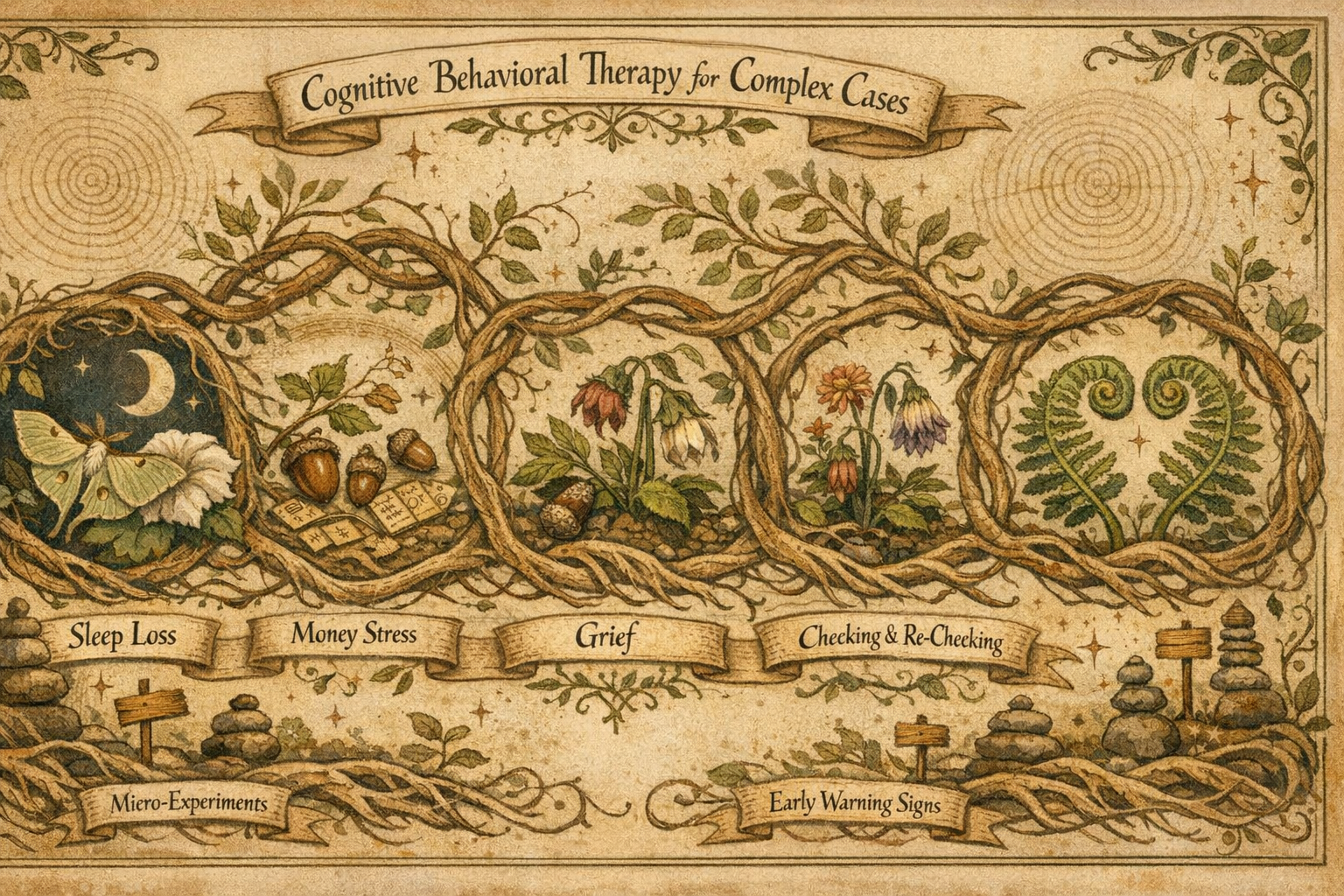
Cognitive Behavioral Therapy (CBT) offers a structured, adaptable way to help people shift long-standing patterns—without denying the fullness of culture, body, history, and community. In complex cases, its strength is simple: it turns tangled stories into clear, testable pathways for change.
Practitioners often choose CBT because the skills can keep working long after the structured work ends. In follow-ups beyond two years, many people maintain their gains, reflecting CBT’s lasting benefits in everyday life—especially helpful when challenges are layered, intergenerational, or recurrent.
CBT is also broader than many assume, with reviews describing its use across anxiety, mood difficulties, trauma responses, and relational patterns—with a steady focus on quality of life. Wayne Dyer captured the heart of it: “Peace is the result of retraining your mind to process life as it is.” Essentially, CBT helps people notice, name, and update the stories shaping their choices—one real-world experiment at a time.
Key Takeaway: In complex cases, CBT works best as a living, collaborative map that links thoughts, emotions, body sensations, behaviors, and context—then turns insight into small, repeatable experiments. When paced in phases and integrated with mindfulness and culture, it builds durable skills for real-life setbacks.
Shift 1: Why CBT Supports Change in Complex, Multifaceted Cases
In complex work, CBT helps organize many moving parts into patterns that can be seen, questioned, and shifted. The goal isn’t “perfect thinking”—it’s practical skills people can keep using in daily life.
CBT is not only for “simple” worries. Reviews highlight its relevance to entrenched interpersonal difficulties, motivational barriers, rigid thinking, and repeating loops—including work with recurrent depression. Its present-focused structure can also support people navigating trauma-related distress, where pacing and clarity matter.
That same structure contributes to long-term stability. Across follow-ups of two years or more, many people supported with CBT remain as well as—or better than—when they completed the work, underscoring CBT’s durability.
Albert Ellis summarized CBT’s agency-oriented stance in a way that’s especially empowering in complex situations: “People don’t just get upset. They contribute to their upsetness.” What this means is not blame—it’s leverage. If a pattern is being co-created by thoughts, sensations, actions, and relationships, then change is possible at more than one entry point.
Shift 2: Build a Case Conceptualization, Not a Label
Complex cases rarely improve through labels alone. A stronger move is building a living map: a CBT case conceptualization that shows how thoughts, emotions, sensations, behaviors, and context keep shaping one another—so you can choose a realistic place to start.
At its core, CBT stays problem-oriented, goal-focused, and present-centric, while still respecting how the past shaped today’s patterns. A collaborative case formulation becomes a shared compass: situations trigger meanings and body responses; those shape actions; actions then reinforce meanings. The map is meant to evolve as you test it.
In complex trauma, for example, models such as Ehlers & Clark help people recognize how triggers, appraisals, and habits like avoidance or hypervigilance can sustain a sense of ongoing threat. A nuanced, individualized formulation is particularly valuable when the story spans families, workplaces, and communities—because it keeps the work specific, humane, and adaptable.
Seth J. Gillihan points to why this mapping matters: “Values give rise to goals, and we reach those goals by planning and completing specific activities.” Put simply, a living formulation translates values into doable steps—and shifts the focus from “What’s wrong?” to “How does this system work, and where can it shift next?”
Shift 3: Use the Relationship in CBT as an Active Tool for Change
In complex cases, the coaching or supportive relationship is more than a container—it’s an active tool. Real-time collaboration gives old assumptions about safety, trust, worth, and power dynamics a chance to be explored gently while they’re happening.
Relational and third-wave CBT perspectives emphasize that the alliance can become a “live lab” for testing beliefs like “If I’m honest, I’ll be rejected,” while still working within a clear, structured frame. Over time, these small corrective experiences loosen long-standing patterns.
CBT overviews consistently emphasize collaboration and empathy, and many settings pair this with shared decision-making. Shared decision-making is often linked with stronger commitment to plans people help create—especially important for those with histories of invalidation or disempowerment.
Many phase-based trauma models also treat alliance-building as a key early outcome, where co-creating boundaries, rhythm, and pace becomes part of Phase 1 success, as phase-based approaches describe. David Burns captured the stance succinctly: one hallmark of CBT is that it refuses to buy into your sense of worthlessness—and a steady, respectful relationship embodies that message again and again.
Shift 4: Turn Insight into Structured, Between-Session Action
Insight is a beginning, not the change. Complex patterns shift through consistent between-session practice that’s culturally attuned and right-sized for real life.
CBT is explicit about this: change grows from planned tasks and behavioral experiments that turn new perspectives into action. Tools may include Socratic questioning, cognitive restructuring, behavioral activation, guided imagery, mindfulness, relaxation, and values-based scheduling. Journaling often grounds the work through thought records that turn difficult moments into learning and next steps.
Follow-through improves when practices match skill level and context. Qualitative work suggests that adjusting difficulty, negotiating around barriers, and normalizing discomfort can support stronger engagement. Think of it like strength training: small, well-chosen repetitions build capacity. In complex cases, even one strategic experiment—sending a message, pausing before a habit loop, asking for support—can carry real weight.
As William James observed, “Action and feeling go together.” And Gillihan adds, “The important thing is finding a way forward, no matter how modest the step.” In practice, that means choosing actions that are safe enough to try, meaningful enough to matter, and specific enough to repeat.
Shift 5: A Phase-Based CBT Map for Complex Trauma Responses
Complex trauma work often benefits from a flexible phased map: stabilization, processing, and integration. The phases are guided by the person’s goals, resources, and readiness—not by rigid timelines.
Stabilization begins with clarity and skills. Many practitioners use psychoeducation grounded in models such as Ehlers & Clark to show how triggers and appraisals can maintain a sense of danger. This normalizes survival strategies while building practical skills for grounding, containment, and emotion regulation—central outcomes of Phase 1 in phase-based approaches. Within CBT frameworks, this stage is intentionally paced and culturally attuned; breathwork, orienting, and resourcing often echo long-standing contemplative and body-centered traditions.
Processing centers on trauma memories and their meanings. Identifying memory hot spots (the moments that still feel threatening now) can guide techniques such as imaginal reliving or narrative writing, where new information and perspectives are integrated. Imagery rescripting can then re-direct the storyline, supporting images that compete with—and gradually outweigh—the old ones. The facilitator’s stance stays collaborative and non-directive, protecting dignity and choice.
Integration consolidates skills into everyday routines. Here, people build relapse-aware structures, reconnect with community and culture, and protect new meanings over time. In some contexts, that may include rituals of remembrance, ancestral gratitude, or community practices that help anchor change in place.
Wayne Dyer’s reminder fits this map well: peace can follow from retraining your mind to process life as it is. Phase-based CBT gives that wisdom a usable structure—so insight becomes skill, and skill becomes a way of living.
Shift 6: Integrate Third-Wave CBT, Mindfulness, and Ancestral Practices
Modern CBT integrates well with mindfulness, somatic awareness, and ancestral practices when it’s done with clarity, humility, and respect. The advantage is range: more ways to support change without losing an outcome-focused, collaborative stance.
Third-wave perspectives explicitly weave in mindfulness, acceptance, and a stronger relational emphasis—qualities that can be especially supportive in multifaceted trauma. CBT’s structure makes it easier to integrate practices—breath awareness, grounding, body scanning, compassionate imagery—while keeping each step transparent, consent-based, and linked to the person’s goals. Overviews also highlight CBT’s flexibility, which matters when honoring cultural roots rather than flattening them.
In many trauma-informed settings, CBT skills sit alongside mindfulness and somatic awareness to support steadier emotions and less anxiety. Phase-based descriptions often include grounding, orienting, and breathwork—approaches that mirror time-tested contemplative traditions. Shantideva offered a centuries-old cognitive reframe that still lands: “If you can solve your problem, what is the need of worrying?”
Ethical integration is specific and crediting: ask permission, name origins, and be clear about purpose—what practice, for whom, and why now. That precision keeps the work respectful, culturally grounded, and genuinely useful.
Shift 7: Design for Relapse, Resistance, and Real Life
Complex work includes lapses, plateaus, and pushback. CBT anticipates this and plans for it, so setbacks become part of the path rather than “proof” something isn’t working.
Relapse-aware planning starts early: identify triggers, track early signs, rehearse coping skills, and gather supports. CBT resources emphasize clear relapse planning, and long-term outcome summaries suggest many people maintain improvements across years—evidence of the staying power of these skills.
Resistance is information, not insubordination. Practice-based literature suggests that renegotiating tasks, matching difficulty to readiness, and naming discomfort can improve engagement. Change-management work also frames resistance as data that strengthens a plan, and shared decision-making is often linked with better follow-through because people invest more in what they help design.
Practical templates make this easier to apply:
- Red flags: Note early signs (sleep shifts, isolation, rumination) and pair each with a five-minute action.
- Micro-skills: One-minute breath cue, ten-minute movement, a single text to a supporter, one line in a thought record.
- Reset ritual: Step outside, feel the ground, name three sensations, then choose the next tiny step.
- Accountability: Choose an accountability partner who supports without shaming.
- Compassionate review: Ten minutes weekly: what helped, what hindered, what’s the 1% adjustment? Aim for discipline and compassion.
Most importantly, treat the plan as a living document. Update it as seasons change, relationships shift, and capacity grows. That steady refinement is one way CBT becomes a reliable way of navigating real life.
From Map to Practice: Bringing It All Together
When CBT’s structure meets lived culture, ancestral wisdom, and everyday constraints, complex work becomes more navigable. A living formulation replaces labels. The relationship becomes an active tool. Between-session experiments turn insight into change. Trauma work is paced in phases, and mindfulness and body wisdom are integrated with respect. Then everything is designed for real life—lapses, resistance, and all.
In that sense, holistic CBT practice is both grounded and evolving. It respects old ways of working with breath, attention, and community while using modern clarity to test what helps, for whom, and when. The path can be structured but kind—disciplined, yet deeply humane.
Master CBT in Practice
Apply these strategies with confidence in Naturalistico’s Cognitive Behavioral Therapy (CBT) Course.
Explore the CBT Course →