Clients often want practical, day-to-day ways to spend less, waste less, and feel more resilient—yet many live in small flats. As a practitioner, principles are helpful, but trust grows fastest when you can point to simple systems you run under the same constraints: limited light, no garden, strict building rules, and busy weeks. When a client asks what to buy, where it goes, and how much time it really takes, a compact setup you can demonstrate is worth its weight in gold.
Flat-based homesteading meets that need by turning your home into a set of small, modular loops—food, water, waste, and energy—built for windowsills, counters, and balconies. The aim is to make your flat feel like a mini ecosystem: start with a low-maintenance greens “stack,” close everyday loops with indoor composting and water habits, then add upgrades only when the basics feel effortless. Done this way, your home becomes a living case study you can adapt into client plans with clear effort, yield, and risk boundaries.
Key Takeaway: Flat-based homesteading works best as a few modular loops you can run reliably in tight spaces—start with a simple greens “stack,” then close the scraps-and-water loop before adding upgrades. When you track effort and yield in your own flat, you can model realistic, client-ready systems with clear boundaries.
Design Your Flat as a Mini Ecosystem and Living Case Study
Start by mapping your flat like a tiny ecosystem. Instead of organizing by rooms, organize by frequency: place daily-touch tasks where your hands already go, and keep occasional tasks slightly farther away. This reduces friction, which is often the real barrier for clients.
A practical tool is permaculture-style zoning adapted for flats. Put sprouts, microgreens, and herbs in the kitchen (Zone 0–1). Place balcony containers or less-frequent greens in Zone 2. Store jars, bulk goods, and equipment in cupboards (Zone 3+). This compact approach aligns with urban permaculture teaching: make the right action the easy action.
Permaculture-style zoning for flats
With zones in place, set targets that feel achievable. Urban initiatives show meaningful portions of fresh produce can come from small spaces through container growing—especially when you focus on fast, repeatable harvests like greens and herbs.
If you have a balcony, vertical thinking helps: racks, hanging baskets, and cut-and-come-again greens can turn a small footprint into steady harvests. And because buildings vary, it helps to know that about half of associations allow balcony containers under basic stability and maintenance rules.
To turn this into a true case study, track what you grow and what it replaces. A small scale, labels, and a simple ledger are enough. Over time, many growers also design for succession: quick annuals first, then longer-lived plants as confidence builds. Wendell Berry captured the spirit many practitioners live by: “The care of the earth is our most ancient and most worthy,” as quoted by Berry.
Start with One Stack: Sprouts, Microgreens and Herbs on a Windowsill
The best starter system is small enough to succeed even in a busy week: one sprout jar, one microgreens tray, and two hardy herb pots. In a few square feet, you’ll have steady greens and a simple teaching framework you can share with clients.
Sprouts are a classic for a reason: no soil, minimal equipment, and quick turnaround. Many sprouting seeds expand at roughly a 1:10 ratio within a few days, and dry seeds store well. Microgreens typically mature in 7–21 days in compact trays. Some varieties are reported to contain up to 40 times the vitamin content of mature counterparts—an echo of traditional spring-green practices found across many food lineages.
A four-week experiment you can run for yourself and clients
- Week 1: Set up and minimal care. Start one sprout jar, one microgreens tray, and two herb pots. Keep care simple and brief—many beginners do best with 15–30 minutes per week.
- Week 2–3: Dial in light. If natural light is limited, compact full-spectrum LEDs in the 20–50W range, positioned close to plants, can make winter and north-facing windows far more workable—often recommended in apartment homesteading guidance.
- Week 4: Track harvests and grocery impact. For seven days, weigh what you harvest, note days to maturity, and record what you didn’t need to buy because your windowsill covered it. This is where “feel-good” becomes measurable.
“Do what you can, with what you have, where you are,” as quoted by Roosevelt. One jar, one tray, two pots is enough to begin—and enough to teach from.
Close the Loop Indoors: Compost, Waste and Water as Daily Rituals
Once the food stack is steady, close the loop. Indoor composting and mindful water habits turn scraps and “waste” into resources. In traditional household practice, this cycle is part of the home’s dignity: nothing is automatically disposable, and every input has a next use.
Two compost styles are especially flat-friendly:
- Bokashi uses sealed fermentation and stays compact and low-odor, making it a strong apartment option. It’s commonly included in home composting guidance.
- Vermicomposting uses worms to turn scraps into castings and a gentle liquid feed. Under good conditions, bins can process roughly 0.5 kg of scraps per day, producing usable castings over time.
Bokashi and worms in a flat: from scraps to nourishment
Pest concerns are usually solved with simple habits: keep lids secure, manage moisture, and handle scraps thoughtfully. City growers often recommend beginner controls like sand layers and freezing scraps in community spaces such as Permies. For bokashi, apartment-focused guidance like bokashi tips often emphasizes keeping the bucket sealed, then blending the fermented material into soil so smells settle quickly.
Water completes the loop. Household changes can reduce use by 20–40% through straightforward steps like efficient fixtures and reusing suitable greywater for ornamentals or hardy plants where appropriate. For container growing, many people use diluted compost liquids to support plants—consistent with soil-building wisdom that prioritizes living inputs and long-term fertility.
As this cycle becomes routine—scraps to castings to herbs—self-sufficiency stops feeling like “extra work” and starts feeling like home care. Annie Leonard’s line captures it well: “There is no such thing as ‘away,’” as quoted by Leonard.
Level Up Gently: Vertical Gardens, Mushrooms and Simple Solar
Only add upgrades when your basics feel smooth. A single new layer is easier to maintain, easier to explain, and far easier for clients to copy without burnout. Choose what fits your space, climate, and bandwidth: vertical greens, mushrooms, or a small solar assist.
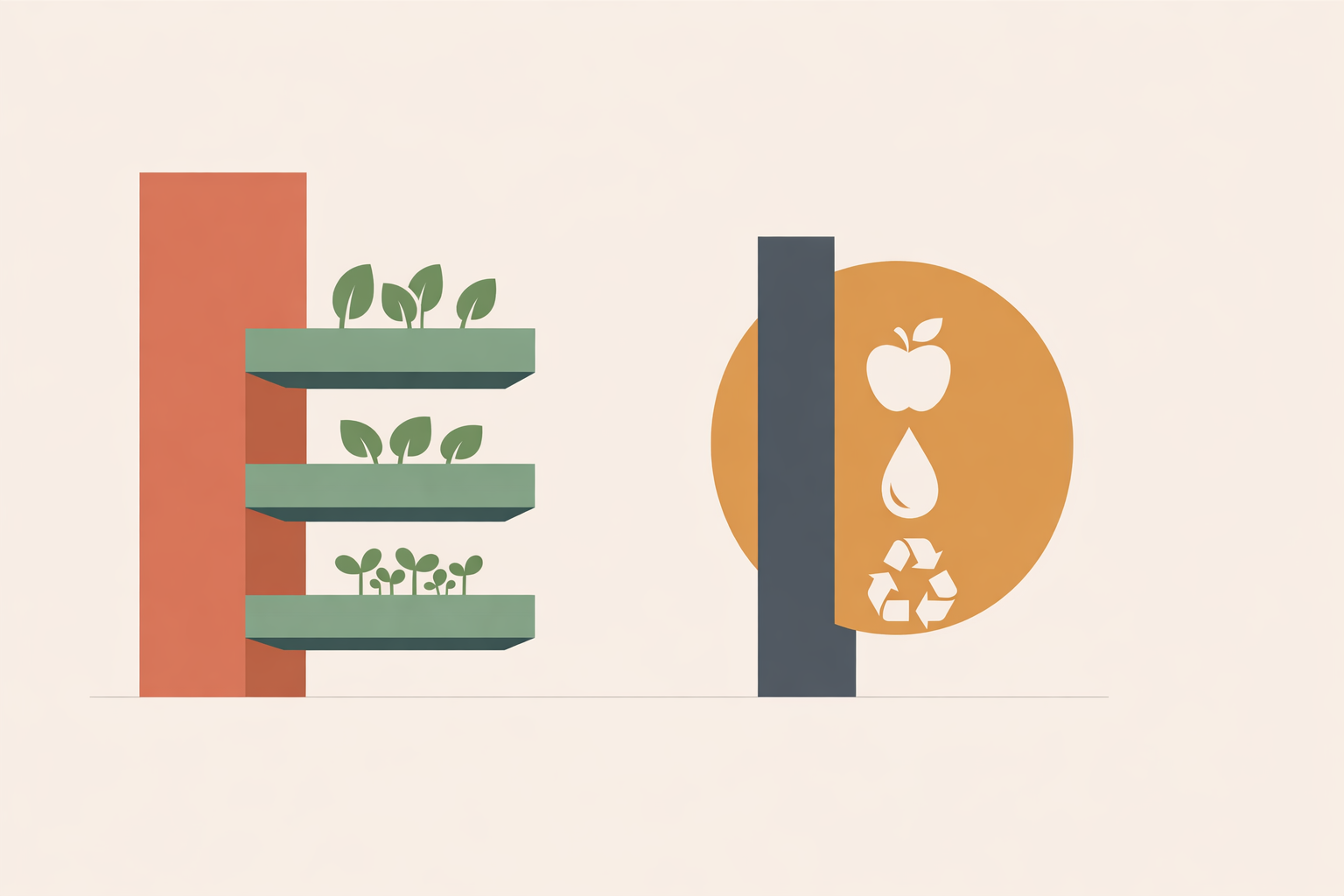
Vertical gardens let you grow more in less space. Towers and compact systems can hold many plants in the footprint of one pot, commonly discussed in small-space guides like HomesteAdapt. If water efficiency is a priority, aeroponic approaches—roots misted instead of soaked—can reduce water demand compared with conventional watering methods.
Choose one next layer that fits your space and bandwidth
Mushrooms are often a surprisingly good fit for flats: low light needs, compact grow bags, and a quick turnaround. Oyster mushrooms grown on straw or coffee grounds are frequently shared in urban farming circles.
Desktop aquaponics can be a vivid teaching tool about cycles and reciprocity—fish and plants supporting one another in a small loop. Entry-level aquaponics guidance shows how compact systems can support greens and herbs in limited space.
Balcony solar can help power lights or small fans. Systems in the 100–400W range can generate around 1–5 kWh depending on exposure. Many growers also point to savings estimates that show how small tools and home systems can add up over a year.
One practical note: dense plantings, mushrooms, or aquaponics can raise humidity in tight flats. A small dehumidifier or window fan is a common solution shared in outlets like Mother Earth News. And for pacing, William Blake offers a timeless rhythm: “In seed time learn, in harvest teach,” as quoted by Blake.
Beyond Your Flat: Barter, Foraging and Community Webs of Support
Self-sufficiency becomes deeper—and often easier—when it’s shared. Once your home systems feel stable, extend outward through bartering, ethical foraging, and shared tools. This is where personal practice turns into neighborhood resilience.
For foraging, start with reliable mapping and strong ethics. Falling Fruit catalogues publicly mapped edible plants worldwide, offering a starting point for learning your area. Pair it with field guides and mentorship, and take identification and local stewardship seriously—principles emphasized by educators like Wild Food UK. Many common urban plants (like dandelion and nettle) carry centuries of traditional food use across cultures; the skill is learning what’s safe, what’s respectful, and what’s appropriate to harvest.
From individual self-reliance to shared resilience
Barter is the simplest next step: cuttings for compost, herbs for a borrowed tool, jars for seeds. Community-sharing platforms highlighted by Shareable often point to meaningful savings when neighbors trade rather than buy. You can also pair homegrown greens with bulk staples from low-waste and bulk stores—now common in many cities according to Plastic Free July—to reduce packaging and keep costs steady.
On a larger scale, organizations working in urban agriculture note that converting unused city space into food gardens can improve accessibility to healthy food. Practically, many households find that greens plus bulk legumes and grains is an achievable baseline that supports consistent, whole-food eating patterns.
Many Indigenous and ancestral traditions hold self-sufficiency as relational—skills are shared, harvests circulate, and the “home” includes neighbors and land. Modern permaculture echoes that same orientation. John Donne said it plainly: “No man is an island,” as quoted by Donne.
Make Flat-Based Homesteading Safe, Ethical and Client-Ready
Systems last longer when they’re kind, legal, and realistic. Keep boundaries clear, use simple safety protocols, and tailor every setup to the person in front of you—especially their space, schedule, and sensory needs.
Food safety matters most with sprouts. Public health guidance from the CDC emphasizes contamination risk with raw sprouts, so keep standards high: clean seed, clean jars, and consistent rinsing. If someone prefers to avoid raw sprouts, microgreens or cooked sprouted legumes can be a comfortable alternative.
Design systems that are kind, legal and realistic
For indoor composting, prevention beats troubleshooting: tight lids, burying scraps under bedding, and keeping bins away from seed trays are commonly shared in communities like Permies. If you add mushrooms or aquaponics, manage humidity with ventilation and, if needed, a dehumidifier—advice repeated in small-space resources like Mother Earth News.
Building rules vary widely. While about half of associations allow balcony gardens with conditions, some restrict visible structures or certain types of collection. If rainwater collection is legal where you live, basic safeguards from the WHO include covering containers, using a first-flush diverter, and filtering or boiling before any non-potable use.
Tailoring is where professionalism shines. For low-bandwidth or ADHD-leaning clients, one sprout jar plus a light timer can be a genuine win. For those with allergies or sensitive breathing, sealed hydroponics without indoor compost or mushrooms may feel gentler. Homes with pets or kids often do best with elevated and hanging pots and no open buckets—an approach echoed in family-oriented guidance like Old-Fashioned Families and practical local resources for tailored designs. “Ethics is nothing else than reverence for life,” wrote Schweitzer, as quoted by Schweitzer.
Conclusion: Turn Your Flat into a Self-Sufficiency Lab for Clients
You don’t need land to live ancestral wisdom. Map your flat like an ecosystem, build one stack (sprouts, microgreens, herbs), close the loop on scraps and water, then choose a single upgrade—vertical greens, mushrooms, or a small solar assist. From there, widen into barter and ethical foraging so your practice reflects what homesteading has long been at its best: relational and generous.
These skills also support steadiness. Urban gardening is consistently associated with lower stress and a stronger sense of agency—qualities that strengthen any coaching container. On the community side, urban growing can improve access to nourishing food, and many households find that pairing homegrown greens with bulk staples fits well with eco-thrift approaches. This direction is also showing up in planning and policy: urban agriculture integration is increasingly discussed as part of climate adaptation.
Keep cultural roots intact as you modernize the form. Seed saving, seasonal preservation, and balcony-friendly companion planting can honor lineage while fitting flat life—values many mentors, including apartment homesteaders, hold with care. And even modest systems can reduce diet-related emissions by 0.5–1 ton CO2e per year—an encouraging, teachable metric when clients want change that’s both personal and practical.
Choose one experiment this week and run it for four weeks. Let your flat become a steady lab that evolves alongside your professional practice. Or, as Emerson put it, “What lies behind us and what lies before us are tiny matters compared to what lies within us,” as quoted by Emerson.
Explore Self-Sufficiency Certification
Apply these flat-based loops with clients using the Self-Sufficiency Certification as your practical teaching framework.
Explore Self-Sufficiency →