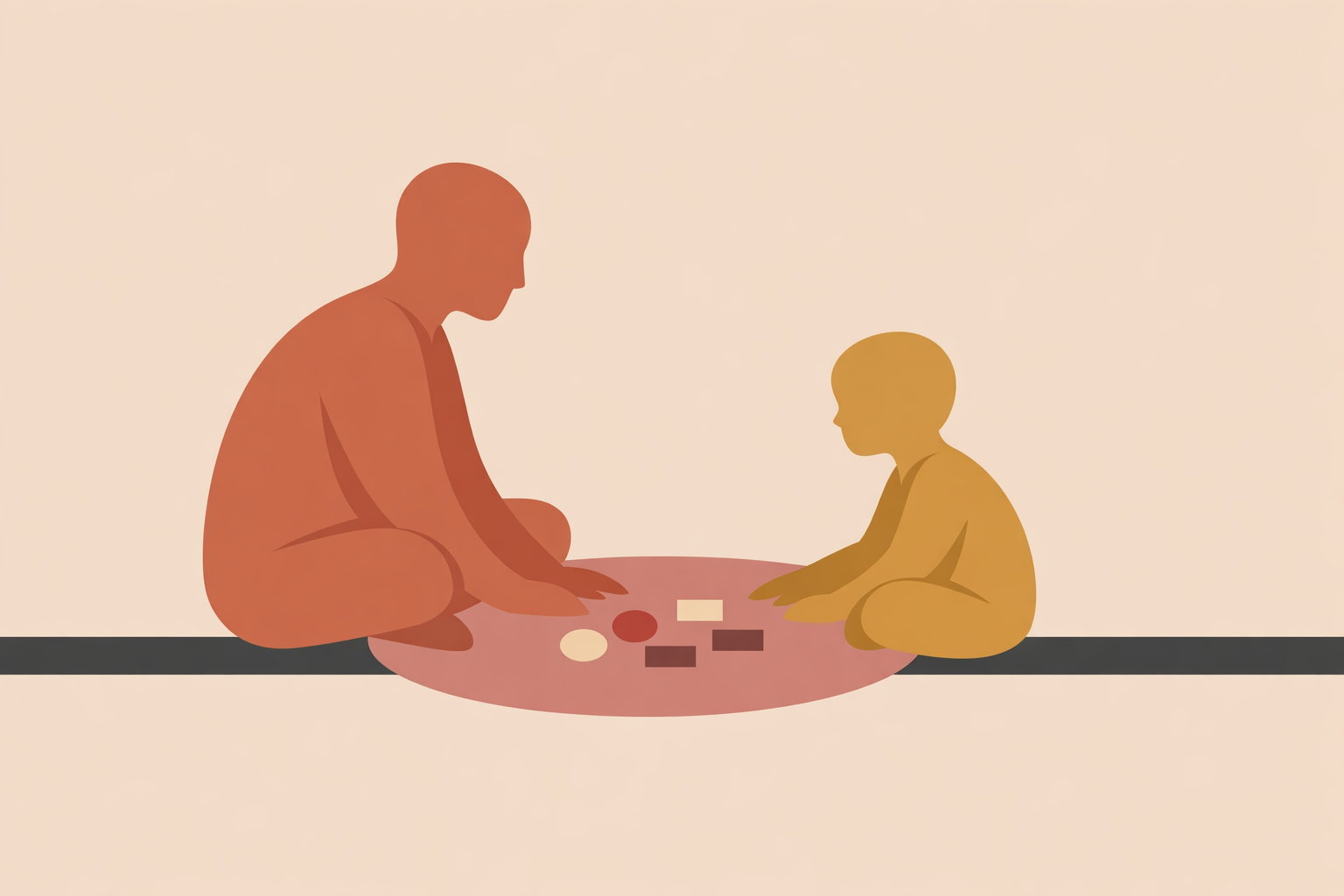
Child-centered play therapy (CCPT) offers a steady, respectful way to support children by leaning into what they already do naturally: play. When play is honored as communication—and the relationship is treated as the catalyst—you don’t need scripts. You need presence, wise boundaries, and a deep trust in the child’s inner capacity to grow.
CCPT is a developmentally responsive, play-based approach commonly used with children ages 3–10. It’s built around a safe, accepting, relationship-focused environment. In many traditional cultures, stories, games, and imaginative play have long helped children make sense of life; CCPT simply gives that timeless knowledge a clear, intentional structure. As Garry Landreth reminds us, “Play is the child’s symbolic language of self-expression.”
Modern findings echo what experienced practitioners and communities have observed for generations. A synthesis of CCPT studies reports a moderate overall effect size for behavior, relationships, self-efficacy, and school performance, with even larger gains reported for children of color. The throughline is simple: when play is respected and the relationship stays steady, children tend to strengthen.
Key Takeaway: Child-centered play therapy skills aren’t scripts—they’re a consistent stance: let the child lead, reflect what you see and feel, and hold warm, clear limits. When the space is symbolic and culturally responsive and sessions close predictably, children often build self-regulation and resilience through the relationship.
Step 1: Honor play as the child’s language
The heart of CCPT is a stance: the child leads, and the practitioner accompanies. Growth comes less from clever techniques and more from the quality of the relationship—warm, consistent, and non-judgmental.
CCPT grows from the person-centered tradition: unconditional positive regard, empathy, and faith in the child’s self-directing tendency. This is clearly reflected in CCPT core principles. In this approach, the child’s experience within the relationship is described as the factor most meaningful in creating lasting, positive change. Essentially, the practitioner stops “fixing” and starts staying close enough—consistently enough—for the child’s own system to reorganize.
This aligns beautifully with older, culturally rooted ways of supporting children through story, rhythm, and imagination—wisdom that trusts children to express what matters through play. CCPT keeps that spirit while offering a dependable frame rather than rigid protocols. As Vygotsky put it, “In play, a child is a head taller than himself,” and Piaget echoed, “Play is the work of childhood.”
When you treat play as language, you start listening differently. You notice symbols, repeating themes, and pacing. You reflect feelings and meanings—not just actions. CCPT uses play and the relationship to offer acceptance and empathy, supporting children’s self-regulation and behavioral control. And because CCPT shows meaningful gains across key areas of functioning, that stance tends to translate well into everyday sessions.
- Mindset mantra: “You lead, I’m with you.”
- Relational anchors: presence, empathy, acceptance, and faith in the child’s capacity.
- What changes: less interrogation, more reflection; less correction, more connection.
Step 2: Create a safe, symbolic, culturally rooted play space
Once the mindset is clear, build an environment that lets it breathe. A predictable, culturally responsive space helps children show you their world safely—using symbols when words are too small.
In CCPT, toys are chosen with intention. The aim is to include items that symbolize real life, nurturing experiences, and powerful or aggressive themes, so the child can express a full range of inner and outer realities—guidance emphasized in CCPT toy selection. The room is typically kept consistent across sessions to deepen safety and trust, a recommendation repeated in CCPT group implementation guides.
Cultural responsiveness isn’t decoration; it’s respect in action. Include dolls with diverse skin tones, familiar household items, and locally meaningful symbols that mirror a child’s family and community—an emphasis present in inclusive CCPT guidance. As Viola Spolin reminds us, “Play touches and stimulates vitality,” awakening intelligence, spontaneity, and intuition. When children feel recognized by the space, that vitality often arrives quickly.
- Core categories: real-life (kitchen set, tools), nurturing (blankets, stuffed animals), expressive (art, sand), protective/power (knights, shields), emotional (faces cards), community/cultural (local foods, ceremonies, transportation).
- Safety cues: consistent layout, clear shelves, soft corners, visible limits (e.g., “Water stays in the tub”).
- Cultural attunement: ask caregivers about meaningful items, avoid caricatures, include multiple ways to represent family and spirituality with respect.
Think of it like giving the child both “words” (toys) and “grammar” (structure). With both in place, play can speak clearly—and the child can feel understood.
Step 3: Lead with presence—tracking and reflecting play
With the space prepared, presence brings it to life. Tracking and reflection turn child-led play into a shared emotional conversation—moment by moment.
Two micro-skills often do the heavy lifting. Tracking names the child’s actions in simple, non-evaluative language (“You put the tiger on the tower”), communicating, “I see you.” Reflecting brings feelings and possible meanings into the room (“The tiger looks powerful—maybe he needs to protect his space”). CCPT training highlights these as core micro-skills that deepen communication. Practitioner resources also emphasize reflection as the primary way children share inner experience through play—often more truthfully than direct questioning.
Here’s why that matters: relationship is the engine. Reviews of CCPT underline empathy, acceptance, and responsiveness to the child’s pacing as key ingredients that support behavioral control. In school settings, children who received a brief series of child-led CCPT sessions often showed improvements compared with comparison groups—a pattern that points to consistent presence, not performance.
This kind of mirroring isn’t new. Across cultures, adults have echoed children’s play through story, call-and-response, rhythms, and games—long before anyone called it a technique. As Dora Kalff observed, play is where we learn trust and “the rules of the game,” the social rhythms that make belonging possible.
- Tracking stems: “You’re…” “You chose…” “Now the… is…”
- Feeling reflections: “That seems…” “He looks…” “It matters to you that…”
- Meaning reflections: “In this world, protectors show up.” “Sometimes small figures find big courage.”
Stay close, go slow, and let the child’s play show the map. Your words simply keep the channel open.
Step 4: Use choice and gentle limits to build self-regulation
Freedom needs a frame. With warm, predictable limits and real choices, children practice responsibility without losing leadership.
In CCPT, the practitioner “returns responsibility to the child” through choices and sincere encouragement—an emphasis embedded in CCPT principles. Reviews also describe how predictable limits, paired with acceptance, support stronger behavioral regulation. Put simply: boundaries aren’t punishment here; they’re part of what makes the relationship feel safe.
Think of limits like riverbanks—they don’t block the water; they help it move with direction. CCPT group resources emphasize consistent, understandable boundaries that protect safety and respect in the space. As Stuart Brown reminds us, those who play rarely lose the capacity for humor, and Brian Sutton-Smith said, “The opposite of play is not work. It’s depression.” Protecting play helps it keep doing what it naturally does: restore aliveness.
- Limit-setting script (CALM):
- C:onnect: “I get how excited you are with the water.”
- A:rticulate: “The water stays in the tub.”
- L:ink choice: “You can splash the tub or pour into the cups.”
- M:ean it: “If water goes on the floor again, the water will rest for now.”
- Responsibility prompts: “You figured out a new way.” “You kept going even when it was tricky.”
- When big feelings surge: ground with presence first (“I’m here with you”), then restate the limit and reoffer choices.
Over time, these consistent choices build self-regulation from the inside out. The child learns: “I can feel big things and still choose within safe edges.”
Step 5: Weave culture, family, and nature into play
Children grow in context. When family stories, cultural roots, and nature’s rhythms are welcomed with respect, play often becomes richer—without ever overriding the child’s lead.
CCPT training materials explicitly highlight cultural competence and work with diverse children, including inclusive toy choices that respect family values, spiritual traditions, and community norms—clear guidance within CCPT training. This fits the wider CCPT spirit of valuing intuitive wisdom over rigid protocols. Evidence statements also position cultural and social diversity as a foundational area of practice, underscoring the need for deep context.
For children navigating adversity, a steady, respectful relationship matters. Reviews of CCPT describe improvements across emotional and behavioral challenges when children participate in consistent play-based support. In higher-adversity contexts—particularly in schools—CCPT has also been associated with improved social functioning and behavior in settings where relational consistency is possible.
Many traditions also include forms of “risky play”—climbing, racing, exploring—which can build resilience and a clearer sense of danger. Writers such as Caroline Paul connect this kind of play to growing confidence.
- Culture-forward choices: locally meaningful foods and tools, musical instruments, textiles, language cards, family role-play sets that reflect varied constellations.
- Family invitations: “Are there objects that feel like home to your child?” “Any stories or games your family cherishes?”
- Nature-based add-ons: basket of stones, shells, pinecones; small plants; sand tray; weather sounds. Let the child decide how nature enters the scene.
When the room reflects the child’s world, they don’t have to translate themselves to be received. That recognition becomes a quiet medicine of belonging—and it often deepens the play.
Step 6: Close sessions with reflection and celebration
Endings are part of the process. Thoughtful closures help children integrate what happened and experience goodbyes as clear, safe, and kind.
CCPT curricula consistently include termination skills: reviewing changes, reflecting strengths, and celebrating progress from the child’s perspective—core practices in CCPT workbooks. Reviews also note that children in CCPT often do better than controls within a time-limited arc commonly used in schools. Group implementation models also highlight the value of a coherent beginning–middle–end process, especially where consistency supports engagement.
When children have lived through overwhelming experiences, consistent play relationships across sessions are linked with reduced stress and improved well-being in CCPT reviews. Many cultures mark transitions with songs, blessings, or simple rituals—wisdom that still guides today. As Theresa Kestly says, “Our brains are built to benefit from play no matter what our age.”
- Mini-closure (last 5 minutes):
- Reflect: “Today you figured out how the small figure could be brave.”
- Celebrate: “You stayed with that challenge and found your way.”
- Preview: “Next time, these toys will be here waiting.”
- Ritual: a consistent goodbye high-five, bell chime, or shared breath.
- Series closure (last 1–2 sessions):
- Invite child-led review: “What changed for you since we first played?”
- Strength mirror: “I saw your patience grow when plans didn’t work.”
- Choose a keepsake: child draws a scene or picks a photo of their build (with permission).
- Future-anchor: “Those strengths go with you to school and home.”
Good endings are a practice. They honor effort, mark growth, and help the child feel continuity beyond the room.
Conclusion: Let CCPT become the way you are with children
CCPT isn’t a bag of tricks; it’s a way of being with children that turns play into a living conversation. When you bring a clear stance, a symbolic and culturally rooted space, reflective presence, kind limits, and thoughtful closures, your skills become dependable—and the impact becomes cumulative.
The evidence supports what practitioners and communities have seen for generations: CCPT is linked to meaningful improvements across behavior, emotional stress, relationships, and school performance—solid evidence for an approach that stays human and grounded. Across controlled school-based studies, benefits are often seen after a brief series of CCPT sessions. It’s also been applied across a wide range of concerns, making it a versatile foundation for well-being support.
Keep learning the way traditional lineages always have: teaching, practice, reflection, and community. Many modern pathways begin with foundations and deepen through guided practice and ongoing study—an arc reflected in CCPT curricula. Neuroscience writers such as Jaak Panksepp emphasize play as a fundamental biological drive, essential for healthy development. Or, as Einstein is often credited, “Play is the highest form of research.”
A final word of care: CCPT works best when it stays truly child-led, culturally respectful, and anchored in clear boundaries—especially when big feelings arise. Stay within your scope, seek supervision where appropriate, and keep the space predictable and kind.
- Quick-practice checklist for every session:
- Arrive, ground, and set the room.
- Greet with warmth; invite the child to lead.
- Track actions; reflect feelings and meanings.
- Hold clear, kind limits; return responsibility with choices.
- Honor symbols, culture, family, and nature as they emerge.
- Close with reflection, celebration, and a predictable ritual.
Practice CCPT Skills Confidently
Deepen tracking, reflection, limit-setting, and cultural responsiveness with Naturalistico’s Play Therapy Certification.
Explore Play Therapy Certification →