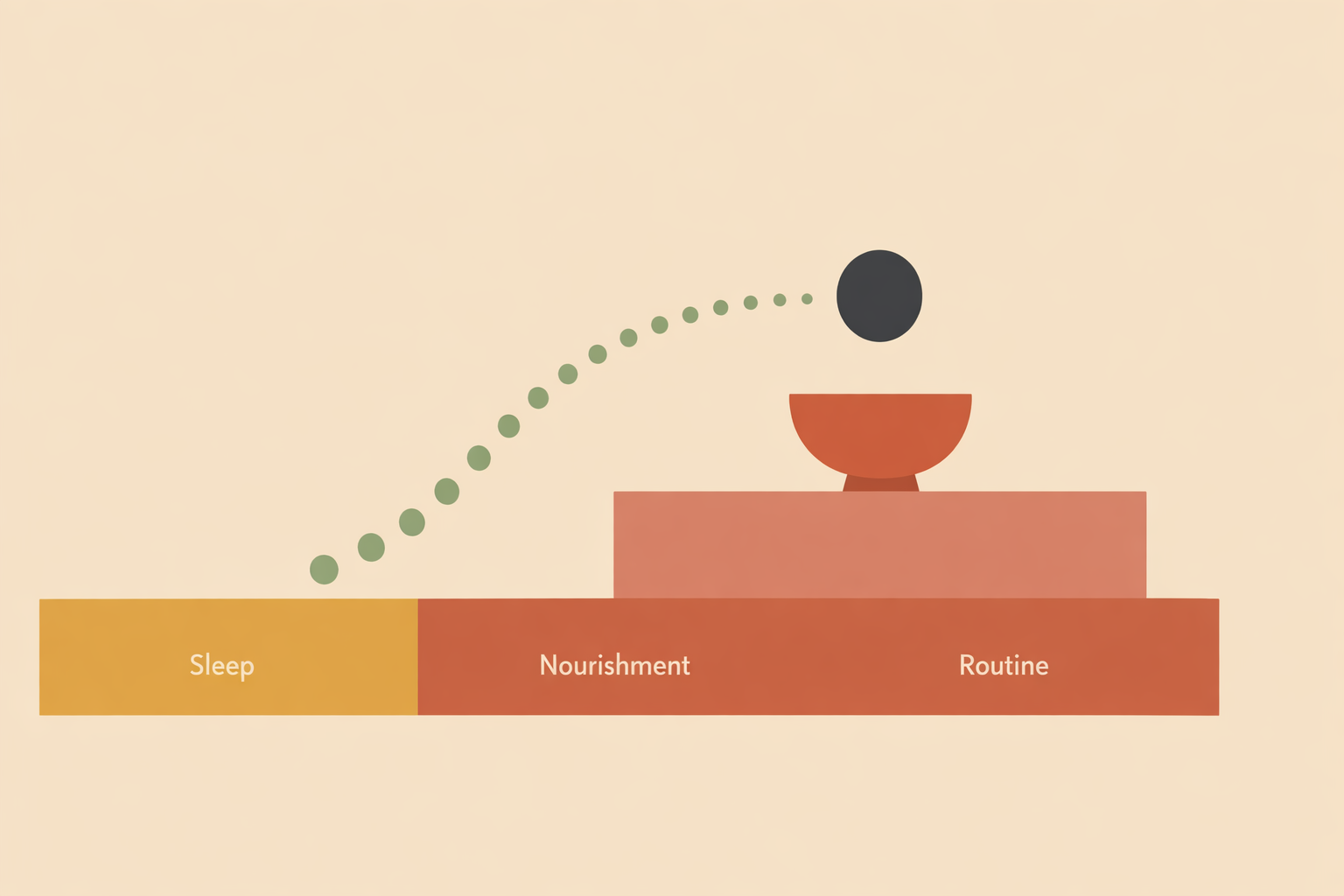
Practitioners committed to evidence-informed support often face a familiar bind: clients want steadier energy and resilience, supervisors want clear language and boundaries, and the word ojas can sound too abstract for both. Then comes the practical question: should someone start a rasayana while their sleep and meals are still irregular? Most experienced practitioners know the foundations matter first. The real skill is explaining that clearly without losing the depth of the tradition.
Key Takeaway: Ojas becomes clinically useful when translated into observable shifts in sleep, digestion, energy, mood, stress regulation, and connection. In most cases, the most reliable way to build it is to stabilize rhythm, nourishment, and rest first, then add herbs and rasayanas once the basics are consistent.
Ojas as a Traditional Map and a Modern Mirror
Ojas is the tradition’s north star for resilience—and it has a modern mirror you can actually observe: steadier sleep, more settled digestion, more regulated stress responses, and a calmer, more connected inner tone.
Just as importantly, ojas is not built in isolation. It depends on robust agni, consistent daily rhythm, nourishing food, restorative sleep, and a balanced nervous system. Put simply: reserves are refined over time from what is digested, assimilated, lived, and restored.
This is why rhythm is such a quiet powerhouse in traditional practice. Regular routines are linked with steadier energy and mood, which echoes what Ayurvedic lineages have observed for centuries: irregular living drains reserves, while steady rhythm protects them.
“evidence‑based research is highly needed”
That call doesn’t weaken the tradition. It strengthens our ability to communicate what practitioners have long seen—clearly, responsibly, and in ways modern settings can understand.
How to Translate Ojas into Client-Ready Language
Clients don’t need Sanskrit first. They need a felt sense of what might change in their week.
A useful translation is this: ojas is your reserves and recovery capacity. When it’s strong, people often notice steadier stamina, better sleep, more emotional warmth, and more resilience across stressors and seasonal shifts. Traditional descriptions of strong ojas include sound sleep, stable stamina, and a generous mood.
When ojas is low, the signs tend to be just as recognizable: chronic fatigue, a brittle mood, “frazzled” nerves, and the sense that life is drying a person out from the inside.
If you want a simple teaching frame, the prana–tejas–ojas triad is often enough to make the picture click:
- Prana: day-to-day energy, breath tone, and how easily the system becomes scattered or settled
- Tejas: clarity, discernment, digestion, and transformative power
- Ojas: reserves, recovery, steadiness, and emotional safety
Used this way, the triad becomes less philosophical and more practical: three kinds of vitality, and a clearer sense of where support belongs first.
Foundational Ways to Build Ojas
The most reliable ojas-building work is usually the least glamorous: support digestion, anchor the day in rhythm, protect sleep, soften unnecessary stress, and nourish connection. These are slow, steady moves—and they’re powerful.
Traditionally, ojas is the refined end-product of perfect digestion. Here’s why that matters: when digestion is erratic, even excellent food can feel heavy instead of restorative.
Ojas-building food is usually simple, warm, moist, digestible, and satisfying. In everyday terms, that often looks like regular meals, well-cooked foods, appropriate healthy fats, and enough steadiness to truly assimilate what’s eaten.
Ojas also loves rhythm. Steady mealtimes, waking with morning light, and consistent evenings can calm the system even before breathwork enters the picture. Essentially, rhythm itself is nourishing.
Everyday Habits That Quietly Build Reserves
- Digestive cadence: warm breakfast within an hour of waking, a main meal around midday, and a lighter earlier supper
- Sleep protection: lower stimulation in the evening, dim lights, and aim for a consistent bedtime
- Stress downshifts: brief pauses during the day for breathing, walking, humming, or silence
- Gentle movement: daily movement for about 20–40 minutes—enough to warm, not drain
- Connection: one nourishing conversation, shared meal, act of service, or meaningful moment of belonging each day
The pattern is simple: reserves build more easily when the body-mind isn’t spending all day adapting to chaos.
Ojas thrives on belonging, and isolation is draining. Many people can verify this directly from their own lives: warmth, trust, affection, and community aren’t “nice extras”—they’re part of what makes a person feel internally resourced.
When sleep and daily rhythm steady out, it can also support cortisol rhythms. What this means is that ojas-building often shows up as better “bounce-back,” not a jittery spike of energy.
Working with Ojas Herbs and Rasayanas
Once the foundations are stable, herbs and rasayanas can deepen the well. They tend to land best when life is already becoming more rhythmic, nourished, and less scattered.
Classic ojas-supportive herbs include ashwagandha, shatavari, brahmi, guduchi, amla, licorice, and shilajit. Traditional lists are remarkably consistent across lineages, even though emphasis and combinations vary.
Rasayana herbs are traditionally valued for their ability to nourish, restore, and support long-term vitality. In practice, they’re usually more effective when digestion is reasonably strong and daily life isn’t in constant disarray.
Chyavanprash is a classic example. Taken regularly over time, Chyavanprash daily has been associated with improved strength, self-reported well-being, and steadier energy.
A reasonable expectation for gentle rasayana work is 4–12 weeks for noticeable shifts in sleep depth, morning energy, and emotional tone. The exact timeline depends on constitution, current reserves, digestion, consistency, and how much strain someone is still carrying.
Many rasayanas are meant to be taken with warm milk or a small snack to support assimilation and protect agni. That traditional instruction is easy to skip, but it often makes a real difference in how well the support is received.
Practical Guidelines for Using Herbs Well
- Build foundations first: herbs usually work better when meals, sleep, and rhythm are already improving
- Keep formulas simple: one well-matched support is often more useful than a crowded blend
- Start low and observe: track digestion, sleep, energy, and mood before changing amounts
- Use clean sourcing: quality and transparency matter
- Think in seasons, not days: ojas-building is usually gradual
The point isn’t to get fancy. It’s to match support to lived reality—and let the basics do most of the heavy lifting.
Avoiding Two Common Extremes
Ojas work becomes clearer when you avoid two unhelpful extremes: magical thinking and hyper-skepticism.
One extreme is overpromising. Ojas isn’t a shortcut, and it shouldn’t be collapsed into vague grand claims. The other extreme is dismissing anything subtle simply because it doesn’t map neatly onto a single modern metric.
The middle path is stronger: respect traditional knowledge, speak in observable outcomes, and stay willing to learn from emerging research without letting it flatten the story.
This is also where practitioner maturity shows. You can make careful claims, track what changes, and speak confidently about what has been observed over generations—without pretending every valuable insight must be reduced to one measurement.
How to Track Ojas Over Time
Ojas is subtle, but its shifts become obvious when you know where to look. A simple weekly dashboard is often enough.
- Sleep: bedtime consistency, ease of falling asleep, night waking, morning feeling
- Energy: morning steadiness, afternoon crashes, end-of-day reserves
- Mood: warmth, irritability, emotional steadiness, bounce-back after stress
- Digestion: appetite regularity, ease after meals, bowel rhythm, cravings
- Stress: frequency of overwhelm, ability to downshift, breath tone through the day
- Connection: sense of belonging, supportive contact, time in nourishing relationship or reflection
Over 4–12 weeks, this style of lifestyle support often aligns with reduced stress, improved mood, and broader shifts in resilience. More generally, integrative programs can improve mood and lower stress reactivity within a relatively short window.
A helpful rhythm is:
- Baseline week: observe current routine and patterns without trying to change everything
- Four-week focus: choose two or three levers, such as earlier bedtime, warm breakfast, or daily pauses
- Review: compare weekly notes and look for what genuinely improved
- Seasonal reset: every 8–12 weeks, reassess and consider whether herbs or rasayanas now make sense
Ojas gives a north star for vitality. The work is to make it visible in ordinary life: one warm meal, one steadier evening, one nourishing conversation—one well-supported week at a time.
Study Ojas in Practice
Apply these ojas-building principles with confidence in the Ayurvedic Practitioner Certification.
Explore Certification →