Many naturopathic coaches hit the same ceiling: a client tries sleep fixes, supplement tweaks, and a new morning routine—yet the daytime crash or nightly waking keeps returning. Sessions can start to feel like triage: a goal for energy here, a plan for digestion there, while the bigger pattern stays blurry. You hear about work stress, late emails, skipped meals, grief that tightens the chest, and a noisy apartment, but there’s no shared way to hold it all on one page.
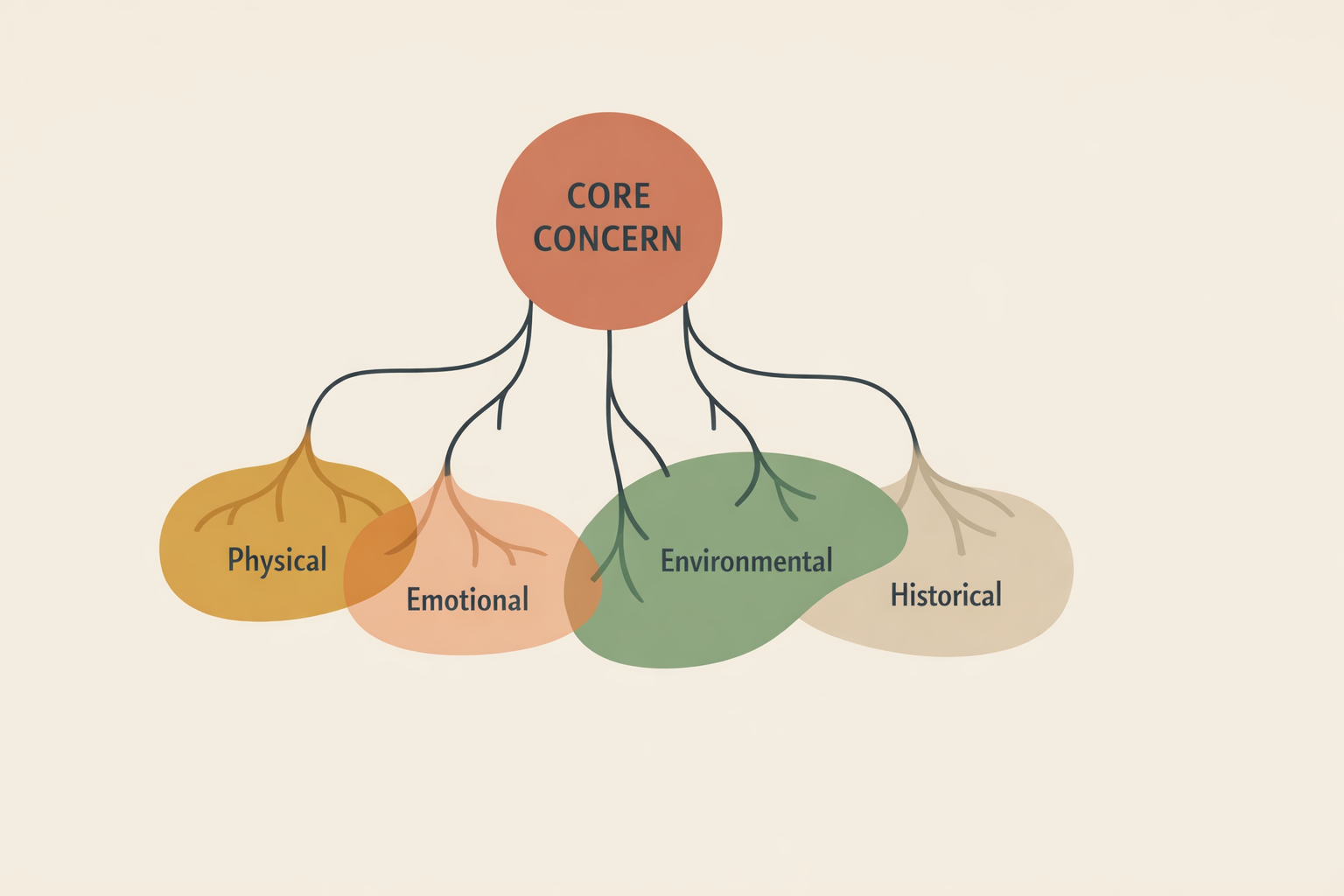
Root cause maps give you that structure. They turn a complex, human story into a clear visual that links a client’s main concern with the physical, emotional, environmental, and historical drivers that keep it going. With a shared map, your support becomes more specific, your experiments become smaller and kinder, and the client can actually see their own agency—where a single change could create a ripple effect. In systems work, focusing on root causes tends to create more durable progress than chasing the loudest symptom.
Key Takeaway: Root cause maps help you and your client see how symptoms connect to upstream drivers across body, emotions, environment, and history. By putting the whole system on one page, you can choose humane leverage points, run smaller experiments, and keep refining the plan as real life shifts.
What a Root Cause Map Is (and How Naturopathic Coaching Makes It Different)
A root cause map is a simple visual that connects a client’s central concern to the factors feeding it across different life domains. In a naturopathic coaching context, it stays practical and structured—but it’s also deeply human: a whole-person framework, not a technical diagram.
At its core, mapping uses boxes and arrows to show cause-and-effect—how one factor can lead to another, and how multiple factors combine. In coaching, those “boxes” might include food rhythm, sleep timing and light exposure, nervous system tone and boundaries, environmental inputs, community support, meaning, and grief. Think of it like drawing the client’s inner ecosystem: not to judge it, but to understand how it’s currently operating.
This is where the naturopathic lens changes everything. Traditional approaches keep the person—not the “problem”—at the center, and they value individualized, relational support. That naturally aligns with maps that honor individualized approaches rather than one-size-fits-all protocols. In real sessions, that might mean mapping digestion alongside grief, or circadian rhythm alongside housing stress, because the client experiences it as one life.
For coaches who appreciate a clear framework, Naturalistico’s Naturopathic Coach Certification emphasizes working with body systems, lifestyle foundations, and emotional balance in an integrated way—an excellent backbone for mapping. And as James D’Adamo put it, “The cornerstone of any method is the individualized diet... nutrition will bring you health, energy, and wellbeing.” On a map, that kind of insight becomes actionable: daily food choices → energy swings → motivation → follow-through, connected with curiosity instead of blame.
Over time, mapping tends to make your support more targeted and sustainable—echoing how root cause analysis in other domains supports long-term improvements rather than quick fixes.
Seeing the Whole System: Weaving Physical, Emotional, Environmental, and Ancestral Threads
Root cause maps invite you to hold the full tapestry: physiology, emotions, environment, and ancestry. The goal isn’t to rank what “matters most,” but to see how each thread pulls on the others—so you can choose a kind, effective starting point.
Traditional wisdom has long linked vitality with the flow of feeling and energy.
“Health is linked to emotional responsiveness... we need to keep our feelings and energy in motion, rather than locking them in our tissues,”
Sat Dharam Kaur’s emphasis on emotional responsiveness lands beautifully in mapping: emotions don’t sit “outside” the physical story—they belong on the same page. A map might connect “unprocessed grief” → “chest tightness” → “shallow breathing” → “afternoon fatigue,” right alongside coffee intake or screen time.
Modern research also reflects this interdependence. Trauma has been associated with higher risks of many physical challenges, and early-life stressors are repeatedly linked to adult outcomes. What this means is simple: learned stress responses and early context often belong close to the “roots” of the diagram, not tucked away as an afterthought.
Environment matters just as intimately—air, water, light, noise, land, and community shape daily regulation.
“Keeping your body healthy is an expression of gratitude to the whole cosmos—the trees, the clouds, everything.”
Thich Nhat Hanh’s sense of gratitude can guide the tone of your map: light after sunset, green time, seasonal rhythms, and home environment aren’t “hacks”—they’re relationships. When clients see all these layers together, many naturally soften into compassion: “No wonder I’m tired—look at all I’ve been carrying.” That clarity is often a turning point.
Step 1: Gathering the Story That Will Feed Your Root Cause Map
Your map is only as wise as the story you gather. The first step is an intake that listens for patterns, not just problems.
Invite a narrative first. A gentle opener like “When did you first notice things shifting?” often reveals more than a checklist. Many practitioners begin by exploring when patterns began, how they changed over time, and what reliably triggers or soothes them. You’re listening for timelines and repeating themes—the architecture beneath the symptoms.
Then move through lifestyle pillars with respect and realism. Naturalistico’s curriculum highlights lifestyle factors like nutrition, movement, sleep, stress, and emotional well‑being. Ask about typical days rather than ideal ones, and make room for what’s already working.
Hold a spacious pace: open questions, long pauses, and reflections in the client’s own words. Coaching emphasizes deep listening because it changes what clients can notice about themselves. Capture key phrases and time markers—those become the language of the map and keep the client’s voice at the center.
- Timeline prompts: “What was happening just before this started?” “Were there any moves, losses, or major life shifts around then?”
- Pattern prompts: “What improves this even a little?” “What reliably makes it worse?”
- Context prompts: “What did you grow up believing about rest, food, or asking for help?” “What’s the environmental backdrop—light, commute, noise, housing?”
- Resource prompts: “Who or what helps you feel grounded?” “What traditions or practices feel like home to you?”
Before you end, reflect strengths and “glimmers” back to the client. That tone is part of the root system too: when someone feels seen and resourced, change becomes more doable.
Step 2: Turning a Complex Story into a Clear Visual Root Cause Map
Next, translate the story into a one‑page visual with boxes and arrows that show how the pieces relate. The goal is clarity at a glance—for both of you.
Start with one precise focus statement in the center: “Afternoon crashes,” “Night wakings,” or “Daily tension headaches.” Then ask why repeatedly and capture each contributor as a short, neutral phrase: “skipping lunch,” “late caffeine,” “blue light after 9 pm,” “rumination before bed,” “low daylight exposure,” “crowded evenings,” “difficulty saying no.” Draw arrows so the story reads like a flow, not a pile of tasks.
Let the map widen as needed. In mapping, diagrams naturally expand horizontally as you uncover contributors. Include combinations (“late caffeine” + “low daylight” → “circadian confusion”) and loops (“poor sleep” → “sugar cravings” → “energy crash” → “late caffeine” → “poor sleep”). Essentially, you’re showing the system doing what systems do: reinforcing what’s already in motion.
Whenever possible, build the map together in real time. Client-friendly visuals can support better understanding and follow-through because the client can literally see what’s happening. Ask, “Does this arrow feel accurate?” or “What are we missing?” and adjust as you go.
- Annotate context: add brief notes under key nodes (“started after job change,” “worse after weekends,” “helped by a 20‑minute walk”).
- Mark leverage points: star 1–3 places that look both high-impact and humane. Root cause mapping is valued because it reveals leverage points instead of scattering effort.
- Name experiments: connect each starred node to a 1–2 week micro-practice that feels realistic.
- Add roots with care: if relevant, place earlier influences near the bottom—“family pattern of over‑giving,” “multiple moves in a short period.” These aren’t labels; they’re context.
Close by asking what it feels like to see their life on one page. Many clients feel both relief and clarity—and that combination often supports lasting follow-through.
Keeping Your Map Alive: Revisiting, Refining, and Respecting Limits
A root cause map isn’t a verdict; it’s a living conversation. It helps you see the system clearly, choose compassionate leverage points, and evolve the plan as the client’s life changes—much like how root cause methods support long-term improvements instead of constant firefighting.
The map gets more valuable when you revisit it. Many systems teams rely on iterative review so diagrams stay accurate rather than becoming stale. In coaching, checking the map every few weeks helps you:
- Update what’s changed (“screen time reduced,” “more regular lunches”).
- Notice fresh leverage points (“asking for help at work,” “morning light exposure”).
- Remove pieces that no longer fit the client’s experience.
- Make progress visible by celebrating what has softened or resolved.
A few principles keep the work clean, respectful, and effective:
- Lead with consent and collaboration. The client’s language belongs on the map; their pace sets the tempo.
- Avoid reductionism. The goal isn’t “the one cause,” but a clear set of patterns and a kind place to start.
- Honor ancestry and culture. When traditional practices appear, credit sources, avoid appropriation, and let the client define what’s authentic for them.
- Prioritize stability when history is tender. When the map touches sensitive experiences, focus on resourcing and steadiness before exploring deeper roots.
- Keep it iterative. Add what you learn, revise what doesn’t fit, and keep choosing the next right experiment.
Blending traditional wisdom with strong systems thinking isn’t about proving which worldview wins. It’s about serving the person in front of you with clarity and care. When the pattern is visible, progress stops feeling mysterious—it becomes a series of small, meaningful arrows.
Map Roots Like a Coach
Build root-cause mapping into real sessions with the Naturopathic Coach Certification.
Explore Naturopathic Coach Certification →