Most practitioners eventually meet a familiar moment: a capable client admits, “I’ve lost my motivation at work,” and the usual levers—goals, deadlines, pep talks—barely register. Some clients look exhausted and reactive; others are flat, clock-watching, and insist they’re “fine.” Burnout, boredom, and a role–values misfit can all sound like low drive, yet they call for very different support.
In practice, “lost motivation” is rarely a character flaw—it’s a signal. Ikigai is a steady, traditional lens for reading that signal and then rebuilding engagement in a grounded way. Often, a few small shifts inside real work do more than grand reinventions, especially when the client’s life constraints are non-negotiable.
Key Takeaway: Low motivation at work is usually a signal of burnout, boredom, or a deeper role–values misfit. Using ikigai’s four circles helps clients identify what’s underfed—love, skill, contribution, or pay—then turn insights into tiny, reversible work experiments that rebuild energy in realistic conditions.
How to coach “I’ve lost my motivation at work” before using ikigai prompts
Seeing beyond burnout, boredom, and misfit
When a client says, “I’ve lost my motivation at work,” it helps to hear it as a layered message rather than a single problem. Most often, it’s some mix of burnout, boredom, or a deeper misfit between the role and the person’s values.
Disengagement can come from being depleted—or from being under-stretched. Put simply, it may be burnout or boreout. Boredom often hides behind “I’m fine,” and many coaches notice that “I’m fine” can hide boredom that’s difficult to admit. Over time, that can become being bored out—quiet procrastination, detachment, and a loss of pride that’s easily misread as laziness.
Your first job is pattern recognition: is the client overextended, under-challenged, or disconnected from meaning? Regular check-ins specifically designed to separate burnout vs boredom can quickly reveal the right doorway back to engagement.
Sometimes the change is gradual: a slippery slope where attention dulls, meaning thins, and motivation follows. That’s where flow becomes a useful compass. “The happiest people are not the ones who achieve the most. They are the ones who spend more time than others in a state of flow,” writes Héctor García—pointing us back to the energizing rhythms that make work feel alive again.
With this map, you can choose the right focus: build recovery and margin for overload, restore stretch for under-challenge, and invite purpose-centered inquiry for misfit. Ikigai supports all three—without judgment—by helping clients name what’s missing and rebuild motivation from the roots.
Introducing ikigai as a traditional yet practical lens for work motivation
From Japanese cultural wisdom to modern workplaces
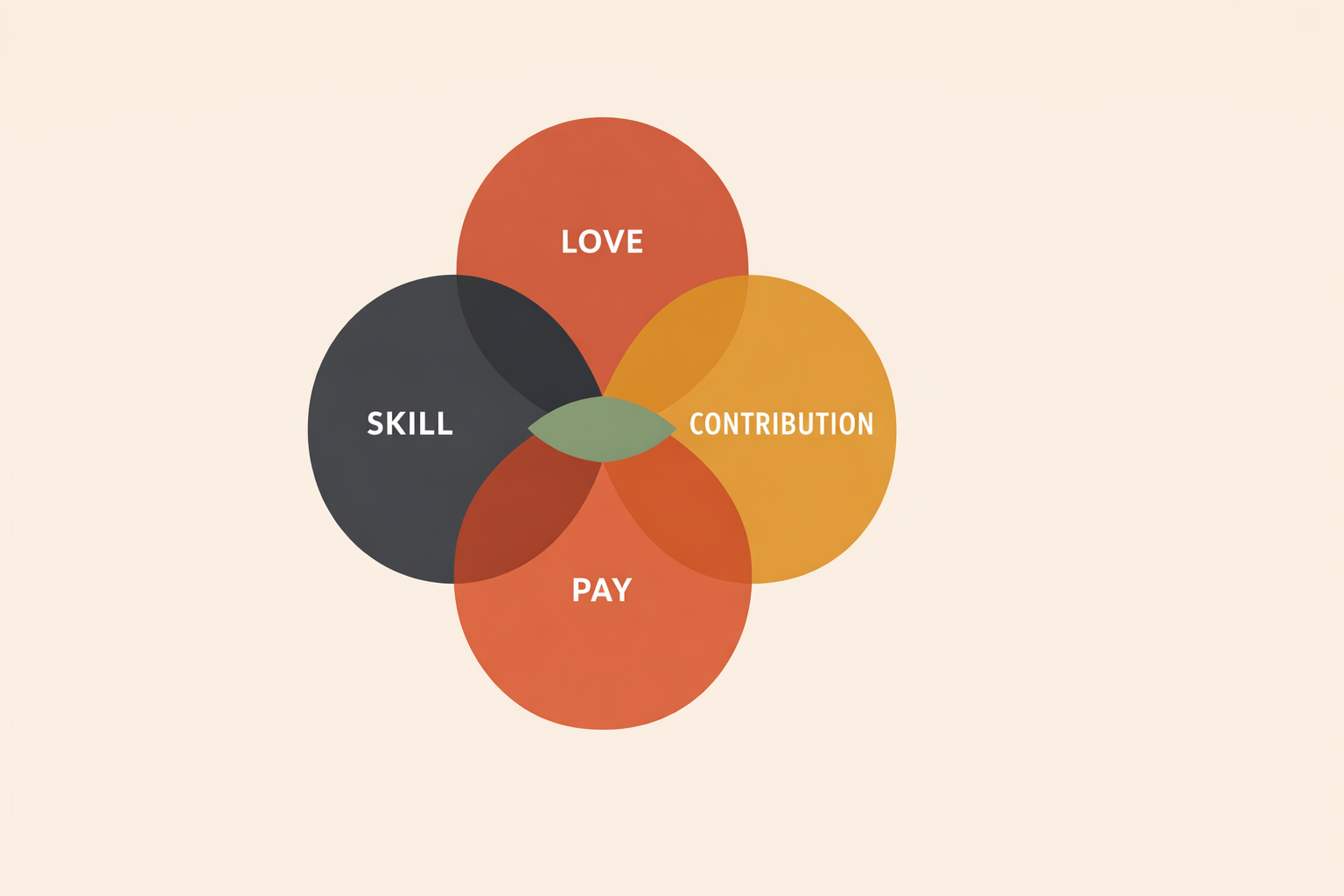
Ikigai, a Japanese cultural concept often translated as “reason for being,” offers a practical way to explore work motivation with depth and simplicity. It’s commonly described as the meeting point between what you love, what you’re good at, what the world needs, and what you can be paid for.
In traditional contexts, ikigai is not a single “big purpose” you find once—it’s an ongoing relationship with daily life, community, and contribution. Contemporary accounts often highlight Okinawa elders describing vitality through everyday purpose—family roles, land, craft, service. For practitioners who value traditional knowledge, this matters: long-lived cultural practice is not a footnote; it’s a form of evidence in itself.
Modern research often echoes the same theme. People who report strong purpose tend to have a lower risk of early death and more stable well-being over time. Leadership thinkers also describe ikigai as a full spectrum lens—honoring inner passion alongside financial reality, which is exactly what many clients need.
In coaching, that integration is the gift: ikigai connects mission, vocation, and paid work in one frame. Naturalistico’s approach emphasizes this ikigai integration so clients can build meaning without pretending money, responsibilities, or workplace limits don’t exist. As García and Miralles put it, “Once you discover your ikigai, pursuing it and nurturing it every day will bring meaning to your life.”
Used well, ikigai becomes a clear diagnostic question: if motivation is low, which circle is underfed—love, skill, contribution, or pay?
Before the prompts: creating a safe, culturally aware container
Clarifying scope, expectations, and cultural respect
Ikigai can open tender territory, so it’s worth setting the container carefully. Clarify that the goal is values-aligned work and life—not pushing performance—and that the client chooses the pace and depth.
Lead with gentle inquiry. Think of it like walking with a lantern: you’re not dragging the client toward an answer; you’re helping them see what’s already true. A psychologically safe space—where doubts, disappointment, and desire can be spoken—supports deeper reflection.
Cultural respect is essential. Ikigai isn’t a corporate slogan; it’s rooted in Japanese culture. If you’re bringing it into workplaces, keep participation voluntary and centered on agency. And when adapting practices across cultures, follow principles of cultural adaptation: honor local values and community structures rather than forcing a one-size-fits-all model.
Accessibility supports depth. Many clients do best with flexible communication, collaborative pacing, and sensory-aware choices—small adjustments that make reflective work easier for different nervous systems and learning styles.
“Accepting yourself is one of the most important and yet difficult tasks we face in our lives.”
Ken Mogi’s reminder helps set the tone: begin with honest self-acceptance, then build from there (accepting yourself).
Guiding clients through the four circles with work-focused ikigai prompts
Designing prompts that speak to real job realities
Once the container is set, structured inquiry brings relief: it gives the client a way in. The classic map is built around four questions: what you love, what you’re good at, what the world needs, and what you can be paid for.
Move one circle at a time, then look for overlaps. Keep it concrete and tied to the client’s current role—not an idealized future.
- What you love — “Which tasks make time disappear?” “If your role ended tomorrow, what would you fight to keep?” “What makes you lose track of time?”
- What you’re good at — “What do colleagues reliably come to you for?” “Where do you produce strong results with less effort than most?”
- What the world needs — “Whose day, workflow, or outcomes improve because of your work?” “Which needs around you feel worth answering?”
- What you can be paid for — “Which strengths are already rewarded here?” “What does your industry value that you can align with?”
To reduce pressure, many clients benefit from spacing this out. A seven-day rhythm—one circle per day, then pattern-spotting—often produces clearer insights. Visual worksheets (or a simple Venn diagram) make the overlaps easier to see.
Next, map the job as it is today. Invite clients to map tasks into the four circles to find where meaning already exists and where energy leaks. Naturalistico’s training includes structured worksheets that make this practical to use with real clients and real schedules.
“Be led by your curiosity, and keep busy by doing things that fill you with meaning and happiness.”
That’s the spirit of good prompts: curiosity that gently reawakens aliveness (keep busy).
From insight to action: turning ikigai reflections into tiny work experiments
Designing small, respectful shifts inside existing roles
Insight becomes confidence when it changes the client’s week. After mapping the circles, co-design tiny experiments: small, low-risk adjustments that test what actually restores energy. Engagement findings often support the power of small, testable shifts over dramatic all-or-nothing moves.
Some workplaces make this easier. Komatsu, for example, has encouraged employees to use roughly 5% time for passion initiatives. Where that’s not available, purposeful side projects (inside or outside the organization) can still bring oxygen back into the week.
Choose experiments that match the client’s reality:
- Job crafting: Redesign a small slice of the week to include one genuinely interesting activity.
- Skill stretch: Run a short, clearly scoped mini-project that builds a growth skill.
- Contribution shift: Add one responsibility that directly supports a person, team, or cause the client cares about.
- Learning loop: Schedule a consistent learning block for a skill sitting in multiple circles.
Keep changes reversible. Naturalistico emphasizes translating purpose into small steps so the client tests direction rather than trying to “become a new person.” When even a small portion of work aligns with inner purpose, motivation often rises—echoing links between purpose and higher motivation.
“If you can make the process of making the effort your primary source of happiness, then you have succeeded.”
Tiny experiments bring this to life: the effort becomes part of the reward (primary source).
Coaching misfit and constraints: using ikigai without forcing positivity
Working honestly with boredom, misfit, and systemic limits
Not every ikigai insight fits neatly into a client’s current role. Economic pressure, organizational culture, family responsibilities, and timing all matter. Ikigai doesn’t deny constraints; it helps clients work with them skillfully.
If a role feels narrow, widen the view of contribution. Explore how the client’s gifts could serve what the world needs—through a different team, a community project, mentoring, or a new internal focus. Fulfilment can sometimes grow without changing jobs, simply by reframing value and choosing more intentional tasks.
Even in constrained roles, people can often influence relationships, problem-solving style, and the quality of service they bring. At the same time, persistent boredom can erode well-being, so it deserves respect—not minimization. Validate real limits while still supporting choice where it exists—an approach aligned with validating limits.
At a system level, healthier workplaces aim for equilibrium between organizational goals, people’s interests, and community impact. If your client has influence, invite them to shape that balance. If they don’t, anchor agency in the next respectful step they can take today.
“Along with joy, the experience of suffering also makes life worth living.”
Professor Yoshikazu Ueda’s words keep the work honest: the goal isn’t forced positivity, but meaning that can grow in real conditions (makes life worth).
Evolving your practice: coaching lack of motivation at work with ikigai prompts
Tracking what shifts when clients reconnect with purpose
Ikigai work deepens when you track what actually changes over time. Focus on client-centered outcomes like clarity, energy for key tasks, and confidence in decisions.
Naturalistico shares practical ways to measure outcomes that clients recognize in daily life. Simple self-ratings (before and after a short experiment cycle) can track motivation, alignment, contribution, and flow. Pair that with one narrative question: “What felt different this week because of what we tried?”
Keep artifacts so progress becomes visible. Ikigai worksheets are designed to be revisited as the circles evolve. A brief journaling cycle can also become useful qualitative data, especially as clients’ language shifts from vague dissatisfaction to clear preferences and boundaries.
As purpose strengthens, outcomes often move together—more engagement, steadier rhythms, and greater life satisfaction. Treat this as an evolving practice: refine prompts, improve experiments, and let each client teach you how to make the process kinder and more effective.
Purpose isn’t something you “install.” It’s something you cultivate—and measure in ways the client can feel, not just describe.
Conclusion
Lack of motivation at work is rarely one-note. When you listen for burnout, boredom, and misfit—and then bring clients through ikigai’s four circles—you help them find the real gap and respond with care and precision.
This is traditional wisdom meeting modern work: meaning grows through daily practices that honor love, skill, contribution, and livelihood. With a respectful container, practical prompts, and tiny experiments, many clients can feel more alive without blowing up their careers.
As García and Miralles affirm, “Once you discover your ikigai, pursuing it and nurturing it every day will bring meaning to your life.” The main cautions are simple: keep the work culturally respectful, client-led, and realistic about constraints—and let the next step be honest, not performative.
Train in Ikigai Coaching
Apply these prompts confidently with Naturalistico’s Ikigai Coach Certification Course.
Explore the Course →