Many coaches and holistic practitioners recognize the moment: a client’s distress seems to flare up “out of nowhere,” the story speeds up, and the session gets pulled into reassurance or quick problem-solving that doesn’t last. Ordinary cues—a tone in a meeting, a late reply, a crowded room—can snowball into rumination, avoidance, or conflict. When the trigger-to-response sequence stays invisible, the same patterns repeat.
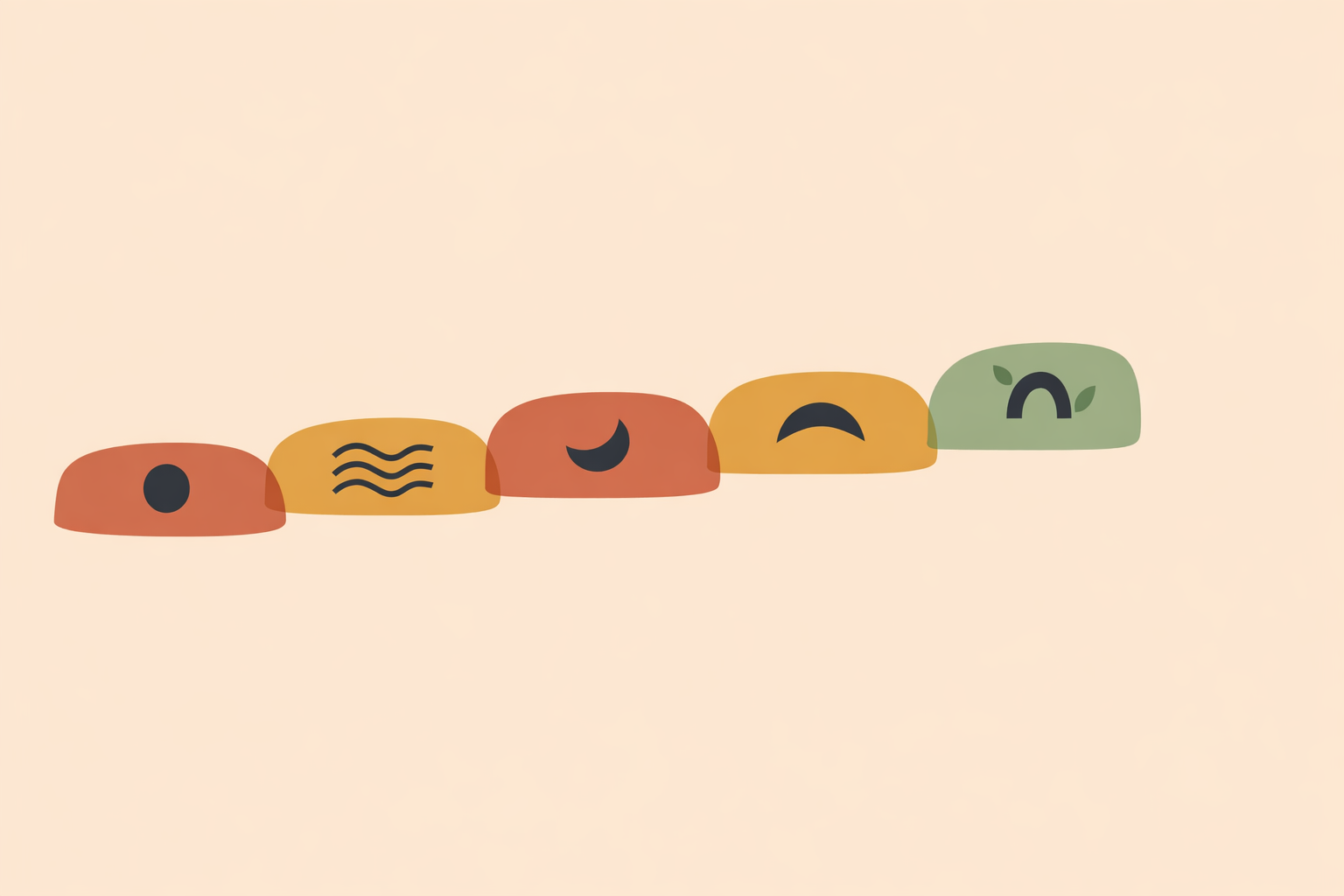
One of the most useful ways to bring calm and clarity is to use CBT as a simple, repeatable five-step workflow: track what happened, what it sparked inside, and what the person does next. It keeps you close to real moments, includes thoughts, emotions, body sensations, and urges, and uses reframes plus small experiments to build new “evidence” through lived experience. That structure is steady enough to return to session after session, and flexible enough to sit alongside somatic and culturally grounded work in non-clinical coaching spaces.
Key Takeaway: CBT becomes most usable when it’s taught as a repeatable five-step loop: name the trigger, map thoughts/feelings/body/urges, reframe one key thought, test a small new behavior, and consolidate what you learned. Repeating this sequence turns insight into evidence and helps new responses stick over time.
Step 1: Name the Trigger – What Actually Happened
Start with the simplest skill that creates the biggest shift: name the trigger clearly and neutrally. Before anyone can change a pattern, they need to separate what happened from the meaning the mind quickly attached to it.
CBT often begins with a straightforward chain: a situation leads to thoughts, emotions, body sensations, behaviors, and then consequences. That’s why anchoring the work in the specific situation gives everything else a stable base.
Triggers are usually everyday moments: an unanswered message, a partner’s tone, a memory while driving, a crowded room, a critical comment, or waking up already tense. It doesn’t have to look “big” from the outside—what matters is that it set something in motion.
That’s also why many CBT worksheets begin with a neutral “situation” column. You capture who/what/when/where first, then interpretation. Instead of “They were disrespecting me,” you might write: “My colleague interrupted me twice during the team call at 10 a.m.”
Services like the NHS reflect this practical starting point: noticing what happened and when difficult feelings showed up is often the doorway to patterns that used to feel automatic.
Over time, this becomes even more useful when you build a shared trigger map from multiple small snapshots, not one dramatic story. CBT’s collaborative, structured mapping is linked with lasting improvements in day-to-day functioning and quality of life—one reason the approach is so teachable.
Simple prompts help keep it factual:
- What happened?
- Where were you?
- Who was there?
- What did you see, hear, remember, or notice?
- What are the facts, before the story?
When intensity is high, pacing matters. Trauma-informed guidance emphasizes working within a person’s window of tolerance—moving gently enough that awareness expands without becoming overwhelming.
Cultural context matters just as much. The same event can mean very different things depending on family history, community experience, spiritual worldview, and ancestral memory. Reviews of culturally adapted approaches consistently highlight exploring individual meaning rather than assuming a universal interpretation.
Once the trigger is named with care, you have a clear starting point. Next comes the inner map.
Step 2: Map the Inner Experience – Thoughts, Feelings, Body, Urges
With the trigger in view, the next step is to make the inner reaction visible: thoughts, feelings, body sensations, and urges. Think of it like turning on the lights in a room—you’re not changing anything yet, you’re just seeing what’s there.
For many people, this brings relief. What felt like a single “blur” separates into workable parts. CBT’s practice of identifying and naming these parts is associated with reduced distress and greater perceived control.
At the center are automatic thoughts—fast interpretations that appear between the event and the response. They can feel like truth simply because they arrive so quickly, which is why learning to spot automatic thoughts is foundational.
Example: Trigger—“My supervisor said, ‘Can we talk later?’” Automatic thought—“I’ve done something wrong.” Emotion—fear. Body—tight chest. Urge—avoid, overexplain, or rehearse mistakes.
Writing it down often creates distance. Research on expressive and cognitive writing suggests it can help people reduce distress by stepping back from the swirl. This is the logic of thought records: separating situation, thoughts, emotions, physical sensations, and behaviors to reveal and modify patterns that otherwise stay hidden.
This is also where holistic practitioners often feel on familiar ground. Modern CBT approaches explicitly include the body, and CBT protocols routinely map bodily sensations alongside thoughts and emotions. Asking “What happened in your throat, belly, jaw, breath, or hands?” doesn’t drift away from CBT—it completes the picture.
Urges matter too, because they often drive behavior more directly than thoughts do. CBT approaches for impulse-related challenges assess urges and cravings precisely because they shape what happens next. Once the urge is named (“I wanted to leave,” “I wanted to shut down,” “I wanted to scroll”), change becomes more realistic and compassionate.
There’s also a natural bridge here with older contemplative traditions. Mindfulness-based cognitive therapy blends mindfulness with CBT and has been combined successfully with other contemplative and body-focused traditions. What this means is that structured reflection and present-moment awareness can work together rather than compete.
When someone can say, “This was the trigger; this was the thought; this was the feeling; this is what my body did; this was the urge,” they’re no longer lost inside the experience. They’re observing it—and that opens the door to changing the story.
Step 3: Reframe the Story – Cognitive Restructuring
Now you choose one key thought and gently test it. Cognitive restructuring asks: is this thought the whole truth, or only the most painful slice of it?
The goal isn’t forced positivity. It’s steadiness and balance. Strong reframing tends to create realistic appraisals that feel kinder and more believable than either self-criticism or “just think positive.”
Practically, this often means looking at evidence for the thought, evidence against it, and then widening into a more grounded alternative. You’re not erasing hard reality—you’re making room for more than one interpretation.
“I always ruin things” can become “I made one mistake, and I can repair it.” “They didn’t reply because they’re upset with me” can become “I don’t know why they haven’t replied yet.” “If I feel anxious, I can’t handle this” can become “I feel activated, but I can move through this slowly.”
Many people find it easier once they can name the thinking style. CBT teaches common cognitive distortions—catastrophizing, mind-reading, all-or-nothing thinking, labeling, overgeneralizing—so thoughts start to look like hypotheses rather than prophecies.
From a traditional and culturally respectful perspective, it’s also important to remember why some thoughts exist. A thought formed in years of unpredictability, exclusion, or shame can be protective. Trauma-focused guidance emphasizes validating survival appraisals before trying to change them, so the person feels understood rather than corrected.
Sometimes the most helpful shift is changing the relationship to the thought, not debating it. Third-wave approaches like ACT teach defusion—observing thoughts without automatically believing them—which pairs naturally with mindfulness and awareness-based practices.
Researcher Steven Hollon has noted CBT can have lasting benefits beyond the period of active support. A big reason is that reframing is a portable skill: pause, question, choose.
People suffer under the weight of stories that became too narrow. Reframing helps those stories breathe again.
Cultural awareness is essential here. A “balanced thought” should be co-created, not imposed. Cultural adaptation research supports integrating practices into existing values and rituals so reframes fit the person’s spirituality, community context, and worldview.
When a reframe feels inhabitable—not just logical—the person is ready to test it in real life.
Step 4: Test a New Response – Behavioral Experiments
This is where insight becomes lived experience. A behavioral experiment turns the new perspective into action so the person can learn from what actually happens, not just what the mind predicts.
Put simply: if the old story isn’t the whole truth, what happens when you respond differently?
CBT has long treated behavior as a strong lever for change. Exposure-based work shows avoidance maintains anxiety, while gradual approach often reduces distress and strengthens functioning. When someone approaches something in a manageable way, the mind and body finally get new information.
Behavioral experiments usually follow a simple structure: “If I do X, then Y will happen.” Then you test it. Testing beliefs in real situations produces stronger belief change than reasoning alone.
Common predictions might sound like:
- If I speak once in the meeting, everyone will judge me.
- If I leave one message unanswered for an hour, the relationship will be damaged.
- If I go to the class while anxious, I won’t be able to stay.
The best experiments are small, specific, and safe-enough. Speaking for thirty seconds (not running the meeting). Waiting ten minutes before sending reassurance (not a full day). Attending the first fifteen minutes (not the whole event).
Behavioral activation can also be a powerful fit here. Scheduling valued activities helps counter withdrawal and inertia, restoring momentum through meaningful action. Traditional practices often shine in this space: time outdoors, journaling, prayer, craft, song, movement, community service—simple acts that reconnect a person with purpose.
Between-session practice matters because change is built in daily life. Consistent homework and practice predict better outcomes than insight alone.
If activation is high, body-based support helps make action possible. Trauma-informed CBT recommends grounding and breathing techniques to settle arousal enough to engage. Think of it like preparing the soil before planting: the experiment “takes” better when the system is resourced.
That resourcing supports new learning. Exposure-based work helps people discover feared cues may be safe enough to tolerate, and that discovery lands in the body as much as the mind.
For avoidance and performance fears, combining reframing with action is especially effective. Protocols that pair cognitive restructuring with real-world tasks show strong symptom reductions, because the new belief gets reinforced by experience.
Consistency beats intensity. Guided, accountable practice tends to work better than going it alone; guided self-help CBT produces larger effects than unguided self-help.
After the experiment, one step remains: capture the learning so it stays with the person.
Step 5: Consolidate the Learning – Making New Patterns Stick
This final step is about integration. You review what happened, pull out the lesson, prepare for future stress, and weave the skill into everyday life until it feels more natural.
CBT guidelines include consolidation and relapse-prevention precisely to help people apply skills under future stress.
A brief review keeps it practical:
- What was I predicting?
- What actually happened?
- What did I learn about the trigger, the thought, or my capacity?
- What would I repeat next time?
- What support would make repetition easier?
Setbacks are part of the learning curve, not proof of failure. Follow-up research suggests people who continue using CBT skills after structured support ends tend to maintain gains better—because repetition is where the skill becomes “yours.”
For holistic practitioners, consolidation is often where the work becomes most culturally rooted and personally meaningful. A thought check can pair naturally with contemplative pauses, breath prayer, journaling, meditation, nature reflection, mindful movement, or other inherited rituals that support steadiness. Cultural adaptation literature supports integrating skills into existing rituals and narratives rather than asking people to replace their own ways of building resilience.
Community helps skills stick. Regular check-ins and shared practice can strengthen maintenance over time; group CBT has been shown to effectively maintain gains, aligning with what many traditions have long held: practice deepens when it’s witnessed and supported.
These tools also aren’t only for crisis moments. People don’t need a label to benefit—CBT-informed skills can help manage stressful life situations and build steadier choices over time, which fits well in coaching focused on self-awareness and values-aligned action.
Once consolidation is in place, the full arc is clear: notice the trigger, map the inner response, reframe the thought, test a new action, and keep what you learned. Then you repeat—with more skill each time.
Conclusion: Explaining CBT in 5 Steps, From Trigger to New Response
At its core, CBT is simple to explain: something happens, a story forms, that story shapes feelings and actions, and with practice, a new response becomes possible. The five-step map is structured enough to teach, yet flexible enough to blend with somatic work and culturally rooted, ancestral ways of supporting well-being.
CBT is widely used because it is adaptable across conditions, populations, and formats. A comprehensive review concluded that no other form is systematically superior, which speaks to CBT’s practical, repeatable structure rather than any claim that it fits everyone in the same way.
For coaches and holistic practitioners, the ethical anchor is scope: using a grounded, evidence-informed process to help clients notice patterns, practice skills, and build more self-led choices—without presenting it as a substitute for clinical care when deeper support is needed.
Light-touch accountability often makes the difference between “a good idea” and real change. Guided CBT with support and structure outperforms unguided self-help, echoing what experienced practitioners see every day: people grow more steadily when they feel supported, witnessed, and gently guided.
Finally, adaptability is a strength. The most respectful CBT explanations stay practical, culturally attuned, and repeatable—especially for trauma-informed and neurodivergence-informed work, where clarity and safety are the foundation for learning.
Master CBT’s Five-Step Model
Build confidence using the five-step workflow with Naturalistico’s Cognitive Behavioral Therapy (CBT) Course.
Explore the CBT Course →