For many practitioners, the first hint that online teaching might be yours doesn’t arrive as a business plan. It shows up when a coworker asks for a short stretch at lunch, a friend requests help with mornings, or someone says your breath cues finally made things click.
You can feel the pull, but a few frictions keep you parked: you don’t want to posture as an influencer, you’re not sure what “qualified” looks like online, and you want to keep students safe when cameras are off and spaces are improvised. And because hybrid practice isn’t going away, the timing feels real. So the practical questions follow: where do you start, what skills translate through a screen, and what do employers actually want to see?
The core path is simple: online success comes from foundation and translation—sound training, clear ethics, and a role you can inhabit with steadiness, expressed through precise, option-rich cueing that works in real rooms, not studios alone. With a defined niche and a few repeatable offerings, you can build real teaching hours, create clean sample classes, and show the exact evidence hiring teams use to decide.
Key Takeaway: Online yoga teaching is built on a strong foundation—training, ethics, and role clarity—translated into clear, option-rich cueing that keeps at-home students safe. Start small with repeatable classes, refine through feedback and recordings, and compile sample classes plus credentials to show employers you can teach steadily on screen.
Building your foundation: training, ethics, and your role
Before you go live, get grounded. Foundational education, clear ethics, and a steady understanding of your role are what turn genuine enthusiasm into trustworthy teaching.
In most places, yoga is not governed through a state-issued license. Still, studios, gyms, and platforms commonly look for foundational training hours—typically a 200-hour-level base (or equivalent) that shows you’ve studied more than shapes and choreography.
Yoga isn’t a playlist of poses. A strong foundation includes alignment, breathwork, meditation, sequencing, philosophy, and ethics—like you’ll find in comprehensive 200‑hour curricula. It should also respectfully engage yoga’s South Asian roots, so your teaching reflects lineage and integrity rather than borrowed aesthetics.
T.K.V. Desikachar describes becoming a teacher as a vehicle for svādhyāya—self-study. Essentially, training isn’t just skill-building; it reshapes your inner posture. As you notice your habits of breath, reactivity, and ambition, your guidance becomes less about proving something and more about transmitting something.
That inner work clarifies values too. As Bo Forbes puts it, deciding what and how to teach reveals what you actually believe yoga is for. Online, that becomes highly visible: your pacing, language, and sequencing quietly communicate whether you value performance or presence, image or inclusion.
Practically, being “ready” also means knowing your role. You guide practice, offer options, encourage self-awareness, and hold a respectful container. You don’t promise outcomes, overreach your competence, or create dependency.
Formal education supports that container. One survey found formal training is associated with stronger ethical familiarity and clearer professional boundaries. Put simply: preparation helps protect the space—for you and for your students.
And because yoga is lived, not “completed,” many students and employers take continuing education as a clear sign of professionalism. It signals humility and steadiness: you’re still listening, still studying, still refining.
Once that foundation is in place, online teaching stops being “content creation.” It becomes a disciplined way of sharing practice with boundaries, respect, and clarity—and then you can focus on translation: how to teach effectively through a screen.
Translating yoga to the screen: teaching and safety skills
Online yoga works best when your teaching becomes simpler, clearer, and more choice-based. Because you can’t read the room the same way, your words, pacing, and boundaries do more of the heavy lifting.
In person, students learn from proximity, shared rhythm, and small visual cues. Online, much of that drops away. That’s why effective digital teaching leans on clear verbal cueing, clean mirroring on camera, and options that make sense even on a small screen—even when cameras are off.
The goal isn’t to become more performative. It’s to become more precise. Think of a strong online cue like a good trail marker: it tells students where to place themselves, what to notice, and how to adjust—without flooding them with words.
Jivana Heyman captures the heart of it: good teaching is about options, not the hardest version. Online, that principle becomes essential. Students may be practicing in tight spaces, on slippery rugs, after long workdays, or without the confidence to be seen. Options keep the practice real and workable.
Safety becomes practical here too. One commentary on home practice highlights risks like muscle strains, sprains, and falls when people push too hard or mimic shapes without context. And participants may push themselves to keep up without the feedback they’d get in person.
You can reduce that risk by normalizing self-pacing as part of the tradition, not a “modifier.” Guidance for at-home practice encourages students to listen for pain versus stretch sensations, move slowly, and rest as needed. What this means is: slow your transitions, name the difference between intensity and pain, offer gentler choices first, and repeat often that pausing is practice.
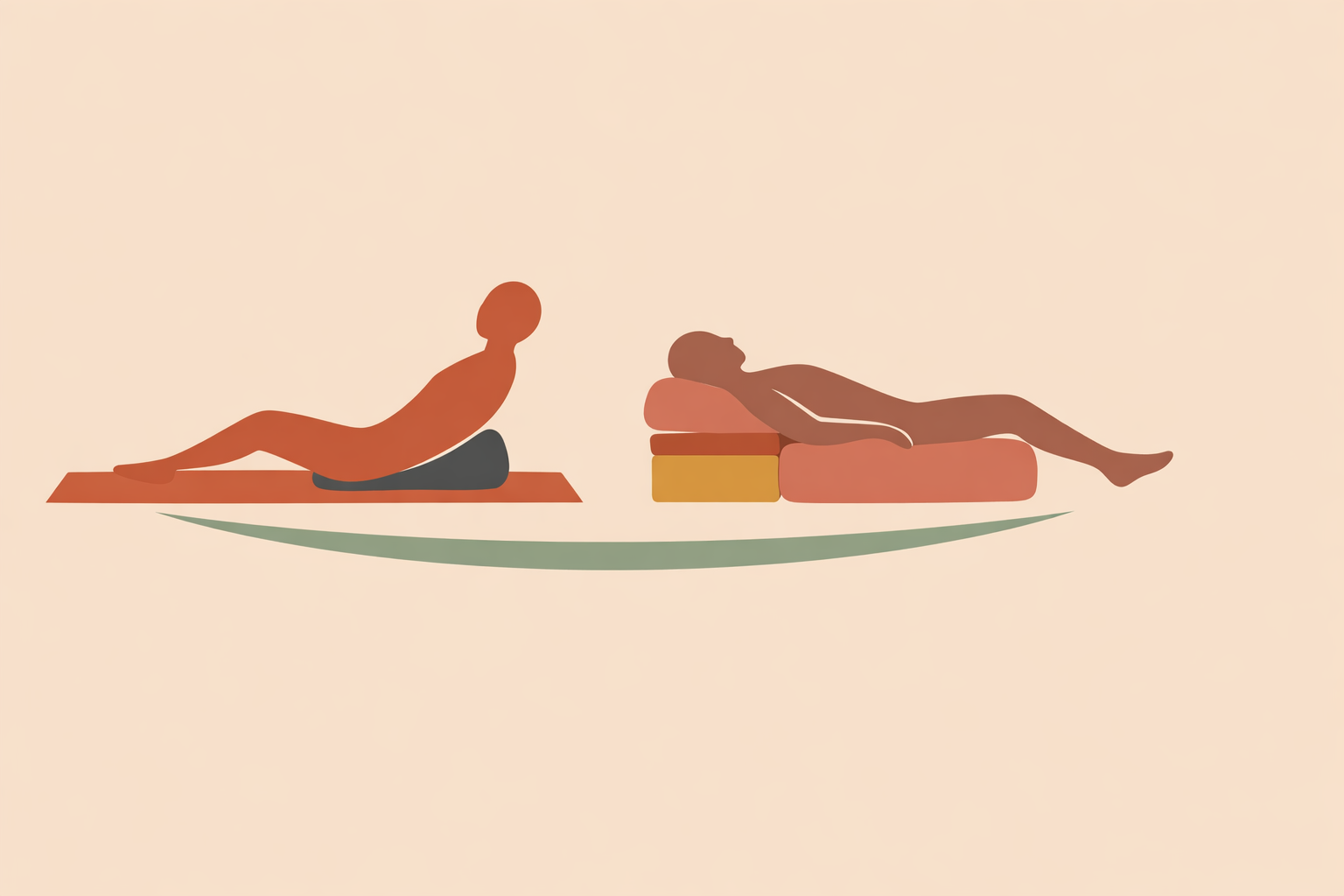
Environmental cueing matters too. Because you’re guiding at a distance, help students set up wisely—teachers commonly remind students to clear sufficient floor space, stabilize rugs, keep a wall or chair nearby, and use props (or household substitutes) for support.
A quick pre-class checklist can help:
- Space: enough room to stretch arms and step back safely
- Surface: mat or stable floor, with rugs secured
- Support: wall, chair, blocks, cushions, or books nearby
- Permission: students are free to pause, rest, or adapt at any time
When you can reliably create that kind of experience—clear, grounded, and choice-rich—you’re no longer “adapting” to the screen. You’re genuinely teaching through it. Next comes a key clarity point: who you most want to serve.
Choosing your online yoga niche and identity
Your niche is not a marketing trick. At its best, it’s the meeting point between lived experience, values, and the people you can genuinely support well.
The digital yoga world is saturated, and general offerings are more likely to disappear into the noise. Teachers with a clear niche are easier for students to find and easier for platforms to place. Clarity doesn’t mean squeezing yourself into a brand costume; it simply means becoming legible.
Look for the clues you already carry. Maybe you’re especially steady with beginners who feel intimidated. Maybe life has made you attentive to desk workers, older adults, multilingual communities, or people who need a calmer evening rhythm. Those aren’t side notes—they’re your map.
Some niches are naturally suited to virtual spaces, including beginner series, chair yoga, stress-support sessions, desk-worker classes, and language-specific offerings. They work because they solve a clear problem for a clear group, making it easy for someone to think, “Yes—this is for me.”
At the same time, your identity stays rooted in yoga—not internet trends. Trina Altman points out that training can pull teachers away from the social-media version of yoga by shifting attention from extreme range of motion toward functional movement and self-regulation. Here’s why that matters: online, spectacle travels fast, but steadiness is what builds trust.
Values make your niche feel real. One guide notes that stating values like consent and inclusivity attracts students who resonate deeply, supporting longer-term relationships. If cultural respect and consistency matter to you, say so plainly—students who want that will feel it.
Your language can help bridge worlds too. Many students and workplace clients respond well to evidence-informed framing that connects movement, breath, and mindfulness with resilience, mobility, and overall well-being. You don’t have to flatten yoga into fitness terms; you can translate yogic intent into words your audience can trust.
Hiring teams notice coherence: when your niche, sample class, and online presence all point to the same audience and values. In that sense, choosing a niche doesn’t limit you—it organizes your teaching into a clear signal.
Designing your first online offerings
Your first online offerings don’t need to be elaborate. They need to help you teach consistently, learn from feedback, and build a reliable class experience.
Many new teachers assume they need polished branding, expensive gear, and a big following. In reality, you can begin with simple equipment and a modest audience. A stable smartphone or webcam, a tripod, basic mic, clear lighting, and a calm background are often enough.
And if you upgrade anything first, upgrade sound: guides consistently note good audio quality matters more than a high-end camera. Students can work with modest visuals; they struggle when they can’t clearly follow cues.
A strong approach is “minimum viable setup, maximum learning.” Start with one recurring class or a short series. Keep it manageable, then let repetition refine your delivery.
Practice hours matter. Some mentors suggest teachers often feel more confident after 30–50 live teaching hours beyond training, including some online time. Those numbers aren’t a rule; they reflect a truth most teachers recognize: steadiness comes from showing up.
Rod Stryker observes that the discipline of planning and delivering classes creates behavioral change that casual practice rarely produces. Teaching asks you to embody the rhythm you’re inviting others into—and that deepens your own consistency.
Recording accelerates growth. Many instructors are encouraged to record and watch back classes to catch pacing habits, unclear moments, and places where cues land differently than expected.
Rachel Scott describes a simple reflection loop: after each class, ask, “What did I intend? What actually happened? What will I adjust?” That one habit can transform your teaching quickly.
To keep feedback useful, ask students:
- Where did you feel especially clear—or confused?
- Was the pacing too fast, too slow, or steady?
- Did the options feel accessible for your body and space?
- Could you hear and follow the cues easily?
As you gather hours, recordings, and feedback, your offerings begin doing double duty: they serve people now, and they quietly become the raw material for your portfolio—which makes the hiring step far simpler.
Conclusion: Getting hired as an online yoga teacher
Getting hired as an online yoga teacher usually comes down to one thing: can you guide a clear, grounded class that people can actually follow from home? Your portfolio should make that answer easy to see.
In many hiring processes, the most important asset is a 30–45 minute sample class, not a flashy reel. It lets a studio or platform feel your cueing, pacing, voice, and presence directly.
This is good news for newer teachers. Hiring resources often emphasize clear verbal cueing and voice presence over difficult poses, especially for beginner and mixed-level groups. Put simply: usability wins.
A strong starter portfolio is usually simple:
- 1–3 full sample classes
- a short introduction video
- a concise CV with your training and areas of focus
- a few student testimonials or reviews
A focused portfolio works because it mirrors what employers truly need: proof you can show up consistently, guide responsibly, and match their audience.
Even modest experience counts. If you’ve led community classes, donation sessions, or self-hosted groups, include them. Many mentors note that having 10–20 hours of online experience can improve your chances because it shows you can handle tech, pacing, and virtual dynamics.
And yes, organizations increasingly expect that readiness: one report noted teachers were increasingly required to adapt to online platforms and develop technology competence. A stable setup and basic platform comfort are now part of the professional picture.
Through all of this, keep the deeper thread in view. Amy Weintraub reflects that one of teacher training’s greatest gifts is moving people from a passive to an active relationship with their own well-being. Teaching online can carry that same gift—quietly, steadily—into modern life.
So begin plainly. Build your foundation. Learn to cue for real bodies in real spaces. Choose a niche that reflects your life and values. Teach small classes, record them, refine them, then package that work into a portfolio that feels honest and clear.
Online yoga doesn’t ask you to abandon tradition. It asks you to embody it skillfully in a modern form. When you do that with steadiness and respect, you’re not just ready to apply for opportunities—you’re ready to guide well.
Train for online yoga teaching
Yoga Teacher Certification helps you build ethical foundations and clear cueing for safe, effective online classes.
Explore Yoga Teacher Certification →