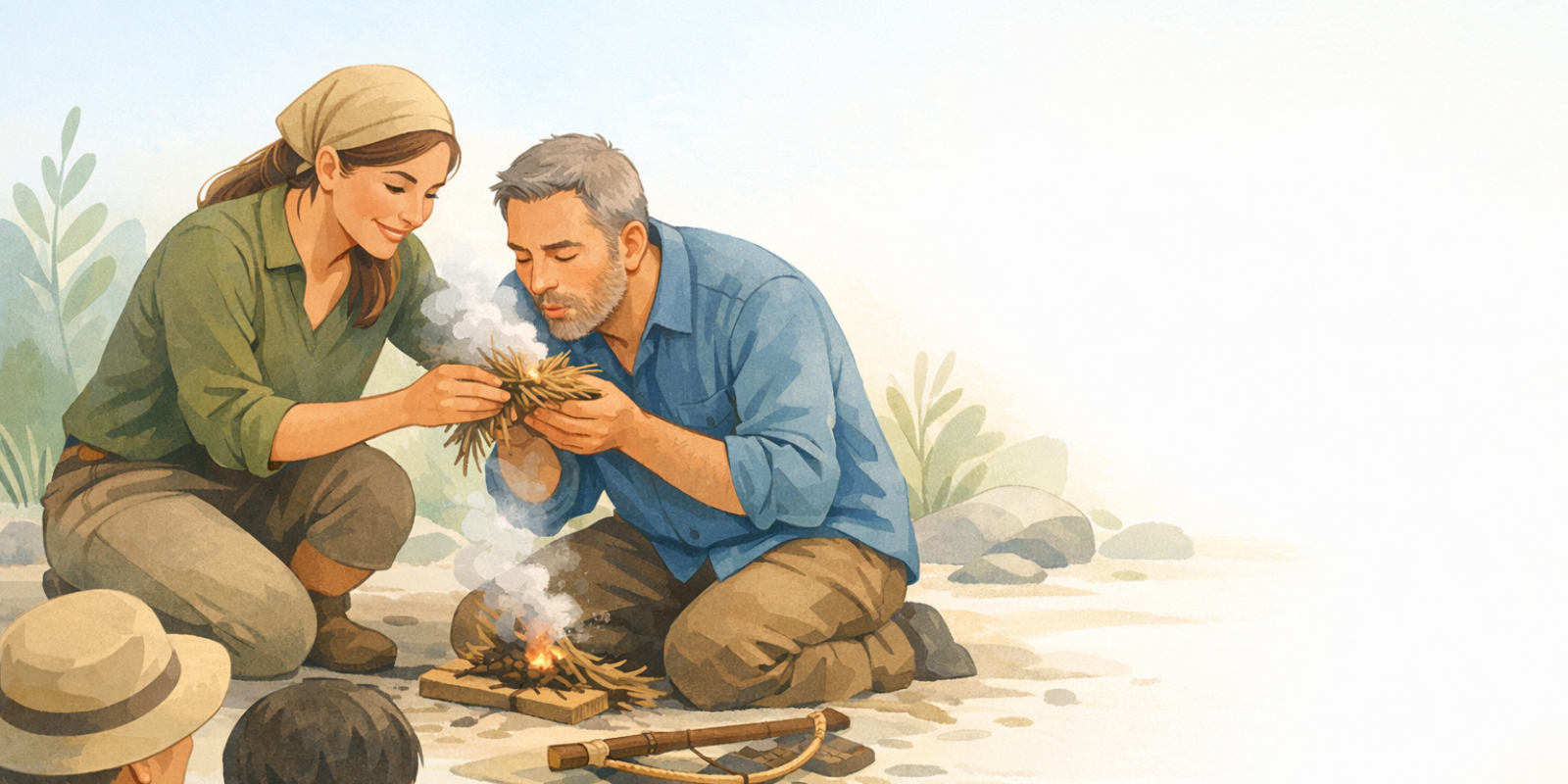
Teaching fire without matches is less about spectacle and more about reconnection—an ancestral craft that builds trust in your hands, your materials, and your breath. When it’s taught in clear progressions, it becomes a reliable pathway for resilience and self-trust, not a parlor trick.
These skills have always carried continuity: skill to ritual, ritual to confidence. In modern terms, they develop capacities that matter “at home,” not only “out there.” Survival training can reach beyond survival, which is exactly why firecraft belongs in a practitioner’s toolkit.
A practical teaching arc is simple: ground everyone in tinder and fire lays, offer early wins with sparks, then deepen into friction methods. Each ignition style—hand drill, bow drill, fire plough, flint‑and‑steel, ferro rods—has distinct materials and difficulty, making it natural to design progressions for different groups. Many instructors regard bow drill as the easiest friction method for adult beginners, and it teaches beautifully through a repeatable step sequence students can return to again and again.
Key Takeaway: Teach fire-starting without matches through a clear ladder: master tinder and fire lays first, create early wins with spark methods, then progress into friction skills like bow drill. When learners can see and repeat each step, the craft builds confidence, resilience, and calm under pressure.
Introduction: How to Teach Fire Starting Without Matches
Teaching fire without matches is less about spectacle and more about reconnection—an ancestral craft that builds trust in your hands, your materials, and your breath. When it’s taught in clear progressions, it becomes a reliable pathway for resilience and self-trust, not a parlor trick.
These skills have always carried continuity: skill to ritual, ritual to confidence. In modern terms, they develop capacities that matter “at home,” not only “out there.” Survival training can reach beyond survival, which is exactly why firecraft belongs in a practitioner’s toolkit.
A practical teaching arc is simple: ground everyone in tinder and fire lays, offer early wins with sparks, then deepen into friction methods. Each ignition style—hand drill, bow drill, fire plough, flint‑and‑steel, ferro rods—has distinct materials and difficulty, making it natural to design progressions for different groups. Many instructors regard bow drill as the easiest friction method for adult beginners, and it teaches beautifully through a repeatable step sequence students can return to again and again.
Why Fire‑Starting Feels Transformational for Clients
Fire-starting teaches more than ignition; it trains attention, patience, and self-respect under pressure. When held well, one ember becomes a mirror: “Can I stay present, prepare carefully, and respond instead of forcing?”
Wilderness educators often notice that these benefits carry into daily life. One bushcraft author describes how survival skills support confidence and well‑being beyond survival, and how simple competence can boost self-esteem. In practice, that looks like small, embodied wins: a tinder nest that’s actually dry, a calmer breath, a coal protected long enough to glow brighter.
Nature also offers honest feedback. As Jessie Krebs puts it, “Wilderness is a great equalizer… it reduces everything to the moment… and to the law of consequences.” Firecraft makes that teachable without shaming: too little preparation means no flame; too much force scatters the coal.
Clients quickly feel the deeper lesson: preparation over push, rhythm over rush, and cooperation with materials over control. Many naturally carry that insight into work conversations, home boundaries, or simply the steady choice to keep going when the smoke stings but the ember is close.
Design Clear Step‑by‑Step Fire‑Starting Progressions
Start with scope, not gear. Decide what you want learners to cultivate—self-trust, calm under stress, care for land—then build a sequence that teaches those outcomes through clear, winnable steps.
A sustainable path blends craft and practical delivery. One seasoned instructor describes two core skill-sets: solid proficiency and the ability to shape, communicate, and offer it. The same source also reminds instructors they don’t need to be proficient in everything to begin—specialize, deepen, and iterate.
Begin with small, focused containers. You can run micro classes around one clear win—like building reliable tinder or making shavings that consistently catch a spark. As Cheryl Strayed reminds us, “We start at the bottom and climb up.” Build your progression the same way.
Sample progressions to pilot:
- Foundations lab (90 minutes): materials walk, tinder nest, small fire lay, ferro rod spark.
- From spark to coal (half day): revisit tinder, ferro and flint‑and‑steel, then first bow drill coal.
- Friction intensive (full day): bow drill carving, form, coal tending; optional partner drill.
- Returner series (3 sessions): refine bow drill, explore hand drill or fire plough, practice minimal‑impact coaling and extinguishing.
Design for momentum and visibility. Without clear offers, even skilled instructors can struggle to fill courses. A simple ladder of learning—each rung a recognizable win—helps people see their path from first spark to steady coal.
Teach Tinder, Fire Lays, and Energy‑Wise Fires First
Tinder is the heart of the craft. Before drills or strikers, help students build a relationship with dryness, texture, and airflow.
Start with the humble bundle—dry grass, shredded bark, plant fibers—teased into a soft “bird’s nest” with a slightly denser “hearth” where the ember will sit. Many modern guides still recommend a tinder bird’s nest, echoing what traditional firekeepers have long known: fine, dry fibers and good airflow do the real work. A common foundational sequence is to build a tinder bundle, add pencil-thin twigs, and only then step up to larger sticks once flame is stable.
Then teach fire lays as embodied physics. Teepee, log cabin, and spiral fire lay patterns change airflow and heat. Think of it like choosing a container: the structure decides whether your fire rises fast, settles into coals, or stays low and steady.
Finally, invite restraint and stewardship. Many communities value efficient small fires that use less wood and attention—an approach that respects body energy and the landscape. A simple way to support this is to stage fuel by size (tinder, pencil, finger, wrist) before ignition; it calms the moment when an ember finally arrives.
Foundations mini‑routine:
- Gather and test: snap‑test twigs for dryness; feel fibers for fineness.
- Build the nest: soft interior, slightly denser rim, thumb‑sized “ember seat.”
- Lay for purpose: choose teepee for quick flame, or log cabin for longer coals.
- Check readiness: fuel staged, wind direction noted, breath calm.
Taught as a small ritual—touch, smell, attention—this foundation gives every later method somewhere trustworthy to land. Over time, many learners develop a deeper appreciation for subtlety over force.
Start with Sparks: Flint, Steel, and Ferro Rods
Spark methods create early success. Once students can build good tinder and a simple lay, they can feel ignition without the extra physical load of friction.
Ferrocerium rods throw intensely hot sparks when scraped with a striker or the squared spine of a compatible knife. A helpful habit is to angle the rod down toward the tinder so sparks land where you want them. Keep the rod steady and move the striker; that controlled motion improves the spark placement and helps beginners stay calm.
Traditional flint‑and‑steel is also a beautiful bridge to lineage. Strike into char cloth (or other prepared tinder), move the glowing ember into the nest, then breathe it to life. Many guides note that sparks are generally easier than friction for beginners because they reduce fatigue and coordination demands.
Preparation still does the heavy lifting. A well-made tinder nest often matters more than the size of the spark. And when someone turns ember to flame for the first time, the confidence shift is real—basic competence can boost self-esteem, which is perfect momentum before friction work.
Micro‑sequence for sparks:
- Tinder nest ready, fuel staged.
- Three test strikes away from the nest to check spark quality.
- Commit: several controlled strikes with the rod steady and striker moving.
- Cradle ember, close the nest, and breathe steadily from the base.
Coach for process, not perfection. Each small improvement—clean scraping, better spark landing—becomes a stepping stone toward friction fire.
Teach Bow Drill as Your Core Friction Skill
For many adults, bow drill is the most teachable friction method. The bow helps maintain speed and pressure more reliably than bare hands, so learners often reach a coal with less frustration and more usable learning.
Comparative guides often describe bow drill as an efficient friction path for beginners. Center your coaching on materials and body mechanics, starting with careful matching of materials: a dry softwood fireboard and a spindle that’s similar hardness (or slightly harder), both well-seasoned. Essentially, the right pairing creates consistent heat and the right dust—fine, chocolate-brown—rather than squeaks and shiny glaze.
Then teach a simple arc people can repeat. A widely shared standard sequence is: carve a depression and V‑notch, seat the spindle, build dust with steady bowing, tap the coal onto a catcher, then move it into the tinder nest and breathe it to flame.
Bow drill micro‑steps:
- Carve: round spindle tip and socket; smooth bow string, snug but not overtight.
- Seat: slow, controlled drilling to burn in a socket before cutting the V‑notch.
- Notch: V cut clean to the socket center so dust can collect.
- Form coal: increase speed and downward pressure with stacked joints and stable posture.
- Catch and carry: tap coal onto a leaf or bark, nest it, then blow smoothly from below.
Normalize stuck points so learners don’t turn friction into self-judgment. Common failure points include spindle slippage (improve seating and contact), not enough pressure (adjust alignment and bearing-block anchoring), or losing the ember during transfer (slow down, cup carefully, breathe steadily). Here’s why that matters: when students see each snag as information, they relax—and relaxed bodies make better coals.
Advanced Friction: Hand Drill, Fire Plough, and Partner Drills
Save advanced friction for experienced or returning students. Here, difficulty is a feature—not to prove toughness, but to deepen attention, humility, and cooperation.
The hand drill is spare and elegant—just spindle and board—and it’s often described as the most difficult approach for many learners. Context matters; it tends to shine in dry climates with very dry, light hearth materials. Offer it when foundations are strong, or when the group is ready for a practice where rhythm and feel matter as much as outcome.
The fire plough channels steady effort: a blunt stick moves back and forth in a groove until dust ignites. It’s demanding, but it teaches perseverance and clean form. Classic explanations of the fire plough are helpful for groove shape and sizing.
To bring community into the circle, introduce coordinated partner variations. These two-person drills share the load through rhythm and timing, and are often described as easier to learn for some groups. Put simply, friction becomes less of a solo test and more of a shared cadence.
These methods naturally develop adaptability—the same adaptability people are building in the rest of their lives. The ember remains both teacher and reward.
Teach with Care: Emotional Safety and Ethics Outdoors
How you hold the space matters as much as what you teach. A calm, non-judgmental field lets learners meet difficulty without shame—and learn from every attempt.
Jessie Krebs notes wilderness can feel like relief because of the lack of judgment, even while it brings up what we carry. Use the law of consequences as a compassionate mirror: “The coal went out because wind entered here—let’s adjust the cradle.” Held this way, practice can genuinely boost self-esteem, especially when you debrief and celebrate after each round.
Ethics also includes sustainability in your work. It’s fair to charge in a way that supports your energy and attention; one mentor points to business acumen as the missing piece that can otherwise make it hard to fill courses. When your offerings are steady, students benefit from your long-term consistency.
And, always, honor the land. Teach respectful gathering, minimal impact, and how to fully extinguish coals. Share lineage stories with attribution and care, avoiding appropriation while inviting learners to reconnect with their own ancestral threads.
Agreements I use to hold the field:
- We are kind to ourselves, each other, and the land.
- We value process over product; every attempt counts.
- We ask permission of place, gather modestly, and leave no trace.
- We celebrate learning and rest before pushing into exhaustion.
Conclusion: Weaving Fire‑Starting into an Evolving Practice
Fire-starting becomes most powerful when taught as a journey: shared foundations, quick wins with sparks, then deeper focus through friction. Each step trains attention, breath, and right relationship with materials and place.
You don’t need a massive program to begin. Pilot focused micro classes on tinder or spark work, then add bow drill when groups are ready. Keep refining your sequence—the path from tinder to ember to steady flame—as your own hands and confidence evolve.
Position your sessions around presence and everyday resilience rather than emergencies. Practiced consistently, these skills support a sense of resilience people can carry far beyond the woods. And weave in story—your teachers, your land, your early failures and bright coals—because story is how craft travels. As field leaders remind us through their survival lessons, it’s the honest conversation between effort and consequence that grows us.
With integrity and care, ancestral fire becomes a modern practice of steadiness. Start small, teach respectfully, and keep tending the ember of your craft—one well-prepared tinder nest, one breath, one bright flame at a time.
Ready to Go Deeper?
Take the next step with a Naturalistico certification — designed for practitioners ready to deepen their expertise.
Explore the Course →