Ocean Session Safety Scripts: Intake, Boundaries, and Briefings That Let the Sea Do Its Work
Introduction: The Quiet Structure Behind Powerful Ocean Sessions
Strong ocean sessions begin before anyone steps onto sand. Clear intake, thoughtful boundaries, and a simple safety briefing create the steady container that lets the sea do its quiet, transformative work.
Traditional coastal wisdom has long recognized what many now feel in their bodies: blue horizons can soften the nervous system. Modern “blue space” findings often echo that lived experience, linking ocean, lake, and river time with reduced stress and enhanced well-being. Many people also find that water views can activate the parasympathetic—the “rest and reset” branch of the nervous system—while wave sounds and a steady horizon invite spaciousness.
When time by the sea is held with gentle structure, the benefits often deepen. Facilitated blue-space programs frequently report stronger emotional regulation and connection than unstructured shoreline time alone, and many facilitators now frame their work as ocean-based experiences—braiding water skills, nature connection, and steady human support.
This approach also belongs to a much older lineage. Across cultures, coastal communities have turned to the sea for grounding, purification, and communal ritual, often held by shared practices and clear boundaries. As Walt Whitman reminded us, “To me, the sea is a continual miracle.” Reverence is the starting point—and it’s exactly why intake, boundaries, and briefings matter.
Why Scripts and Boundaries Make Ocean Work Trustworthy
Scripts don’t box the ocean in; they help people meet it with steadiness. When boundaries and briefings are clear, your intuition becomes a repeatable framework participants can relax into.
Structured surf and ocean programs show this well. Groundswell’s eight-week offering built confidence through progressive skill-building and a consistent safety briefing, welcoming people with no prior experience. In another evaluation, reliable structure and communication helped participants keep showing up, with 84% attendance across sites—often a quiet sign that trust and pacing felt right.
Many experienced facilitators describe a formalized protocol that blends water literacy, group rituals, and safety scaffolding. Clear scripts also make sessions more repeatable and consistent, which supports quality and reduces avoidable risk—especially when conditions change quickly.
Ethical outdoor facilitation calls for strong risk management, clear roles, and communication plans. Structure doesn’t flatten the ocean’s magic; it protects it, so you can stay present with the group.
“The sea is as near as we come to another world.” — Anne Stevenson
Step 1: Intake That Honours Capacity, Culture, and Consent
Intake is where safety begins. Done well, it honours identity, clarifies water skills and emotional readiness, and supports real consent for being near and in the ocean.
Think of intake as relationship-building, not a gate. In the Groundswell model, participants were screened via questionnaires and brief conversations to confirm they could travel independently, communicate needs, and participate as part of a group near water. Importantly, the team also welcomed people with no previous experience—separating trainable skills from non-negotiable safety limits.
It’s also wise to ask early about mobility and sensory considerations, past experiences near water, and what kinds of support cues work best. Practical topics like severe allergies and gear comfort are not “details”; they often decide whether the beach feels welcoming or overwhelming.
Informed consent is most supportive when it’s specific: currents, fatigue, marine life, and clear exit/stop signals, so each person can choose their level of engagement with eyes open. Evaluations of ocean group work repeatedly highlight the value of clear informed consent alongside warm encouragement.
“The sea does not reward those who are too anxious, too greedy, or too impatient.” — Anne Morrow Lindbergh
That’s a useful teaching for facilitators, too: set a humane pace, then let people choose what’s right for them that day.
What to include in your intake form
Pronunciation of name, pronouns, and cultural or water lineage (optional)
Swimming comfort, ocean experience, and shore/river/lake familiarity
Mobility and sensory considerations, and preferred support cues
Energy patterns, anxiety triggers, and self-regulation strategies that help
Any allergies or gear sensitivities (e.g., neoprene, sunscreen)
Emergency contact who understands the nature of the activity
Consent to group norms, photos (optional, always opt-in), and stop signals
Script snippet (in writing and verbally): “You are always the expert on your body and your pace. We’ll review currents, wildlife, and our stop signals on land. You can choose your level of participation at any moment—on the sand, at the shoreline, or in the water.”
Step 2: Turning Intake into Clear Physical Boundaries
What you learn in intake should shape the session immediately: the location, group size, depth limits, supervision plan, and gear. Physical boundaries make invisible care visible.
Begin with place. Choose lifeguarded beaches when possible, use designated zones, and avoid steep drop-offs and strong currents—classic beach safety. Then layer protections: barriers, flotation, and skill-building should work together rather than relying on any one thing—an approach often framed as multiple protections.
Group size matters, too. Many surf-therapy teams cap sessions at 8–10 participants, a range that tends to support close supervision and real relationship over time.
Prepare with a mariner’s mindset: check flotation, first-aid supplies, and—where relevant—comms and emergency beacons. And treat the shoreline like a studio. When people experience the environment as predictable, it feels more restorative; research on perceived safety supports this. Practical checks like water depth, temperature, access routes, and obvious hazards help the group settle faster.
Translate intake into boundaries
Depth zones by color or cones: ankles, knees, hips—and a clear outer line
Staffing: designate a lead, a water safety spotter, and a beach anchor
Buddy pairs matched by comfort level and communication style
Gear by need: PFDs, soft-top boards, helmets (for rocky entries), bright rash vests
Entry/exit points and a land-based “safe bay” for rest or grounding
Hard stops: thunder, poor visibility, high winds, or shifting rips
“The ocean is a mighty harmonist.” — William Wordsworth
Your boundaries help the group hear that harmony without getting lost in it.
Step 3: Land-Based Opening Circles and Safety Briefings
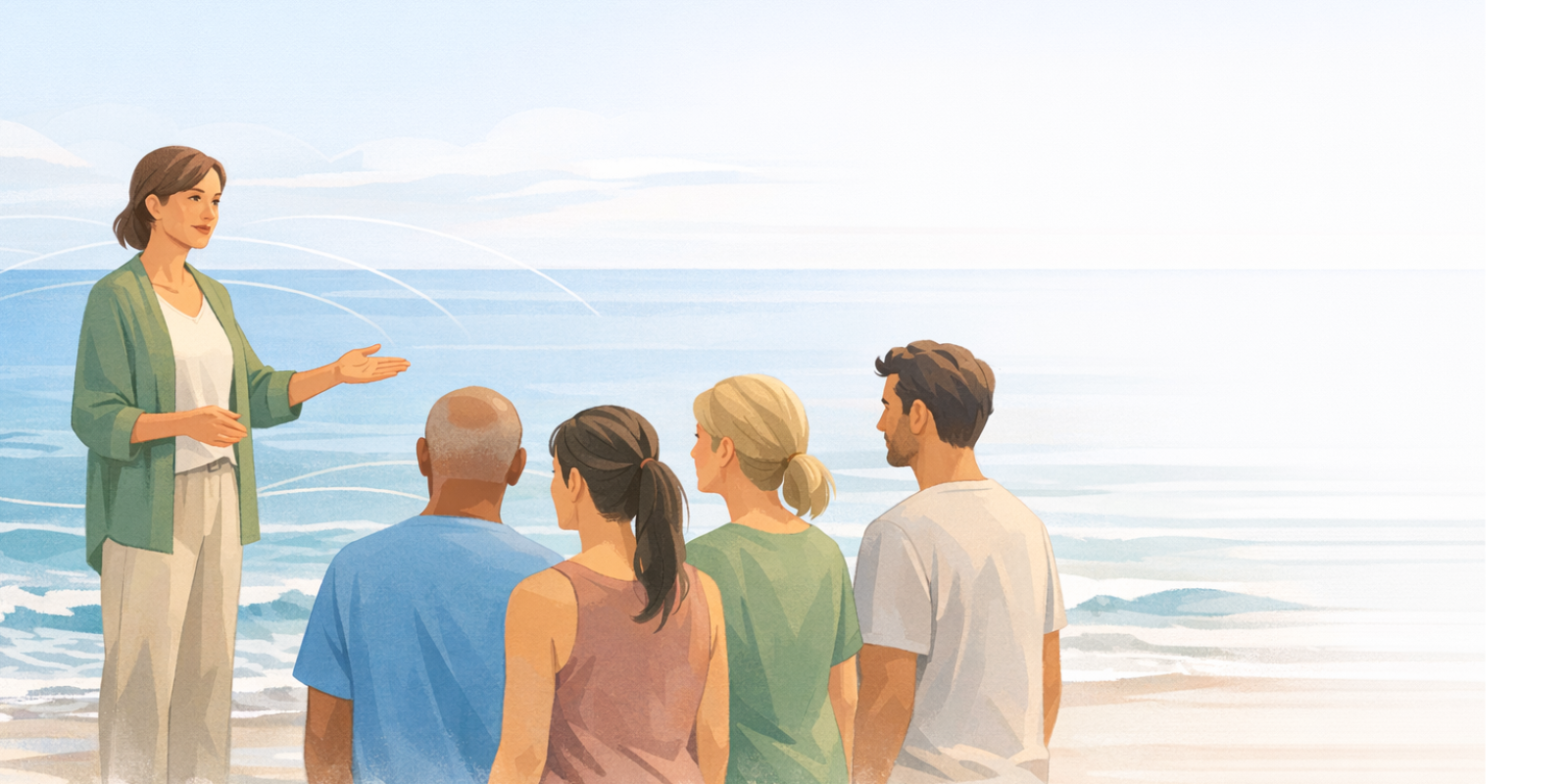
The opening circle is where bodies, breath, and attention align. A few grounded minutes on land can turn jitters into presence and help the ocean feel like a partner.
Keep it simple and consistent: gear check, a short breath practice, then a clear water briefing. That’s the flow in Groundswell’s protocol, which begins with breathing exercises, grounding, and beginner-friendly ocean literacy. These land-based moments also match what many people report about the coast: blue horizons support relaxation and help attention widen.
Small partner or triad sharing builds trust quickly. In Groundswell’s model, partner sharing supported accountability and personal agency. Then, before entry, name the tide, waves, and rips, and confirm personal limits—again aligned with the program’s basic education approach.
Blue-space facilitation naturally blends ancestral sensibilities with present-moment tools. Breath, body scanning, and sensory attention—done gently—can support nervous-system regulation and bring the group into a shared rhythm before the first step into the water.
“The ocean stirs the heart, inspires the imagination and brings eternal joy to the soul.” — Wyland
Honour that energy by starting slow.
Opening circle script (5–8 minutes)
Welcome and names: “Share your name, and one word for how you arrive.”
Grounding: “Feel the sand. Three slow breaths. Eyes soft on the horizon.”
Intention: “One thing you’re curious about. One boundary you’ll honor.”
Ocean literacy: “Today’s tide is [x]. Waves breaking [left/right]. If you feel a pull seaward, we’ll float, breathe, and move parallel.”
Signals: “Thumbs up to continue. T-shape for pause. Hand on head means ‘I need support now.’”
Consent: “You choose ankle, knee, or hip depth—and you can change your mind at any time.”
Step 4: Real-Time Safety Language in the Water
In the water, clarity keeps the experience alive and well-held. Simple, consistent cues let you adapt to changing conditions without spiking stress in the group.
Start with a few non-negotiables. Use the buddy system so no one is alone, and ensure everyone knows how to respond if a rip current becomes an issue—float, breathe, and move parallel. For participants who are less confident or who have mobility or sensory differences, plan for touch supervision within arm’s reach when appropriate.
Your designated spotter stays sober, undistracted, and scanning—aligned with NOAA’s emphasis on attentive safety watchers. In surf-therapy settings, shared signals are often credited with helping groups coordinate smoothly even when wind, noise, and waves make speech unreliable.
Most importantly: when someone uses a stop signal, the culture should pivot immediately and quietly. Norms that consistently honour stop signals support physical safety and strengthen psychological safety, making it easier for people to advocate for themselves in real time.
“The sea, once it casts its spell, holds one in its net of wonder forever.” — Jacques Cousteau
Clear signals keep that wonder shared—without losing track of one another.
In-water cue set
“Yellow zone” (palm down, gentle press) = slow and closer
“Green zone” (thumbs up) = continue as is
“Red zone” (T-shape or fist) = pause and regroup
“Come to me” (arm waving overhead) = approach facilitator
“Buddy check” (tap head twice) = find and signal your buddy
Step 5: Debrief, Integration, and Resetting Boundaries
Closing the loop matters. A gentle debrief, a few recovery basics, and simple reporting turn each ocean session into guidance for the next one.
Many ocean programs gather again on the beach after toweling off. Healing Waves describes post-session check-ins that invite participants to name sensations and insights, then refine boundaries for next time. In one surf-therapy evaluation, closing circles were associated with a supportive sense of well-being across the season.
On the practical side, logging what happened—especially near-misses—builds collective wisdom without blame. Other high-intensity contexts also point to the value of structured debriefing for processing demanding experiences and improving next-time decisions.
Then come the basics that make integration kinder: water, warmth, shade, and a small bite to eat. Even simple supports like hydration and warmth can shape how resourced people feel as they transition back to daily life.
“The sea is life.” — Jean-Michel Cousteau
Close with respect: tidy the gear, thank the place, and carry forward what the water offered.
Five-minute debrief flow
Body: “Name one sensation you notice now.”
Emotion: “One feeling that visited you today.”
Meaning: “A moment you want to remember.”
Boundary: “One choice you honored, or would change next time.”
Operations: Quiet incident scan; log any observations or gear notes
Conclusion: Turning Your Safety Scripts into a Living Ocean Practice
Intake, boundaries, and safety briefings are living documents. As you braid them with your coastline, your culture, and your group, they evolve—just like the sea—into a body of practice you can stand on.
People often leave the shore feeling lighter because of multi-sensory immersion: rhythmic sound, salt air, shifting light, and a sense of scale that restores perspective. Wave-pattern sounds may lower cortisol and support parasympathetic settling, while wide water views invite possibility.
Your role is stewardship: meet the ocean’s natural support with careful intake, clear physical and relational boundaries, and briefings that protect agency and consent. Then let conditions—and people—tell you what to refine next time.
“Ocean is more ancient than the mountains, and freighted with the memories and the dreams of Time.” — H. P. Lovecraft
Build your scripts. Keep them kind. Let the water do the rest.
For practitioners who feel called to deepen this work, Naturalistico’s Ocean Therapy Practitioner Certification offers structured training in ocean-session design, safety frameworks, and client-centered facilitation, with ongoing community support as your practice evolves.