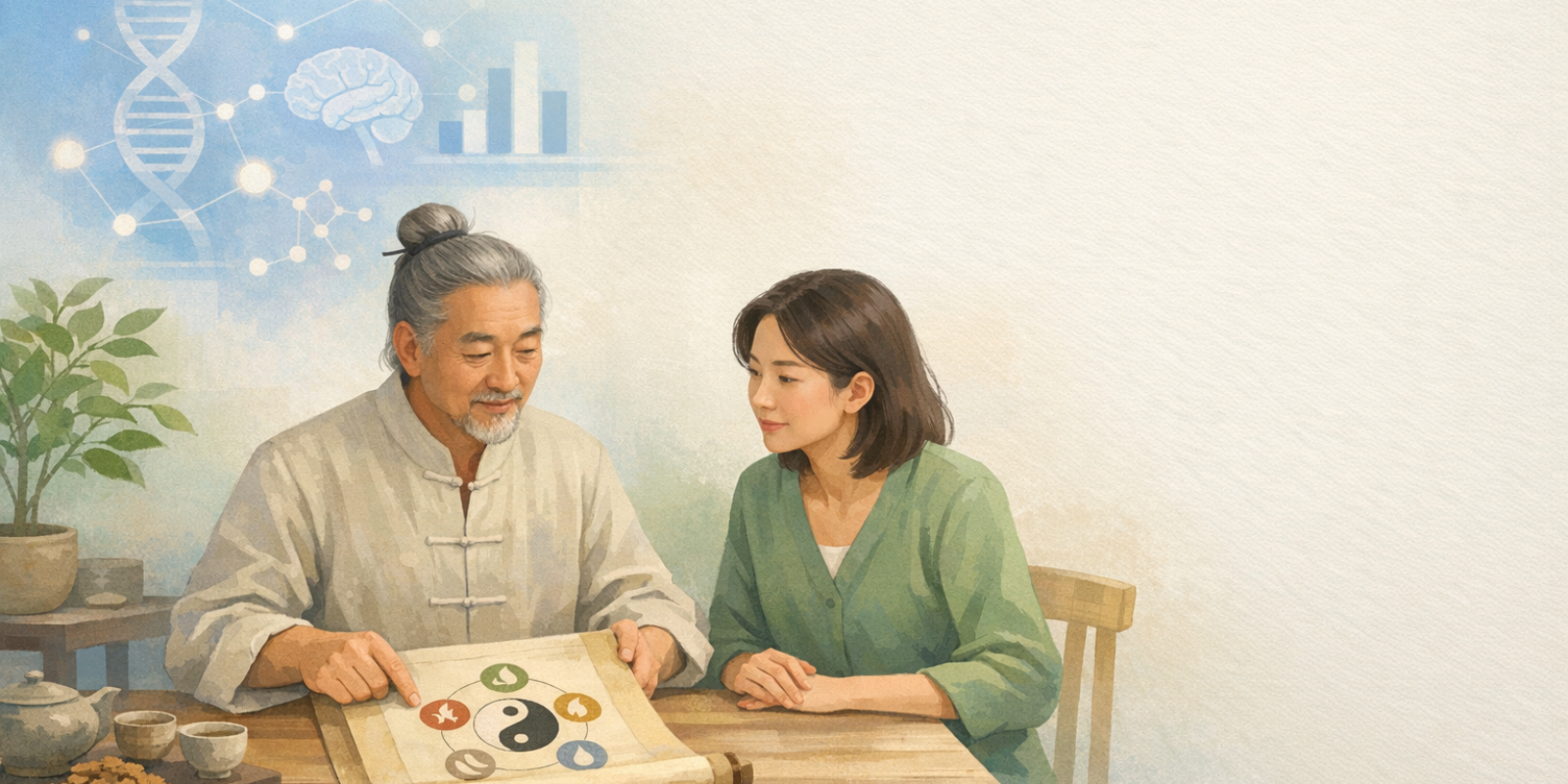
Integration doesn’t mean dilution. When practitioners stay grounded in lineage and let research deepen—rather than replace—traditional frameworks, Chinese medicine keeps its character while gaining fresh clarity.
Chinese medicine grew through lived experience: teachers, apprentices, and communities tracking seasons, meals, dreams, and emotions as one continuous field. Over more than 2,000 years, that careful noticing shaped Yin–Yang, the Five Elements, the language of Qi, and a pattern-based way of understanding what’s happening beneath the surface. Historical accounts describe how these models emerged from observation and experience, carried forward through mentorship and community practice.
What sustained these frameworks isn’t nostalgia—it’s usefulness. The Five Elements still offers a coherent way to connect functions, emotions, seasons, and the senses with nature’s rhythms. Increasingly, Chinese medicine is also described as a bridge where ancestral wisdom and modern methods can illuminate each other without being flattened into the same thing.
At Naturalistico, Chinese medicine is held as a living tradition—something you practice, refine, and carry forward with care. That means studying the classics while also building ethical, modern client journeys that respect both lineage and real-world needs.
Staying rooted is what makes integration workable. Keep the tradition’s language and logic intact, and let research act as a dialogue partner—not a gatekeeper. From that stance, everything else gets simpler.
Key Takeaway: Integrative Chinese medicine stays effective when it preserves classical models—Yin–Yang, Five Elements, Qi, meridians, and pattern differentiation—while letting modern evidence refine clarity and consistency. Rooted ethics, cultural respect, and practical, rhythm-based plans keep integration from becoming dilution and help clients experience coherent, personalized care.
Why integrative Chinese medicine is rising now
People are hungry for coherence. They’re tired of fragmented, symptom-only advice and are looking for systems that connect body, emotions, and environment into one understandable whole.
Chinese medicine has long emphasized prevention and early course-correction—working with cycles rather than waiting for a crisis. Put simply, many people want steadier sleep, smoother digestion, and more emotional ease before they hit a wall, and this tradition naturally speaks that language.
Modern discussions also highlight how the tradition’s individualized lens can support long-term imbalances and emotional steadiness. Instead of chasing isolated issues, practitioners read the terrain and adapt plans to the pattern that’s uniquely present in the person in front of them.
It also helps that Chinese medicine’s attention to daily and seasonal rhythms sits comfortably beside modern interest in biological clocks. Meal timing, light exposure, and pacing movement aren’t trendy add-ons here—they’re woven into how the tradition understands human rhythm.
“For some types of pain and nausea, acupuncture may help.”
Read in the spirit of integration, that line doesn’t place one worldview above another. It simply makes room for the idea that different frameworks can work side by side—especially when the goal is calm, practical support.
Naturalistico responds to this moment by combining deep philosophical study with modern practice-building tools, so learning doesn’t stay theoretical. The shift from symptom-chasing to systems thinking becomes something you can actually apply—session by session.
Classical roots in practice: Yin–Yang, Five Elements, Qi, and meridians
The classics become practical the moment you sit with a real person. Yin–Yang, the Five Elements, and Qi aren’t abstractions—they’re lenses that help you notice patterns, name dynamics, and design supportive plans.
Yin–Yang offers relational eyesight. Instead of labeling experiences as “good” or “bad,” you look for the balance of opposites: rest and activity, cool and warm, inward and outward. Think of it like a seesaw—when one side stays up too long, the whole system feels off. A client who’s wired at night and heavy in the morning may be living one inverted rhythm, not two separate problems.
Five Elements (Wood, Fire, Earth, Metal, Water) helps coordinate seasons, emotional tone, and functional tendencies. Late-summer heaviness may echo Earth; autumn grief may echo Metal; spring’s urge to move may echo Wood. It’s not a checklist—it’s a correspondence map grounded in classical thought that helps plans feel timely and human.
Qi is the language of flow. Essentially, it keeps the practitioner curious about movement and distribution: Are things circulating smoothly, or getting stuck? Classical concepts of Qi, blood, and body fluids help you track ease, vitality, and coherence across the whole person, rather than reducing the story to isolated markers.
The meridian system turns that into a body-based structure. Traditional charts describe primary channels that guide acupoint work, movement, and mindful awareness—so sessions feel organized and consistent, not like a collection of disconnected techniques.
Threading it all together is pattern differentiation: seeing what’s uniquely present and working from there. Contemporary authors note that Chinese medicine approaches are customized to individual patterns, and that personalization is central to the tradition.
When these lenses work together, a session becomes a conversation with an ecosystem. That’s where integration starts to feel natural.
Let research be a dialogue partner: blending evidence with ancestral models
Evidence and ancestry don’t have to compete. When modern tools sit alongside classical frameworks, each can sharpen the other—and clients benefit from both precision and depth.
One example is how digital informatics is engaging Chinese medicine. Recent work explores AI used with traditional methods like inspection, inquiry, and palpation, aiming for more consistency in recognizing patterns while staying inside the Chinese medicine worldview. Related efforts also describe converting clinical experience into structured data so accumulated wisdom can be shared and refined.
Herbal knowledge is evolving through a similar dialogue. Historical overviews describe how formulas arise from lineages of practice, with modern researchers examining bioactive components while still respecting classical combinations and internal balance. Here’s why that matters: it encourages clearer teaching, better quality conversations, and more accessible learning—without discarding what makes the formulas coherent in the first place.
The tradition’s emphasis on living in rhythm also resonates with research interest in chronobiology and hormone timing. It’s not about translating one system into the other; it’s about noticing where different languages point toward similar patterns of regulation and recovery.
And for body-based methods, biomedical discussions suggest acupuncture may influence certain neurotransmitter pathways related to how discomfort is perceived. For integrative practitioners, these ideas can add another thread to the tapestry—useful context, not a replacement for the classical map.
So measure when measurement genuinely helps, and keep tradition where it does its best work. The aim is a practice that becomes more precise and more teachable, while staying recognizably rooted.
Staying rooted in ethics, lineage, and cultural respect
Integration is only as strong as its ethics. Cultural respect, sourcing, boundaries, and integrity aren’t optional extras—they’re the soil that keeps the work honest and sustainable.
Ethical reflections on Chinese medicine emphasize teacher–student transmission, tacit knowledge, and accountability over generations. In modern settings, that includes being transparent about influences and naming cultural roots rather than repackaging practices as context-free “well-being hacks.”
Ethics also includes material responsibility. The global reach of herbs and related resources calls for quality and stewardship—clear sourcing, ecological care, and thoughtful standards. Traditionally, communities and lineages held this accountability; today, mentorship, study groups, and transparent practice standards can carry the same spirit forward.
At Naturalistico, cultural honoring and non-appropriative language are built into how we teach and coach. That commitment to cultural honoring keeps learning connected to meaning, not just technique.
- Name your sources: Credit teachers, texts, and lineages when sharing practices.
- Honor language: Use traditional terms accurately; avoid flattening culturally specific ideas into generic buzzwords.
- Source with care: Choose suppliers committed to quality, ecology, and transparency.
- Stay within scope: Offer education, coaching, and support; refer out when needs fall outside your role.
- Keep learning: Seek mentorship and community feedback; make integrity an ongoing practice.
Ethics isn’t a hurdle—it’s a lighthouse. It keeps you oriented as you integrate, innovate, and grow.
From theory to session: cycles, food, movement, and integrative plans
Clients don’t need a lecture—they need a doable path. The most effective plans feel simple, seasonal, and personal, even when the thinking behind them is sophisticated.
1) Begin with cycles. Map the person’s rhythms: sleep–wake, work–rest, hunger–satiety, inward–outward. Then layer in the season and what it tends to ask for. Chinese medicine has long integrated seasonal living with food, rituals, and pacing, so plans can feel aligned with what the world is already doing.
2) Feed the element in season. Offer one simple food focus per cycle: sprout-forward and light in spring (Wood), bright and hydrating in summer (Fire), grounding warmth in late summer (Earth), crisp and mineral-rich in autumn (Metal), slow-cooked and restorative in winter (Water). Keep it flexible—the point is relationship, not rigid rules.
3) Move Qi, gently and often. Consistency beats intensity. Teach small daily practices that open joints, coordinate breath, and build awareness along familiar pathways. Gentle routines like Qi Gong and related exercises can help people reconnect with rhythm, even when time is short.
4) Use the map. The channel system provides structure for touch, movement, and mindful attention. For example, in autumn you might combine gentle acupressure with breath awareness along the Lung pathway and a journaling prompt about letting go—tying body and emotion into one coherent arc.
5) Anchor routines with time and light. Encourage steady wake time, consistent meals, and outdoor light exposure that matches the season. This is where classical rhythm-thinking meets modern interest in biological clocks. Timing and light can be low-effort anchors for steadier energy and mood.
6) Personalize, then pace. Add herbs, teas, and self-massage only as needed and within your training and ethical scope. Keep the plan focused: one rhythm change, one food emphasis, one movement anchor—then refine. Work on individualized approaches highlights how tailoring can make support more sustainable.
7) Educate with care. A little meaning goes a long way. Explain why autumn often emphasizes lungs or winter often emphasizes kidneys, and offer a proverb or seasonal image. Many people remember symbols long after they forget a list.
As Dr. Maoshing Ni reminded practitioners, certain methods can be “used in conjunction with other traditional acupoints, particularly those located on the ear.”
Even a brief nod to ear points—paired with breath, posture, and a small daily routine—can make between-session self-care feel tangible and empowering.
Over time, these small rhythm-led steps add up. Life starts to feel less like something to push through and more like something to move with—and that’s the heart of integrative Chinese medicine.
Conclusion: walking an integrative Chinese medicine path, rooted and evolving
Chinese medicine thrives when practitioners honor its roots and allow respectful evolution. The goal isn’t to swap one lens for another—it’s to let ancestry and inquiry walk together.
Recent work describes the future of the field as a bridge that balances fidelity to Chinese medicine theory with thoughtful use of contemporary evidence. That fits the tradition’s origins in observation of nature—and its ongoing commitment to refinement, personalization, and prevention in everyday life.
Naturalistico is built for this path, with a focus on integrity, cultural honoring, kindness, and continual improvement. Learners go deep into classical frameworks while also developing practical systems for session design, seasonal planning, and ethical communication.
Walk the path with care. Let cycles guide you. Keep ethics close. Learn from mentors and peers. Integration begins when you trust the wisdom in practiced hands—and allow evidence to help your eyes see even more clearly.
Ready to Go Deeper?
Take the next step with a Naturalistico certification — designed for practitioners ready to deepen their expertise.