Most holistic practitioners recognize the moment when conversation stops being enough. A client can describe what’s happening with real insight, yet the chest is still tight, the jaw still clenched, and the same pattern returns next week. Without a shared, repeatable map, sessions can start to feel like a series of helpful moments rather than a clear pathway forward.
Emotional-center mapping offers that pathway. When clients learn to notice and name sensations, they begin to access their own guidance system. Add gentle regulation and real choice, and the work often becomes more embodied, more collaborative, and easier to bring into everyday life.
Key Takeaway: Emotional-center mapping turns insight into a repeatable, body-first process: notice sensations, name them clearly, and choose a small regulating action. With consent and gentle pacing, clients learn patterns they can track between sessions, making the work more collaborative and easier to integrate into daily life.
Why emotional-center mapping belongs in holistic sessions
Emotional mapping brings attention back to what’s happening now in the sensing body: tightness, warmth, pressure, restlessness, settling. That simple shift—from looping the story to noticing the present—often changes the whole tone of a session.
From a traditional perspective, this is deeply familiar. Feelings aren’t only thoughts; they move, gather, and speak through different regions. Modern interoception language points to the same truth from another angle: inner sensation is central to emotional awareness and self-understanding.
It also gives clients an active role. Instead of the practitioner doing all the meaning-making, the client learns to track, describe, and reflect—building self-trust and a method they can use between sessions.
“Health is more than just the absence of disease; it is a vital dynamic state.”
That lens matters here. Emotional-center mapping isn’t about forcing interpretations; it’s about noticing where vitality feels braced, blocked, collapsed, or available—and helping the client relate to that with kindness and skill.
For many of us working in holistic naturopathy, that rings true in session. Emotional mapping gives clients an active role, honors the wisdom of their bodies, and, as Arno Koegler put it, stays “as new as tomorrow.”
Core principles: interoception, naming, and choice
At the center of this approach is interoception: the ability to notice internal signals like breath, heartbeat, tension, temperature, fullness, or emptiness. Essentially, it’s the body’s “status update.” As clients get better at sensing those signals, they often get clearer on what they feel and what they need.
Emerging research suggests interoception training can support emotional clarity. In practice, it can be very simple: pause, notice one area, describe the sensation, and ask what it might be pointing toward.
Naming is the bridge between sensation and choice. When a client can say “compressed,” “fluttery,” “buzzing,” or “numb,” the experience becomes more workable. Guided body-based labeling can help reduce misread cues, making decisions feel steadier rather than reactive.
A helpful rule of thumb: fewer explanations, more noticing. A quiet check-in with the chest, belly, throat, or legs can reveal more than prolonged analysis.
Adapting the work for different nervous systems and neurotypes
People relate to body signals in different ways. Some feel subtle shifts immediately; others feel very little, feel too much, or get unsure the moment attention turns inward. That’s not “failure”—it’s a meaningful starting point that helps you tailor the approach.
For many neurodivergent clients, this work becomes easier with concrete language, visual supports, and explicit permission to pause. Neurodiversity-affirming guidance often recommends visual supports and practical tools for identifying internal states.
A few adjustments can make sessions feel immediately safer and more workable, especially within holistic stress management work:
- Use concrete prompts: “Warm or cool?” “Still or buzzy?” “Heavy or light?”
- Offer visual options: body maps, color scales, sensation lists, or emotion wheels.
- Normalize pausing: stop, switch regions, or return attention to the room anytime.
- Keep practice short: frequent brief check-ins often land better than long internal focus.
Over time, building a personal interoceptive map can help clients catch activation sooner, which often reduces overwhelm and improves follow-through.
Preparing the ground: consent, pacing, and cultural respect
Body-based work lands best when it’s collaborative: slow pacing, clear choice, and steady consent. That’s what makes it feel supportive rather than intrusive.
Before any mapping prompt, set a simple agreement: “We can check in with the body briefly, and you can pause or switch at any point.” Agency stays exactly where it belongs—with the client.
It’s also wise to remember that “body awareness” doesn’t have to mean going inside right away. External orientation—looking around the room, naming colors, noticing contact with the chair, feeling feet on the floor—can be a grounded doorway into sensation.
- Consent script: “Would you like to try a 60-second body check-in? We can pause or switch at any point.”
- Green/yellow/red plan: “Green” = stay with noticing; “yellow” = add breath or feet; “red” = stop and reorient.
- Helpful frame: sensations are information, not commands.
If you draw on chakras, meridians, elements, yoga, or qigong, name their cultural roots clearly and respectfully. Offer them as maps of attention and meaning—not as universal verdicts. That respect isn’t an add-on; it’s part of good coaching craft.
A simple first-session structure for emotional-center mapping
In a first session, aim for brief, rhythmic steps that are easy to repeat. A clean arc works well: open, explore, regulate, integrate.
- Open: Orient to the room, feel feet or seat, and agree on today’s focus.
- Explore: Move through a few key regions with curiosity, not pressure.
- Regulate: Add grounding after each area or anytime activation rises.
- Integrate: Name what was noticed and choose one small practice for the week.
Keep check-ins short so the work stays friendly to the nervous system. Even a 30–60 seconds scan can be enough to uncover something useful without pushing.
Simple prompts tend to work best:
- “Notice your chest for a moment. What stands out first?”
- “Move attention to the belly. Is there movement, holding, emptiness, warmth?”
- “Now come back to the feet or the chair. Let the body settle before we continue.”
The goal isn’t intensity—it’s repeatability. Think of it like building a reliable path through the woods: small, consistent steps create trust.
Working with key emotional centers
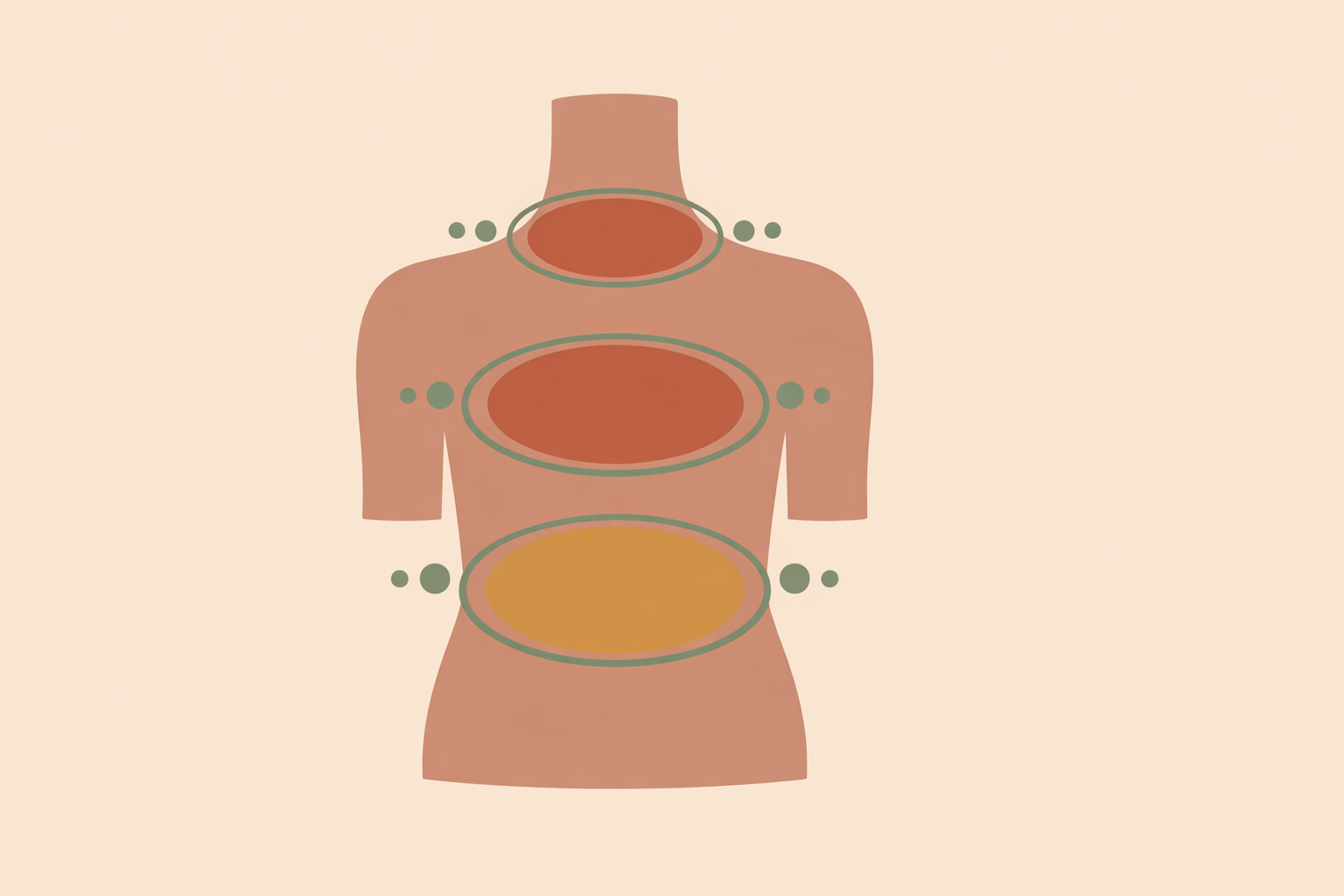
Many sensations cluster in familiar regions. These areas aren’t rigid codes; they’re places to listen and learn the client’s personal language.
Head and throat. Pressure behind the eyes, jaw tension, busy thoughts, or a lump in the throat often appear when expression is constrained or the mind is overworking. Instead of interpreting quickly, invite gentle softening: “What changes if your jaw loosens?” “Does a sigh want to come?”
Chest and heart area. Fluttering, pressure, tightness, shallow breath, or openness here can reflect tenderness, activation, grief, relief, or connection. When constriction shows up, even slow breathing for a few minutes can support steadiness.
Solar plexus and belly. Knots, butterflies, hollowness, or warmth in the belly often track with anticipation and boundary themes. Concrete sensory questions help: “Tight or soft?” “Warm or cool?” “Full or empty?”
Pelvis. Heaviness, numbness, or charge here can connect to safety, creativity, and intimacy themes. Keep everything choice-based. Small movement, rocking, or shifting pressure in the seat is often more supportive than prolonged focus.
Back and shoulders. Bracing, hunching, collapse, or holding between the shoulder blades can signal long-standing effort. Clients often recognize this region through lived metaphors—carrying too much, holding it together, staying on guard.
Legs and feet. Heavy or numb legs can reflect shut-down energy, while springy legs can suggest readiness or momentum. Contact with the floor can be especially grounding when someone needs steadiness.
Across all regions, keep the tone curious. The practitioner isn’t telling clients what their body “means”; you’re helping them build their own legend for the map.
Weaving traditional maps with nervous-system language
Traditional maps and modern nervous-system language don’t need to compete. In skilled practice, they sit side by side—each offering a different kind of clarity.
If a client already relates to chakras, meridians, or elemental patterns, you can work with that respectfully. If another prefers language like activation, grounding, settling, and breath, lead with that. Many people naturally move between both when you give them permission.
What matters is usefulness, not dogma. If heart-area sensations make more sense as grief, connection, or heart energy, use that frame. If throat tension lands better as expression, inhibition, and breath, use that. When both help, translate between them so the client feels supported rather than boxed in.
Traditional language can organize meaning; simple body-based prompts keep everything anchored in direct experience. Together, they create sessions that feel both soulful and practical.
Turning body maps into daily change
The map becomes powerful when it shapes everyday choices. Once a client can notice a cue, the next step is linking it to a need, a boundary, or a small action they can actually do.
Invite clients to track one or two cues per day and jot what those cues might be asking for. Over time, this kind of attention can strengthen clarity and pattern recognition.
Examples you can offer as starting points:
- “Chest tightens before a call → pause, lengthen the exhale, choose what support is needed.”
- “Belly knots after certain conversations → review boundaries.”
- “Heavy legs mid-afternoon → step outside or take a short walk.”
- “Throat closes during conflict → write the key sentence before speaking.”
From there, co-create small weekly experiments:
- Rhythm: morning light, gentler transitions, more realistic pacing.
- Breath and voice: longer exhales, humming, sighing, practicing one clear boundary.
- Movement: walking, swaying, stretching, spiraling, shaking out the hands.
- Nourishment: noticing which foods, drinks, or timing patterns leave the body steadier.
- Rest and creativity: more spacious evenings, simple making, less overstimulation.
As James D’Adamo said, “The cornerstone… is the individualized diet,” which supports nutrition-led vitality.
As clients act on what their bodies signal, they often report steadier moods, clearer boundaries, and fewer “energy leaks.” That’s the deeper value of mapping: not just insight in session, but a more responsive way of living.
Closing perspective
Emotional-center mapping is simple, but it isn’t shallow. Invite sensation, regulate along the way, reflect on meaning, and choose one grounded next step. Over time, this becomes a humane structure clients can return to—especially when life gets busy or intense.
Keep it client-led, culturally respectful, and paced for the person in front of you. Some will resonate most with chakras or meridians, others with breath and grounding, and many with both. The aim is a personal map that supports kinder self-relationship and steadier choices.
Like any skill, it tends to deepen through consistent practice between sessions. It doesn’t need to be elaborate—just clear, repeatable, and alive.
Explore Naturopathy Certification
Deepen emotional-center mapping with practical naturopathic frameworks in the Naturopathy Certification course.
Explore Naturopathy Certification →