When doubt surges mid-session, the goal isn’t to wrestle uncertainty into submission—or to soothe it with reassurance. The goal is to meet it with a clear, respectful practice that keeps your client moving forward.
ERP-informed imaginal exposure scripts are one of the most dependable tools for this. They turn vague dread into a specific story your client can face on purpose, again and again, until their system learns: “I can feel this, and I can still choose my next step.”
Across cultures, people often carry distress in narrative form—recurring themes, images, and “scenes” that replay under pressure. Research has noted shared narratives in responses to intense stressors, and traditional communities have long used story, repetition, and ritual to reshape one’s relationship with fear. Modern scripting echoes that lineage—simply with more tracking, structure, and reflection.
As the International OCD Foundation explains, scripts are a form of imaginal exposure: they help transform intrusive uncertainty into a sequence your client approaches deliberately. Over time, many practitioners notice distress over repetitions naturally softening—without adding “just in case” statements or other subtle forms of neutralizing.
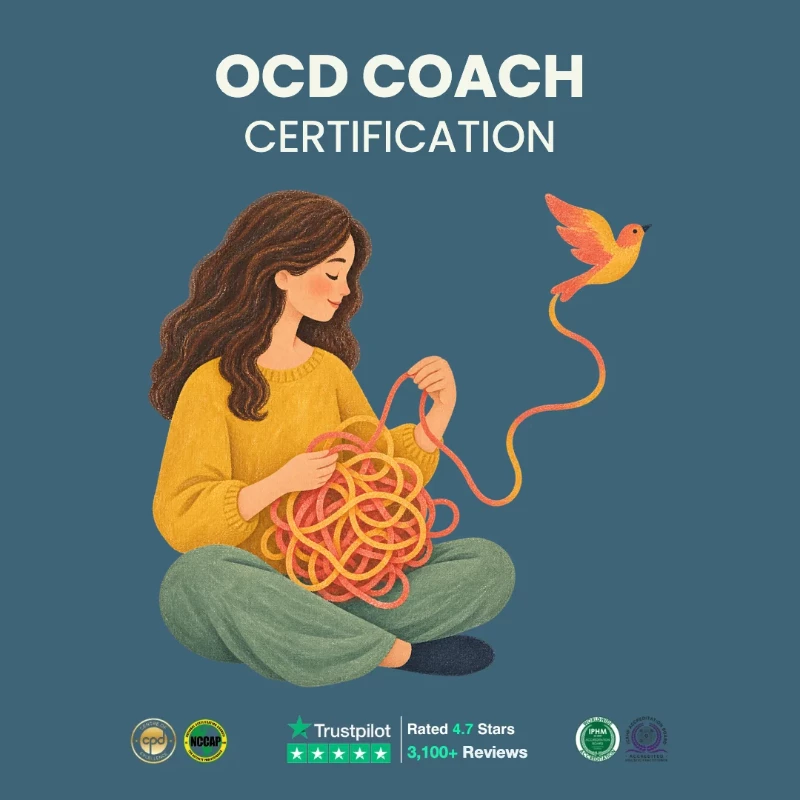
On Naturalistico, our Obsessive–Compulsive Disorder (OCD) Coach Certification treats scripting as a craft inside a larger container—values, practical systems, and community reflection—so coaches can support growth while staying firmly within a coaching scope. The program explicitly integrates scripting with tools designed for real client work, and it welcomes culturally rooted practices (such as prayerful breath or storytelling) when they’re client-led, consensual, and respectful of tradition.
Key Takeaway: When doubt spikes, imaginal exposure scripts offer a structured way to approach uncertainty without reassurance, debate, or analysis. By turning intrusive “what ifs” into repeatable narratives—paced with consent, grounding, and clear referral boundaries—clients practice letting fear be present while still choosing their next valued step.
When Doubt Floods the Room: Why Scripts Belong in OCD Coaching
When doubt floods the room, scripts offer form without rigidity. They give you and your client a shared path through the spike, so the session doesn’t slide into reassurance, debate, or endless analysis.
You’ve likely seen it: breath shortens, a “what if?” takes over, and the client looks to you for certainty. If you answer the content, the loop tightens. If you step back too far, connection can fray. Scripts create a third way—by turning a blurry fear into a detailed narrative that can be approached on purpose.
Done well, scripts intentionally trigger obsessions so anxiety can rise and fall through repetition—without hidden mental rituals or “fixing” statements. Many clients record and replay their scripts for repeated listening until the sting begins to soften.
Precision is part of the medicine here. Step by step, the client hears how doubt strings together images, sensations, and meanings; that clarity makes it easier to spot OCD as “a story,” not “the truth.” You can write lines that spotlight doubt chains, then (when appropriate) braid the imaginal work into real-life practice through in‑vivo exposure.
Early on, scripting can also help reframe OCD itself—often lowering shame and strengthening willingness. And as the saying goes, “OCD speaks loudly, but it never speaks accurately.” Sometimes that single line becomes an anchor when the wave hits.
Tool 1: Foundational Doubt Stories That Reframe OCD
Before you work with intense spikes, it helps to get rooted. Foundational scripts clarify what doubt has been costing your client—and why choosing uncertainty can be an act of self-respect.
Two early practices often set the tone:
- “Lost to OCD” narratives. The client names what rituals and avoidance have taken—time, opportunities, closeness, ease. These gentle truth-telling scripts, sometimes called “Lost to OCD”, often build motivation for the harder work ahead.
When clients can hear the cost clearly, they’re often more willing to tolerate short-term discomfort in service of long-term freedom. In youth workshops, scripting has been used to build willingness through values-anchored story.
- Doubt rehearsal drills. Here, the client deliberately evokes small uncertainties (“Maybe I didn’t say that right”) and watches how doubt tries to multiply. Practices like doubt rehearsal—including “might be” phrasing and tracing the urge to justify—can strengthen insight without turning the session into an argument.
For guilt-heavy themes, Dramatized Socratic Dialogue (DSD) can also help by making the inner debate more experiential, not just intellectual. Early evidence suggests DSD shows promise for softening rigid self-blame.
From an ancestral lens, this stage is also about remembering the stories that carried people before us—courage, endurance, right relationship with fear. You might invite a client to bring a proverb from their elders, or to name an ancestor known for steadiness. As Melody Beattie reminds us, “Trusting yourself is the ultimate lesson.” Placed beside a family saying, the script becomes less “technique” and more a bridge between lineage and present-day growth.
Tool 2: Hierarchies and Worst‑Case Scripts That Truly Spike Anxiety
Once motivation is steadier, you can move closer to fear’s center—deliberately, respectfully, and at the right pace. Hierarchies and worst-case scripts are often where the deepest learning happens.
Step 1: Build a hierarchy. Together, map scenarios from least to most activating. A lower rung might be a mild “I might be wrong,” while a higher rung moves toward the core catastrophe. Many coaches follow IOCDF guidance on hierarchical scripting and climb gradually through repetition.
Step 2: Consider worst‑case “flooding.” For some clients—once tolerance has grown—jumping straight to the worst case can be effective. Used judiciously, flooding scripts may loosen fear’s grip more quickly for certain people, especially when the client actively prefers the approach.
Step 3: Add rich detail. Strong scripts include the elements the client actually fears: images, bodily sensations, meanings, and imagined consequences. Many practitioners emphasize catastrophic detail over polite generalities, because the nervous system can’t learn to coexist with a fear it never truly contacts. Structured client exercises can help you shape this detail with consistency.
Step 4: Bridge to real life. When real-world practice feels too intense at first, imaginal work can function as a strong intermediate step. Over time, you can move from recording to action, supported by intermediate imaginal steps that lead into in‑vivo practice. The IOCDF also recommends repeating the phrases that hit hardest; monitoring of key lines helps keep the work targeted rather than diffuse.
“Do the thing you fear and the death of fear is certain.” – Ralph Waldo Emerson
In coaching, that “death” is never force. It’s capacity—built through values-anchored readiness, respectful pacing, and the choice to let uncertainty stay in the room. That spirit fits naturally with traditional ways of facing, not fleeing: one breath, one story, one step at a time.
Tool 3: Proactive and Reactive Script Routines That Keep Sessions Steady
Consistency turns scripting from a concept into a lived skill. Using scripts both proactively and reactively helps sessions stay steady—without drifting into reassurance or rumination.
Proactive practice. Many practitioners suggest frequent repetition to match OCD’s persistence. A workable rhythm is listening or reading 1–5 times daily, so the practice shows up at least as often as the doubt does.
Reactive use. When a spike hits, return to the relevant script and lean into the lines that bite. The IOCDF emphasizes repeating highest‑anxiety lines without covert self-reassurance, rather than skimming the easy parts.
To disrupt mental loops, it can help to pair scripts with simple stances that don’t debate the content:
- “Maybe–maybe not.” A clean way to decline certainty using maybe–maybe not phrasing directly inside the script.
- Notice and refocus. Label rumination, then return to a valued action, using a notice‑and‑refocus loop.
- Humorous agreement. Light agreement (“Sure, maybe I’m a villain”) can reduce OCD’s authority; some people use this tone in loop tapes.
- Reassurance‑seeking interrupters. Brief lines like “Maybe, who knows?” can interrupt reassurance‑seeking without shaming the need for comfort.
Many clients do well with a blend of set times plus “as needed” use—an approach echoed in IOCDF-informed hybrid protocols.
“The only way over fear is through it—one step at a time—never giving up hope.” – James Callner
Lines like these can live inside the script as a steady north star—especially for clients practicing never giving up on the days that feel heavy.
Tool 4: Somatic and Ancestral Grounding Inside Script Work
Grounding isn’t about removing activation; it’s about staying connected while activation is present. Brief somatic and lineage-honoring moments can help clients remain here—without turning “grounding” into a safety ritual.
Somatic cues as bridges. Within a script, you can add tiny orientation cues: “Feel your feet. Slow exhale. Name one color you see.” Think of these as five-second bridges, not exits. Naturalistico emphasizes somatic grounding that supports pacing without becoming a compulsion—the point is presence, not relief.
Weaving in cultural roots. When it’s meaningful to the client, cultural and ancestral resources can sit beautifully alongside ERP-informed structure: an ancestral blessing line, a whispered name, a breath pattern learned in the family, or nature-based cues like touching a stone or gazing at a tree. Naturalistico encourages this client-led blend within clear agreements and consent, a kind of holistic integration that honors tradition without appropriating it.
Right dose for neurodivergent and trauma‑affected clients. Some clients experience spikes as more sensory-intense or overwhelming, especially when neurodivergence and trauma patterns intersect. Ongoing conversations about trauma and neurodivergence and neurodiversity‑affirming approaches reinforce the value of pacing and sensory respect. Practically, that can look like shorter scripts, captioned recordings, or movement breaks—keeping exposure-like work balanced carefully with energy and sensory load.
Across cultures, people have long relied on breath, earth cues, and shared story during transitions. There’s also evidence that shared narratives can shape how fear is processed. Scripts simply give these older human ways a modern container.
“I stood on the ground my grandmother walked and read my lines. I felt afraid—and held.”
That’s the heart of earth‑based support inside contemporary practice: fear is present, and so is connection.
Tool 5: Scripts That Clarify Boundaries and Referral Lines
Scripts don’t only build courage; they also illuminate boundaries. When certain lines consistently create unmanageable distress, point to significant risk, or uncover needs beyond coaching, the script is giving you useful information: it may be time to widen the circle of support.
Naturalistico sets out practical scope rules—written agreements, clear confidentiality limits, clean boundaries, early referrals for crises, and ongoing cultural humility—so your practice stays kind and clear. This includes systems-level clarity (like documented response times and secure portals for sharing scripts and notes), aligned with our scope rules.
Professional guidance strongly supports referral when a client’s needs fall outside a coach’s training, experience, or contract. The ICF points to the importance of refer when appropriate, and ethics resources note practitioners must refer when they can’t support someone safely or effectively. Clear boundaries also protect the relationship itself by reinforcing clear professional structure—clean roles, clean endings, and predictable expectations.
If script work repeatedly leads to worsening well-being, that’s also a cue to pause and reconsider fit. Some clients report deterioration when support doesn’t match what they need, which is why responsiveness matters.
Let the script guide your next step: if worst-case lines raise credible safety concerns, if trauma responses repeatedly overwhelm, or if day-to-day functioning is so impacted that the client can’t engage even with careful pacing, treat that as a prompt for early, collaborative timely referrals—not a last-minute emergency.
You might say, “Your courage is clear. And what these lines are showing us is that we’ll serve you best by bringing in specialized support alongside coaching.” The work continues—just with a wider net beneath the leap.
Conclusion: Growing Your Script Practice as an OCD Coach
Scripting isn’t a trick; it’s a craft. It sits at the crossroads of exposure-informed structure, ancestral story, and clean scope—refined session by session as clients build a new relationship with uncertainty.
On Naturalistico, imaginal scripting is taught as a practical cornerstone within a wider ecosystem of tools for values alignment and real client work. The OCD Coach Certification positions scripting as a core skill, supported by peer learning, reflection, and ethical consultation as caseloads and cultural contexts evolve.
At its best, this approach is integration: structure and soul, clarity and compassion. Strong boundaries, culture-honoring grounding, and ERP-informed scripting can work together to support growth—aligned with Naturalistico’s commitment to ethical boundaries and practical, respectful support. And because many ancestral systems treat story and repeated phrases as living tools, scripts naturally evolve over time rather than staying frozen as a protocol.
As you refine your scripting, keep listening—to your client’s values, to the traditions that have shaped how humans face fear, and to the steadier confidence that grows when uncertainty is allowed to exist without running the show. May your scripts be honest, your pacing kind, and your practice a place where courage has room to breathe.
Train in OCD Coach Certification
Build ethical, ERP-informed scripting skills in the Obsessive–Compulsive Disorder (OCD) Coach Certification.
Explore the OCD Certification →