Most bio-architecture studios don’t lose money through dramatic blow-ups; they lose it through familiar patterns. Proposals get framed as sheets and hours, so clients compare them to drafting. Early discovery quietly turns into unpaid “thinking time.” Scope expands because each project rebuilds the process. The design stays careful and values-led, yet the business signals commodity pricing—so the studio absorbs the gap through overtime and undercharging. Over time, distress and fatigue can rise when mentally demanding work stretches beyond sustainable limits, making this pattern personally costly as well.
A more sustainable path is to change what you’re selling. Instead of pricing documents and revisions, price the transformation your work reliably supports: a design that aligns people, place, materials, energy, and long-term stewardship. Make that value easy to grasp by pairing performance (what the design is likely to do) with story (why the project matters and how to explain it). Then stop reinventing delivery: turn core expertise into repeatable service modules and a 2D→3D workflow that preserves intent, contains scope, and improves margins. In professional services, command a premium is often possible when fees are anchored to results rather than hours.
Key Takeaway: Bio-architecture studios improve profitability and sustainability by pricing outcomes (performance plus story) rather than drawings and hours, then delivering that value through repeatable service modules and a disciplined 2D→3D workflow. This reduces unpaid discovery, contains scope, preserves intent, and makes fees easier for clients to understand.
Play 1: Price the transformation, not the drawings
The short answer: a profitable bio-architecture studio doesn’t charge only for plans, elevations, and revisions. It charges for the deeper shift a project can create: a healthier relationship between people, place, materials, energy, and long-term stewardship.
Underpricing usually begins with a narrow story. When the work is described as “drawings” or “hours,” clients naturally compare it to any drafting service. When it’s framed as a guided transformation—drawing on vernacular wisdom, climate responsiveness, material intelligence, and modern performance thinking—the value becomes much harder to flatten into an hourly rate.
This is the heart of bio-architecture: not producing documents, but orchestrating how orientation, thermal mass, airflow, shading, local materials, and cultural context work together. Traditional builders understood this without needing a slide deck. They weren’t selling lines on paper; they were shaping dwellings that belonged to land and season. A modern studio can honor that lineage while naming the value in terms today’s clients can act on.
So the first play is simple: stop pricing the artifact, and start pricing the outcome.
Practically, that means shifting from hours to outcomes. Instead of centering how long modeling takes, center what the work supports: clearer decisions, fewer late-stage changes, stronger material coherence, better thermal logic, more compelling project storytelling, and a steadier path from vision to build. In other sectors, tying fees to measurable benefits helps clients choose with more confidence and reduces friction when changes arise.
Grounded pricing also protects integrity. Many risk-aware design professionals commit to design-specifiable metrics—envelope targets, glazing ratios, shading logic, and airtightness goals—while keeping operational outcomes as projections shaped by real-world variables. That distinction lets you charge fairly for meaningful work like airtightness targets and shading factors without overpromising.
Clients also tend to recognize value faster when it’s bundled. When offers are packaged around outcomes (not inputs), it becomes easier to connect the fee to perceived impact, which can support higher pricing when the benefits are clear.
A reliable way to make outcomes tangible is to pair performance with story. Performance answers: “How is this design likely to behave?” Story answers: “Why does this project matter, and how do we explain it well?”
Together, they create a fuller service clients can actually see. A simple energy-use-intensity estimate, a daylight and solar study, a concept section showing envelope logic, and a high-level embodied-carbon summary can form a “minimum viable” performance package. For a small studio, this doesn’t need to be elaborate—just consistent and decision-useful.
Here’s why that matters: bio-architecture has enormous leverage early. Clear, simple studies can steer the whole project before effort gets locked into expensive downstream changes.
Then comes the story layer—where tradition becomes practical value, not “nice-to-have” language. A studio rooted in place-based building intelligence can translate technical choices into a narrative clients are proud to repeat: local materials chosen for climate fit, passive comfort strategies inspired by vernacular precedent, and assemblies that reflect care for land and community. That story supports communication with collaborators, communities, and (sometimes) funding stakeholders—often smoothing the path for the project itself.
There’s a commercial dimension too. Research on certified and energy-efficient buildings has found modest rent premiums and faster lease-up compared to similar local buildings. The takeaway isn’t to overclaim—it’s to recognize that visible ecological value and better performance can shape market perception, which strengthens the case for higher design fees.
To reflect the transformation in your proposal, describe deliverables as decision support—not as paperwork:
- Concept energy study: supports early massing and orientation decisions
- Daylight and solar review: clarifies seasonal comfort and facade strategy
- Material pathway summary: compares bio-based or low-impact assembly options
- Project narrative deck: helps communicate ecological intent and design rationale
That subtle shift changes the conversation. Clients aren’t buying “more drawings.” They’re buying clearer choices and a stronger outcome.
And it gives you permission to name what experienced practitioners often undercharge for: synthesis. Knowing how an earthen wall changes the feel of a room, how a deep overhang softens summer light, or how local craft traditions shape belonging is real expertise—rooted in lineage and practice. It simply needs language that clients can recognize.
As the Naturalistico teaching team puts it, guided training in bio-architecture can help people learn to design, visualize, and draft an eco-home even without prior architecture experience. That’s a helpful reminder: what feels “obvious” to you may be highly specialized to everyone else—and your fees should reflect that integration.
Once you price the transformation, the next question follows naturally: how do you deliver it consistently, without reinventing your process every time?
Play 2: Turn your bio-architecture know‑how into repeatable products
The short answer: a studio becomes more sustainable when its wisdom doesn’t live only in the founder’s head. Turning key parts of your process into repeatable service modules and 2D→3D systems protects your energy, improves consistency, and makes pricing easier to accept. When fees connect to outcomes through structured offers, they’re more likely to align with perceived value and support steadier income.
Values-led studios sometimes worry that “productizing” will make the work generic or detached from place. Done well, it does the opposite. Modules don’t replace intuition; they create a stable container for it, so your attention stays on what truly requires sensitivity: reading the site, responding to culture, and choosing materials with discernment.
Think of it like traditional pattern knowledge. Many regional building traditions use recognizable forms and principles—courtyards, wall types, roof responses, orientation rules, local palettes—then adapt them to land, climate, and community. Repeatability isn’t the enemy of integrity; it’s often how practical wisdom gets transmitted.
That’s why the second play is to create signature service modules that are narrow, useful, and easy to scope.
For example, a fixed-fee bio-material options study can compare earth, straw, timber, or hybrid assemblies with strengths, tradeoffs, indicative cost notes, and carbon considerations. Many specialists find this is easier to deliver consistently—and easier for clients to say yes to—than an open-ended “materials consult.”
Likewise, an envelope and daylight concept pack can be a focused module built around key sections, shading logic, and daylight diagrams. It’s clear, repeatable, and naturally tied to early decisions.
Modules also stop the slow bleed of exploratory work. Long-standing practice guidance in design fields emphasizes giving early discovery a clear container so it doesn’t quietly expand and erode profitability. A defined fee for early discovery lets you listen deeply without letting the phase become endless.
Here’s what a modular offer can look like:
- Site & climate reading: orientation, seasonal light, wind, water flow, and vernacular cues
- Bio-material options study: 2–4 assembly pathways with pros, tradeoffs, and indicative cost notes
- Envelope & daylight pack: sections, shading logic, and daylight iterations
- 2D concept set: plans, sections, and layout logic for early alignment
- 3D spatial model: visual walkthroughs and coordination-ready geometry
- Project story pack: concise visual narrative for stakeholders, collaborators, or community presentations
The goal isn’t to force every client through every module. It’s to make your expertise legible. Once clients can see the pieces, they understand the sequence—and the fee stops looking arbitrary.
From there, the next layer is straightforward: use 2D→3D systems to scale craft.
Without a reliable workflow, every change triggers redraws, coordination drift, and avoidable confusion. With a strong 2D→3D system, changes move through the work with far less friction. Teams using templates and model-based coordination often report fewer documentation hours, largely because duplicated drafting drops and issues surface earlier.
The deeper win is coherence. Real-time updates reduce the inconsistencies that creep into 2D-heavy work. In a bio-architecture context, that means thermal strategy, material logic, and spatial intent are less likely to fragment as the project evolves.
Put simply, a 2D→3D workflow helps you:
- Preserve design intent as complexity grows.
- Close the gap between intuition and communication, because clients can see decisions earlier.
- Build reusable libraries—assemblies, details, standards—that make future projects easier to deliver.
This becomes especially valuable when you work with bio-based or regionally specific materials that aren’t represented in default software libraries. Building your own wall types, roof build-ups, shading devices, and passive-design templates takes effort upfront—but then it becomes studio infrastructure: hard-won knowledge you can actually reuse.
That’s how you scale without diluting tradition. You don’t automate the soul of the work. You systematize the repeatable backbone so your best attention stays available for what’s unique: reading a site well, sensing proportion, choosing material expression, and guiding clients toward wiser decisions.
Clear modules and a clean workflow also build trust. Clients are more comfortable paying strong fees when they can see a defined process. Instead of defending a number, you can walk them through a sequence: clarify climate and site logic, compare material pathways, test light and envelope, then model the concept in 3D so decisions are visible and coordinated. Each step earns its place.
Conclusion: Let integrity and structure support each other
For many bio-architecture studios, the issue isn’t talent or conviction. It’s that pricing still reflects an old story: selling drawings, absorbing endless early-stage thinking for free, and rebuilding the process from scratch each time. That road trends toward exhaustion, and prolonged cognitive strain without firm boundaries is linked with distress and fatigue.
A healthier path is also the more honest one. You’re not just offering documents; you’re guiding a place-rooted transformation shaped by material intelligence, ecological awareness, and lived human experience. When you price that transformation clearly—and support it with repeatable modules and respectful systems—you create space for the practice to keep evolving. In other sectors, outcome-based pricing tied to results is one way teams work to future‑proof revenue; a similar logic can be adapted to bio-architecture without reducing it to a commodity.
This is where tradition and modern studio discipline work beautifully together. Ancestral building wisdom teaches attention to orientation, climate, local materials, and belonging. Contemporary practice strategy teaches you to communicate value, define scope, and build systems that support consistency. Together, they create a studio model that’s principled, practical, and financially steady.
If one idea is worth carrying forward, it’s this: profitability isn’t betrayal. In a values-led practice, it protects the time, care, and discernment the work truly requires.
Price the transformation. Build the modules. Strengthen the workflow. Then let the studio grow in a way that honors land-centered roots—and the very real need for a business that can last.
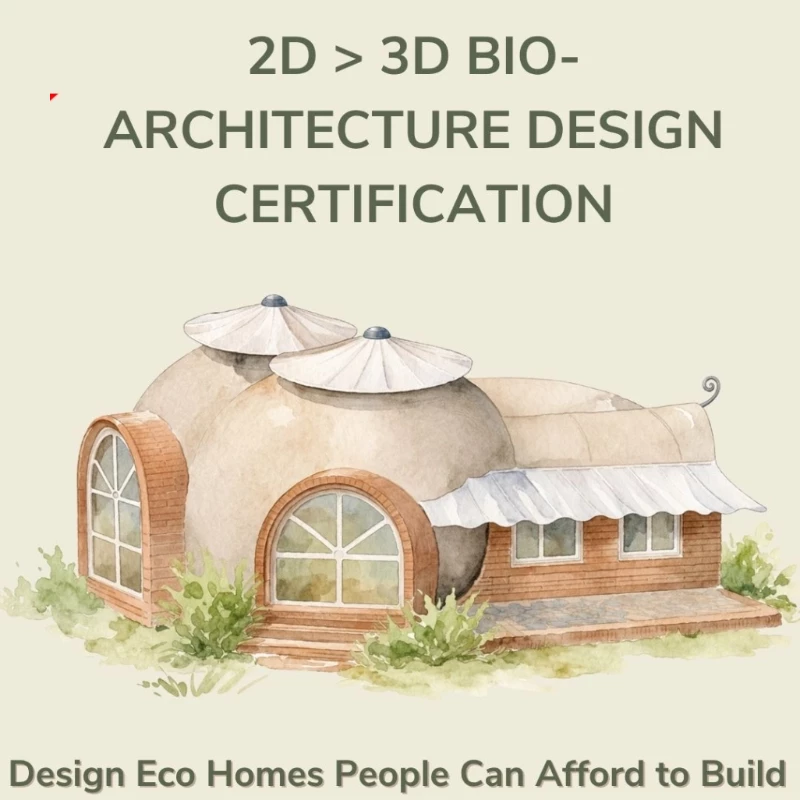
Explore 2D-3D Bio-architecture Design Certification
Apply outcome-based design packaging by learning consistent eco-home visualization and drafting in 2D-3D Bio-architecture Design Certification.
Explore 2D-3D Bio-architecture →