Low-energy clients often struggle with standard exercise advice. Even a cautious plan can still lead to a next-day crash, and a routine that looks “simple” on paper may be too demanding to remember when someone feels foggy or depleted. Standing tolerance, balance, and the emotional charge of exertion can narrow what’s actually workable. These clients aren’t avoiding effort; they’re rationing it.
In that context, Qi Gong and Tai Chi offer something more intelligent than “just move more.” Both are meditative movement arts rooted in Chinese tradition, and both can help restore steadiness without asking someone to borrow energy from tomorrow. The art is matching the practice to the person’s real capacity.
Key Takeaway: For low-energy clients, use meditative movement as energy stewardship: start with simple, repeatable Qi Gong when bandwidth is low, then layer in Tai Chi as stamina, balance, and cognitive clarity improve. The goal is movement that restores steadiness today without triggering a next-day crash.
Qi Gong and Tai Chi: related arts, different demands
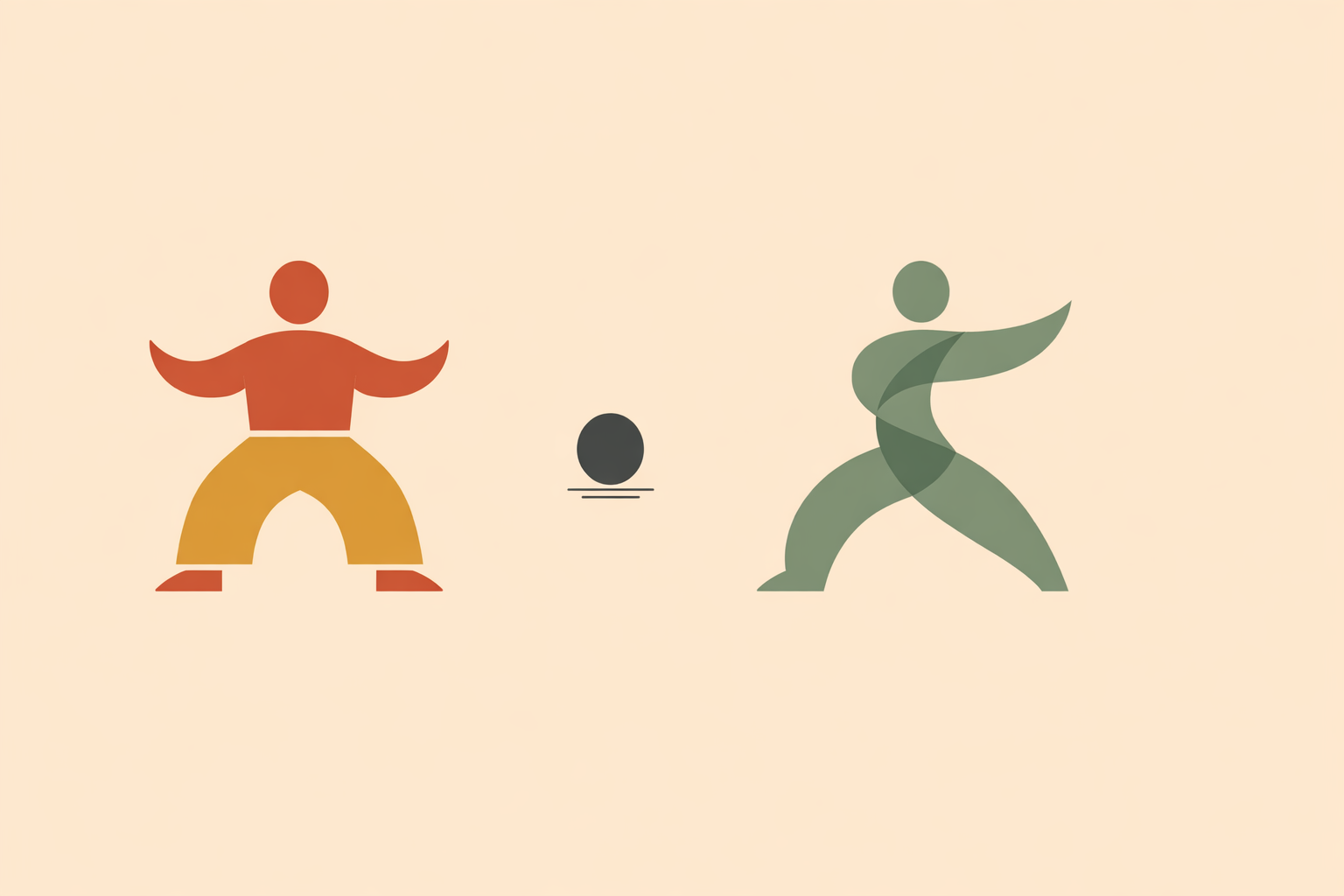
Qi Gong and Tai Chi belong to the same family, but they place different demands on the body and mind. Knowing the difference helps you guide clients with much more precision.
Qi Gong is a broad category of practices that cultivate and regulate qi through posture, breath, movement, and attention. It can be extremely straightforward: a single movement repeated slowly, a standing posture, a seated sequence, or breath-led motion with minimal choreography.
Tai Chi is typically more structured. It’s practiced as a flowing sequence of linked postures with coordinated weight shifts, timing, and direction. Think of it like a moving meditation with more “steps” to remember—so it often asks more of balance, memory, and concentration.
Both sit under the umbrella of meditative movement and are traditionally taught through the coordinated regulation of body, breath, and mind. That framework still matters because it explains why these arts can feel restorative even when they look gentle from the outside.
How these practices support low energy
From a traditional perspective, Qi Gong and Tai Chi help make energy more usable rather than scattered. The pathway is simple: settle the body, regulate the breath, calm the mind. When those three align, people often feel less internally strained and more steady through the day.
Modern research broadly echoes this. Tai Chi has been associated with reduced fatigue, and the same body of evidence also describes improved sleep, mood, and day-to-day steadiness. Put simply, what tradition has long observed in lived practice is being mirrored in outcomes related to nervous system balance, sleep quality, mood, and inflammation.
Here’s why that matters: you don’t have to abandon traditional language to be evidence-informed. When breath, posture, and attention stop pulling in different directions, a person often feels more resourced—whether you describe that as regulating qi or restoring internal coherence.
Why Qi Gong is usually the best starting point
When energy is fragile, Qi Gong is usually the best on-ramp. Its simplicity reduces cognitive load, and its flexibility makes it easy to scale without losing the essence of the practice.
Most forms rely on short, repetitive patterns. That repetition is often a relief for clients who feel foggy, overwhelmed, or easily overstimulated because they don’t have to keep learning new transitions just to continue.
Qi Gong also adapts beautifully to the body in front of you. If standing feels risky due to fatigue or unsteadiness, seated work can be the better choice. Essentially, you can keep the benefits of meditative movement while reducing the “cost” of the session.
In practice, Qi Gong is often the gentlest doorway because it can be distilled down to essentials: a stable position, an easy rhythm, and just enough attention to gather rather than drain.
When Tai Chi becomes the better fit
Tai Chi tends to suit clients who have regained some bandwidth and want more structure. Once someone can tolerate a bit more coordination and learning, Tai Chi’s flowing sequences can become deeply nourishing.
The form itself offers a gentle challenge: learning and refining a sequence can build confidence, coordination, and presence. Research also suggests Tai Chi can support balance and coordination, and many practitioners value the way it strengthens self-trust and embodied focus.
There’s also a quiet psychological lift at this stage. For someone emerging from fatigue, the experience of remembering, linking movements, and moving with continuity can feel genuinely empowering—progress you can feel in real time.
Qi Gong or Tai Chi? Read today’s capacity
The best choice is based on today’s energy, not yesterday’s plan. That single principle prevents many setbacks.
If a client is depleted, foggy, emotionally frayed, or physically unsteady, begin with Qi Gong. If they’re more settled, can tolerate complexity, and enjoy skill-building, Tai Chi may be the better fit. A common progression is to start with Qi Gong and add Tai Chi as capacity returns.
- If waking energy is low, choose 5 to 15 minutes of simple Qi Gong.
- If energy is moderate, combine a short Qi Gong opener with a brief Tai Chi sequence.
- If energy is stronger, let Tai Chi lead and use Qi Gong to settle at the end.
This is best understood as cyclical, not linear. Low-energy recovery rarely climbs in a straight line, and trying to change everything at once can overwhelm tired clients. That’s why small changes that can flex day by day are usually the most sustainable.
Designing sessions that clients can actually sustain
Small, consistent practice is usually more useful than occasional heroic effort—especially when energy varies day to day.
Micro-dose Qi Gong can be a game-changer here. Short practices of two to five minutes are often more realistic than full sessions, and very short movement breaks are frequently described as practical, sustainable on severe fatigue days. In real coaching, those tiny sessions are often the difference between “I can’t keep up” and “I can do this.”
As clients become steadier, you can expand gradually with a step-by-step progression:
- Weeks 1–2: 5 to 10 minutes of Qi Gong most days.
- Weeks 3–6: 10 to 15 minutes of Qi Gong, with short Tai Chi added on better days.
- Weeks 7–12: use Qi Gong as a settling or preparatory layer, then extend Tai Chi as tolerated.
Across real-world coaching, the rhythm matters as much as the method. Consistency builds confidence, and confidence makes practice feel lighter.
Working within a Chinese Medicine–informed perspective
These arts are more than movement tools. They come from a living tradition of self-cultivation, attentiveness, and respect for natural rhythms. Used well, they support not only movement capacity, but also a wiser relationship to effort.
Qi Gong teaches restraint, listening, and the skill of doing enough. Tai Chi adds refinement—flow, timing, and rooted movement under slightly greater demand. Together, they offer a nuanced way to support well-being without forcing progress.
As Dr. Jianping Chen reminds us, “In general, ‘best practitioners’ are more important than ‘best practices’ in Chinese medicine due to the role of individual judgment.” That’s a powerful anchor for coaches, too: strong guidance comes from reading the person, not just following a template.
Conclusion: start where the energy is
There’s no single winner between Qi Gong and Tai Chi—only the right doorway for the person in front of you, on that particular day.
For most low-energy clients, Qi Gong is the gentler beginning: simpler, easier to adapt, and less demanding when energy is fragile. Tai Chi often becomes more useful later, when the client can benefit from structure, coordination, and the quiet satisfaction of learning a form.
Keep the aim simple: match practice to capacity and let progression bend with real life. With that approach, both arts can become reliable allies for rebuilding steadiness, confidence, and usable energy. As always, encourage clients to work within their comfort and seek appropriate guidance if symptoms are complex or worsening.
Study Chinese Medicine Practice
Build on these movement principles with Chinese Medicine Practitioner to better match practices to individual energy patterns.
Explore Chinese Medicine Practitioner →