For practitioners who offer both Reiki and meditation, the same question comes up again and again: what should lead today—receptive energy work or active attention training? Often, you’ll know within minutes. One person arrives wired-tired and asks for grounding without much talking. Another wants something practical they can use between sessions, preferably in a secular frame. In groups, mixed beliefs and limited time make the choice even more important. Without a clear path, blending modalities can blur consent, overwhelm the system, and dilute results.
Key Takeaway: Choose a clear lead—Reiki for receptive settling and energetic support, meditation for active skill-building and portable self-regulation. When you combine them, use a simple prepare–receive–integrate flow so pacing stays coherent, consent stays explicit, and the nervous system isn’t overloaded.
Inside a Reiki Session
Reiki sessions are built for receiving. The practitioner offers steady, consistent presence, and the receiver isn’t asked to perform, analyze, or “do it right.”
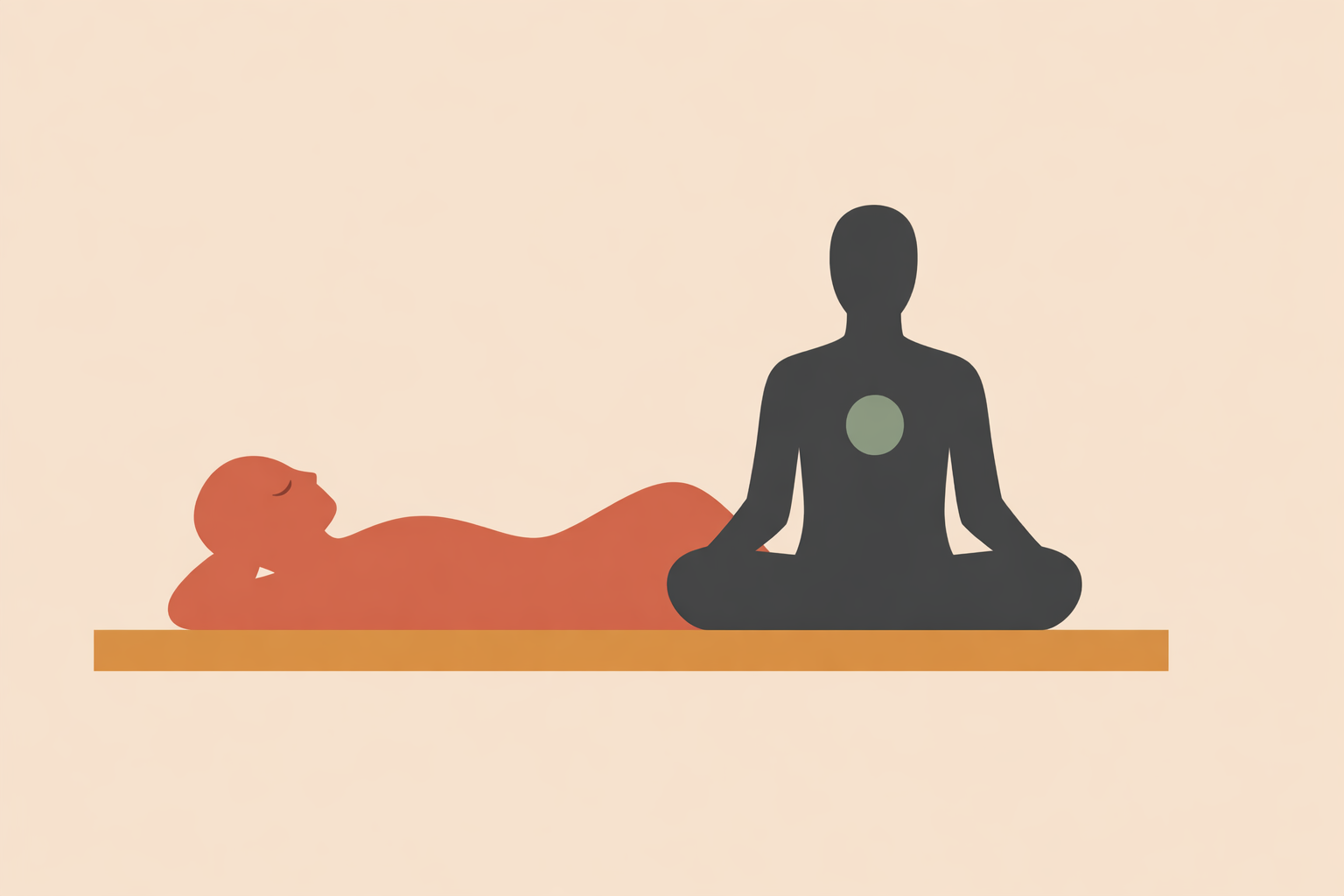
Most sessions involve lying down or sitting comfortably while hands are placed lightly on or just above different areas of the body. The receiver can simply rest, which is why Reiki can be so accessible when the mind is tired: active concentration isn’t required.
Reiki can also downshift fast without demanding cognitive effort. Research summaries have linked Reiki sessions with relaxation markers such as lower heart rate, lower blood pressure, and patterns consistent with parasympathetic settling. Put simply, it often functions as a reliable “landing pad” for people who arrive keyed-up or depleted.
On the felt level, receivers often report warmth, tingling, subtle pulsing, or a wave of quiet. Others notice very little in the moment and only realize later they feel lighter, softer, or more rested. That delayed unfolding is common and worth normalizing early.
“Reiki has been shown to be better than placebo for inducing a state of relaxation.”
Inside a Meditation Session
Meditation asks for more active participation. The person is invited to place attention, notice distraction, and return—again and again—to a chosen anchor.
A session may start with posture, breath, mantra, or body awareness. The practice is simple but not always easy: noticing what’s happening and relating to it more skillfully, without harshness. Here’s why that matters—these are trainable skills that can travel with someone into daily life.
Contemplative research suggests meditation can strengthen self-regulation, including attention control, emotional regulation, and present-moment awareness. In lived practice, that often looks like more awareness and more choice in real time.
For session design, the contrast is straightforward: Reiki can be fully passive for the receiver, while meditation is active at the level of attention. Neither is “better.” They simply open different doorways into steadiness.
When Reiki Should Lead
When someone arrives depleted, overwhelmed, highly activated, or explicitly seeking energetic support, Reiki is often the kindest lead.
Because concentration isn’t required, Reiki can be easier to receive when mental effort feels out of reach. In periods of acute stress or high activation, reducing anxiety and inviting relaxation may be more supportive than asking someone to focus inward intensely.
Practice wisdom strongly supports this. When someone is flooded or struggling to follow instructions, starting with Reiki often creates enough softness for the rest of the session to unfold naturally—like letting the system exhale before asking it to learn something new.
Reiki is also a natural lead when the intention is explicitly energetic: clearing, grounding, or spiritual nourishment. Contemporary descriptions frame Reiki as support for spiritual well-being as well as overall balance, which matches how many lineages and practitioners understand the work.
“Reiki is a safe, gentle, and profoundly relaxing healing modality…”
When Meditation Should Lead
When the goal is portable self-regulation—something the client can use between sessions—meditation is usually the better lead.
Meditation helps build awareness and choice in real time. Over time, that can support steadier responding, clearer perception, and a more grounded relationship with stress. Even a few minutes can start to re-orient the mind.
Research suggests mindfulness practice can improve attention control and reduce mind-wandering, which is one reason meditation is so effective when the intention is skill-building rather than pure receiving.
Meditation can also be the most accessible option in groups with mixed beliefs. A simple invitation to feel the breath or observe thoughts often welcomes participation more easily than energy-based language. It can also support communication, boundaries, and values-based choice—outcomes that many practitioners recognize through consistent, lived experience.
There’s a practitioner-facing benefit, too: steady meditation often strengthens stability, resilience, and steadiness of presence—qualities that support Reiki just as much as they support coaching conversations.
“The benefits of Reiki can be all-encompassing… opening us to personal growth as we progress.”
How to Combine Reiki and Meditation Coherently
Reiki and meditation can deepen one another when they’re combined with a clear structure. The simplest, most reliable arc is: prepare, receive, integrate.
Many practitioners find that light meditation reduces mental noise so Reiki can be felt more clearly, while Reiki makes inner observation less effortful. The key is to keep the meditation portion supportive—an easing-in, not another demand.
A few minutes of breath awareness can orient attention and settle the mind. Reiki can then support a softer, more receptive state. During the Reiki portion, a very gentle anchor—often the breath in the belly—is usually enough.
Think of the breath anchor like a handrail: it offers orientation without turning the experience into effort.
Keep the timing humane. Short blended sessions can work beautifully for drop-ins and groups, while longer sessions often suit deeper one-on-one work.
- Prepare: arrival, consent, simple breath awareness, intention
- Receive: Reiki with or without a very light attentional anchor
- Integrate: silence, brief reflection, journaling, or one next step
When to Keep Reiki and Meditation Separate
Sometimes the most skillful choice is not to blend at all. Keeping the modalities separate can protect pacing, clarity, and consent—especially when someone is sensitive, uncertain, or easily overwhelmed.
Start by being explicit about what’s being offered. If a session includes touch, energy language, silence, guided awareness, or all three, name it plainly. Clear framing helps people choose what feels right for them.
Next, work trauma-aware: clarify touch, offer opt-outs, and keep any mindfulness very light if needed. For highly activated clients, simple is often best—a brief grounding followed by Reiki with clear choice points—rather than layering multiple practices.
It’s also wise to stay modest in claims. Reiki and meditation both have rich traditional roots and a growing evidence base, but not every meaningful observation has a neat citation. Integrity tends to sound like clear, honest language about likely experiences rather than big promises, with clear, ethics-led communication helping that land well.
Finally, respect lineage. Reiki has Japanese roots, and meditation emerges from multiple contemplative traditions. Treating both with care keeps the work deeper—and avoids flattening what should remain distinct.
- Be clear: name the modality and get consent
- Be choiceful: offer opt-ins and opt-outs for touch and inner focus
- Be respectful: acknowledge roots and avoid flattening traditions
- Be modest: describe likely experiences without exaggeration
Choosing with Integrity
Good session design begins with the state of the person in front of you. When the system needs refuge, let Reiki lead. When the aim is portable awareness and everyday practice, let meditation lead. When both belong, combine them simply enough that the experience stays coherent.
As practice matures, discernment becomes part of the craft. Growth in Reiki isn’t only about technique—it’s also about ethical grounding, inner steadiness, and community reflection.
“A Reiki Master… develops a greater connection and can reach an enhanced awareness,” a description that reflects how many lineages understand advanced training as a deepening of both skill and presence. Contemporary overviews similarly describe the Master level as involving deeper spiritual awareness beyond foundational techniques.
Ultimately, Reiki and meditation are complementary paths. The art is knowing which one to lead with, when to braid them together, and when to let each stand on its own.
Advance with Reiki Master Certification
Refine your session design and practitioner presence with the Reiki Master Certification.
Explore Reiki Master Certification →