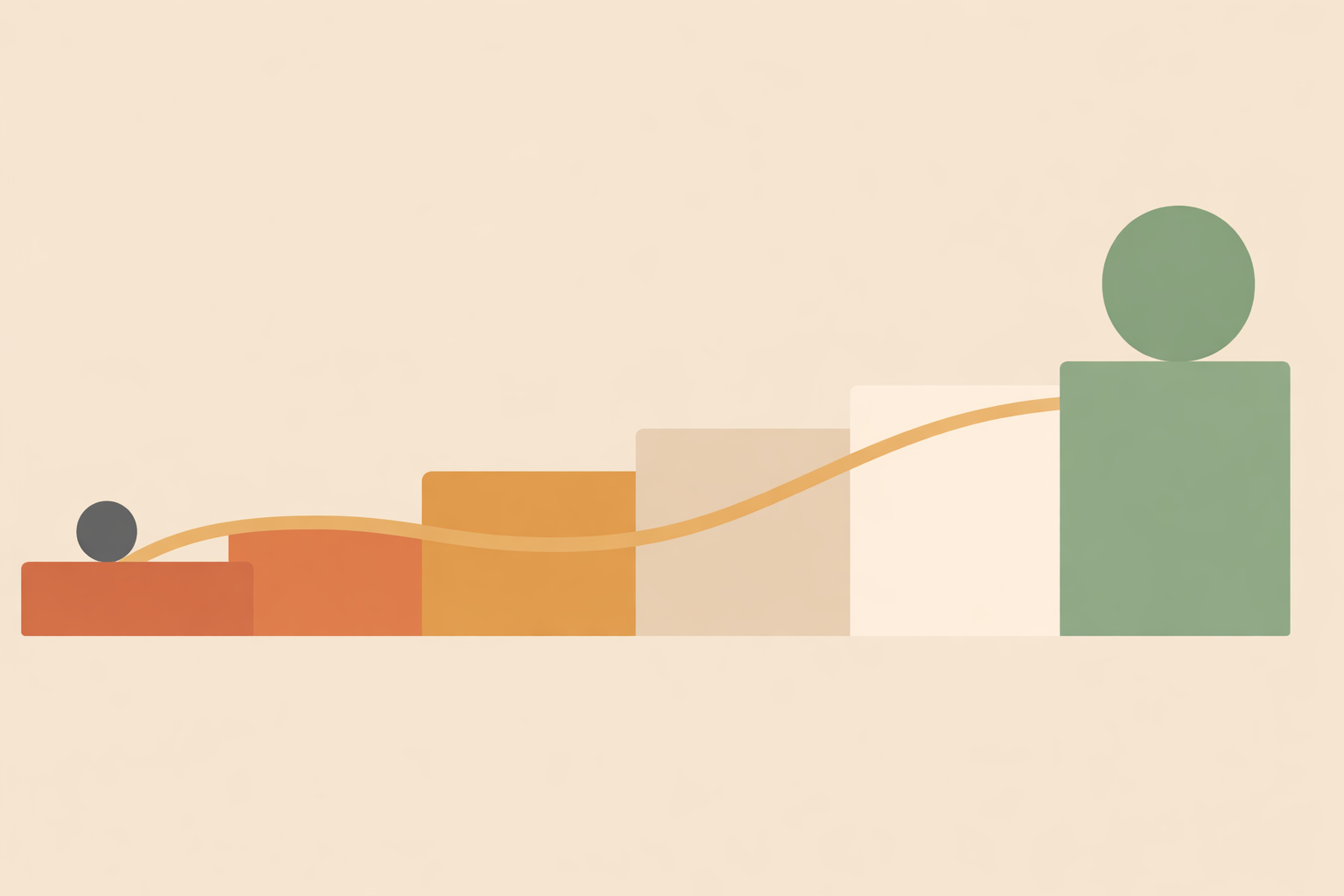
When you’re flooded with techniques, the kindest choice is often not adding more—it’s choosing a clear somatic life coach roadmap you can genuinely live. A grounded path—from your own body-awareness to a stable, values-led practice—will take you further than a scattered toolbox ever will.
Somatic coaching is built on the premise of the body–mind connection: one living system, not two separate parts. People don’t only “think through” patterns—they also breathe them, brace them, and carry them in posture. A tight jaw, shallow breath, or collapsed chest isn’t something to fight; it’s a doorway back into presence and choice. As Richard Strozzi-Heckler reminds us, “Somatic Coaching is distinct from conversational coaching,” because it brings the whole body into the work.
That’s why a coherent somatic coaching journey matters. Simple practices—brief body scans, breathwork, grounding, micro-movements—become skills you can feel, not just ideas you can explain. And when body awareness practices can improve emotional regulation, it’s not abstract theory; it’s lived stability you can build day by day.
Start small: 10 minutes of scanning, a few regulated breaths, a gentle check of your posture and feet on the floor. Those modest moments add up—and they’re the roots of a durable practice.
Naturalistico is designed around this embodied arc. The Somatic Coach Certification blends deep learning with hands-on practice and community, so your skills evolve in real conversations and real bodies—including your own. Learn it, live it, then guide it with integrity.
Key Takeaway: A stable somatic coaching practice grows best through a clear progression: begin with daily body awareness, then guide simple repeatable tools, and only later build longer client journeys and a values-led business. Consistency, consent, and nervous-system-friendly pacing matter more than collecting techniques.
Stage 1 – Seedling: Living in your own body before you coach anyone
Stage 1 is where curiosity becomes daily embodiment. Before guiding anyone else, you build a personal baseline—small, repeatable practices that help you trust your own physiology and read your own signals clearly.
Begin with attention, not fixing. Try 10-minute body scans and simply notice how sensation and emotion travel together: a tight chest, a fluttery stomach, a numb patch you’d usually ignore. Practices that develop body awareness are associated with calmer mood and less anxiety—exactly the steadiness you’re rehearsing in yourself first.
Keep a simple journal. Over time, your notes become an honest map: patterns, triggers, and the conditions that help you return to center. It’s also training—because what you learn to spot in yourself is often what you’ll recognize quickly in others.
Thomas Hanna captured the spirit of this phase: “the body is not an instrument to be used, but a realm of one’s being to be experienced.”
Let that be your compass. Small rituals done consistently are far more powerful than heroic practices done once.
Build a daily somatic baseline
- 2–5 minutes of arriving: feet on the floor, sense your weight.
- 3–5 minutes of breath: longer exhales, hands on ribs or belly.
- 1–3 minutes of micro-movements: slow neck rolls, shoulder spirals.
- Quick journal note: one sensation, one emotion, one behavior you notice.
Keep it simple. The goal is reliable awareness—not peak experiences.
Traditional wisdom supports this stage beautifully. Many lineages understood, long before modern terminology, that rhythm, rest, walking, squatting, and breath keep us steady. You can honor that depth without borrowing rituals out of context—stay close to your own lineage, your lived environment, and what you can practice respectfully every day.
Root your practice in simple, ancestral-friendly rituals
- Begin your day with a grounding posture you can sustain with ease.
- Walk at a natural pace for 10 minutes, sensing contact and cadence.
- Pause before meals: two breaths, feel your belly and jaw, then begin.
In the Naturalistico Somatic Coach Certification, learners apply breathwork, grounding, and micro-movements to themselves first—so when you eventually guide others, you’re teaching from experience, not only theory. Many graduates share in their reviews that their body–emotion relationship shifted first, and the desire to coach grew naturally from that lived change.
Stage 2 – Sprout: Guiding first sessions and tiny somatic experiments
Stage 2 is where inner practice becomes outward support. You keep things low-pressure and practical, offering clear experiences people can feel right away—and repeating what works until confidence becomes steady.
Early sessions often land best when they’re concrete. Guide a short grounding through the feet, a few minutes of breathwork, and one small posture adjustment the person can sense immediately. These are “repeatable wins”—easy to practice between sessions, where real change consolidates.
Richard Strozzi-Heckler points to the heart of this work: helping someone “feel and be with this animating force” that makes them alive—life moving toward life. Essentially, your role isn’t to fix someone; it’s to guide attention to what’s already present, with care and precision.
In peer labs and early practice, you’ll often see small but meaningful shifts—shoulders softening, facial expression brightening, breath becoming steadier. Think of these as the body making a little more room.
Translate your practice into simple client experiences
- Open with a check-in: 30–60 seconds to name sensations and breath.
- Offer one felt tool: feet grounding, rib breath, or a small posture shift.
- Invite reflection: what changed in breath, tension, or mood?
- Close with integration: a tiny practice to repeat daily.
Use plain language and a slow pace. When consistent body awareness practice can decrease anxiety and support steadier emotions, Stage 2 is where you help people build that capacity through repetition.
Use beta clients to grow skill and confidence
- Offer 3–5 free or reduced-fee sessions to peers or friends.
- Track tangible shifts: easier breathing, less shoulder tension, softer jaw.
- Ask for feedback on clarity of instructions and pacing.
- Refine your mini-offers based on what feels most natural and effective for you.
These early experiments help you discover your voice, your pacing, and what fits your culture and values. Each session adds a growth ring to your emerging practice.
Stage 3 – Rooted Guide: Designing embodied journeys, not one-off sessions
Stage 3 is where your work becomes structured and dependable. Instead of reinventing each session, you shape a clear arc—often a three-month foundation—so people can commit with confidence and track their progress.
Most somatic models emphasize regulation first: breath, grounding, and steady orientation before anything more emotionally intense. Starting here can support nervous system steadiness and helps keep the work within a sustainable range for both of you.
The Naturalistico training then layers in somatic “attachment awareness”—tracking how the body responds in relationship—and body-based parts work, helping people befriend different inner impulses without getting pulled into inner conflict, all within a coaching frame.
Peter Levine’s reminder is useful context here: “Trauma is not what happens to us, but what we hold inside in the absence of an empathetic witness.”
Somatic life coaching stays firmly within scope and does not attempt clinical trauma work. Still, this wisdom can guide how you show up: go slowly, offer choice, and stay close to capacity—steady principles of being trauma-informed and respectful.
Shift from ad‑hoc sessions to clear journeys
- Weeks 1–4: Regulation—breath, grounding, body scans, gentle movement.
- Weeks 5–8: Relating—somatic attachment cues, boundaries, “felt sense of yes/no.”
- Weeks 9–12: Integration—parts dialogue in the body, everyday rituals and experiments.
A simple session arc can be: brief check-in, guided exercise, reflective dialogue, then a grounding close—an approach widely used across somatic approaches.
Layer regulation, attachment, and parts work respectfully
- Choice first: always offer options and respect no/yes/not yet.
- Scale sensations: “How big is that tightness, 1–10?” so you can pace carefully.
- Micro-steps: touch a sensation for 10–20 seconds, then return to grounding.
- Integrate life: translate insights into one tiny daily ritual or boundary experiment.
By now, you’re not offering “sessions.” You’re inviting people into a steady somatic coaching roadmap with rhythm, consent, and respect—the conditions where change can actually root.
Stage 4 – Branching Out: Deep dives, boundaries, and a values-aligned business
Stage 4 expands your work in both time and depth. You guide longer journeys around boundaries, purpose, and relationships—and you put clean systems in place so your work stays sustainable, not draining.
Many coaches here offer six‑month deep dives focused on boundary-setting, purpose alignment through felt yes/no/not yet, and monthly real-life experiments. Some also guide vocation mapping—tracking contraction, expansion, and aliveness to design next steps in work and contribution. Put simply: people test changes in the real world, then return to the body to learn from what happened.
Longer arcs make change easier to see. When you track simple pre/post baselines—posture, jaw tension, shoulder softness, breath quality—people can feel their progress and stay engaged with the process.
Traditional roots also meet modern language here. Some breath and regulation practices are described today as polyvagal‑informed, pairing nervous system concepts with the same grounded centering many lineages have practiced for generations.
Hold six‑month somatic deep dives
- Boundaries: rehearse “no/yes/not yet” in the body, then in life.
- Purpose: track expansion/closure as you test small career steps.
- Relationships: monthly “field experiments” with reflection and repair.
Bruce Lipton puts it provocatively: “Beliefs are physical.”
In day-to-day practice, that might look like helping someone notice how a story changes their breath or posture—and then supporting them to build new lived patterns over months, not minutes.
Build ethical sales and retention systems
- Clear, consent-based discovery calls that map a felt roadmap.
- Simple, named offers: three-month foundations and six-month deep dives.
- Pre/post somatic baselines: posture notes, breath notes, tension maps.
- Care-centered follow-ups: recap wins, name next tiny step, confirm consent.
Good structures protect everyone involved. They help you stay aligned with care, integrity, cultural respect, and realistic outcomes—while making your work easier to sustain.
Stage 5 – Canopy: Becoming a stable, ever-evolving somatic leader
Stage 5 is maturity with humility. Your practice becomes stable and spacious; you refine your craft, perhaps mentor others, and weave embodied wisdom into your community with care and cultural respect.
Many developmental maps describe a “mastery” phase—not a finish line, but a season where your impact is consistent and your attention turns toward legacy.
Graduates of the Naturalistico somatic pathway often report feeling more grounded, clearer in boundaries, and more confident weaving somatic tools with previous training or cultural traditions. Some move into advanced topics—relational body practices, rupture–repair skills, or place-based work—always with consent and cultural respect.
Adyashanti once observed, “We suffer in the present from past experiences in direct proportion to how much identity we derive from that suffering.”
A mature somatic guide hears that as a gentle invitation: keep loosening the grip of old identities, not by rejecting your history, but by meeting it with more breath, more space, and more choice.
Daily rituals stay central, because your own regulation becomes the steadiness others can lean on. Practices that blend movement, breath, and awareness have been associated with improved well-being over time—echoing what traditional practice has long emphasized: consistency shapes the nervous system.
Stabilize your practice and impact
- Maintain personal rituals: movement, breath, stillness, nature time.
- Host a community practice space: short weekly circles or seasonal workshops.
- Refine your signature journey: update language, rituals, and measures yearly.
Let embodiment guide leadership and mentorship
- Mentor early-stage coaches with consent and clarity.
- Co-create community guidelines that protect safety and cultural respect.
- Continue learning through evolving, embodiment-focused professional development.
Leadership here is quiet, steady, and generous. You don’t need to be loud to be felt.
Conclusion: Living your somatic roadmap one grounded stage at a time
These five stages aren’t a staircase—they’re a spiral. You’ll circle back: re-seed your own practice after a busy season, or return to “Sprout” experiments when your niche changes. That’s not a problem; it’s the living nature of an embodied coaching journey.
Wherever you are, choose one next step:
- If you’re at Seedling: commit to a 10-minute daily body scan and one journal note.
- If you’re at Sprout: design a 3-session reset and invite two beta clients.
- If you’re a Rooted Guide: craft a three-month foundation with clear milestones.
- If you’re Branching Out: build a six-month deep dive and a simple discovery call map.
- If you’re at Canopy: formalize mentorship and tend your community practice space.
Evidence and tradition often point in the same direction. A review of yoga and related body-based practices found mood improvements in 58% of included studies, and 12‑week programs combining group dialogue with embodied practice were associated with improved quality of life compared with controls—research language that echoes what many lineages have practiced for generations.
And this work still moves at a human pace. As one practitioner put it, “What matters most is delivering results, which you’ll gain through real-life experience.”
To finish well: honor your scope, lead with kindness, keep learning, and keep your consent practices clear. If intense distress, overwhelm, or persistent destabilization shows up, it’s wise to pause, return to grounding basics, and encourage the person to seek appropriately qualified support.
Train as a Somatic Coach
Build your stage-by-stage approach with the Naturalistico Somatic Coach Certification.
Explore Somatic Coach Certification →