Many teen groups start strong, then attendance fades after the first couple of weeks. By week three, it’s common to see a noticeable drop-off as the novelty wears off and everyday life takes over.
When a group isn’t designed to keep teens genuinely engaged, conversations often drift into awkward silence or default to advice-giving. At the same time, a few confident voices may dominate while quieter teens pull back.
Just as importantly, motivation can become mostly external—driven by facilitators, parents, or grades—so it naturally fades between sessions. And even when helpful tools are shared, they often don’t travel with teens into their after-school reality.
Group formats that center autonomy, competence, and relatedness can shift peer influence into something more sustainable: intrinsic motivation. When teens feel choice, capability, and belonging, they’re far more likely to show up, speak honestly, and use skills the same day.
Key Takeaway: Teen groups stay energized when the structure supports autonomy, builds real competence, and creates genuine belonging—so motivation comes from within the group, not outside pressure. Designs like circles, projects, skill labs, pods, and youth-led clubs turn peer influence into consistent attendance and same-day skill use.
Design 1: Small peer coaching circles (4–6 teens)
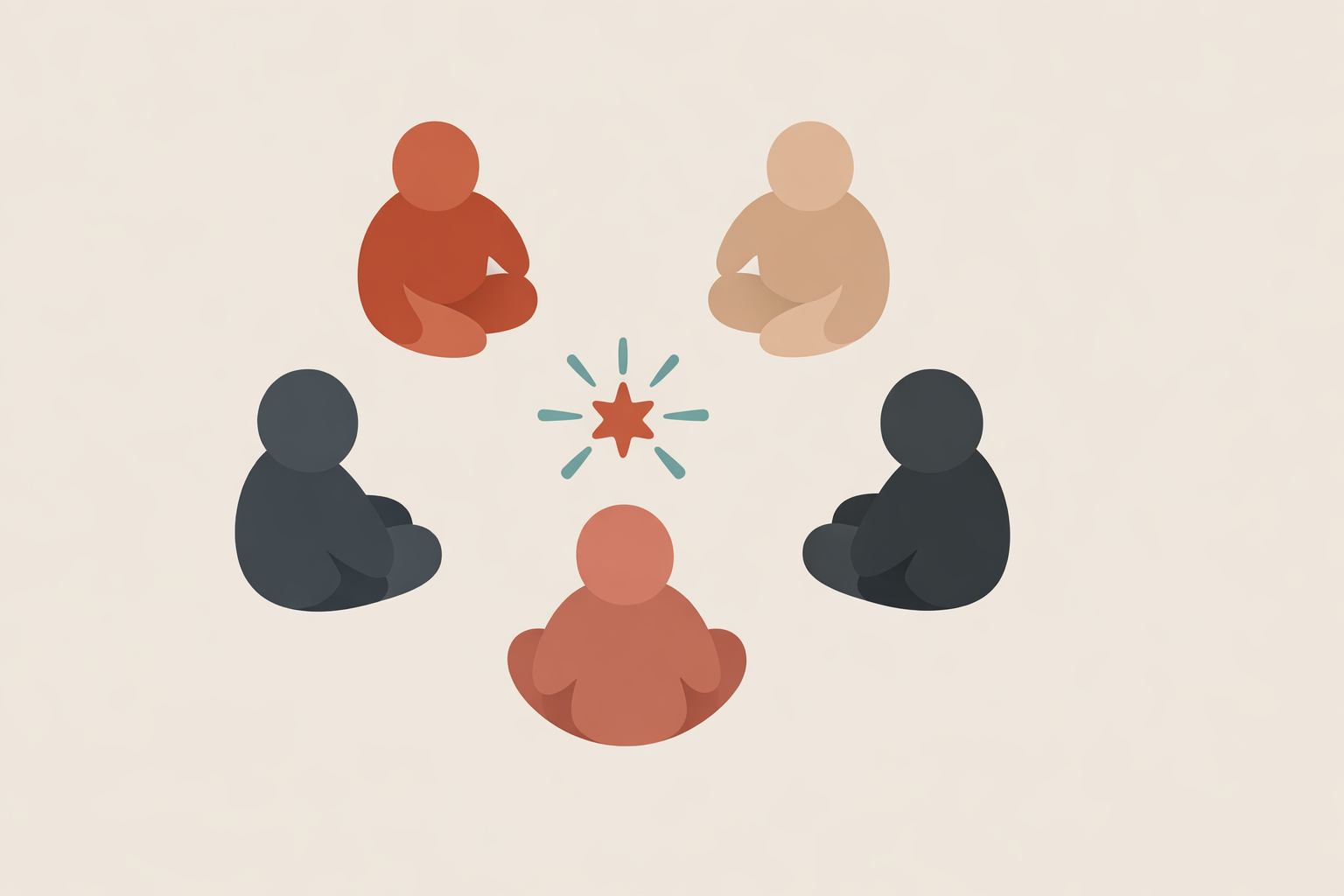
Small peer coaching circles help teens clarify what they want and choose a realistic next step. They tend to “work” because they meet core needs for autonomy (choice), competence (growing capability), and relatedness (real connection).
There’s also something timeless here. Across cultures, people have historically gathered in circles for listening, learning, and being witnessed—and teens often respond quickly to that steady, respectful attention.
In a circle, consistent peer presence can lower performance pressure and bring out more honest motivation. In today’s digital era—where peer influence strongly shapes teen behavior—circles can channel that influence toward supportive norms.
Over about a month, a stable group of 4–6 teens often becomes a “mirror and cheer squad,” reflecting strengths back and helping motivation feel shared instead of forced. A quieter teen usually speaks more, and a more vocal teen often learns to listen—balance improves naturally when the structure invites it.
Two simple additions make circles even stronger:
- A brief mindfulness or grounding moment at the start to slow the nervous system.
- Consent-based agreements (like the right to pass and confidentiality) so there’s enough safety to speak openly.
Repeating weekly goal-setting and reflection inside the circle steadily builds competence, confidence, and motivation over time.
Design 2: Project-based groups with real-world outputs
Project-based groups raise motivation by making progress visible. When teens can point to something real they’re building, pride and momentum follow—especially when the project ends in a public share or showcase.
This style reflects “old apprenticeship models” of learning-by-doing: skills grow faster when they’re used for a purpose. Real roles also help personal growth goals become concrete. “Speaking up,” for example, becomes easier to practice when it’s tied to a role the team depends on.
Projects also create “generous accountability.” Teens tend to show up more consistently when teammates rely on them, and the accountability feels relational rather than punitive.
When teens steer the project and adults facilitate, self-belief grows—and so does peer connection that can last beyond the program. Over time, many teens discover strengths they didn’t know they had, which naturally feeds ongoing motivation.
Design 3: Skill labs that create same-day wins
Skill labs are built for immediacy: teach one tool, practice it right away, then make a simple same-day plan. That structure helps teens feel benefits quickly, instead of experiencing the session as “another class.”
Skills-based groups strengthen self-regulation when tools are concrete and paired with between-session practice. Many teens engage especially well when breathwork, movement, and journaling are blended with simple planning tools—embodied, expressive, and practical all at once.
One of the best ways to improve carryover is to begin the next session with peer reflection. When teens share what they tried, what worked, and what didn’t, skill use between sessions becomes more likely and more normalized.
Design 4: Accountability pods (2–3 teens)
Accountability pods improve consistency by making accountability “human-sized.” A check-in with two peers is easier to follow through on than a big group message thread, and it reduces “social load,” especially for teens who feel overwhelmed by constant online interaction.
Pods also support momentum through short, no-shame challenges—small enough to be doable, light enough to avoid pressure. This approach can be particularly supportive for perfectionistic or neurodivergent teens who may shut down when goals feel too big or too public.
Short feedback loops and visual progress tracking lower working-memory strain and help prevent perfectionism spirals. Many high-achieving teens experience anxious perfectionism, and normalizing small imperfect steps is often what breaks the “perfectionism trap.”
Coaching approaches that build self-efficacy and goal-directed habits can strengthen resilience over time. In pods, trust often builds quickly through a repeating rhythm: check in, choose a next step, then reflect. Adding a simple shared tracker can make progress feel real and increase consistency.
Design 5: Youth-led interest clubs (identity-first motivation)
Youth-led interest clubs shift motivation from short-term goals to identity. Instead of “I should do this,” it becomes “this is who I am,” which is a much steadier fuel source for teens.
These clubs often function as “communities of practice,” where belonging and mastery develop together. In an online-saturated world, group spaces that offer real belonging can support motivation and overall well-being in a grounded, practical way.
Psychological safety is foundational here. Clubs thrive when adults “hold the edges”—clear container, simple guardrails—while teens lead the content, roles, and culture.
Over months, teens commonly grow into more advanced identity roles (gamer → level designer; dancer → choreographer). Frequent small events—“show and share” moments and mini-showcases—often build motivation more effectively than rare, high-stakes events.
Archiving group accomplishments (photos, a shared folder, a simple timeline of wins) strengthens pride and helps teens see their own growth. Peer mentorship also becomes a natural feature over time, and a small skill gap is especially effective because it feels approachable rather than intimidating.
With steady stewardship instead of direct adult leadership, youth-led clubs can become increasingly self-sustaining.
Closing note: what matters more than the perfect format
Each design above works best when it’s built around autonomy, competence, and relatedness—turning peer influence into something supportive and lasting. That’s when attendance steadies, participation becomes more candid, and tools are more likely to be used in real life.
And across every structure, one truth holds: kindness, safety, and honest reflection contribute more to teen group outcomes than any single curriculum. Keep the container clear, keep the expectations humane, and let teens feel both respected and genuinely included.
Train as a Teen Life Coach
Apply these motivation-friendly group structures with the Teen Life Coach course in real teen sessions.
Explore Teen Life Coach →