Lithotherapy is an ancestral, non-medical way of working with crystals to support spiritual growth, clarity, and inner steadiness. In practice, stones are used as companions for intention, attention, and ritual—not as a replacement for other forms of support.
The name itself reflects its roots: “lithos” (stone) and “therapeia” (service or care). Historical overviews suggest that ancestral practice is a better description than “modern trend,” because humans have long carried stones as amulets and used them in ritual for protection and meaning.
In modern coaching spaces, crystals are often blended into intention-setting, meditation, and mindful routines that help daily life feel more balanced and present. Many contemporary guides describe emotional balance as one of the main reasons people keep stones close.
Part of the pull is wonderfully simple: stones feel good to hold, they catch the light, and they carry stories. Practitioners often find that even beyond “energy” language, the symbolic presence of a crystal can steady attention and keep a meaningful intention close—especially for beginners who want “crystals for spiritual growth” without the hype.
Clients arrive curious—and sometimes skeptical. The craft is meeting both with warmth and grounded clarity.
Key Takeaway: Lithotherapy tends to help most when it’s framed as a non-medical practice of attention and meaning: stones act as sensory anchors for intention, while ritual and expectation shape outcomes. With skeptical clients, clear language, ethical boundaries, and simple, repeatable routines build trust and real-world benefits.
Why Skeptical, Thoughtful Clients Still Reach for Crystals
Even rational, data-oriented clients try stones because they want steadier moods, a calmer mind, and more meaning in their routines. Skepticism isn’t a barrier; it’s often the very thing that keeps the exploration honest and practical.
Crystals have moved into mainstream self-care, sitting beside journaling, mindfulness, and breathwork. Most people aren’t chasing miracles—they’re looking for small, repeatable supports for well-being. As one reviewer puts it, “Lithotherapy is hotly debated as to its actual efficacy… many people report positive experiences.”
Crystals can also be simply useful. During meditation, a stone can help focus attention by giving the mind a gentle place to “land.” Their aesthetic appeal adds symbolism to the practice—something to see, hold, and remember when life gets busy.
It’s also true that outcomes are influenced by mindset. One meta-analysis estimated that belief predicted about 87.7% of reported outcomes—an insight many practitioners use constructively, because it highlights how powerful meaning, ritual, and expectation can be when they’re guided with integrity.
Rooted in Ancestral Wisdom: What Lithotherapy Actually Is
Lithotherapy isn’t a passing fad; it sits within a wide human lineage of using stones for meaning, protection, and spiritual alignment. In modern practice, it stays non-medical and centers intention, energetic language, and ritual.
Historical accounts describe crystals and gems appearing in religious and ritual settings across many cultures—worn, carried, or placed in sacred spaces. This supports the view that cross-cultural lineage is at the heart of crystal work, rather than a single isolated origin.
Contemporary francophone guides describe lithotherapy as working with stones’ color, composition, and felt vibration to support energetic balance across body, mind, and spirit—an energetic worldview focused on harmony and inner alignment.
Many practitioners also map stones to the chakra system, using color and felt qualities as a practical shorthand—dark stones for grounding, green or pink for heart-centered compassion, blue for expression. Think of it like a symbolic language: simple, memorable, and easy to apply in everyday rituals.
At the same time, modern reviews emphasize no solid scientific evidence for stone-specific energetic effects. And yet the practice continues to grow; some sources note rising demand for stones alongside meditation and personal growth. For skilled practitioners, that’s not a problem to fear—it’s the invitation to stay grounded, respectful, and precise.
Explaining Crystal “Energy” in Down-to-Earth Language
Clients don’t need to adopt a belief system to explore crystal work. When “energy” is framed through resonance, attention, and symbolism, pragmatic clients can engage without feeling pressured.
Many resources describe crystals as carriers of subtle vibrations shaped by their mineral structure. In everyday coaching language, this often becomes simple correspondences—matching visible colors and felt qualities with inner states (red for steadiness, blue for clear expression) so clients have an easy “map” to work with.
If “energy” doesn’t land, shift the metaphor. Some authors describe a stone’s vibratory signature like a tuning fork: it doesn’t force anything, it invites resonance. What this means is clients often notice practical changes first—more presence, less rumination, softer breathing—through mindfulness and meaning-making.
For evidence-oriented clients, clarity builds trust. Many summaries attribute measurable changes largely to belief and the placebo effect, and some reviewers describe a beneficial placebo effect for certain people. Put simply: stones can be powerful symbols and sensory anchors for qualities someone is actively practicing—calm, courage, compassion—while the lived experience does the teaching.
Placebo, Ritual, and Meaning: How Crystals Still “Work” for Skeptical Clients
Placebo doesn’t mean “imaginary.” Expectation, ritual, and symbolic focus can create real shifts in mood, stress response, and behavior—often well before a client adopts any energetic framework.
In crystal-focused research summaries, expectation shows up clearly: one analysis found belief predicted about 87.7% of reported outcomes. This aligns with broader placebo research describing neurobiological shifts linked to expectation. As one reviewer notes, crystals may offer a beneficial placebo effect for some people.
Ritual is where that potential becomes a practice. Choosing a stone, cleansing it, setting an intention, and returning to it daily turns a vague hope into something structured. Some analyses suggest these rituals can strengthen self-efficacy—the felt sense of “I can influence my inner state”—which naturally supports steadier habits.
Adjacent practices show the same pattern: sound-and-frequency sessions can reduce stress, and crystals can serve as focal points that keep attention in the present. Whether someone credits resonance, psychology, or both, the lived outcome many report is similar: more calm, more clarity, and a kinder inner voice.
Guiding a Skeptical Client Through Their First Crystal Experience
With skeptical clients, start simple, avoid dogma, and let direct experience lead. A well-structured first session invites curiosity without demanding belief.
Designing a grounded, non-dogmatic first session
- Set the frame (2 minutes): “We’ll use a stone as an anchor for attention. No need to believe anything—just notice.” Be transparent that this is an experiment in awareness, and acknowledge the power of placebo and meaning.
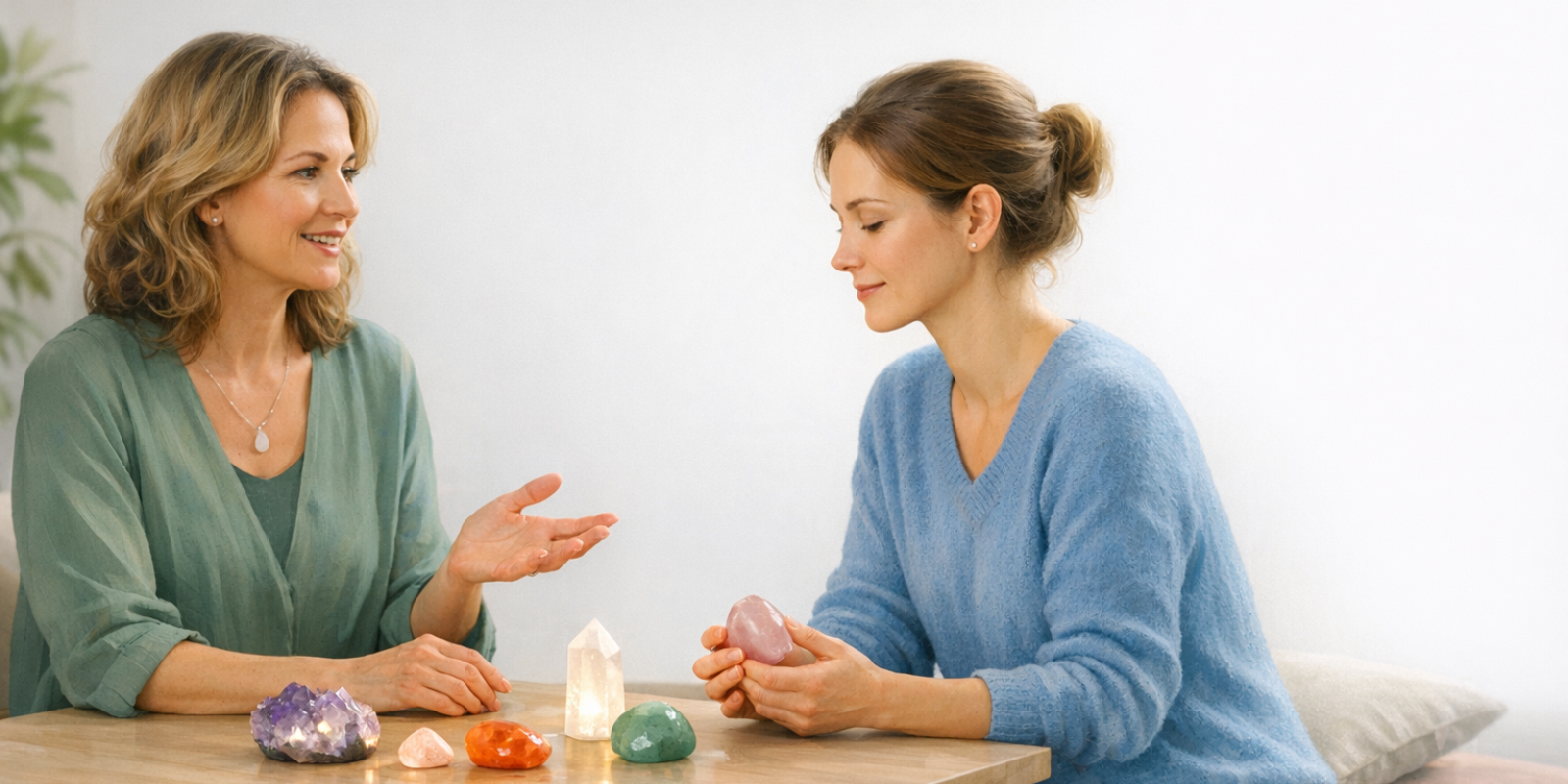
- Choose the stone (2 minutes): Offer three options matched to common intentions—amethyst (clarity), rose quartz (softness), black tourmaline (grounding). Many beginners like choosing by color and feel; some guides highlight amethyst for calm and clarity.
- Simple contact (6 minutes): Invite the client to hold a stone or rest it over the heart or lower belly. Pair with slow breathing and a gentle body scan.
- Intention phrase (1 minute): One plain sentence internally, e.g., “With this breath, I practice calm.” Keep it personal and grounded.
- Debrief (3 minutes): Use open-ended questions: “What did you notice in your body? What changed about your breath or thoughts? What surprised you?”
- Integrate (1 minute): Tie the stone to an existing habit—by the kettle or keyboard—and repeat a three-breath ritual twice daily. Many practitioners recommend embedding stones into self-care rituals to build consistency.
Keep it brief and kind. Evidence from mindfulness programs suggests even short, guided sessions can reduce anxiety and lift mood; pairing a crystal with mindful attention gives skeptical clients an easy doorway into that same territory.
Helpful scripts
- “Let’s treat this like a lab of your inner world. The crystal is a prompt; the practice is you.”
- “If nothing happens, that’s valuable data. If something shifts, we’ll note what and how.”
- “We’ll keep language simple—no need to adopt any belief to benefit.”
Ethical, Grounded Crystal Work: Boundaries and Cultural Respect
Integrity keeps crystal work trustworthy. Clear boundaries, realistic language, and cultural respect are not extras—they’re the foundation.
Evidence summaries commonly note no robust proof for stone-specific energetic effects beyond placebo; one reviewer similarly describes no solid scientific evidence to confirm efficacy. That’s exactly why ethical practitioners avoid health claims and position crystals as supportive tools within a broader growth process.
Two ethics anchors keep the work clean:
- Guard against magical thinking: Some analyses caution that overemphasizing external objects can encourage magical thinking. Keep returning clients to personal agency, skills, and supportive community rather than implying “the stone will do it for you.”
- Honor cultural roots: Crystal lore draws from diverse traditions. Credit lineages where appropriate, avoid appropriation, and be thoughtful with sacred symbols and culturally specific rituals.
Practical safety matters too. Some minerals aren’t suited for water contact, certain metals can irritate sensitive skin, and small stones can be choking hazards for children or pets. Staying informed about basic mineral safety is part of ethical practice.
Above all, keep perspective: crystals are one tool among many. They tend to shine most when they complement breath, movement, rest, and nourishing relationships.
Deepening Your Skills with Lithotherapy in Modern Coaching
If crystals are already meaningful to you, structured learning can turn that connection into a reliable, client-ready skillset. The core is twofold: practical mineral knowledge and the art of holding a steady, transformative space.
Strong foundations often include geology basics like mineral families, structure, and hardness, alongside energetic frameworks such as color symbolism and chakra correspondences. This blend helps you answer practical questions and translate spiritual language into grounded, accessible terms.
Experienced practitioners also rely on repeatable session frameworks: intake, stone selection, intention-setting, guided practice, and debrief. A clear arc keeps sessions client-centered and ethical, rather than driven by vague promises.
The Lithotherapy Certification at Naturalistico approaches crystals within a coaching context, focusing on stress relief, energetic harmony, and inner peace without medical framing. The program creator notes that the course is designed to help you work with the potential of crystals in a way that is structured, respectful, and suitable for real client work.
Conclusion: Explaining Crystals for Spiritual Growth to Skeptical Clients
The most trustworthy way to talk about crystals is often the simplest: honor tradition, speak plainly about what’s known, and invite direct experience. Thoughtful clients tend to relax when you’re open about acknowledging limits while also respecting the depth of ancestral use.
Many people report shifts like stress relief, emotional steadiness, and a clearer inner compass once stones become part of a consistent ritual. Whether you frame that through resonance or psychology, crystals usually land best when paired with steady practices like meditation, journaling, and breathwork.
For practitioners, the path is ongoing refinement: choose careful language, keep testing what’s helpful, and keep learning in community. Lithotherapy can be hotly debated, and yet many still report positive experiences. Let that tension strengthen your ethics and deepen your listening—so clients feel supported, respected, and empowered by what they discover.
Ready to Go Deeper?
Take the next step with a Naturalistico certification — designed for practitioners ready to deepen their expertise.
Explore the Course →