Most practitioners hear it weekly: “I want to be more self-sufficient—where do I start?” Usually, that question carries more than logistics. It often comes with future worry, frustration with fragile systems, and the quiet belief that “real” homesteaders do everything at once.
The most helpful response is rarely a flood of resources. Too much information can stall momentum, invite unsafe shortcuts, or pull the conversation into areas that aren’t yours to guide. A better opening lowers pressure, names what matters, and turns a broad wish into one small, workable win.
Key Takeaway: The most effective self-sufficiency support helps people begin with one safe, right-sized step instead of chasing total independence. Normalize self-reliance as layered and community-rooted, match projects to real constraints, and keep clear guardrails around safety, ethics, and scope so momentum stays sustainable.
Normalize self-sufficiency as a spectrum, not a purity test
People usually do better when they stop aiming for total independence and start building one realistic layer at a time.
Seasoned homesteaders don’t do everything at once. They build strategically—food first, then water, everyday household skills, preservation, repair, relationships—and only add the next layer when the previous one feels steady.
This is where reflective listening does real work. Ask what they’ve already tried, what felt natural, and what got in the way. Then mirror back strengths: keeping herbs alive on a windowsill, learning basic mending, or freezing seasonal produce already counts as self-reliance taking root.
A helpful reframe is: “We’re not chasing perfect—just your next layer of self-reliance.” As one grower puts it, complete independence is a fantasy for almost everyone: “For almost everyone… that is a fantasy.” You can read his fuller reframe here.
Values make the next step clearer. Ask what they’re truly reaching for: resilience, nourishment, lower household costs, ancestral skills, or a deeper connection to place. Once the value is clear, the plan tends to simplify on its own.
Reframe the goal: layered, community-rooted resilience
Self-sufficiency works best as layered resilience, not isolation. Even modern resilience frameworks emphasize how much community connections support stability and adaptation through disruption.
That matches lived practice. Many experienced homesteaders choose strategic self-reliance rather than full autonomy: some food grown at home, some preservation skills, some trusted local exchange, and some continued reliance on wider systems. The aim isn’t to stand apart—it’s to become steadier, more capable, and more connected.
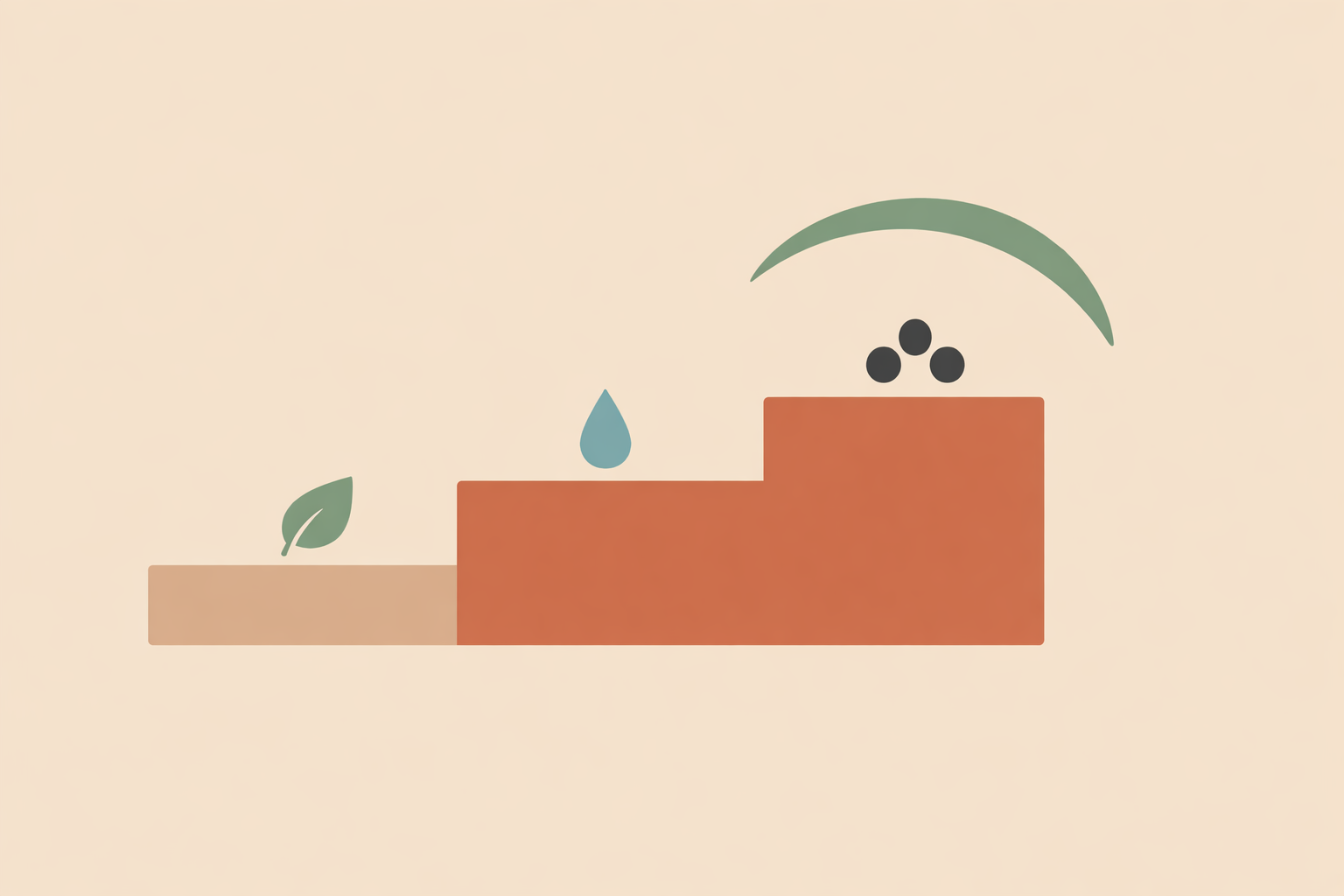
One simple way to teach this is through three layers:
- What you can produce or preserve at home
- What you can share, swap, or co-create with neighbors
- What the wider system still provides
“Rather than trying to become completely independent,” writes Huw Richards, “a more realistic approach is to strengthen each layer in order.” He also reminds us that self-sufficiency doesn’t have to mean isolation—more like becoming a contributor within a local web of food and skills.
Even modest household production can change confidence and daily rhythms. Not because it makes someone fully independent, but because it reshapes their relationship to effort, resources, and what’s possible.
Turn values into small, time-bound experiments
Once the goal is clear, translate it into tiny experiments that are easy to repeat. Small wins build rhythm; rhythm builds identity.
Use simple if/then plans to make the first step concrete. Learning science suggests spaced practice supports stronger long-term learning than one-off bursts—perfect for skills that deepen over seasons through repetition.
So “I’ll learn to preserve food someday” is usually too vague. Think of it like laying one brick you can reliably place each week: “If it’s Sunday afternoon, I freeze one tray of chopped seasonal vegetables and label it.”
Keep the first step small enough to fit real life:
- One weekend setup task
- One short weekly maintenance task
- One habit only, until it feels natural
Examples:
- Nourishment value: “If it’s Sunday afternoon, I batch-cook two simple soups and freeze four portions.”
- Frugality value: “On payday, I transfer $10 into a ‘tools and seeds’ envelope, then price two secondhand items.”
- Tradition value: “On Thursday at 6, I call my aunt to learn her pickle brine and write it in my homestead journal.”
Early success matters. Many new preservers thrive when they start with one food and one simple method, then repeat it until confidence feels earned, much like using checklists to keep progress visible and manageable.
Match starter projects to apartments, suburbs, and rural land
The best first project is the one that fits someone’s real space, schedule, and level of support—so it becomes sustainable rather than aspirational.
Apartments
- Start with three reliable containers and forgiving herbs or greens, especially when drawing on small-apartment homesteading approaches.
- Learn one low-equipment preservation method, such as freezing.
- Build space-independent skills like stock-making, knife confidence, mending, or pantry organization.
Suburbs
- Begin with a small raised-bed plan rather than a full-yard overhaul.
- Grow easy, high-use crops such as salad greens, beans, and herbs.
- Add one preservation rhythm during peak season: drying herbs, freezing greens, or making a simple high-acid pickle.
- Join a seed swap, local garden day, or neighborhood exchange circle.
Rural land
- Start with water, access, and observation before expansion.
- Plant low-effort perennials along edges while learning the land’s patterns.
- If animals are part of the dream, begin with one suitable species and one trusted mentor, not a whole system at once.
Across all settings, morale matters. Choose a first project that’s visible enough to feel rewarding, small enough to maintain, and safe enough not to create unnecessary strain.
Honor ancestral skills while adding modern guardrails
Many practices now called “homesteading” are continuations of older knowledge systems. Seed saving, composting, and fermentation have long histories across cultures and food traditions—and it’s good practice to name that lineage directly.
Much of this wisdom came through elders, households, local ecologies, and shared community memory. That deserves respect, and it also asks for care: honoring cultural roots and Indigenous stewardship without borrowing sacred practices, flattening differences, or treating all traditions as interchangeable.
Modern guidance is at its best when it acts as a guardrail rather than a replacement. Put simply, you can pair inherited know-how with clear, practical standards around sanitation, storage, salinity, timing, and tool use.
In conversation, that might sound like: “Your grandmother’s kraut method is gold—let’s pair it with a simple salinity rule so you feel confident every batch.”
Keep safety and scope boundaries clear
Support should feel encouraging, and it should stay grounded. Confidence grows fastest when safety, ethics, and scope are clear from the start.
Tools and equipment. Many homestead injuries come from underestimating tools and machines. Risk rises when people skip safe operating procedures, training, and basic capacity limits. Encourage eye and hand protection, learning a tool before using it solo, and avoiding improvisation with equipment they don’t fully understand.
Food preservation. Hold a firm line with high-risk methods. If someone wants to can food, be clear that low-acid foods require pressure canning, tested recipes, and correct processing because of botulism risk. For early wins, freezing and other lower-risk methods are often the wiser starting point.
Animals. If animals enter the plan, encourage species-appropriate housing, clean routines, and hands-on local guidance before expansion. Animal systems add daily responsibilities quickly, and structure matters as much as enthusiasm.
Local rules. Zoning, water access, fencing, noise, compost, and setbacks vary widely. “Check the local rule first” helps people avoid spending money or building momentum in the wrong direction.
Scope boundaries. Your role is to support planning, habit-building, reflection, and appropriate skill development. Structural work, specialized animal concerns, complex land systems, and high-risk preservation questions may need local experts. Clear boundaries protect your integrity and the other person’s well-being.
- Script: “I can support your planning and skill-building. For structural work on that barn, let’s bring in a licensed pro and I’ll help you scope the questions to ask.”
- Script: “I don’t advise on pressure-canning low-acid foods; here’s the tested resource I trust.”
Think in seasons, not weekends
Homesteading unfolds in cycles. First comes experimentation, then systems settle, and later many people find themselves sharing surplus, swapping skills, or mentoring someone just behind them.
This is why seasonal learning fits so well. Skills revisited over time tend to stick, especially when each season adds one new layer rather than five. Essentially, the land (and the household) becomes the teacher through repetition.
A simple structure is often enough:
- A brief weekly review
- A small seasonal plan
- An annual look-ahead
This creates continuity without rigidity. It also helps people see progress accurately: a balcony herb habit, a first batch of frozen greens, a repaired shirt, a steady compost routine, a new seed-saving practice. These aren’t small—they’re foundational.
Conclusion: help people begin where they are
When someone asks for self-sufficiency support, the real opportunity isn’t to impress them with everything they could do. It’s to help them begin where they are, in a way they can sustain.
Listen for the hope and the worry. Normalize self-sufficiency as layered and relational. Help them choose one or two right-sized experiments. Respect lineage. Keep safety and scope clear. Then let the next season reveal the next step.
Above all, frame self-sufficiency as participation, not isolation. As Huw Richards reminds us, it doesn’t have to mean standing apart; it can mean becoming a contributor to a living web. Meet people there—with respect for roots, real-world limits, and the long arc of growth—and you become the steady ally they return to season after season.
Ready to deepen this work?
Explore Naturalistico’s Self-Sufficiency Certification to build practical, grounded support skills you can use with confidence.
Explore Self-Sufficiency Certification
Use Self-Sufficiency Certification to guide safe, layered projects that fit real homes, seasons, and community support.
Explore Self-Sufficiency Certification →