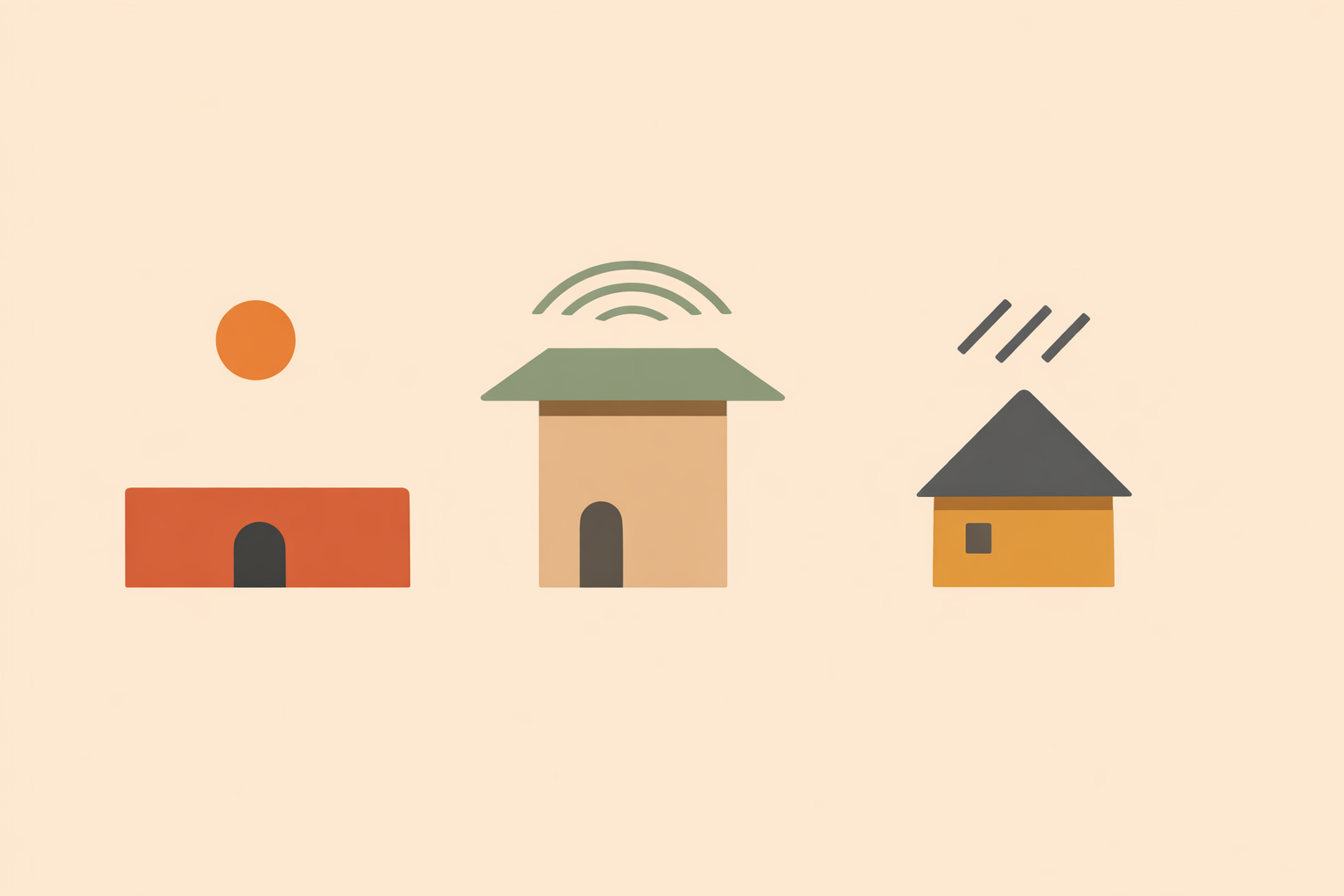
Designers and owner-builders run into the same problem again and again: natural materials can feel like a style choice—right up until the first heatwave, long wet spell, or maintenance surprise proves otherwise. A beautiful straw-bale wall that can’t dry in your valley, an earthen home that overheats because the day–night swing is small, a timber house in monsoon country with weak roof drainage—these are expensive lessons. When your work spans regions or even microclimates, the risk multiplies. The practical need is simple: learn to read a site quickly and shortlist assemblies that the climate will support, not punish.
The most reliable approach starts with climate physics and vernacular precedent, then matches material families—earth, timber, fibers, and hybrids—to the behaviors of heat, moisture, sun, wind, and rain where you are. Choose mass when temperature swings are big, favor hygroscopic (moisture-buffering) fibers when humidity rules, keep assemblies vapor-open so they can dry, and let roofs and shading do the first round of heavy lifting.
From there, it’s a straightforward journey: read the key climate signals, translate them into priorities, then match those priorities to hot-arid, tropical, cold, and storm-prone regions—finishing with detailing choices that stay sensible as weather grows more extreme.
Key Takeaway: Choose natural materials for how your site handles heat and moisture, not how they look. Match thermal mass to large day–night swings, use hygroscopic fibers in humid regions, and keep assemblies vapor-open so they can dry—then rely on roofs, shading, and drainage details to do the first work.
Step 2: Read Your Climate the Way Traditional Builders Always Have
Before choosing any wall system, read your sky. A few grounded observations translate directly into material priorities—and they’re the same signals traditional builders have watched for generations.
Begin with the broad Köppen–Geiger lens—tropical, arid, temperate, Mediterranean, polar—then tighten it to your daily pattern. If days are hot and nights cool, high-mass walls can delay and soften heat moving indoors by 70–80% through the hottest hours. If moisture is your constant companion, prioritize materials with real hygroscopic capacity so the indoor feel doesn’t swing between clammy and parched.
Moisture pathways shape assemblies as much as temperature does. Walls with good vapor permeability can dry after wet seasons instead of holding dampness inside the build-up. As sustainability advocates note, “Natural building holds huge promise…”—and that promise shows up most clearly when design responds to how a climate behaves in real time, not just on paper averages.
Vernacular buildings are climate diaries: earthen towns across North Africa, timber halls in Scandinavia, and stilted homes in Southeast Asia all encode rainfall, wind, and temperature into their materials and proportions. They’re not templates to copy blindly—they’re lessons in local logic.
Translating weather patterns into material needs
- Temperature swing: Large day–night differences favor high-mass materials like adobe and stone. Small swings usually favor insulation and shading over extra mass.
- Humidity: Persistent moisture calls for hygroscopic fibers and vapor-open assemblies that can buffer and release water vapor.
- Rain patterns: Intense seasonal rain argues for deep overhangs, splash protection, and quick-drying, sacrificial finishes.
- Wind and storms: Prioritize bracing, continuous structural connections, and lighter roofs that reduce uplift stress.
- Sun path: Orient for winter gain or summer shade as needed; use courtyards, trellises, and vegetation as climate “valves.”
- Groundwater and flood: Raise floors, use plinths, and design for drainage if water lingers after storms.
If you can, walk the site through a season. Notice where dew clings longest, where wind funnels, and where soil drains fast. Those small truths often matter more than broad regional labels.
Match 1: Hot-Arid & Mediterranean – Thick Earth, Cool Shadows
In sun-blasted, low-humidity regions, earthen and stone walls shine by smoothing out daytime heat spikes. Shade becomes your second material—sometimes your most important one.
Adobe thrives here because climate and craft align: it needs long dry periods to cure well and stay robust. Once built, massive earth and stone can create a thermal lag of 12–16 hours, so peak outdoor heat arrives indoors much later, often when the air has already cooled. Desert and Mediterranean towns teach the same core moves: thick walls, shaded openings, inward-facing courtyards, and windcatchers that support passive cooling. Pale exterior plasters can help as well, reflecting solar load before it builds in the wall.
Adobe, rammed earth, and stone as heat batteries
- Mass near the living core: Put thick walls where afternoon sun is strongest and where stable indoor temperatures matter most.
- Night flushing: Use high vents or courtyards to release hot air and pull in cooler night air to “recharge” the mass.
- Window discipline: Limit west-facing glazing; use deep reveals and shading that self-protects at critical hours.
Protecting earthen walls from rare but intense rain
- High boots: A durable plinth above grade reduces splashback and capillary rise.
- Big hats: Deep overhangs, covered porches, and arcades protect walls and create comfortable shade.
- Sacrificial skins: Lime or clay plasters that are easy to renew; avoid impermeable films that trap moisture.
- Good shoes: Perimeter drains and capillary breaks keep foundations and floor edges drier.
When mass, shade, and night air are designed as one system, hot days can feel surprisingly livable—without constantly leaning on mechanical cooling.
Match 2: Tropical & Monsoon – Raised Timber, Breathable Walls, Big Roofs
In hot-humid zones, airflow is your closest ally and trapped moisture is the biggest threat. Build lighter, lift the floor, and let assemblies dry quickly.
Traditional builders in monsoon regions learned to keep living spaces out of standing water and to invite wind underneath: stilted homes raise timber floors and encourage airflow for comfort and durability. Locally appropriate woods and bamboo can perform beautifully when sourced with care and detailed to suit their strengths. In many places, laterite blocks bring a grounded solidity without forcing a sealed, moisture-trapping approach.
Here, the roof does the hardest work. Monsoon logic favors steep pitches and wide eaves that shed water fast and protect shaded verandas—the real day-to-day living zones in sticky seasons. Well-made thatch can be long-lasting and insulating, and it softens the sound of heavy rain when maintenance is part of the plan.
As one practitioner group likes to say, effective projects “think globally and act locally.” In the tropics that means honoring airflow paths, giving water an easy way out, and using plant-based materials that dry quickly when the sun returns.
Working with heat, humidity, and heavy rain
- Cross-ventilation: Align openings with prevailing breezes; pair low inlets with high outlets to exhaust rising heat.
- Shading layers: Deep eaves, verandas, shutters, and vegetation cool incoming air before it reaches the wall.
- Flood-smart foundations: Use piers or plinths that resist scour; avoid enclosed spaces that trap damp air and water.
Timber, bamboo, laterite, and thatch in conversation with airflow
- Breathable skins: Plastered lath, woven bamboo, or timber cladding that allows vapor movement rather than sealing it in.
- Detail for drying: Drip edges, back-vented claddings, and replaceable layers where splash is constant.
- Biological durability: Prioritize clearances and fast drying, supported by compatible natural finishes.
The goal is a home that rides humidity’s rhythms: open, shaded, quick to shed water, and even quicker to dry.
Match 3: Cool Temperate & Cold – Wrapped in Timber, Straw, and Wool
Cold climates reward deep insulation and vapor-open detailing using local fibers and timber. The aim is straightforward: hold warmth comfortably while still giving moisture a safe path out.
In forested regions, softwoods like spruce, pine, and fir have long provided strong, workable structures. For wall insulation, straw bale offers high performance and a familiar, craft-friendly workflow. Sheep’s wool is another traditional standout: it insulates well while buffering moisture, which can help interiors feel steadier through seasonal shifts.
Snow loads also shape material choices through roof form. Steeper pitches shed snow faster, reducing how long moisture sits on or against the roof. Many northern timber buildings have lasted for centuries under freeze–thaw cycles because their roof geometry, joinery, and maintenance routines were designed for that reality from day one.
Using local forests and fibers for deep insulation
- Continuous wraps: Reduce thermal bridges by keeping insulation unbroken around the shell.
- Window discipline: Place glazing thoughtfully and plan shading so windows support comfort instead of draining it.
- Balanced ventilation: Create reliable fresh-air paths while protecting the integrity of the insulated envelope.
Keeping vapor moving in freezing climates
- Vapor-open layers: Clay or lime plasters help buffer and release moisture rather than trapping it.
- Smart airtightness: Reduce drafts, while still allowing assemblies to dry to at least one side.
- Roof-first strategy: Use robust underlayments, ventilated eaves, and simple rooflines that don’t trap meltwater.
Winter comfort is a system outcome: warm fibers, controlled airflow, and walls that quietly “exhale” moisture through the season.
Match 4: Mixed, Seismic, and Storm-Prone – Hybrid Systems for Uncertain Weather
When your region shakes, floods, or gets hit with hard wind, hybrid natural systems can be an excellent fit. The winning combination is usually a flexible frame, forgiving infill, and a lighter roof—so the whole structure can move, drain, dry, and recover.
Timber’s natural “give” helps buildings handle earthquakes; with careful connections and bracing, frames can move without sudden failure. Earthen infill strengthened with plant fibers can act as a sacrificial layer that spreads stress—an approach carried through traditions from Peru to Japan. Overhead, lighter roofs reduce seismic mass and can lower the stakes when shaking or uplift hits.
Wind brings its own pattern: problems often start at the roofline. Gusts over 100 mph can peel roofs and walls or exploit weak foundations. More than chasing any single number, focus on a continuous load path from roof to walls to foundation. Public guidance strongly emphasizes continuous connections using straps, anchors, and ties.
Blending earth, timber, and light roofs for movement
- Timber frame + earth infill: Pair ductile frames with clay-straw or light earth panels designed to fail gently, not dangerously.
- Replaceable claddings: Choose exterior skins that can be repaired after impacts or wind-driven debris.
- Simple, steep roofs: In cyclone-exposed sites, reduce vulnerable overhangs; add strong strapping and drainable, vented layers.
Designing for wind, flood, and earthquakes with natural materials
- Anchors and ties: Connect rafters to plates, plates to studs, studs to sills, and sills to footings—no weak links.
- Flood-smart siting: Raise floors above known high-water lines; choose finishes that can dry without drama.
- Round the corners: Softer shapes and wind-deflecting vegetation can reduce pressure on exposed faces.
Resilience is less about sheer heaviness and more about choreography: materials and details that flex, drain, dry, and can be repaired without tearing the whole system apart.
Step 3: Think Like a Future Ancestor – Designing for Climate Change
Design for the weather your grandchildren will live with. Choose assemblies that handle hotter spikes, bigger storms, and longer wet periods—without assuming the past will neatly repeat.
Many regions are already seeing more intense rainfall events and heatwaves. That reality favors vapor-open layers that dry quickly, generous shading, and water routes that never dead-end. Natural materials—earth, timber, straw, hemp, cork—pair well with passive strategies that reduce ongoing energy demand while keeping the build-up repairable.
As a rule of thumb, assemblies that can dry to at least one side—and include drainage and ventilation gaps—cope better with wetter extremes than tightly sealed systems. Where it suits the structure and site, green roofs can slow stormwater and improve insulation, provided drainage and detailing are handled thoughtfully.
Finally, think in cycles. Earthen and fiber-based components are often repairable in place, and many can return safely to the land at end of life. Done well, a natural building doesn’t just “hold up”—it matures with care as conditions change.
Choosing materials that can adapt as your climate shifts
- Design for maintenance: Prefer finishes you can re-plaster, re-coat, or re-thatch without dismantling the whole assembly.
- Water first: Oversize gutters, splash zones, and drains; lift vulnerable edges and thresholds.
- Heat logic: Prioritize external shading, reflective finishes, insulated shutters, and night-ventilation paths.
- Modularity: Detail claddings and services so future swaps are realistic as needs and tools evolve.
Thinking like a future ancestor is simply craft plus foresight: build with what the land offers, then detail it to stay steady through wilder patterns.
Conclusion: Choose Natural Building Materials That Truly Suit Your Climate
Every climate points toward a different “comfort strategy.” Hot-arid and Mediterranean regions typically benefit from thick earth and dependable shade; tropical and monsoon settings thrive with raised timber, breathable skins, and big roofs; cold regions often excel with timber frames wrapped in straw and wool; and mixed, seismic, or stormy places gain confidence from well-connected hybrids that flex, drain, and dry.
To turn this into a quick site-driven routine:
- Track temperature swing, humidity, and seasonal rain patterns on your plot.
- Walk wind paths, note flood clues, and study sun angles at solstice and equinox.
- Sketch massing that works with those forces—then choose wall, roof, and floor assemblies that support it.
Hands-on learning and community builds can turn principles into true skill; many projects are participatory projects where stewards and learners collaborate. And the reminder still stands: with smart design and locally appropriate materials, it’s possible to create beautiful, durable spaces that support well-being and a lighter footprint.
Build Climate-Smart, Naturally
Apply these climate signals in practice with Natural Building Course.
Explore Natural Building Course →