



Imanuel Ross is the founder of Naturalistico, a platform dedicated to exploring holistic well-being and the human experience. He holds a Bachelor’s degree in Psychology and Counseling from the University of the Sunshine Coast, Australia. With a deep passion for understanding the human condition, Imanuel focuses on helping individuals achieve balance, self-awareness, and personal growth through natural and mindful approaches.
How to Run Safe, Grounded Groups: 7 Group Art Therapy Ideas
Veröffentlicht am April 9, 2026
Depth and safety can coexist. What makes the difference is a clear arc, generous choice, and simple nervous-system supports that help people stay resourced from start to finish.
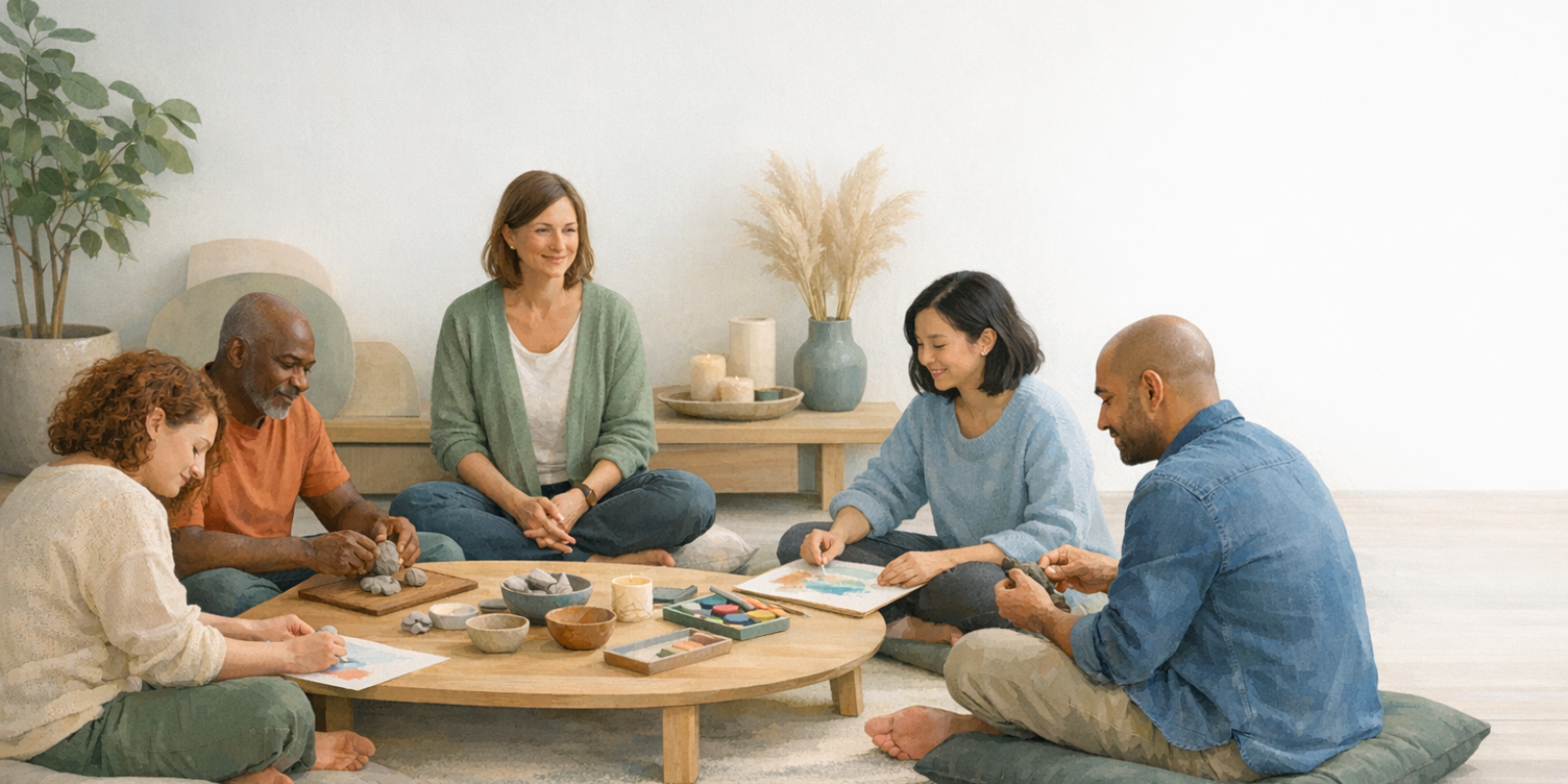
A dependable rhythm is a three-phase flow—stabilization, processing, and integration—mirroring many trauma-focused art frameworks that emphasize three phases and steady closure. In the room, this usually looks like: a grounding opening, an opt-in prompt with plenty of alternatives, and a calm return ritual before anyone leaves.
That “how” matters as much as the activity. As Natalie Rogers reminds us, expressive arts flourish in a “safe, non-judgmental” space—exactly the kind of climate that helps groups soften, connect, and create without pressure.
Art also works through the senses, not just through words. Cathy Malchiodi highlights the “action-oriented” and embodied layers of experience reflected in the expressive arts’ sensory nature. Put simply: sometimes hands and materials can say what the voice can’t yet say. And for many people, making art can support stress relief—one session of art-making has been associated with lower cortisol.
Groups often become safer faster when there’s a little play in the mix. Gentle collaboration can improve communication without putting anyone on the spot. Traditional forms help too: mandalas, long used across cultures, are now adapted in modern mandalas practices to support focus and steadiness.
Key Takeaway: Trauma-informed group art works best when depth is paced inside a simple three-phase structure—stabilize, process, integrate—so participants can stay resourced. Choice-based prompts, sensory grounding, and clear closure rituals create safety, allowing meaningful expression and connection without pushing anyone into overwhelm.
Idea 1: Emotions Colour Wheel Circle
Begin with color and language, not stories. An emotions color wheel gives the group a shared vocabulary and gentle regulation skills before anything deeper.
Why start with colour and feelings
Drawing emotions as a pie-shaped wheel—coloring, naming, and symbolizing each segment—helps people “put feelings on the page” in a way that’s approachable and non-invasive. DBT-informed art approaches often use an emotion wheel to build awareness and choice. Similar tools (like wheels and thermometers) can support emotional regulation by making intensity visible and workable.
Essentially, once a feeling becomes an image, it becomes easier to relate to. Visual processes can externalize feelings that are hard to express verbally.
“The creative arts provide opportunities to make concrete objects representing feelings… less threatening than discussing difficulties directly.” – Bruce Moon
Steps to guide an emotions wheel circle
- Open with 2–3 minutes of breath and orienting. Normalize emotions as natural signals and offer light psychoeducation.
- Invite participants to color and label 6–8 core feelings. Encourage images or textures (e.g., “gritty anger,” “watery sadness”).
- Pair each feeling with one small resource (e.g., “anger → feet on floor,” “sadness → warm tea”), echoing how naming can support self-regulation.
- Invite sharing only if it feels safe. Reflect group-wide patterns, then close with brief grounding.
Idea 2: Tree Self-Portraits to Root People in Strength
Before touching challenging material, root people in what sustains them. Tree self-portraits center identity, values, and supports in a warm, nature-based frame.
Designing the tree self-portrait ritual
Invite each person to draw themselves as a tree: roots for supports, trunk for daily self, branches for hopes, and the surrounding landscape for community. Many facilitation guides use this “self-portrait with a twist” to explore what nourishes and sustains. It’s naturally strengths-forward and aligns with approaches that reconnect people with resilience.
When the images sit side by side, the group can often see how individual strengths create a collective whole—different roots, different weather, shared ground.
Stephen K. Levine writes that the arts “give form and substance to our capacity to be who we are.”
This also nods to ancestral art: tree motifs in textiles, carvings, and story-maps have long symbolized lineage and life-force. Contemporary facilitators adapt this symbolism respectfully in expressive-arts toolkits.
Keeping the focus on roots, resources, and resilience
- Prompt examples: “Name three root supports,” “What weather has your tree learned to withstand?”
- Invite sensory detail (soil texture, wind sound) to deepen grounding.
- Share reflections that spotlight values and resources, not problems.
Idea 3: Safe-Place Mandalas for Group Grounding
Create a reliable inner anchor. Safe-place mandalas blend an ancient form with simple visualization so participants have somewhere steady to return when emotions rise.
Blending mandalas with safe-place imagery
Start with a short guided visualization of a place that feels completely safe—real or imagined. Participants then draw or color a mandala that holds this safe place at the center. Safe-place drawing is widely used in safe place imagery, and it fits beautifully inside a paced, three-phase arc—especially when you keep returning to the image as part of structured pacing.
Mandalas have appeared across cultures for centuries; modern guides often adapt them to support calm and mindfulness. Focused coloring can strengthen present-moment attention, and focused creative activity has been associated with lower cortisol for many people.
Step-by-step facilitation and pacing
- Open with 2–3 minutes of breath, then guide the safe-place imagery.
- Invite a circular design with the safe place at center; add borders, pathways, or guardians as desired.
- Offer the option to pause and color the safe place any time emotions rise.
- Close with a brief return-to-body ritual and a one-word check-out.
Idea 4: Containment Jars and Self-Care Boxes
Give emotions a symbolic “home.” Containers—drawn and tangible—help people hold intensity without feeling flooded, while building a practical support kit.
Why containment tools support overwhelm
Symbolic containers let participants place big feelings somewhere specific, with the understanding they can return later when they feel resourced. Many facilitators start with drawing jars, bowls, or boxes to visualize containment. Then they shift to decorating a real container with calming colors, affirmations, and grounding objects—creating a self-care box that’s easy to use between sessions.
Cathy Malchiodi notes that “the creative process itself is truly the most healing part,” a perspective widely shared by expressive-arts practitioners.
Slow, repetitive decorating pairs naturally with breath practices, and structured breathwork has been linked with lower perceived stress over time. There’s also a deep traditional thread here: across cultures, people have placed prayers and emotions into vessels—bundles, boxes, altars—so today’s self-care kits echo ancestral wisdom in a modern form.
Guiding self-care boxes in a trauma-aware way
- Offer choice-based prompts: “What colors feel sheltering?” “What words calm your breath?”
- Invite sensory items (smooth stone, scent sachet, tea packet) to support multi-sensory grounding.
- As a ritual: place one “too-big” emotion on paper into a container, with a plan to revisit only when resourced.
Idea 5: Body Mapping Circles for Gentle Somatic Awareness
Reconnect to the body slowly, with choice at every step. Body mapping can support felt sense and boundaries without requiring detailed personal disclosure.
Making body maps choice-based and safe
Invite participants to trace a body outline (or use a template), then fill areas with colors, words, or images that reflect sensations and emotions. This can reveal patterns—where tension gathers, where calm lives—an aim central to trauma-aware body mapping. Normalize what’s common and keep everything opt-in: what to map, what to share, and what stays private.
Weaving in breath, grounding, and respect for the body
Layer the art with simple somatic supports—orienting to the room, grounding touch, or a 4–6 breath that lengthens the exhale—tools aligned with grounding tools and paced breathing. Malchiodi’s reminder to “come to our senses” fits here: expressive arts often return people to the body through sensation and practice.
Offer an easy exit: participants can switch to coloring a safe-place mandala or quietly journal at any time. Consent and kindness stay in the foreground.
Idea 6: Theme-Based Group Murals – Touching Shared Challenges Safely
When the group is ready, murals let people name harder material together—indirectly and symbolically—while staying resourced. Themes like “stress and support” keep the circle balanced.
Structuring depth work without overwhelm
Choose a theme that pairs challenge with resource—“change and belonging,” “grief and community,” “stress and support.” Expressive-arts guides describe murals for small groups exploring deeper themes. You can use turn-taking for more containment or simultaneous drawing for more spontaneity, adapting as these toolkits recommend.
Keep pacing gentle: offer pauses, choices, and a clear option to return to supportive imagery if distress rises—an approach grounded in trauma-aware pacing.
Murals work partly because they’re sensory and communal. Malchiodi points to expressive arts rooted in the senses, and many traditions have long held collective grief and hope through shared making—community walls, ritual textiles, story cloths. Modern conversations about a sensory approach echo that lineage.
Close with a witnessing round: “What did our mural show us about support?” and “What will you carry from this image into the week?”
Idea 7: Collaborative Canvases and Round-Robin Art
Build connection through play. Shared canvases can soften perfectionism and remind people that creativity—and challenge—can be held together.
Designing low-pressure collaborative pieces
Place a large canvas in the center with simple materials. Invite participants to add marks, colors, or textures anywhere, emphasizing curiosity over polish. Low-stakes group art can strengthen relationships and keep the room light.
For extra play, use a round-robin: each person starts a small drawing and passes it along so creativity can circulate and no one carries the whole “performance” alone.
Using shared art to build connection and safety
Display the finished piece in the meeting space to reinforce shared values and group pride. As Sandra Bertman notes, the arts help “thaw what trauma and suffering freezes,” a reflection many practitioners share.
Keeping groups right-sized and aligned around clear aims also supports cohesion, especially when activities include sharing.
Idea 8: “How I See Myself / How Others See Me” – Relational Portraits
Invite perspective-taking without shame. Paired portraits open grounded conversations about identity, boundaries, and belonging.
Inviting perspective-taking without shame
Offer two portrait prompts: one showing how I see myself, and one showing how I imagine others see me. Expressive-arts toolkits suggest questions like “How are your portraits alike or different?” This kind of gentle mirror can uncover deeper layers without interrogation—because the page does the talking first.
If sharing follows, revisit group agreements and confidentiality. Ethical practice emphasizes consent and respect when interpersonal themes surface, supported by clear boundaries. Over time, as people gain mastery with materials, many authors have noted growth in positive self-regard. Keep the tone curious, never evaluative.
Idea 9: Masks, Portraits, and Narrative Art for Story Work
Touch identity and meaning without reliving events. Masks, split-portraits, and gentle character work invite story in digestible, choice-based ways.
Outer/inner masks without overwhelming detail
Provide mask templates or split-face portraits: the outside shows how I present; the inside shows how I feel. This structure is common in identity art because it creates helpful distance while still being honest.
For anxiety, try personification: an “anxiety monster” participants can befriend, resize, or speak to—an indirect route to agency. Timelines or gratitude paintings can hold pain and resilience in the same field, which often feels more manageable than a single “big story.”
Inviting story while staying resourced
Frame sharing as optional and brief, and keep a clear return path: safe-place mandala coloring, or holding a grounding item from the self-care box. Traditional cultures have long used mask-making to explore roles, spirits, and community stories; used respectfully, masks become metaphors for parts of self we’re ready to reveal.
As Natalie Rogers reminds us, the aim isn’t to erase suffering, but to “give a voice to it,” trusting expression as a path of transformation.
Idea 10: Narrative Art Prompts – Weaving Individual Journeys Together
When the group is strong, story work can be deeply empowering. Use narrative prompts that re-author identity around strengths, values, and next steps.
Story-based prompts within a coaching scope
Offer playful, structured prompts like “Retelling My Story,” “Mapping My Galaxy,” “Redacted: Exploring Our Edits,” or “Losing Control.” These have been adapted for groups in creative group prompts. Visual timelines and story-maps can help participants chart key moments alongside current supports and future intentions, building continuity and perspective.
Keep the three-phase arc in mind. Many trauma-aware frameworks highlight how end-stage meaning-making supports closure. You can also offer optional additions—movement, sound, a few lines of writing—since creative approaches often reach embodied layers that words can miss.
Natalie Rogers: “Expression is itself transformation.”
Let the group witness each strengths-forward retelling, then end with a collective breath to settle the room into calm, shared presence.
Bringing It All Together: Holding Safe, Grounded Art Groups
Skilled facilitation is simple, steady, and kind. Safety grows from pacing, choice, containment, cultural respect, and clear ethics—held consistently, not perfectly.
Core practices that help keep groups steady include:
- Right-sized containers: Keep groups small and set explicit agreements and confidentiality at the start to support safety.
- Informed consent, always: Revisit consent as the group deepens; shared facilitation can help monitor intensity in line with ethical guidelines.
- Micro-skills for spikes: Teach brief tools like the DBT-informed STOP technique so participants have options when emotions rise.
- Ongoing learning: Training pathways in therapeutic arts often blend experiential work with ethical competency.
- Cultural humility: Honor lineages—mandalas, murals, masks, story circles—without appropriation. Let local traditions and participant cultures guide imagery and meaning.
When creativity is paired with structure and respect for roots, groups often rediscover balance and possibility with surprising ease—an observation echoed across arts and well-being practice.
Conclusion: Evolving Your Trauma-Aware Group Art Practice
These activities aren’t quick fixes; they’re steady pathways. Begin with emotional literacy, root in strengths, establish inner and outer containers, and only then move toward story and shared challenges—always with choice, consent, and culture at the center.
Expressive-arts approaches that blend image, movement, sound, and word can support holistic well-being by reaching embodied layers that conversation alone may not fully access, a view reflected in creative arts approaches and growing international literature.
Rogers also reminds us that expressive arts invite inner experience into form within a “safe, non-judgmental” space. As circles deepen, ethical guidance emphasizes informed consent, clear boundaries, and attention to dynamics.
The wisest stance is both practical and respectful: keep listening to the people in front of you, keep your structure simple, and let tradition and research sit side by side. With care, the art will meet the moment—and your groups will, too.
Published April 9, 2026
Ready to Go Deeper?
Take the next step with a Naturalistico certification — designed for practitioners ready to deepen their expertise.
Explore the Course →
 Ähnliche Kurse
Ähnliche Kurse


Efficientcoach
12 Module
Positive Psychology Coach Certification

Efficientcoach
11 Module
Art Life Coach Certification
Efficientcoach
12 Module
Grief Coach Certification

Efficient Therapist
11 Module
Play Therapy Certification

Efficientcoach
23 Module
Life Coaching Certification

Naturalistico
11 Module
Sex Therapy Practitioner Certification


