


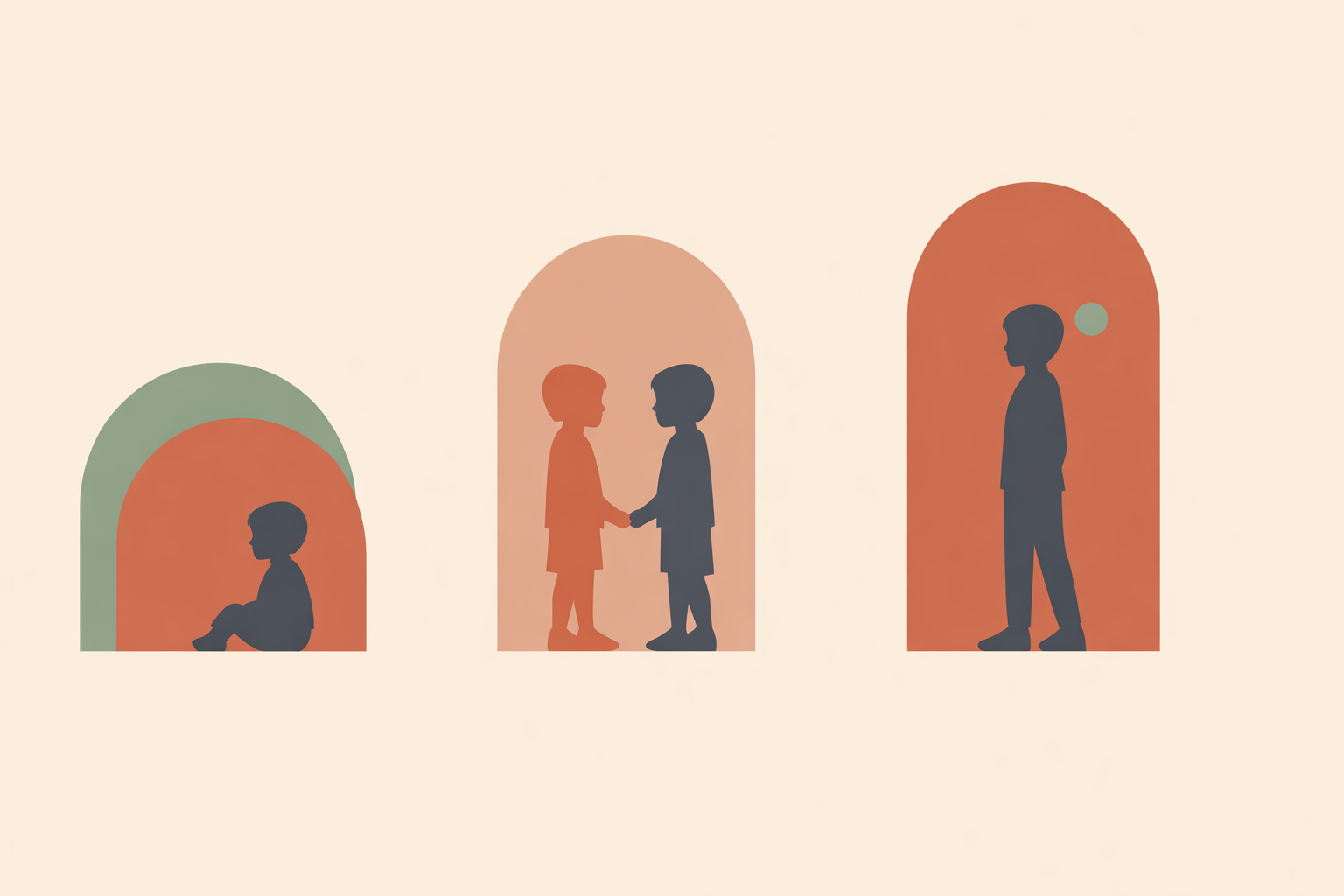
Practitioners see the same pattern again and again: a preschooler grabs a toy and dissolves into tears, a nine-year-old hovers outside a recess group, a tween is flattened by a group chat. The misstep is usually the same too: giving the same advice at every age. “Use your words,” “ignore it,” or “stand up for yourself” can all fall flat when the child’s developmental task is different.
Key Takeaway: Social coaching works best when it matches the child’s stage of development. Ages 2–6 need connection and co-regulation before teaching will stick. Ages 6–11 benefit from explicit coaching in group navigation, cue-reading, and repair. Ages 11–15 need partnership around identity, belonging, boundaries, and digital life. Across all three stages, the sequence is similar: settle first, make sense of what happened, then choose a next step.
Child Social Development Stage 1 (Ages 2–6): Connect and Co-Regulate First
In early childhood, social learning is body-first. Before a young child can share, wait, or problem-solve, they usually need help settling. Connection comes before instruction.
Co-regulation supports the growth of self-regulation, which makes sharing and problem-solving more available. Young children also borrow adults’ nervous systems, so an adult’s breath, tone, and pace shape what a child can access in the moment.
This is also where lifelong social habits start to take form. Young children learn through repetition, play, rhythm, and the steady responses of trusted adults far more than through long explanations.
What matters most in ages 2–6
Answer first: body regulation, turn-taking, and quick repair.
At this age, conflict often looks “big” because language disappears under overwhelm. A grabbed block or a push is usually about impulse, timing, and frustration tolerance, not character.
The most effective sequence stays simple: connect, regulate, then teach. Once the child settles even a little, a short lesson can land.
Practical coaching moves for young children
- Start with your own body. Slow your breath, soften your shoulders, lower your voice.
- Name safety first: “You’re safe. I’m here.”
- Name one feeling: “Frustrated.” “Sad.” “Mad.”
- Offer one concrete action: squeeze a pillow, stomp three times, hold the timer, take a breath with you.
- Keep scripts tiny: “My turn next.” “Help please.” “Stop.”
Preventing conflict often works better than sorting it out mid-storm. Turn-taking games and snack-time routines give repeated practice with pacing and waiting, supported by everyday structure that builds turn-taking.
Many traditional cultures teach social living through story, song, and shared rhythm. A short tale about fairness, a call-and-response rhyme, or a repeated clean-up chant can carry a social lesson more naturally than a lecture, especially when it comes from the child’s real home culture and is used respectfully.
Repair matters here, but it works best when it’s brief and linked to action. Flexible interaction and repair processes are associated with stronger regulation in the preschool years.
When things escalate, separate briefly to settle, then bring children back to reconnect and plan. Many practical guides to sibling conflict recommend making space first, then returning to problem-solving once everyone is calmer.
Over time, steady family rituals do quiet, powerful teaching. Children who take part in more family routines often show stronger empathy and social competence.
Child Social Development Stage 2 (Ages 6–11): Coach Skills and Group Navigation
By middle childhood, the social world organizes around groups. The question expands from “How do I share?” to “How do I join, belong, recover, and keep my dignity?”
That’s why school-age conflict can look like “drama” while actually being about membership, status, and reading the room. At this stage, peer group norms often shape behavior more than any single incident.
Children here are ready for explicit skill-building: rehearse, reflect, try again, and improve with feedback. Group formats that use role-play, rehearsal, and feedback suit this age well.
What matters most in ages 6–11
Answer first: group-entry skills, boundary language, and structured reflection.
Coaching works best when it turns a vague story into a clear plan. Instead of “Just be nice,” children do better with steps: watch first, wait for a pause, ask clearly, recover well, and try again tomorrow.
Practical coaching moves for middle childhood
Simple frameworks help a child organize a messy peer situation into something they can actually do. Many coaches lean on streamlined models such as GROW, CLEAR, or FUEL because they provide a sequence without turning the moment into a lecture.
- GROW: Goal, Reality, Options, Way forward.
- CLEAR: Contract, Listen, Explore, Action, Review.
- FUEL: Frame, Understand, Execute, Learn.
So when a child says, “Nobody lets me play,” you can guide them toward specifics: Which group? What happens first? Where’s the pause? Who is easiest to approach? What will you try tomorrow?
This is also the right age for direct rehearsal. With supported practice, children can strengthen cue-reading, group entry, handling a “no,” and stating boundaries without escalating, much like social skills coaching aims to do.
- Join: “Can I play after this turn?”
- Boundary: “I don’t like that joke. Please stop.”
- Repair: “I interrupted. You go first.”
Debriefing locks in learning. A brief reflection after a real moment helps children notice what they did well and what to adjust next time, aligning with guidance that emphasizes naming what went well.
Finally, don’t skip micro-wins. A brave ask, a calmer tone, or one good recovery after rejection builds the confidence that helps skills transfer into everyday peer life.
Child Social Development Stage 3 (Ages 11–15): Partner Around Identity, Belonging, and Digital Conflict
Early adolescence changes the emotional temperature of peer life. Belonging, status, exclusion, and identity become more charged, so a small moment to an adult can feel enormous to a young teen.
In this stage, peer relationships and belonging become central to identity. Support works best when it feels like partnership: steady presence, respect, and concrete options that protect dignity.
What matters most in ages 11–15
Answer first: validation, action, boundaries, and digital safety.
Teens can spiral when they feel exposed or rejected, especially online where conflict spreads fast. Validation helps them settle enough to think, and approaches that emphasize validation before problem-solving are linked with reduced distress and better communication.
Pair that emotional acknowledgment with a doable next step. Most teens steady more quickly when they can take one protective action right away.
Practical coaching moves for early adolescence
A brief structure works well here:
- Regulate first.
- Map thoughts, feelings, and actions.
- Generate alternatives.
- Take one safety action.
- Review what changed.
For digital conflict, a short protocol keeps things practical. Many structured approaches teach young people to challenge unhelpful interpretations, strengthen coping, and practice safe internet use.
- Regulate: pause, breathe, move, wash face, step away from the screen.
- Map: “What did I think? What did I feel? What did I do next?”
- Shift: generate two or three alternative readings.
- Act: mute, block, leave the thread, or save screenshots if needed.
- Review: decide what protected your peace and what to do next time.
Role-play remains powerful in adolescence. Practicing a boundary message out loud makes it easier to use under pressure, and many programmes rely on explicit teaching, role-play, and feedback to strengthen assertive responses.
Cue-reading drills can help too. Training teens to notice and respond to nonverbal cues has been linked with gains in social closeness and understanding.
It also helps to write a safe-harbor plan: two supportive peers, one trusted adult, and one offline practice that helps them reset. Intentionally naming supportive peers makes support easier to reach for when emotions run high.
Values and culture belong here as well. Family sayings, songs, communal practices, and inherited ways of making meaning can strengthen social resilience when used with care and respect. The aim is to draw on what is already real in the teen’s world, not to decorate coaching with borrowed traditions.
Bringing the Three Stages Together in Coaching Practice
Across all three stages, the pattern stays consistent: settle first, make meaning next, act last. What changes is how you do it.
- Ages 2–6 need adult calm, play, rhythm, and very small scripts.
- Ages 6–11 need explicit coaching in groups, cues, repair, and reflection.
- Ages 11–15 need partnership around identity, boundaries, and digital decisions.
A developmentally matched approach usually works better than one-size-fits-all advice. Tailoring support to a child’s stage can lead to stronger social gains and fewer repeated struggles.
Culturally grounded practice strengthens this work. Story, song, proverb, rhythm, shared meals, and family rituals often carry social teaching in ways children absorb naturally. When culturally rooted approaches are combined thoughtfully with evidence-informed tools, outcomes can improve; research on culturally responsive interventions points to meaningful benefits for children’s social and emotional development.
In practical terms, a simple weekly rhythm might look like this, whether you are building skills through child and adolescent development study or everyday coaching practice:
- For ages 2–6: one co-regulation ritual, one turn-taking game, one short repair practice.
- For ages 6–11: one group-entry rehearsal, one boundary script, one debrief with a micro-win.
- For ages 11–15: one thoughts-feelings-actions map, one boundary practice, one digital safety plan review.
The work is simple, but not small. Match the support to the stage, and children are more likely to feel understood, recover faster, and try a better social move next time — an approach at the heart of child psychology coaching.
Train as a Child Psychology Coach
Deepen these stage-matched coaching skills in the Child Psychology Coach Certification.
Explore Child Psychology Coach →










