Many relationship coaches learn solid communication tools, then find sessions pulled back into the details of the latest argument. Dishes, money, family, timing—any topic can ignite it. What keeps couples stuck is usually the repeatable loop that turns one hard moment into the same conflict again and again.
Live visual mapping shifts the work fast. When partners can see the pattern together, they stop wrestling only with content and start responding to structure. The map becomes a steady reference point: first the immediate conflict loop, then the wider system around it, and finally the older stories shaping present-day reactions.
Key Takeaway: When couples are stuck, live visual mapping can turn arguments into shared problem-solving. Start with a negative cycle loop to show the moment-to-moment pattern. Add a systemic circle to map family, work, culture, and resources around the relationship. Then use a compact genogram and journey line to surface inherited themes and turn them into respectful, practical next steps.
Map 1: Negative Cycle Loop for How a Couple Gets Stuck
Start here when conversations keep spiraling. A live negative-cycle map helps partners see the pattern, rather than each other, as the problem. In couple work, a circular diagram can map the interaction cycle that keeps conflict going.
Drawing the loop in real time often changes the atmosphere. When both people can point to the same pattern on the page, blame softens and curiosity grows. What felt personal a moment ago starts to look familiar and predictable.
Keep it straightforward: “Let’s capture the last argument step by step.” On a whiteboard or shared document, write the sequence as it happened: Maya raises her voice about chores → Leo goes quiet → Maya feels ignored and pushes harder → Leo shuts down more. Then ask what sits underneath each move. Maya names fear that it will all fall on her. Leo names fear he will never get it right. Circle the loop and name it together.
What to include in a live negative-cycle map
Keep the first version spare. The goal is recognition, not a complete explanation.
- Trigger: what set the moment in motion
- Each partner’s move: the visible action or reaction
- Meaning: the story each person makes about the other’s move
- Primary emotions: the softer layer under the protective response
- Longing or need: what each person is really reaching for
- Next turn: what usually happens next that sends the loop around again
As you draw, it can help to name each partner’s typical stance, often a pursue–withdraw dynamic. Use the label lightly as a shorthand for what’s happening today, not a personality description.
A concrete version might read: “Trigger: bill arrives.” Under Maya: “Moves: presses for a plan. Meaning: ‘If I don’t push, we drown.’ Primary emotion: fear. Need: ‘Tell me we’re a team.’” Under Leo: “Moves: goes quiet. Meaning: ‘Whatever I say will be wrong.’ Primary emotion: shame. Need: ‘Encourage me without attack.’” Then connect the arrows and circle the loop.
Prompts that help couples name the loop together
The best prompts go beneath the surface story in language the couple can reuse at home.
- “What flashed inside first, before the words came out?”
- “If this move is protective, what is it protecting?”
- “If I paused the moment one second earlier, what would your heart be asking for?”
- “What should we call this loop when it shows up again?”
Shared language matters. When a couple can say, “There goes our loop again,” the moment often becomes less charged. Naming the softer layer—hurt, fear, longing—also reduces defensiveness and creates space for better choices.
Keep your pen moving. The live map slows the moment without losing it, so you’re not refereeing every detail; you’re helping the couple witness the structure as it unfolds.
Map 2: Systemic Circle for the Wider Relationship Context
Once the immediate loop is visible, widen the lens. A systemic circle places the couple at the center and maps the wider field around them: family, work, finances, community, culture, expectations, responsibilities, and sources of support. This helps partners see how outside pressures feed the conflict they’ve been treating as purely personal.
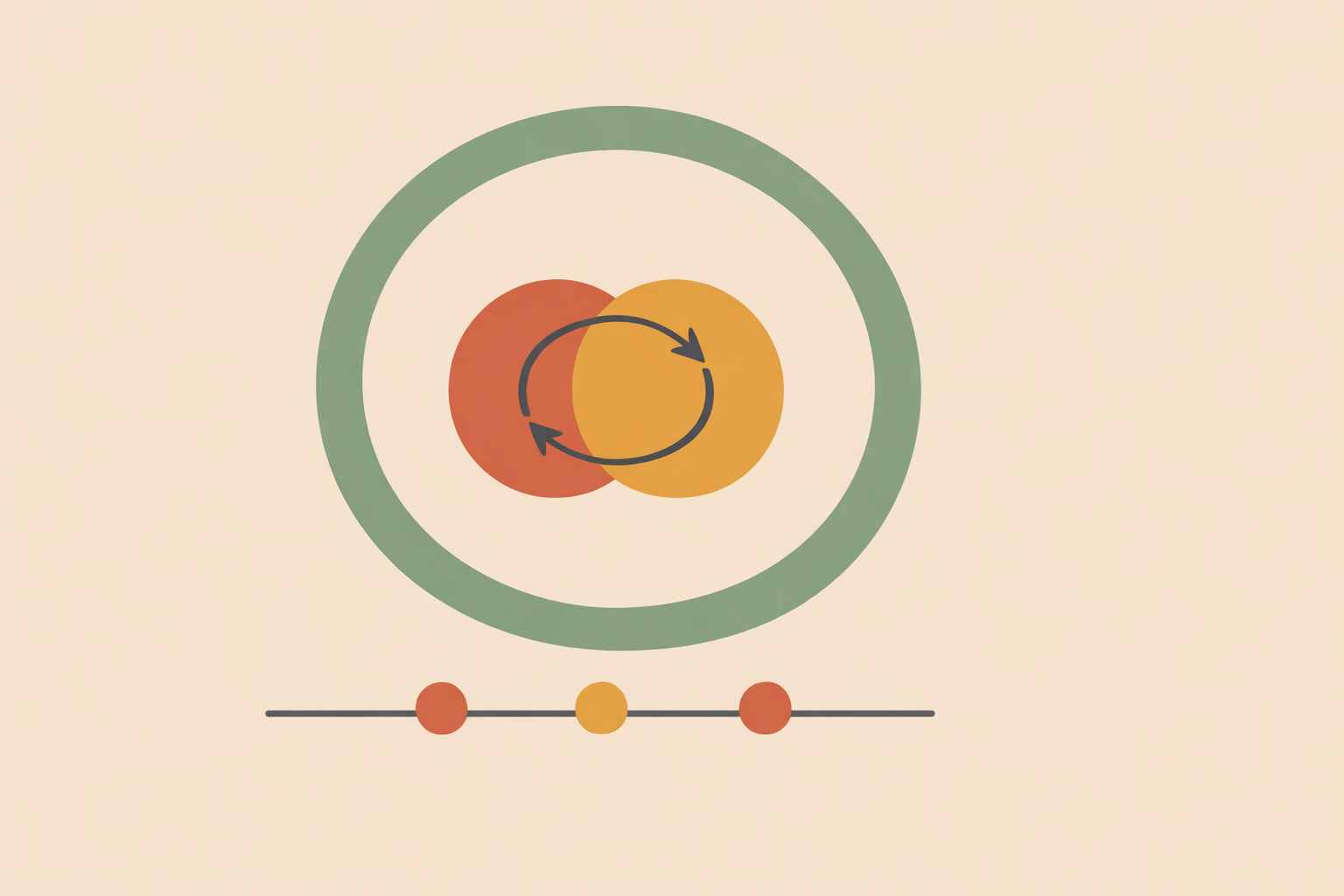
Draw a large circle with the couple’s names in the middle. Around them, add nodes such as “night shifts,” “shared account,” “parental expectations,” “school pickup,” “faith community,” “commute,” or “lack of rest.” Place the strongest influences closer to the center. Use different line styles so the quality of each connection reads at a glance.
This shift can be immediate. A couple arguing about “standards” at home may realize they’re also carrying exhaustion, family pressure, and too little support. In a few minutes, the conversation moves from blame to teamwork.
How to use a systemic circle in session
This map is especially useful when the couple is stuck in a two-person story. Relationships and intimacy live inside larger systems.
- Place people, roles, places, and recurring pressures around the couple.
- Put closer influences nearer the center and more distant ones farther away.
- Use solid lines for nourishing or reliable connections.
- Use dashed lines for draining, strained, or inconsistent connections.
- Mark any node that regularly triggers the negative cycle.
- Circle resources that restore steadiness and connection.
A systemic circle can show multiple layers at once: actions and feedback loops, the meanings attached to them, and the inherited relational models shaping reactions. That’s why it works so well in real-time coaching.
You might ask, “Looking at this picture, what needs a boundary? What deserves more care? What one source of support could be strengthened this month?” Those questions tend to open more possibility than revisiting who was right in the last argument.
Questions that shift couples from accusation to teamwork
Pointing to the wider field, not only the friction, often changes the energy. These questions redirect attention toward shared problem-solving:
- “Which outside pressures make this loop much more likely?”
- “Whose expectations are both of you carrying when this fight starts?”
- “What in your environment is draining the relationship right now?”
- “Where could one steady support replace one recurring strain?”
Often the most helpful shift is practical: adjust a schedule, reduce one obligation, ask for support, or protect a restorative routine. When the system around the conflict changes, the conflict often changes with it.
A small example: a couple circles “Sunday dinner with aunties” as nourishing and marks “phones in bed” as a daily drain. Their next step is modest and effective: a shared 10 p.m. phone basket and one consistent family meal that leaves them feeling resourced.
Map 3: Ancestral Trail Map with a Genogram and Journey Line
Some patterns are older than the relationship itself. When conflict feels sticky, repetitive, or strangely charged, it helps to map the family and life stories behind today’s reactions. An ancestral trail map combines a compact genogram with a shared relationship timeline so partners can recognize what they inherited, what they learned, and what they now want to choose differently.
Start with a simple two-family genogram across three generations, with the couple at the center. Inherited patterns can show up in conflict style, money, closeness, cutoffs, and silence across generations.
Then add emotional line styles between key family members. Line styles can show tension, distance, fused closeness, or cutoff in a way that becomes readable quickly.
Under the genogram, draw a simple journey line: “Before we met → early dating → moved in → first major rupture → major life change → now.” Invite each partner to mark formative early experiences alongside turning points in the relationship. Present-day friction often looks different when it’s seen as an echo of earlier learning rather than a personal flaw.
What an ancestral trail map can reveal
Ariana shuts down during budgeting talks; Mateo gets louder. On the genogram, Ariana marks a home shaped by financial stress and long silences. Mateo marks a family pattern of strict standards and pressure to get things right. On the journey line, they add job loss, a first apartment, a bereavement, and the birth of their daughter. Suddenly “numbers night” is not just about budgeting; it touches older material for both of them.
In sessions like this, what looks like bad behavior is often current behavior shaped by older survival strategies. Bringing those stories into awareness does not excuse hurtful patterns, but it makes them easier to understand and easier to shift.
Once the map is visible, the conversation usually becomes less moralized and more compassionate. The couple can begin asking, “What did I learn? What am I replaying? What do I want to keep, and what am I ready to update?”
Turning inherited patterns into present-day choices
After insight comes practice. Small experiments usually work best, especially when they honor family roots rather than rejecting them.
- Legacy naming: before a hard conversation, each partner names one inherited habit they feel tempted to repeat and one family value they want to keep.
- Two-voice exercise: speak first in the language learned at home, then as the present-day self who wants a different outcome.
- Timeline re-anchoring: revisit three moments when the relationship felt easier and identify what was being practiced then.
- Ritual redesign: pair a difficult topic with a grounding routine that brings more steadiness and care.
Early experiences and cultural teachings shape how people read cues, choose partners, and navigate closeness. Early experiences influence the relational scripts many people carry into adult connection.
A practical example: Ariana and Mateo create a 20-minute money check-in after a walk. Ariana speaks first. Mateo reflects back before offering solutions. They keep the genogram nearby, not as a label, but as a reminder that they’re writing a new chapter rather than repeating an old one.
Bringing the three maps together in grounded relationship coaching
Used together, these three maps create a strong, flexible structure for live coaching. The negative cycle loop shows how conflict unfolds moment by moment. The systemic circle reveals the pressures and supports shaping that loop. The ancestral trail map brings family legacy and lived history into view so the couple can respond with more awareness and choice.
You don’t need a complicated setup. A whiteboard, paper, or shared digital canvas is enough. Map the loop in a few lines, then add a systemic circle to spot drains and supports. When the pattern clearly reaches further back, sketch a compact genogram and journey line. From there, guide the couple toward one small experiment that feels realistic and doable.
This way of working stays humane because it keeps attention on patterns, context, and responsibility rather than personal defects. The couple leaves with something they can use between sessions: a shared picture and shared language.
Keep your boundaries clear. Some situations aren’t suited to real-time joint mapping and may need more specialized support first. Used well, though, these maps are steady tools that help couples move from reactivity toward repair, from confusion toward recognition, and from repetition toward choice.
As a coach, you’re helping people see the structure around the argument, the forces behind it, and the possibilities beyond it. Sometimes a few lines and circles are enough to make that new view possible.
Train as a Relationship Coach
Build mapping-led sessions like these in the Relationship Coach Certification.
Explore Relationship Coach Certification →